What should a server know?
A server needs to know the menu cold, follow the sequence of service, ring up a check without errors and know what to do when something goes wrong at the table. O*NET, the US Department of Labor's occupation database, lists 27 tasks for waiters and waitresses. They run from taking orders and collecting payment to explaining how a dish is prepared, announcing the daily specials and checking ID for anyone ordering alcohol. It names three knowledge areas: customer and personal service, sales and marketing, and the English language.
The Bureau of Labor Statistics adds what the job asks of a person: listening to customers and relaying information to the kitchen, recording orders accurately, and standing or walking most of a shift while carrying trays. It lists no formal educational credential as the typical entry requirement, so whatever you don't teach in your restaurant, your new server won't know.
This table is ours, built from the O*NET tasks. Use it to write the content of your manual:
| What they need to know | What it looks like when they know it |
|---|---|
| The menu | Explains the ingredients and preparation of any dish without looking at the menu, and knows the specials and what's 86'd |
| Allergies and restrictions | Follows the protocol without improvising and confirms with the kitchen before answering |
| The sequence of service | Does each step in order and knows which one gets shortened when the room is full |
| The check | Builds the check with taxes and knows the process for comps and voids |
| Alcohol | Checks ID when required |
| Mistakes | Tells the kitchen and the manager when a dish comes out wrong and tells the guest without arguing |
| Hygiene and the station | Washes hands when needed and leaves the station ready for the next shift |
In Mexico, add tips: the server should know how they're split, so they don't learn it from rumors (see the tips law). For checks, comps and voids, read employee theft and cash control.
How do you train a new server?
You train a new server in four steps: explain the manual, have them taste the menu, put them behind a trainer, and let them work their own tables while someone watches. The order is our suggestion, not a rule.
- Explain. Day one is for the manual: the menu, the floor plan, the station, the uniform and hygiene. If you don't have a manual, start from the training manual template and fill it with your dishes.
- Taste the menu. They should try what they're going to sell. It's hard to describe a dish you've never tasted.
- Follow a trainer. A few shifts with someone who has already been signed off on the skill, not whoever happens to be free that day. Our staff training guide explains why trainers should be certified before they teach.
- Work their own tables under observation. Start with a small section, and have the trainer correct afterward, at the bar or in the kitchen, not in front of the guest.
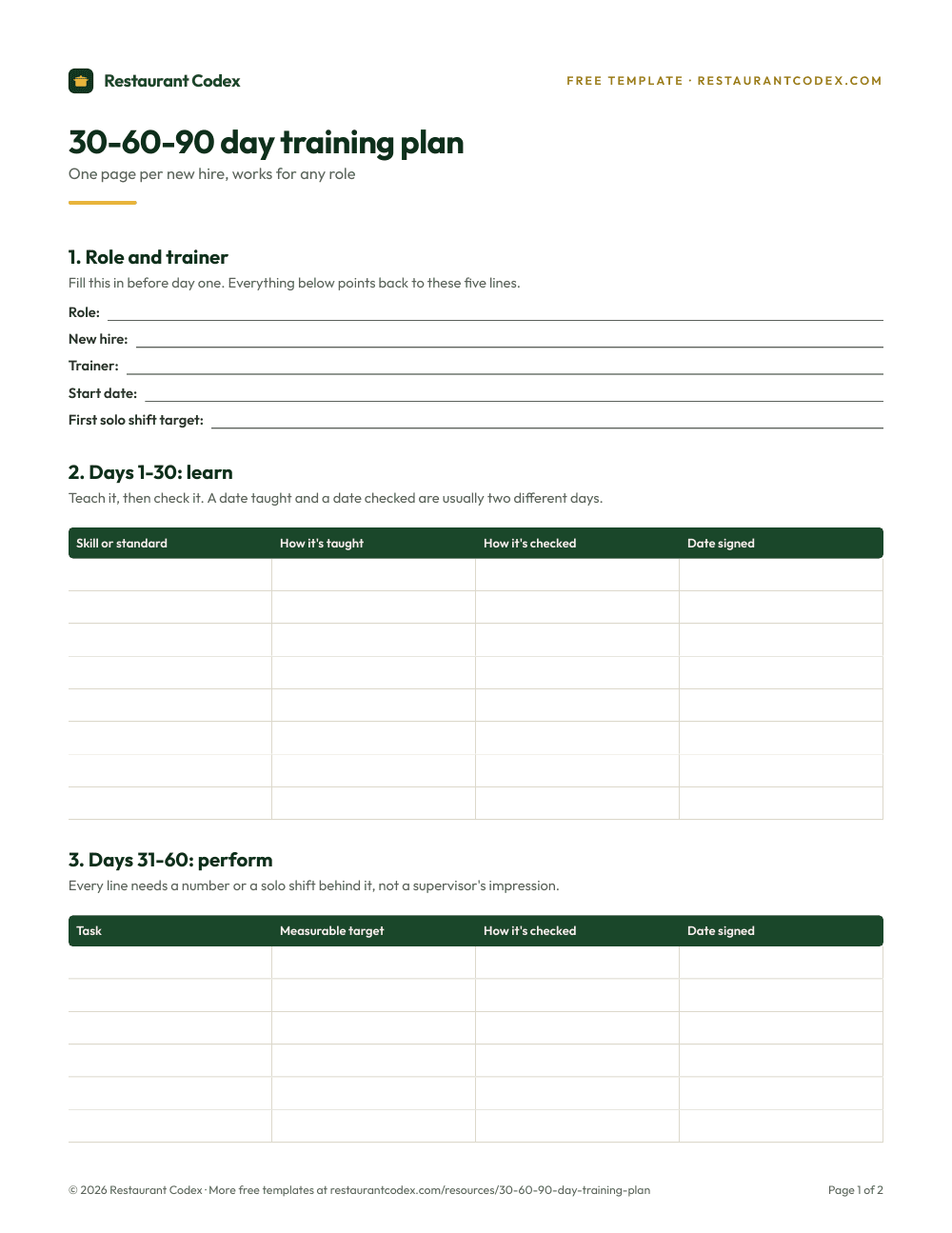
At the end of each step, the trainer signs. A checklist with each skill and a box for date and signature is enough. The 30-60-90 day plan template already has that structure.
What are the steps of service to teach?
The steps of service follow the order of a meal: greet, present the menu, take the order, send it to the kitchen, serve, check the table, clear and settle the check. The tasks come from the O*NET list for waiters; the sequence is ours.
- Greet and seat. Walk the guest to their table.
- Present the menu and the specials. Answer questions and explain how each dish is prepared.
- Take the order. Complete, repeated back to the guest, with allergies on their own line.
- Send the order to the kitchen. Clearly, without assuming the kitchen understood.
- Serve. Each dish to the right person, naming it.
- Check the table. Ask if everything is fine and fix any problem on the spot.
- Clear. Plates and glasses off the table and back to the kitchen.
- Settle the check. Check with taxes, then payment.
- Thank and reset. Clean the table and restock the station.
Teach them one at a time, with a written standard for each, not with phrases like "treat the guest well." You decide, for example, how fast a table gets greeted, and you put it in the manual. A number borrowed from another restaurant is useless; one of your own that you can measure every shift is not. How to write each procedure is covered in the guide on restaurant SOPs.
How do you train servers on allergies and suggestive selling?
You train servers on allergies with a fixed procedure and one person designated for questions, and you test them with real cases, because sitting through a talk doesn't guarantee they know. The evidence comes from a CDC study of 278 randomly selected US restaurants (32.6% of the eligible ones agreed to take part), with interviews of 156 servers.
Only 33.5% of servers (52 of 155) had been trained on allergies at their restaurant. They knew the basics, such as that a person with an allergy can die from eating the food (97.4%), but 11.5% believed someone with a food allergy can safely eat small amounts, 72.4% named eggs as a major allergen and 23.7% named tomatoes, which aren't one. Training alone was not associated with more knowledge in any group, though it was associated with better attitudes. What was associated with more knowledge was having a specific person to answer allergy questions: those servers had an odds ratio of 2.49 of landing in the top half of scores. It's an interview study and shows associations, not causes. Still, it points to a practical conclusion: training without checking isn't enough.
A minimum procedure for the server, which is ours and covers what Massachusetts requires of its approved courses (steps for service staff, what to do if you don't know the answer, communication with the kitchen, and emergencies):
- Ask which allergen it is and how severe the reaction is.
- Don't answer from memory: confirm with the kitchen.
- Write the allergy on the ticket as its own line and tell a manager.
- If you don't know the answer, say so: "Let me confirm that with the kitchen."
- If there's a reaction, call your local emergency number and stay with the guest until help arrives.
Massachusetts lists nine major allergens: peanuts, milk, soy, tree nuts, shellfish, fish, eggs, wheat and sesame. Adjust your list to what your kitchen uses. In the US, the FDA Food Code, as that document cites it (point 2-103.11 N), says the person in charge must ensure that all employees are trained in food safety, including food allergy awareness, as it relates to their duties. Neither NOM-251 nor Colombia's Resolution 2674 contains the word allergy or allergen (we searched the full text of both), so the standard is yours to set. The full procedure is in the guide to allergen management.
Suggestive selling. It's a specific recommendation of a dish or drink the server knows, made while the guest is deciding. O*NET includes it in the job: presenting menus and answering questions while making recommendations, announcing specials and recommending wines. You train it with a menu tasting and the server's own phrases, not a script, and always after asking about allergies.
There's little research on why a guest follows a recommendation. Borchgrevink and Susskind (2006) write in their abstract that little is known about the conditions under which restaurant consumers follow server recommendations. Their survey of about 550 people uses data from the 1990s and covers only beverages and wine, with a sample the authors acknowledge isn't representative. The best predictor of following a recommendation was that past ones had gone well (nearly 20% of the variance); the server knowledge the guest perceived explained only 2%. Our reading: recommend what usually goes well, and don't push a mediocre dish because it has margin. To choose what to recommend, look at your menu engineering. We didn't find an independent, verifiable figure for how much suggestive selling raises the check, so we don't give you one.
How long does server training take?
Server training usually takes several days to a few weeks, according to the US Bureau of Labor Statistics, and the laws in Mexico and Colombia set ceilings, not recommended durations. O*NET places the job in preparation zone 1-2, where on-the-job training runs from a few days to a year; that describes the whole zone, not servers in particular.
| Country | What the law sets | Article |
|---|---|---|
| Mexico | Trial period of up to 30 days; initial training of up to 3 months; neither can be extended or repeated | Federal Labor Law, 39-A, 39-B and 39-D |
| Colombia | Trial period of up to 2 months; in fixed-term contracts under a year, up to a fifth of the term | Código Sustantivo del Trabajo, 78 |
| United States | We only checked whether the time is paid; state rules aren't covered | 29 CFR 785.27 to 785.29 |
In Mexico, a trial period can be set in open-ended relationships or ones that run past 180 days. The law extends the limits (up to 180 days of trial and six months of initial training) only for management, executive or specialized technical or professional positions, and in our reading that doesn't include a server. If the relationship continues after the period ends, it becomes open-ended and those days count toward seniority (article 39-E).
A shape for your plan, which is our proposal and not an industry figure: in week one, menu, manual and steps with a trainer; in weeks two to four, their own tables under observation, with sign-off on day 30. At 60 and 90 days you add what raises their level: the bar, bigger sections and closing. Because periods can't be extended in Mexico, set the sign-off date on day one and review progress at the midpoint, while there's still time to reinforce.
How do you know a server is ready?
A server is ready when they pass a menu evaluation, work real tables on their own while a manager watches, and you have it in writing. The reason to check is the CDC finding: having been trained was not associated with knowing more. You measure what they know, not whether they showed up.
Three checks, with criteria written before you start:
- Menu and allergies. A question sheet they answer without the menu in hand: ingredients, preparation, what's in a dish for someone with a given allergy. Include one allergy case; the right answer includes telling the kitchen.
- Real tables. One shift where they work their full section and the manager observes with the steps-of-service list. The manager doesn't step in unless there's a risk.
- A second look. Two weeks after sign-off, another short observation. What gets learned for the test doesn't always survive a Saturday night.
Write down what counts as a pass before the period begins, and keep the signed sheets. In Mexico, article 39-A leaves it to the employer's judgment, taking into account the opinion of the joint commission, whether the worker showed the required knowledge, and article 153-D obliges the worker to take the assessments requested. Without signed sheets you'd only have your opinion. In Colombia, either party can end the trial period at any time (article 80), and the person keeps all benefits. Talk to your labor lawyer before letting someone go for failing.
What do the law and the standards require when you train servers?
When you train servers, the obligations differ in Mexico, Colombia and the US, and the most practical ones are to put the trial in writing, pay for training time and keep your plan. This is what we read in the official texts, and it doesn't replace a lawyer.
Mexico.
- The employer must provide training (Federal Labor Law, article 132, fraction XV) to all workers and during working hours, unless the nature of the work leads both sides to agree otherwise (article 153-A).
- Initial training and the trial period must be in writing, or the relationship is treated as open-ended (article 39-C), and neither can be applied twice or for a different position or a promotion (article 39-D).
- The employer must keep the agreed training plans and programs available for the Ministry of Labor and the Ministry of Economy (article 153-F Bis).
- NOM-251 requires hygiene training at least once a year for all staff in production or preparation areas (point 5.14.1). More in the guide to NOM-251 for restaurants.
Colombia.
- The trial period is agreed in writing (Código Sustantivo del Trabajo, article 77, item 1), can't exceed two months (article 78), can be ended without notice (article 80, item 1) and carries all benefits (item 2).
- Resolution 2674 of 2013, article 12, calls for a continuous training plan for food handlers from the moment of hiring, of at least 10 hours a year. It doesn't say whether a server counts as a food handler; if in doubt, include the floor team.
United States.
- Training the employer provides that is directly related to the job is time worked (29 CFR 785.29). For a course not to count, four conditions must all be true: outside working hours, voluntary, unrelated to the job and with no productive work (785.27). It isn't voluntary if the employer requires it or leads the employee to believe that skipping it affects their job (785.28).
- State rules on probation, wages and deductions aren't covered here.
How do you train servers across several locations?
With several locations you train the same way in all of them: the same menu test, the same sign-off sheet and a certified trainer at each site, and you compare who's ready by location. If every manager invents their own version of service, the guest gets a different experience depending on the site.
What changes by site is the menu or the seasonal list, so split the test: a common core with the steps of service and the allergy protocol, and a part per location with its own dishes. If everyone passes at one site and almost nobody at another, the criteria may differ. More on keeping things the same across sites in the guide to consistency across locations.
Where Restaurant Codex fits
Restaurant Codex isn't a point-of-sale or payroll system, so it doesn't track sales or tips by server. What it does is carry the training. Training and LMS gives each new server a role path in the staff app from day one; tests are graded on the server, the manager signs off the practical and the certificate is issued. You see who's ready by location, role and path.
The manual and the recipes live in the knowledge base. When a server isn't sure about an ingredient, Codex Bot answers from the group's manual and recipes and shows the entry it used. With an allergy, the last word is still the kitchen's and the manager's. And the Operations lists cover what gets checked before opening and at close, per location and with photo proof.
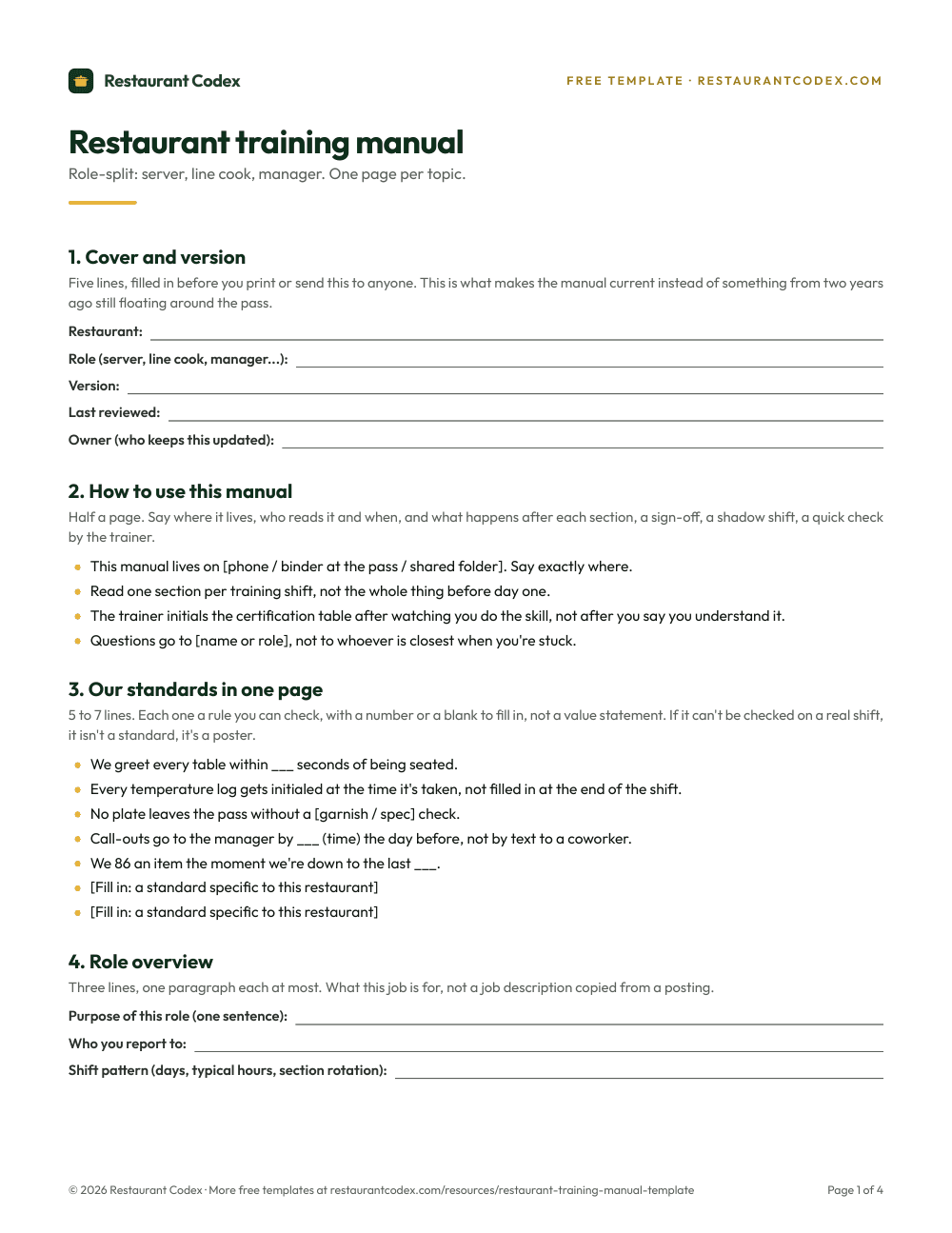
To have a manual from scratch, start from the template:
Restaurant Codex
The same checklist, on every phone, with photo proof
Restaurant Codex runs this template as a live task with timestamps, photos and one view across every location. Bring it to a 30-minute working session and we'll show you how it would run across your locations.
By the Restaurant Codex team
Written with operators who run multi-location restaurant groups. Reviewed against the FDA Food Code and the sources listed below.
Sources
- Bureau of Labor Statistics, Occupational Outlook Handbook: Waiters and Waitresses (How to Become a Waiter or Waitress)
- O*NET OnLine, Waiters and Waitresses (35-3031.00): tasks, knowledge, job zone
- Radke et al., Food Allergy Knowledge and Attitudes of Restaurant Managers and Staff: An EHS-Net Study (Journal of Food Protection, 2016, via PubMed Central)
- Massachusetts DPH, Retail Food Code Standards for Allergen Awareness (cites the FDA Food Code, 2-102.11 and 2-103.11)
- Borchgrevink and Susskind, Consumer Acceptance of Server Recommendations (International Journal of Hospitality & Tourism Administration, 7:4, 2006; author version at Cornell eCommons)
- Orden Jurídico Nacional, Ley Federal del Trabajo (articles 39-A to 39-E, 132 fraction XV, 153-A, 153-D and 153-F Bis)
- Diario Oficial de la Federación, NOM-251-SSA1-2009 (points 5.14.1 and 5.14.2, training)
- Senado de la República de Colombia, Código Sustantivo del Trabajo (articles 76 to 80, trial period)
- Ministerio de Salud de Colombia, Resolución 2674 de 2013 (article 12, education and training; article 11, health status; definition of food handler)
- eCFR, 29 CFR Part 785, Subpart C (785.27 to 785.29, training and hours worked)