How many restaurants are there in Mexico?
Mexico has 741,499 restaurants, cafés and places that prepare food to eat right away, according to DENUE 05/2026, the directory of active businesses that INEGI, Mexico's national statistics institute, publishes. The count covers SCIAN class 7225 (Mexico's version of NAICS): full-service restaurants, taquerías, antojito counters, cafés and ice cream shops, pizza and rotisserie-chicken takeout, seafood restaurants and self-service places. It leaves out the 32,361 bars and cantinas the same directory lists separately, along with hotels and catering.
By state, the largest is the State of Mexico, which surrounds the capital, with 89,408 establishments. Mexico City follows with 55,753, then Jalisco (48,957), Veracruz (48,430) and Puebla (44,719). Those five add up to 287,267, close to four in ten restaurants in the country. All 32 states are in the downloadable table at the end.
One thing to keep in mind for everything that follows: the DENUE counts establishments, not companies. A group with six locations shows up six times, once per address, and a one-table fonda counts the same as a 100-seat restaurant.
How big are restaurants in Mexico?
The typical restaurant in Mexico is small: 657,347 establishments, 88.7%, employ 0 to 5 people, by the staff-size bands INEGI records. Another 56,443 (7.6%) have 6 to 10. Only 27,709, or 3.7%, employ 11 or more.
| Staff | Establishments | Share |
|---|---|---|
| 0 to 5 | 657,347 | 88.7% |
| 6 to 10 | 56,443 | 7.6% |
| 11 to 30 | 22,943 | 3.1% |
| 31 to 50 | 3,531 | 0.5% |
| 51 to 100 | 887 | 0.1% |
| 101 to 250 | 288 | under 0.1% |
| 251 or more | 60 | under 0.1% |
That jump matters more than it looks. With five people, the owner sees everything from the register. With eleven or more there are shifts, a manager who isn't the owner, recipes someone else cooks and new people every month. That 3.7% is where the problem that shouting from the kitchen can't fix shows up: keeping the standard when the owner isn't there.
Where are Mexico's larger restaurants?
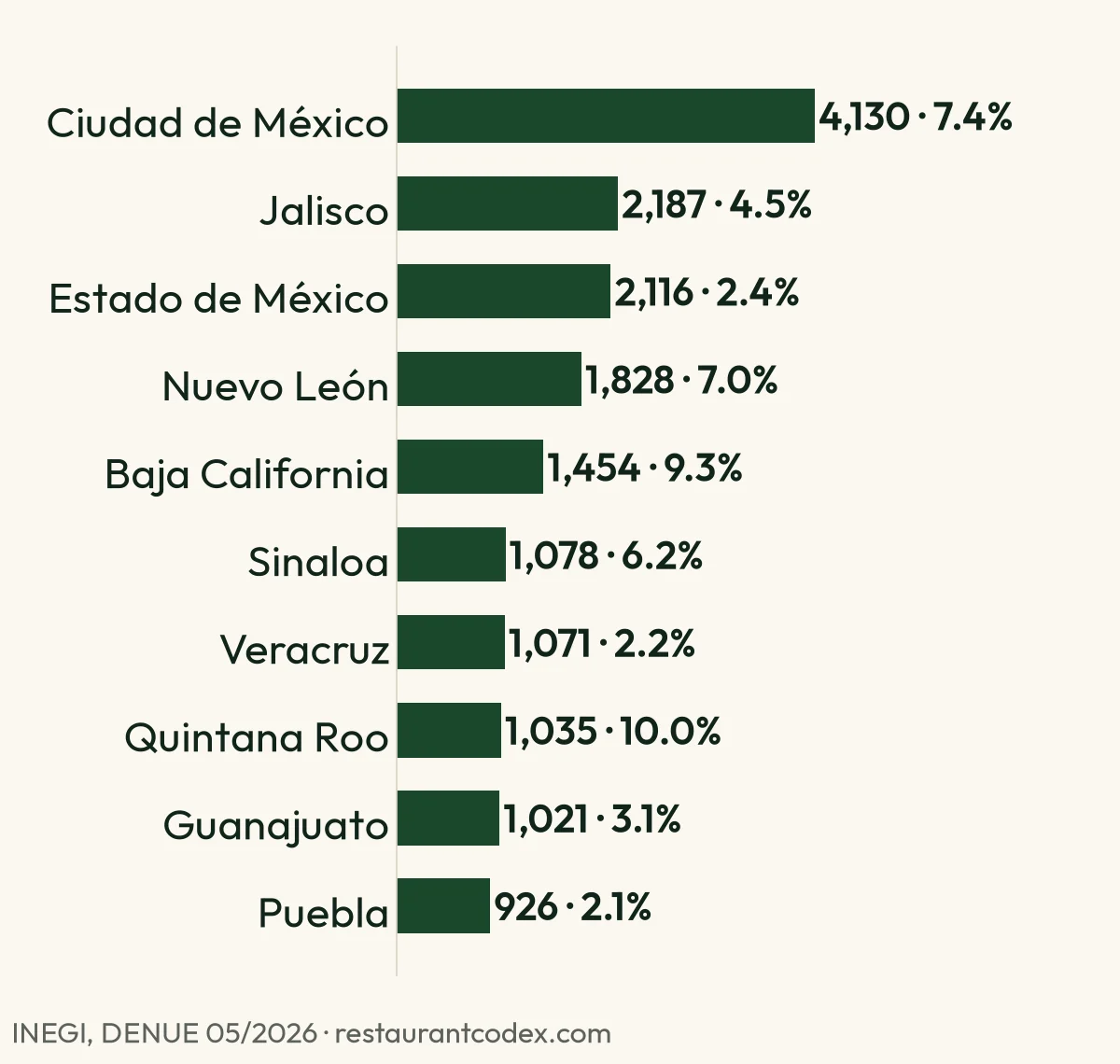
Restaurants with 11 or more staff cluster in four states: Mexico City (4,130), Jalisco (2,187), the State of Mexico (2,116) and Nuevo León (1,828). Together they hold 10,261, or 37% of the country's larger restaurants.
The absolute count hides a second reading. Look at what share of each state's restaurants are larger, and the order changes completely:
| State | Restaurants with 11+ staff | Share of the state's total |
|---|---|---|
| Quintana Roo | 1,035 | 10.0% |
| Baja California | 1,454 | 9.3% |
| Baja California Sur | 476 | 8.4% |
| Mexico City | 4,130 | 7.4% |
| Nuevo León | 1,828 | 7.0% |
| Sonora | 863 | 6.3% |
| National average | 27,709 | 3.7% |
At the other end sit Tlaxcala (1.1%), Oaxaca (1.3%), Chiapas (1.6%) and Guerrero (1.9%), states where almost every restaurant is very small. Quintana Roo and the two Baja Californias share tourism and the border, and restaurants built for volume and long hours.
By municipality, the list of larger restaurants is led by Cuauhtémoc in Mexico City (998), Tijuana (758), Monterrey (715), Guadalajara (680) and Mérida (587). Then come Miguel Hidalgo (531), Querétaro (525), Zapopan (512), Benito Juárez in Mexico City (508), Puebla (502), Benito Juárez in Quintana Roo, which is Cancún (484), and Culiacán (449).
What kinds of restaurants does Mexico have?
Mexico is first of all a country of antojitos and tacos: 168,295 antojito restaurants and counters and 147,589 taquerías and torterías, together 42.6% of all establishments. Nearly all are very small; only 0.8% and 1.4% of them employ 11 or more people.
| Type (SCIAN) | Establishments | With 11+ staff |
|---|---|---|
| Antojitos | 168,295 | 0.8% |
| Tacos and tortas | 147,589 | 1.4% |
| Cafés, ice cream, juice and soda fountains | 94,062 | 3.7% |
| Pizza, burgers, hot dogs, rotisserie chicken (takeout) | 79,622 | 2.6% |
| Other food for immediate consumption | 73,482 | 0.3% |
| Full-service, à la carte or set menu | 72,521 | 16.3% |
| Other takeout | 60,421 | 0.6% |
| Seafood | 28,902 | 7.8% |
| Self-service | 16,605 | 24.5% |
The right-hand column tells the story. Full-service, à la carte or set-menu restaurants are 9.8% of all establishments, yet they hold 11,816 of the country's 27,709 larger restaurants, 42.6%. Self-service is even more concentrated: one in four has 11 or more staff. If you're looking for where operations with big teams happen, it's there, not at the corner taquería.
How many restaurant groups operate in Mexico?
At least 875 company-named groups run between 2 and 15 restaurants in Mexico, with 3,129 establishments between them: 741 have 2 to 5 locations and 134 have 6 to 15. Above them, 68 groups run 16 or more establishments, 4,235 in total, and that's where the chains everyone knows sit.
"At least" isn't decoration. The DENUE records a legal name (razón social) for about one in eight establishments, mostly the larger ones, and many of those legal names are a person's name. To avoid counting two unrelated people with the same name in different states as one group, we only count legal names that read as a company (Operadora, Grupo, Restaurantes, Corporativo, Alimentos and similar) and that appear at two or more establishments. That leaves out groups that set up one company per location, franchisees, and small groups the directory has no legal name for. The real number is higher; this is the floor you can check.
Two things about that floor are solid. 73.3% of groups with 2 to 15 locations operate in one state: they grow in their own city before leaving it. And they're based where the larger restaurants are: Mexico City (172 groups with 2 or more locations), Nuevo León (94), Jalisco (51), Puebla (51), the State of Mexico (49) and Baja California (49).
What do these numbers mean for restaurant operators?
The first reading is that running several locations in Mexico is rare. Of 741,499 restaurants, only a few thousand belong to mid-sized groups, and most owners who open a second location do it with no nearby model to copy, because the country is built on single-unit businesses. What works with five people (the owner at the register, the recipe in the cook's head, the WhatsApp group) stops being enough right when a business enters that 3.7%.
The second is geographic. In Quintana Roo, Baja California and Baja California Sur, one in every ten to twelve restaurants already runs with a large team, so training and staff turnover weigh more there than anywhere else. Open in Cancún, Tijuana or Los Cabos and you're competing for staff with restaurants that also need eleven or more people per shift.
The third is format. Full service and self-service concentrate the big teams, and that's where a recipe change, a closing procedure or a temperature log has to reach every location the same way. If your group is in those formats, the guides on opening a second location and running a multi-location group start from exactly that point.
Method, sources and downloads
We used INEGI's bulk download of DENUE 05/2026, sector 72, published May 20, 2026, and kept SCIAN class 7225. Size is the staff band INEGI records for each establishment; "11 or more" adds up every band from 11 to 30 upward. States and municipalities are the directory's own. The group count follows the rule explained above and is a floor, not a census. The DENUE is a directory of active businesses that INEGI updates mainly for larger establishments, so counts of very small businesses may lag reality.
The tables are free to download under CC BY 4.0; credit INEGI as the source and Restaurant Codex for the processing:
- Restaurants by state, with those employing 11 or more and their share
- Restaurants by type
- State, type and staff band, the full table
- Restaurants with 11 or more staff by municipality
- Groups by home state
- Summary figures
The script that produces every number is published with the data, so anyone can rerun it on the next DENUE edition. The same kind of analysis for Colombia, from the chambers of commerce registry, is in Colombia's Restaurants in Numbers.
Where Restaurant Codex fits
We published this because Restaurant Codex was built for restaurants in that 3.7% and for groups that already run more than one location: one place for each location's recipes, photo-proof checklists, training and inventory. Mexican groups running on Restaurant Codex include Koli Cocina de Origen in Monterrey, Tapiz Bistro & Bakery and Quanto Basta in Mexico City, and Côt Winehood and Autóctona in Cancún; the full customer list has the rest. If your group shows up in these tables, the page on software for multiple locations shows what each part of the system handles, and what Restaurant Codex is covers what it doesn't do.
Restaurant Codex
The same checklist, on every phone, with photo proof
Restaurant Codex runs this template as a live task with timestamps, photos and one view across every location. Bring it to a 30-minute working session and we'll show you how it would run across your locations.
By the Restaurant Codex team
Written with operators who run multi-location restaurant groups. Reviewed against the FDA Food Code and the sources listed below.