Store six's punch list looks nothing like store one's. The new GM doesn't know the walk-in compressor on that model needs a two-week lead time, or which inspector always asks for the sanitizer log first. None of that lives anywhere except in the head of whoever opened the last one. Opening another location is really an audit of the first: everything you learned by accident has to land on paper before it can move to a new address.
What's in the download, and who owns each date
The checklist below is one sheet organized as a timeline, not a category list: 120 to 90 days out, 60 days out, 30 days out, opening week, and the first 30 days after doors open. Each of the 57 lines has a box, initials and a time, because "the permit's filed" with no date and no name is a guess by the time anyone checks it. The header carries the location, the target open date, the opening lead, and a version number, since you'll run this sheet again for the next store.
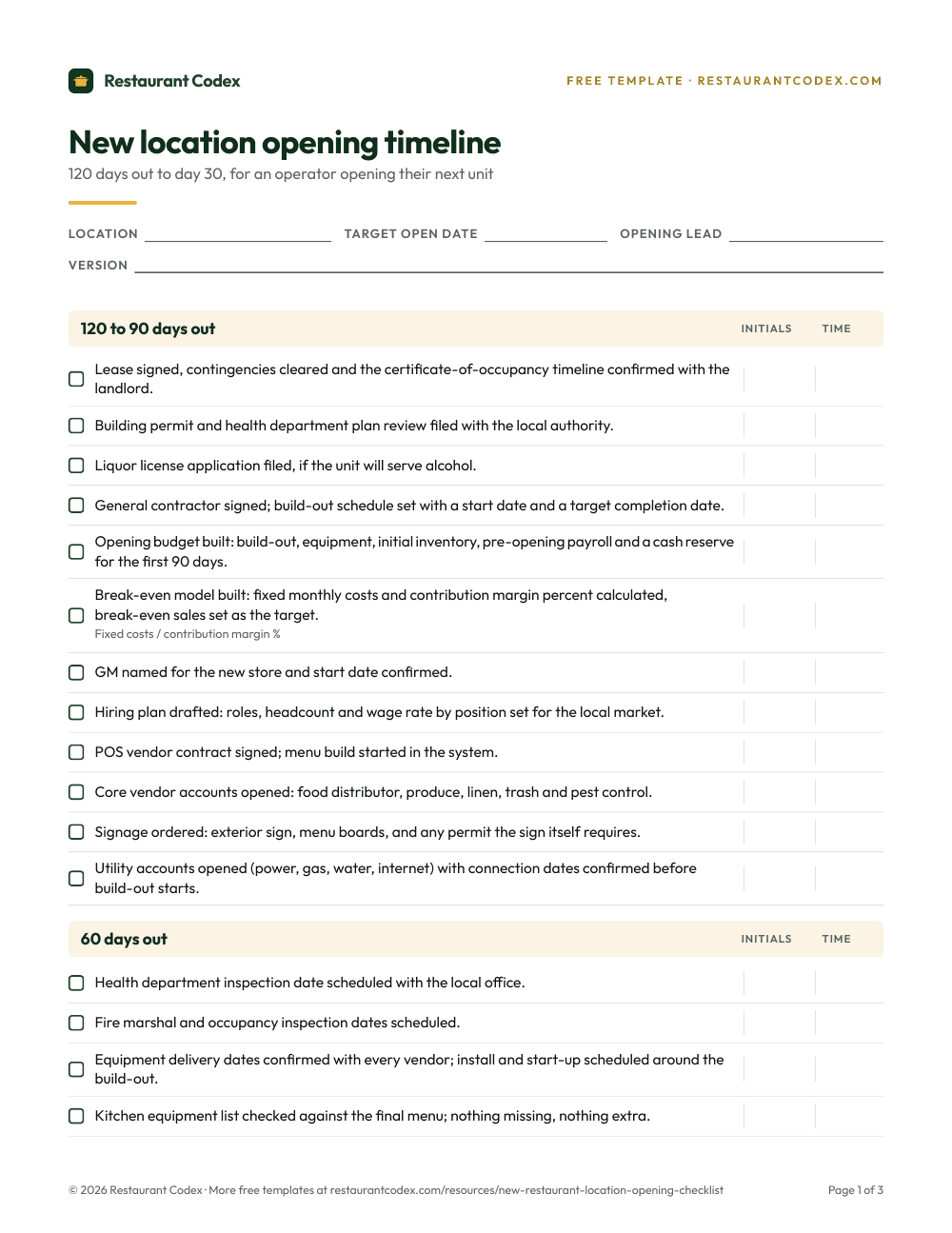
New location opening timeline
120 days out to day 30, for an operator opening their next unit · 57 items
One person, usually the operations lead or the owner, holds the opening-lead role and owns the sheet start to finish, but most lines get initialed by whoever does the work: the GM signs the hiring and training lines, the opening lead or a controller signs the budget and break-even lines, the chef signs the menu-lock and recipe-costing lines. The district manager or owner signs off at three checkpoints instead: the budget and break-even model at 90 days, the inspections and licenses at 30 days, and the handoff meeting at day 30 of operation. That last signature matters most. It's the point where the store stops being an opening project and becomes a regular location, and somebody has to say out loud that it happened.
The timeline logic: what has lead time, what can't slip
Work backward from the open date and everything on this sheet sorts into two piles. The first has real lead time and doesn't compress under pressure: a permit application, an equipment order, a hiring plan for a market you don't already have a bench in. File the health department plan review two weeks late and your open date doesn't move two weeks, it moves however long that office's queue happens to run that month. Order the walk-in and the hood system late and you're waiting on a manufacturer's build schedule, not your own.
The second pile is genuinely flexible, and treating it like the first wastes worry on the wrong things. A soft-open date can move a few days for free. A marketing push can start a week later. Uniform sizing can happen after the crew's hired instead of before. The mistake isn't picking the wrong items to worry about, it's not sorting them at all, so a flexible line gets the same panic as a permit on the critical path.
The money: what it costs and when you break even
Square's 2026 cost breakdown puts the overall range at $175,000 to $750,000 to open a location, with full-service running $300,000 to $750,000 or more, fast-casual $200,000 to $500,000, and quick-service $150,000 to $300,000. Where you land depends on whether you're building raw shell space or taking over a fitted-out lease, and on local construction and rent costs, so use it to sanity-check a contractor's bid, not as a number you plug in.
The number that actually tells you whether the site works is break-even, and the math is simpler than most operators expect. Add up fixed monthly costs, rent, insurance, salaried management, any loan payment, and divide by contribution margin percent, what's left of a sales dollar after variable costs: food, the hourly labor that scales with volume, paper goods, credit card fees. Fixed costs divided by contribution margin percent equals break-even sales, which is the formula Binwise publishes. Say fixed costs run $45,000 a month and contribution margin is 35%: $45,000 divided by 0.35 is about $128,600 a month, or roughly $4,200 a day if the store's open every day. If your realistic sales forecast sits well under that number, the site doesn't work at the rent you're being offered, no matter how good the concept is next door.
That's also why the 90-to-120-day budget line includes a cash reserve for the first 90 days, not just build-out and opening inventory. A new location almost never opens above break-even in week one, and the reserve pays payroll and rent while sales climb toward that number.
Transplanting the culture, not just the equipment
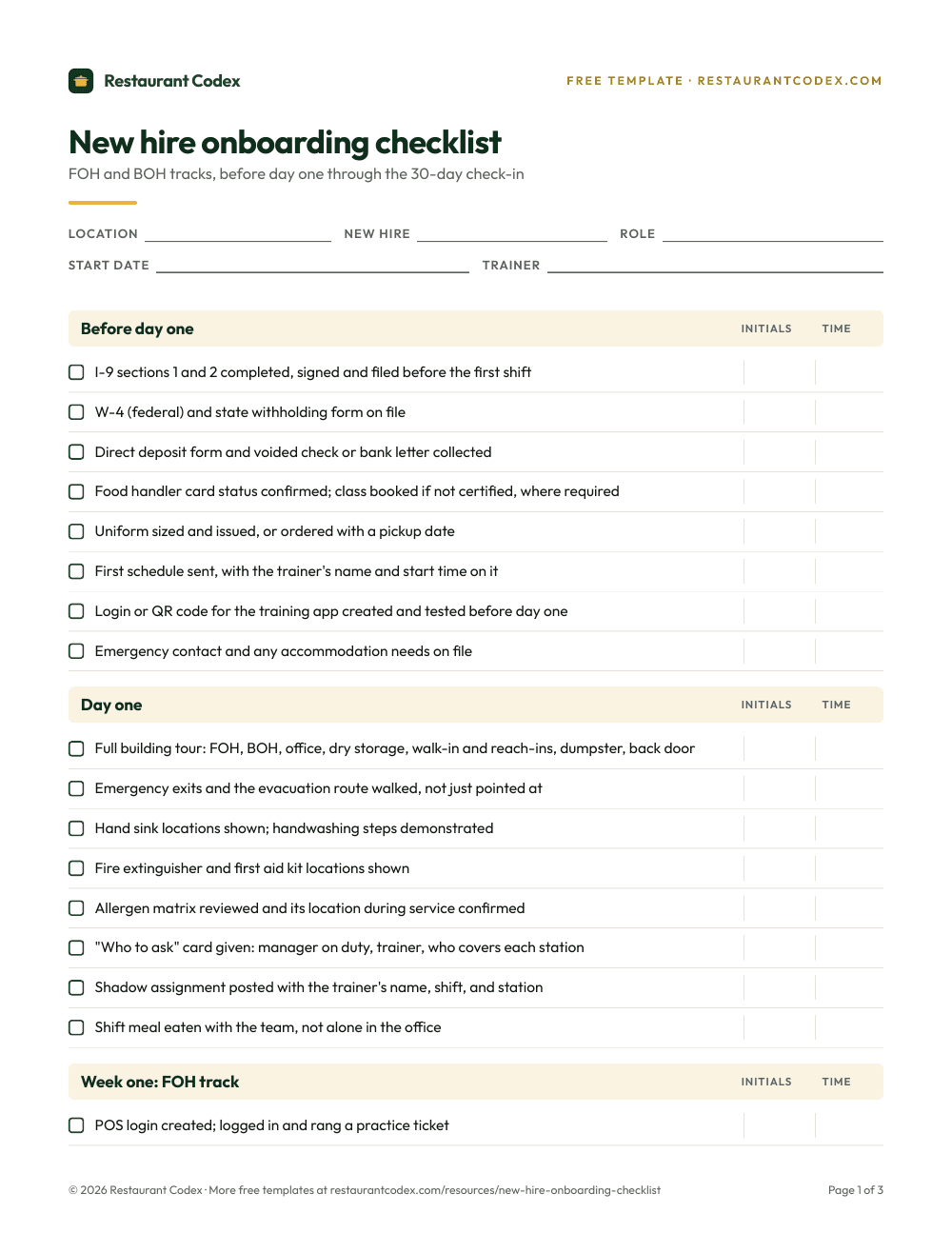
Equipment ships fine. Culture doesn't, unless you move it on purpose. The single most important line on this checklist is naming trainers from an existing store at 60 days out, not hiring local trainers or promising to "figure out training once we're open." A trainer from a store that already runs your systems right can show a new hire the standard instead of describing it, and can catch the small drift, a recipe card followed loosely, a closing step skipped because nobody's watching, before it becomes how the new store does things.
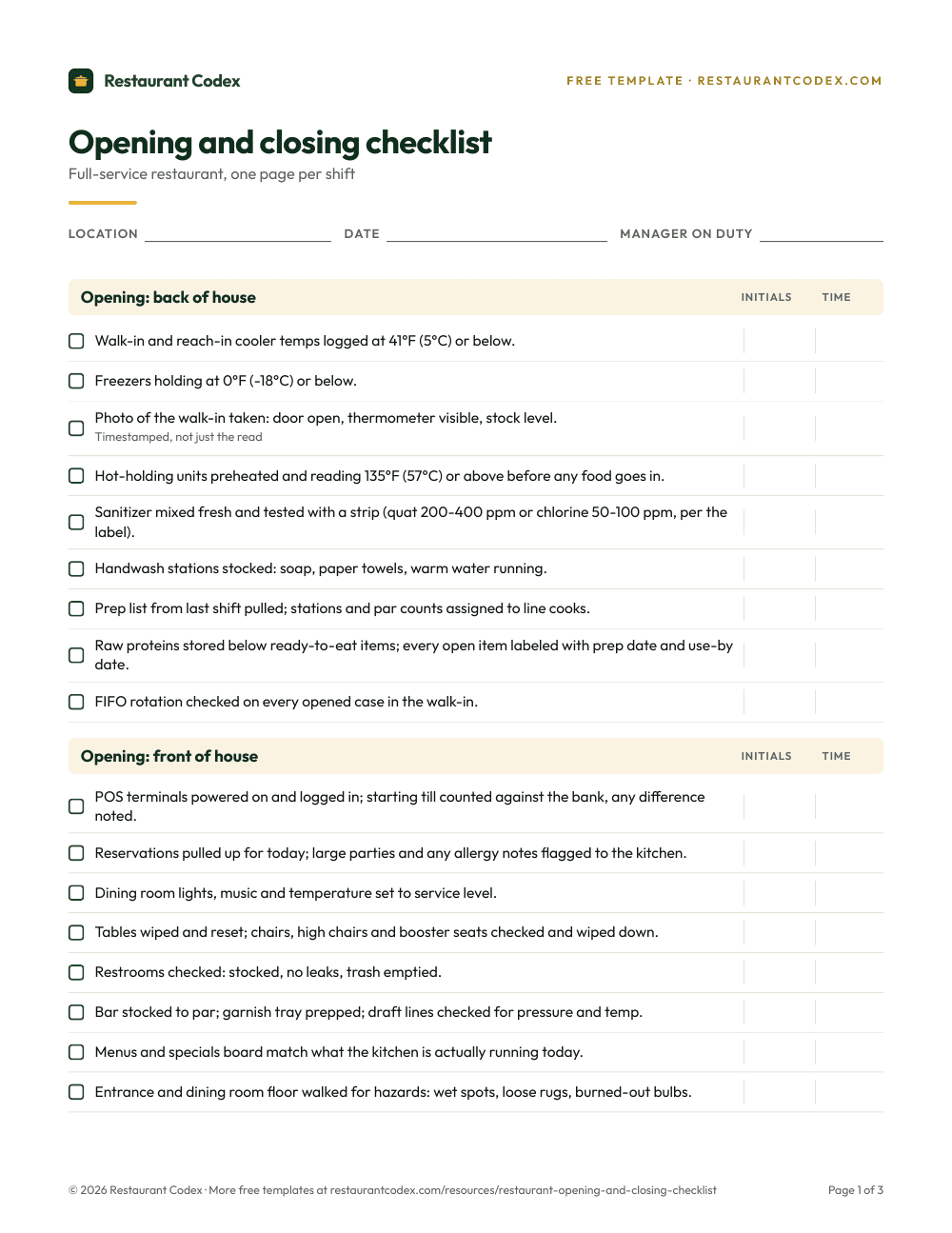
The other half is running the new store on the existing checklists from the start, not a simplified version meant to get through the first few weeks. The SOPs, the opening and closing checklist, the prep lists, all of it loads at 30 days out and goes live on the soft open's first shift, same as every other location. A store that spends its first month on an informal version rarely formalizes later; the informal version is what the team learns, and that's what sticks.
Running this across a group
The checklist you use to open store six shouldn't be the one you used for store one. Version it, literally: keep the version number in the header, and after every opening hold a short debrief, what line was missing, what took longer than planned, what a vendor promised and didn't deliver, and fold the fixes into the next version before the next opening starts. A checklist that never changes means nobody's learning from the last one, which is expensive given how many of these lines punish you for finding out late.
The other piece is owning the first 30 days specifically. The GM runs the store, but the district manager or ops lead owns the 30-day clock: weekly prime cost checks, the variance count, the punch list, the handoff meeting. A GM running their first opening alone, with nobody above them checking the 30-day items on a schedule, is the most common way a new store's early numbers drift for months before anyone notices.
Mistakes that turn an opening into a scramble
Opening with an undertrained crew is the most common one, usually because hiring ran late and there wasn't time for more than a walkthrough before doors. A crew that's seen the line once doesn't have the muscle memory a soft open assumes, and the gap shows up as slow tickets and wrong orders in front of your first paying guests.
A menu that isn't costed is the second. Recipe changes after the 60-day lock, "one more tweak" from the chef, a supplier substitution nobody re-costed, mean the printed menu was never actually priced against target food cost. You find out three weeks in, when the P&L doesn't match the plan.
Skipping the soft open, or running one too short to count, is the third. A soft open exists to find problems that only show up under real covers: a ticket time that's fine for eight tables and falls apart at twenty, a wrong POS modifier, a station short a person during the rush. Compress that into one dinner service and you find those problems at the grand opening instead, in front of the people you most wanted to impress.
The fourth is the owner moving into the new store and letting the existing ones drift. It feels responsible, but a month of full attention on store six is a month store one through five didn't get, and their numbers usually show it by the time the owner comes back.
The fifth is not budgeting for the first 90 days of losses. A location almost never opens above break-even, and a budget that stops at build-out and initial inventory leaves nothing for payroll and rent while sales climb toward that number. That's the fastest way a site that would have worked runs out of cash first.
How Restaurant Codex runs this
We run this same timeline as a live checklist inside Restaurant Codex instead of a shared document: the opening lead assigns each line to a name, dates and initials log the moment a line's marked done, and the owner or district manager sees every open item across every store currently opening from one screen. When the next opening starts, last time's version comes with the fixes already folded in.
Restaurant Codex
The same checklist, on every phone, with photo proof
Restaurant Codex runs this template as a live task with timestamps, photos and one view across every location. Bring it to a 30-minute working session and we'll set it up on your real operation.
New location opening timeline
120 days out to day 30, for an operator opening their next unit · 57 items
By the Restaurant Codex team
Written with operators who run multi-location restaurant groups. Reviewed against the FDA Food Code and the sources listed below.