The week that decides everything
A new line cook shows up Monday, fills out paperwork in the office for forty minutes, gets a shirt and a locker, then gets handed to whoever's on the line that night with "show him where the sauté station is." By Thursday he's still guessing which cutting board is for produce and which is for raw chicken, nobody's checked his temp log habits, and Friday he doesn't show. That's not a rare restaurant. It's the ordinary one.
The federal government tracks how ordinary. In July 2026, the quits rate for accommodation and food services ran 3.5%, and total separations hit 5.2%, both preliminary (BLS JOLTS, Table 4; FRED, JTS7200TSR). More than one worker in twenty in the industry left a job that single month. None of that separation happens on day 45. Most of it gets decided in week one, shift by shift, while a new hire figures out whether the job matches what the interview promised.
New hire onboarding checklist
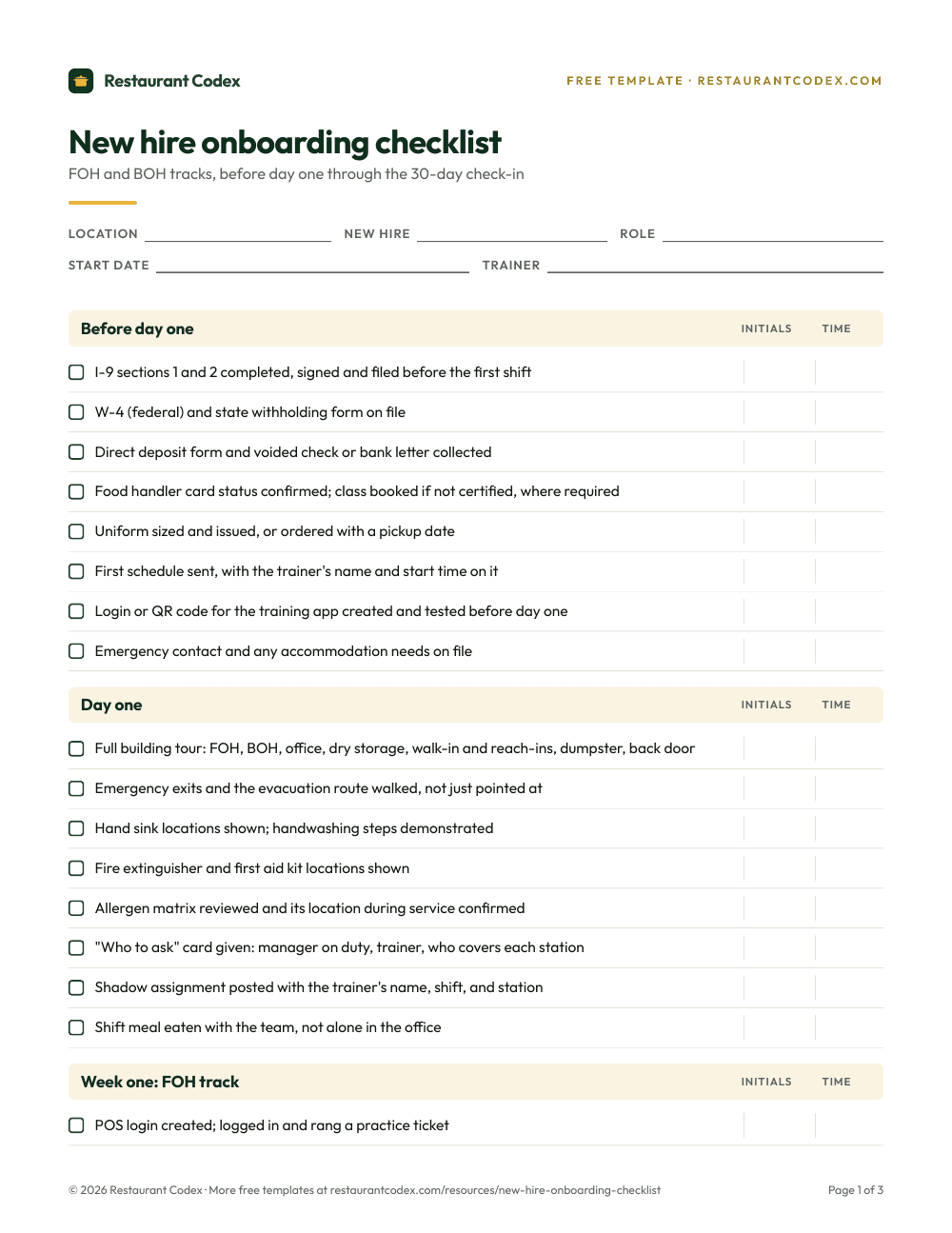
FOH and BOH tracks, before day one through the 30-day check-in · 44 items
What's in the download and how it actually gets used
This is one form, filled by different people at different points, not a sheet someone completes in one sitting. The header, location, new hire, role, start date, trainer, gets filled by whoever schedules the hire, before day one. The "before day one" section is HR's or the manager's job, done from a desk days ahead of the start date: I-9, W-4, direct deposit, food handler card status, a uniform in the right size, a first schedule with the trainer's name already on it. Day one belongs to the trainer, initialed line by line as the tour and the safety walk actually happen, not filled out from memory at the end of the shift. Week one and week two get initialed as each skill gets checked off, with a time next to each line so a manager reviewing the sheet later can tell a five-minute glance from a real demonstration.
Orientation is not training
Most restaurants run one process and call it both. Orientation is paperwork and a tour. Training is a cook breaking down a case of chicken to a standard, or a server running five courses without checking a cheat sheet. Confusing the two is how a new hire ends up "trained" after a forty-minute HR session and nothing else.
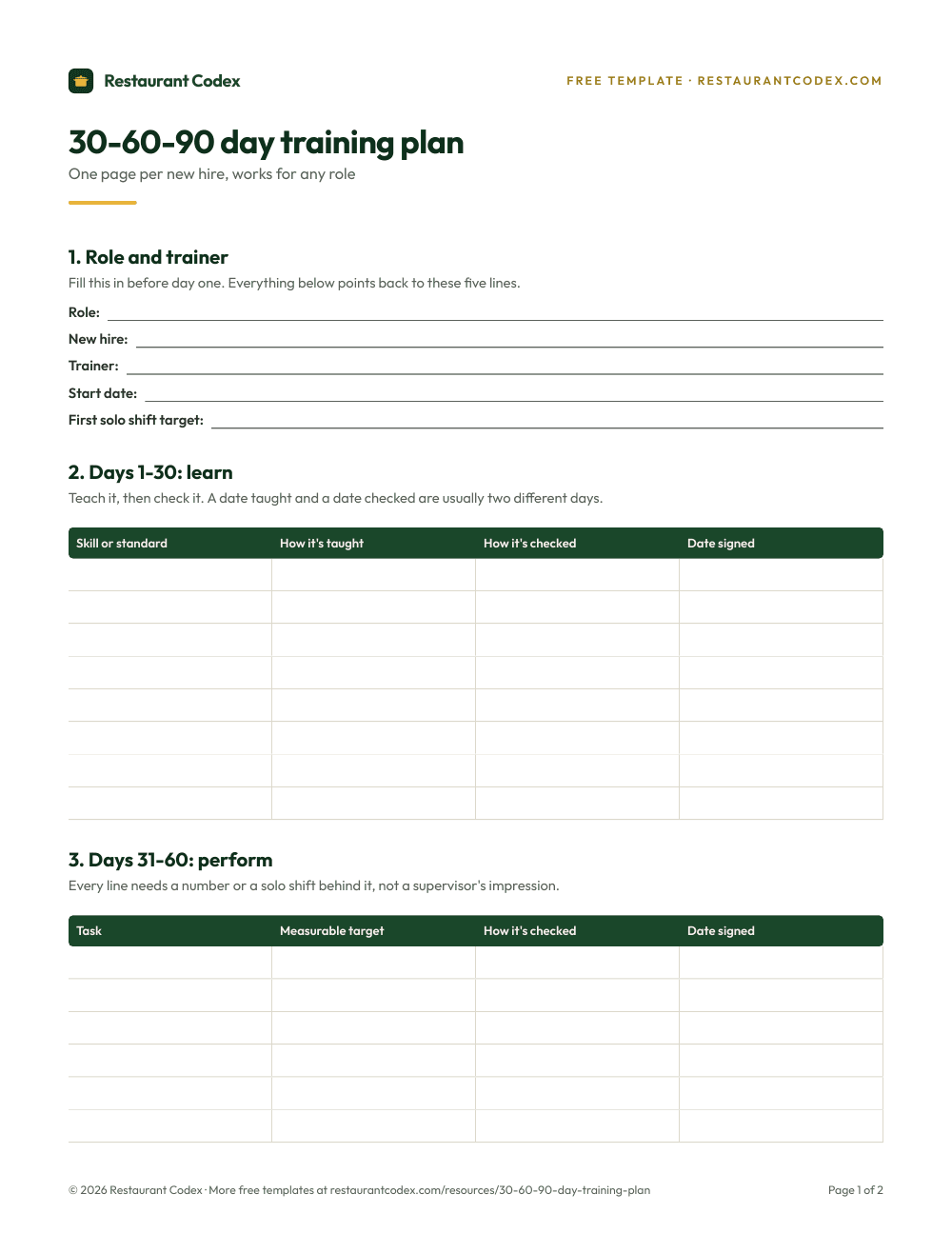
How long real training takes varies by role more than most schedules admit. O*NET classifies restaurant cooks as Job Zone 1 to 2, a range from a few days to a year of on-the-job learning depending on the station and the menu. A checklist that treats week one as the finish line is guessing. This one treats week one as floor-ready, not fully trained, and says so on the form. What comes after the 30-day check-in belongs in a longer 30-60-90-day training plan built around the same sign-offs.
Two tracks, one trainer
FOH and BOH learn different jobs in the same building, and stapling them into one generic list is why so many onboarding checklists read like a shell nobody customized. The FOH track in week one covers the POS login, the section map, steps of service walked with a trainer and then repeated solo, a menu tasting the new hire can talk through unprompted, and the allergen protocol on its own line, not folded into "menu knowledge." The BOH track covers the station map, knife handling, where the temp logs live and what the standard is (cold holding at 41°F or 5°C or below, hot holding at 135°F or 57°C or above), the labeling and FIFO system, and two or three recipe cards walked in person before anyone's expected to cook from memory.
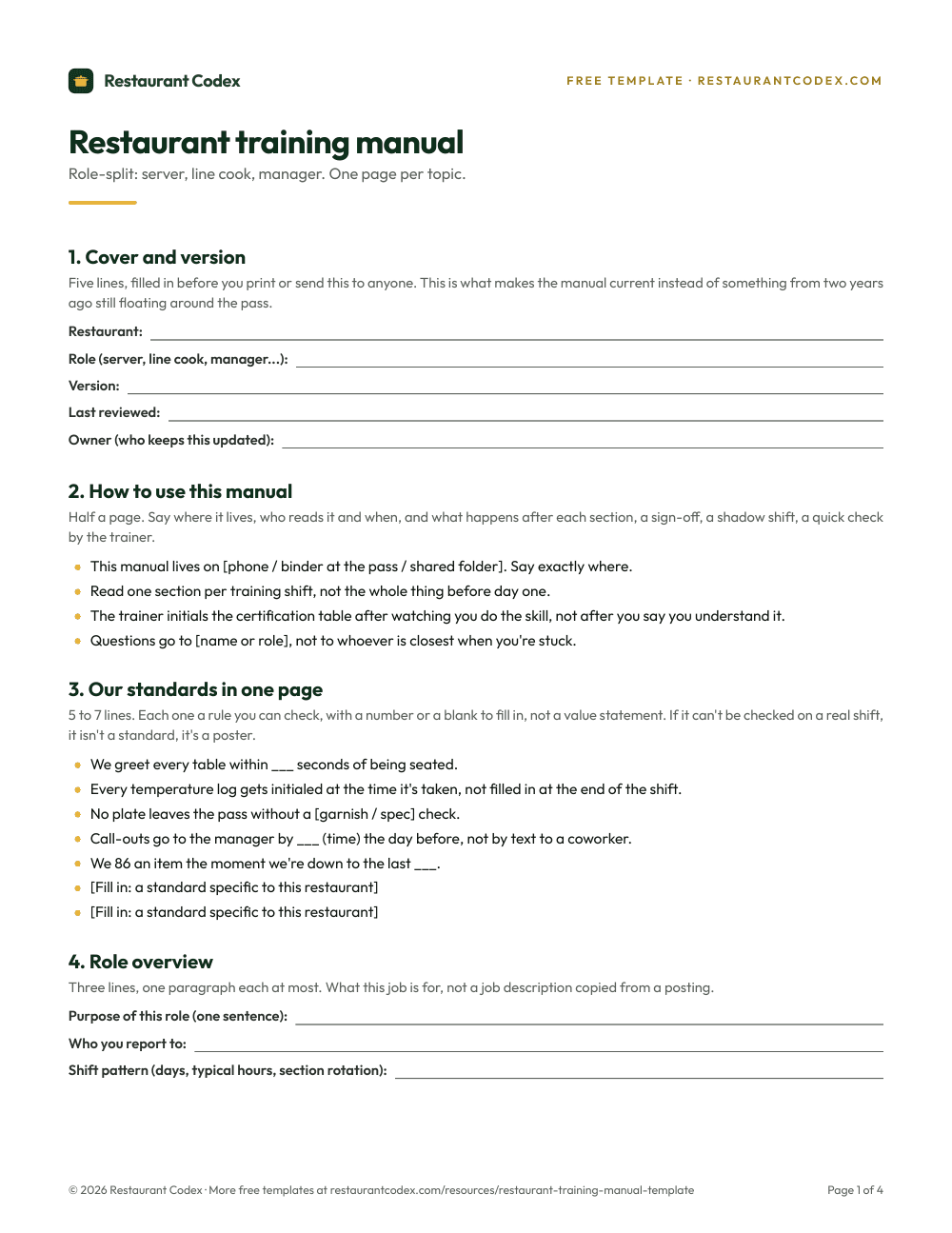
Both tracks report to one trainer, named on the header field, not whoever's on the schedule that day. A rotating cast of trainers is how the same question gets three different answers in one week, and how nobody ends up owning whether the new hire is actually ready. Week two closes the loop: a practical check-off against the trainer's own standard, a quiz, and a first solo shift paired with a buddy, not alone on a slow Tuesday and called trained. Once the sign-offs are real, a role-specific training manual is what carries someone from floor-ready to genuinely good.
The 30-day check-in is where people quit or stay
QSR employees who made it 90 days were running at 54% in 2022, down from about 58% before the pandemic, based on surveys HourWork ran across more than 8,000 quick-service restaurants (Restaurant Dive, citing HourWork). The 30-day mark sits inside that window, and it's the point where a restaurant still has time to fix something before it turns into a resignation.
The check-in itself runs about fifteen minutes and goes both directions. The new hire says what's working and what's still unclear, to a manager sitting across from them, not into a suggestion box. The manager gives feedback that's specific and tied to the sign-off sheet, not a vague "you're doing great." The form closes with a plain decision: on track, needs another pass at something specific, or not a fit. Writing that decision down, even the uncomfortable one, is what makes the next hire's 30-day check-in better than this one.
Running onboarding across five, ten, fifty stores
One operator with five locations can't run five different versions of "how we onboard a server" and still compare the results. The fix isn't a single checklist for every role. It's one checklist per role, server, line cook, host, dishwasher, run identically at every store. HQ owns the compliance section: the paperwork items, the food handler card tracking, the deadlines, standardized so a district manager can audit any location's file the same way. The GM owns the culture items: who the trainer is, how the shadow assignment gets paired, what the first shift meal looks like, the parts that should feel like that specific restaurant, not a corporate script read off a page.
What that split buys an owner is a real comparison. Pull 90-day retention by store, and the location where the GM treats the 30-day check-in as optional will show it in the number, months before anyone would have noticed from the floor.
Where onboarding breaks down
Paperwork day gets called training. A new hire fills out an I-9 and a W-4, watches an orientation video, and someone marks the whole checklist done because the form got signed, not because anything was taught.
Shadowing happens without sign-offs. A new server follows someone for two shifts, which feels like training and checks no actual skill, so week three arrives and nobody can say what she's competent at.
Food handler cards go untracked after hire. The card gets mentioned once and never checked again, and six months later a health inspector finds three lapsed cards on one shift.
The 30-day conversation gets skipped for a busy week, then skipped again, and the new hire's first real signal that something's wrong is a two-week notice.
And the first shift gets scheduled on a Friday, the busiest night of the week, because that's where the hole in the schedule was. That teaches someone in their first hour that nobody here is going to catch them.
How Restaurant Codex handles this
On paper, this checklist works as well as the trainer filling it out honestly. Restaurant Codex keeps the same sections digital: the trainer initials from a phone as each line actually happens, the food handler card date sits on the employee's profile instead of a sticky note by the office computer, and an owner watching five stores sees every new hire's progress and every location's 30-day completion rate in one view, not five folders in five back offices.
Restaurant Codex
The same checklist, on every phone, with photo proof
Restaurant Codex runs this template as a live task with timestamps, photos and one view across every location. Bring it to a 30-minute working session and we'll set it up on your real operation.
New hire onboarding checklist
FOH and BOH tracks, before day one through the 30-day check-in · 44 items
By the Restaurant Codex team
Written with operators who run multi-location restaurant groups. Reviewed against the FDA Food Code and the sources listed below.
Sources
- BLS, Job Openings and Labor Turnover Survey, Table 4, quits rate by industry
- FRED, Total Separations: Accommodation and Food Services (JTS7200TSR)
- O*NET OnLine, Cooks, Restaurant (35-2014.00), Job Zone
- Restaurant Dive, citing HourWork, most QSR employees worked 90 days before quitting in 2022
- FDA Food Code 2022, cold holding 41°F/5°C or below, hot holding 135°F/57°C or above