Shadowing someone for a week isn't a training plan
A new hire's first two weeks usually look like this: two or three shifts trailing someone busier than they are, a lot of nodding along, then their name shows up on the schedule alone with no trainer next to it. Nobody decided that moment was the right one. It's the next open slot on the calendar.
Restaurants lose people faster than almost any other industry. The Bureau of Labor Statistics JOLTS series for accommodation and food services (JTS7200TSR) put total separations at about 65.3% in 2025. That series counts hotels alongside restaurants, so it isn't restaurant-only, but it's the most current federal number you can actually check. A share of that walks out the door in the first month, when the only plan anyone wrote down was "watch Maria for a few shifts."
A 30-60-90 day plan fixes the vague part. It isn't a longer training program; it's the same training with three dates attached: what a new hire is taught by day 30, what they do alone by day 60, and what they own by day 90. Each mark gets a real check, not a gut feeling, and a signature with a date next to it.
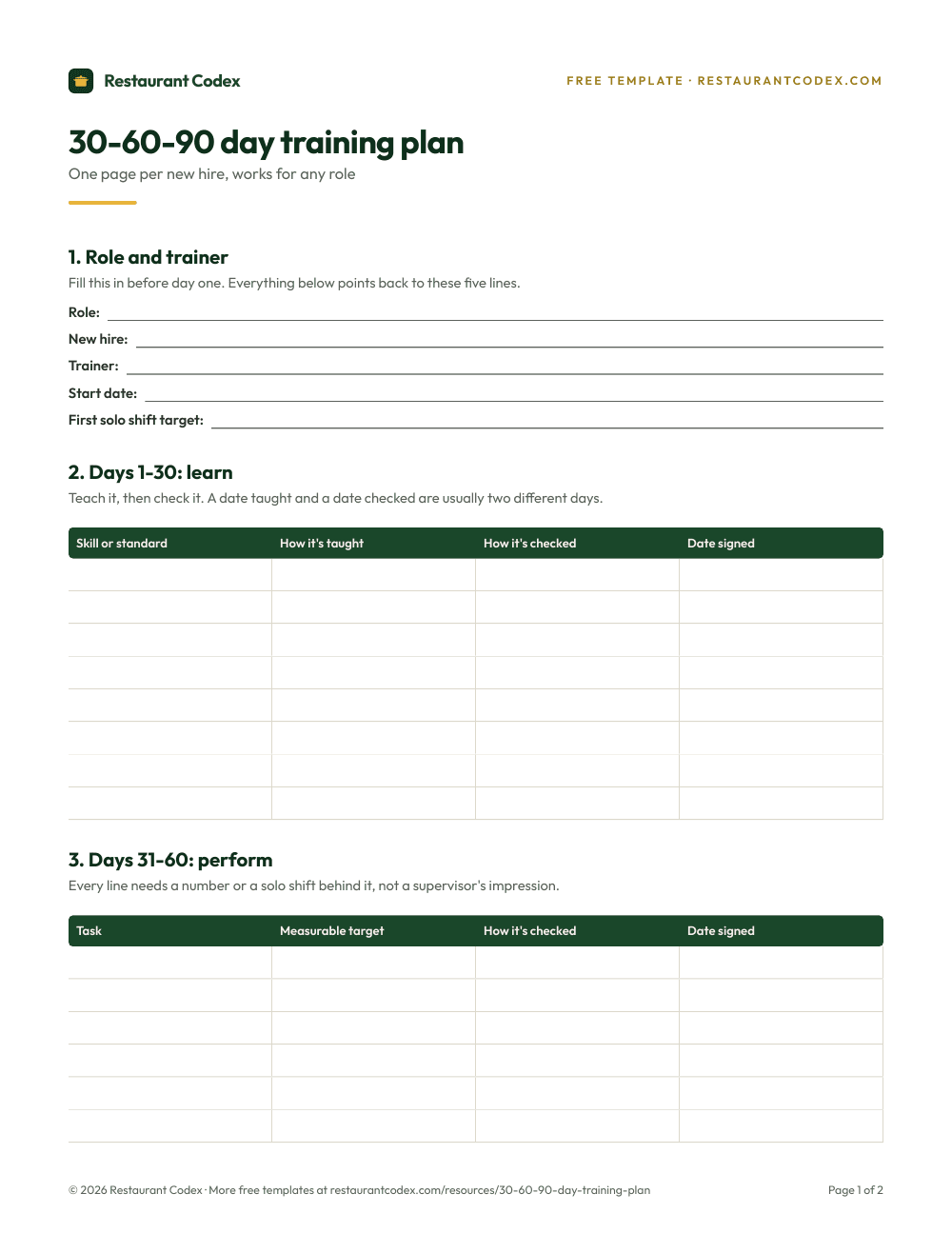
The download is one page, built for any role, front or back of house. The examples through this guide use a server and a line cook, the two jobs that turn over fastest and the two most templates skip past a generic checklist. The trainer fills in the role, the new hire's name, and a target date for the first fully solo shift before day one starts, not after week two once the shadowing has gone on too long. Naming that date up front turns "we'll see how it goes" into a commitment somebody has to answer for.
The sheet lives wherever the schedule lives: taped inside the office binder, or pinned next to next week's shifts, so the trainer and the manager both see it without having to ask. Each phase gets signed as it's cleared, not all three at once on day 90. An unsigned line at day 75 tells you exactly where a plan quietly stalled out.
30-60-90 day training plan
One page per new hire, works for any role · 7 sections
Days 1 to 30: learn
For the first month, nobody's checking whether the new hire is fast. They're checking whether they were taught, and whether it stuck. A server learns the POS, table numbering, the allergen protocol, and the handful of menu items that account for most of what a table actually orders. A cook learns knife cuts to spec, that station's mise en place, and the recipes on the station's card, not all at once.
The check at day 30 isn't a nod from the trainer walking by. It's a written or verbal quiz score on the menu and allergens, and a practical walkthrough where the new hire does the task while the trainer watches and initials it, not describes it back from memory. "Can recite the allergen list" and "correctly flagged a shellfish allergy on a real ticket without being prompted" are different claims. Only the second one earns a signature.
Days 31 to 60: perform
This is where the plan asks for a number instead of an impression. A server runs their own section solo for a full shift and hits ticket times the kitchen can actually measure: entrees out inside the restaurant's own standard, not "seemed on top of it." A cook runs their station alone through a full rush and holds pace without a trainer stepping in to finish plates. Both get checked against something the POS or the pass already shows you, not a manager's memory of how the night felt.
Cross-training starts here, not before. A new hire who hasn't run their first station solo yet doesn't have the bandwidth to learn a second one; add it too early and both stations end up half-learned. Once someone's holding their home station clean, day 31 to 60 is the window to add one more: the server who can also run expo, the cook who can also hold garde manger when someone calls out. One second station by day 60 is enough. Three is how a schedule looks flexible on paper and falls apart on a Friday when nobody's strong anywhere.
Days 61 to 90: own
By day 90, the new hire isn't just doing the job. They're passing part of it to someone else, the actual test of whether they own it. That might mean training a newer hire on one specific task, plating a dish without oversight, or covering a single shift-lead duty like opening the safe or running a pre-shift meeting once. It doesn't mean handing them a section they've never worked, or a task nobody checked first.
Certifications close out here too, with a hard deadline instead of a target: food handler and allergen training, plus alcohol service certification wherever the state requires it for anyone pouring or serving. ServSafe, run by the National Restaurant Association, is the most widely used program; its manager exam carries ANAB-CFP accreditation, which is why most health departments accept it without a second look. Put the issue and expiry dates on the sheet itself, not in a separate binder. A cert expiring in month fourteen lapses quietly unless the same document tracking training also tracks when it runs out.
The check-in conversation
Three check-ins, at day 30, 60 and 90, each one an actual conversation, not a form passed across a desk. Two questions carry most of it: what's working, and what isn't. The second one is the one managers skip, because it's more comfortable to hear that things are fine. Ask it anyway, and write down the answer even when it sounds small. A new hire who says the schedule keeps changing with no notice, or that nobody's told them which manager to ask about a comp, is handing you a fixable problem for free.
Close every check-in with what changes in the next 30 days, specific enough that both people could repeat it back a week later, then both sign. A check-in with no next step is a status update.
Where this plan goes wrong
Five mistakes account for most of the plans that don't work.
No dates. A line that says "learns the menu" with nothing next to it isn't a plan, it's a wish. Every row needs a date it was taught and a date it was checked, and those are usually two different days.
No trainer named. If a new hire was trained by "whoever was on," nobody's accountable for what got skipped, and the new hire has no one specific to go back to with a question three weeks later.
"Perform" without a measurable. "Doing well" isn't a check. A ticket time, a quiz score, a section run solo through a full shift, something a second person could look at and agree happened or didn't.
Skipping day 60. Day 30 gets done because it's close to the start date and still feels urgent. Day 90 gets done because it's the last one. Day 60 is the mark that quietly disappears, and it's usually where a real problem, someone stalled and not improving, first shows up on paper.
Treating the whole thing as a probation document. A 30-60-90 plan measures whether training worked, not whether to fire someone. Use it that way and new hires stop being honest at check-ins, which defeats the plan before day 30 is even over.
Running one plan across a group of restaurants
Across a group, the plan itself should be identical for a given role at every location: same three phases, same fields, same sign-off. What varies is execution, and that variance is worth watching. If cooks at one store reach "own" by day 90 and cooks at another are still stuck at "learn" past day 60, the gap is almost never about who got luckier with new hires. It's about who's training them. A trainer who watches a knife cut instead of asking if it's fine produces cooks who own a station on schedule; one who signs off from across the kitchen produces the other result. Pull the signed sheets across locations once a month and the pattern shows up fast: which GMs are running a real plan, and which have a form nobody's filling in.
How Restaurant Codex handles this
Restaurant Codex keeps the same plan digital, inside the same LMS new hires already use for first-day modules: each phase gets signed on a phone as it clears, certifications carry their expiry date and flag before they lapse, and an owner running several locations sees every new hire's progress against day 30, 60 and 90 in one view instead of chasing a stack of binders. The plan doesn't change. What changes is whether anyone has to go looking for whether it happened.
Restaurant Codex
The same checklist, on every phone, with photo proof
Restaurant Codex runs this template as a live task with timestamps, photos and one view across every location. Bring it to a 30-minute working session and we'll set it up on your real operation.
30-60-90 day training plan
One page per new hire, works for any role · 7 sections
By the Restaurant Codex team
Written with operators who run multi-location restaurant groups. Reviewed against the FDA Food Code and the sources listed below.
Sources
- FRED (Federal Reserve Bank of St. Louis), Total Separations Rate: Accommodation and Food Services (JTS7200TSR)
- O*NET OnLine, Cooks, Restaurant (35-2014.00), Job Zone and Training
- National Restaurant Association, ServSafe Training and Certification
- ServSafe, ServSafe Manager Certification (ANAB-CFP accredited)