A handbook nobody signs is just a PDF you can get sued over
A written policy only protects the restaurant if somebody actually read it, signed it, and got asked to follow it before you need it. Most restaurant "handbooks" never clear that bar. They get downloaded once, the logo gets swapped in, and the file sits in a shared drive nobody below management has opened. This is an eleven-section handbook plus a state and local addendum, built to be printed, walked through in one meeting, signed, and kept in a folder, not admired from a distance.
Restaurant employee handbook
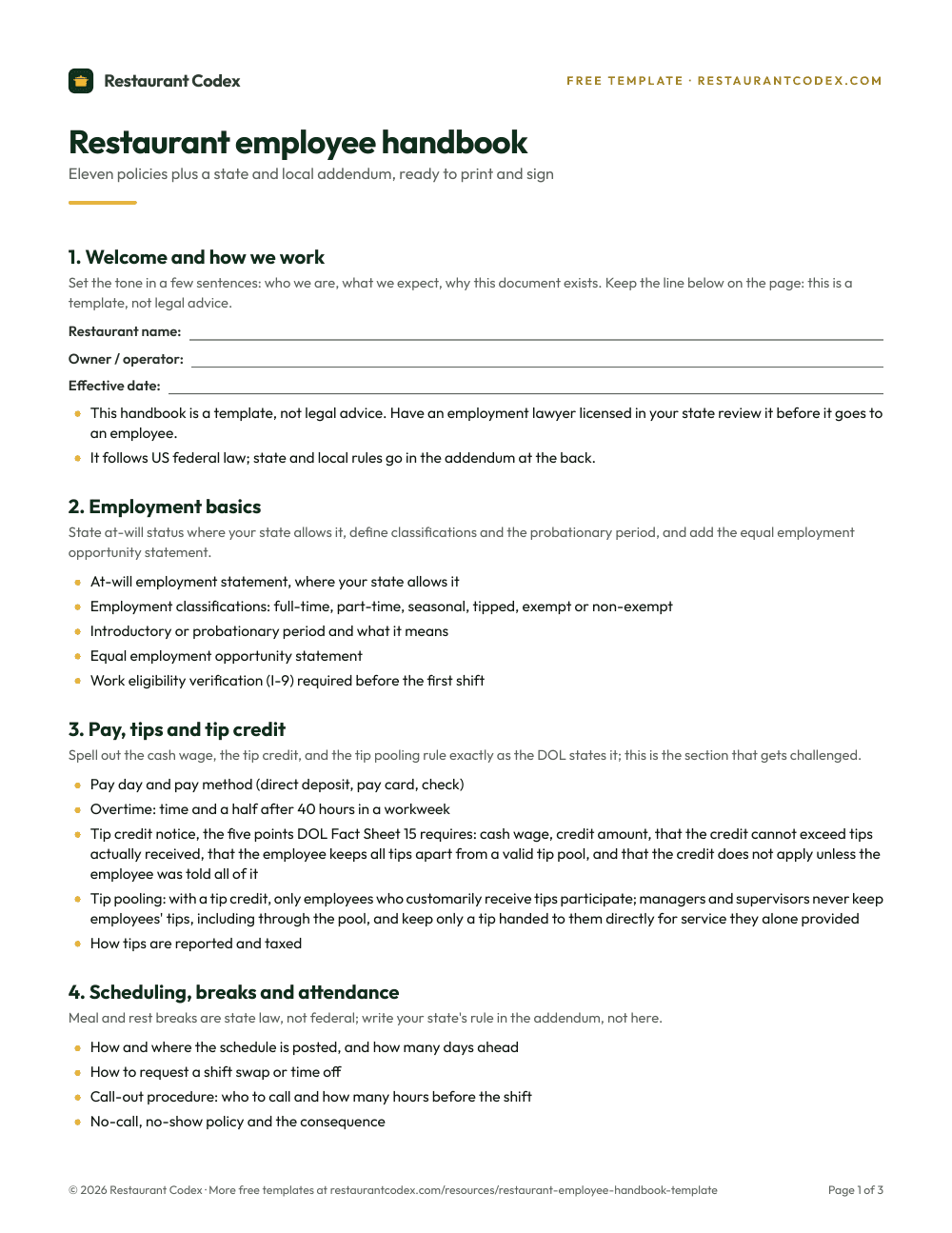
Eleven policies plus a state and local addendum, ready to print and sign · 12 sections
What's in it, and how it actually gets used
The sections run in the order a new hire needs them: welcome and how the restaurant works, employment basics, pay and tips, scheduling and attendance, conduct and appearance, food safety, safety and incidents, guest service, alcohol service, discipline, and an acknowledgment page. A twelfth section, the addendum, is where your state's rules live.
The owner or GM fills the front fields first: restaurant name, owner or operator, effective date. That date matters. Every copy you hand out from that point forward carries it, so when you update a policy next year, the new date settles which version is current.
Employment basics, at minimum, should cover the four things SHRM lists as the floor for any handbook: a disclaimer that it isn't an employment contract, an at-will statement where your state allows it, an equal employment opportunity statement, and a process for the ADA's interactive accommodation conversation. Skip one and the handbook has a hole in it.
Roll it out in one sitting, not a silent handoff. A new hire reads it on day one, before their first shift, and a manager walks the room through it out loud, section by section, the way you'd run a pre-shift meeting: five minutes on pay and tips, five on food safety, a minute on where to report a problem. The employee signs only the acknowledgment page at the back, not the whole document, and that signed page goes in the personnel file. It's the page that matters in a dispute, because it's proof someone got the handbook, not proof one exists. If any part of your crew works better in Spanish, hand out the Spanish edition alongside the English one, same content, same acknowledgment page.
What federal law actually requires here
Three federal rules touch a restaurant handbook directly, and most generic templates either skip them or wave at them with "insert your state law."
If you pay a tipped employee less than minimum wage and count tips toward the difference, the FLSA caps the credit: a federal cash wage floor of $2.13 an hour, a maximum tip credit of $5.12, against a $7.25 federal minimum wage. Before you take that credit, DOL Fact Sheet 15 says you have to inform the employee of five things: the cash wage you're paying, the credit amount you're claiming, that the credit can't exceed the tips actually received, that the employee keeps all their tips apart from a valid pool limited to employees who customarily and regularly receive tips, and that the credit doesn't apply unless they've been told all of it. Print those five in the handbook, get a signature, and you have your proof. The same fact sheet is explicit on pooling: managers and supervisors may not keep employees' tips, including through a pool. The one tip a manager does keep is the one a customer hands them directly for service the manager alone provided. That distinction is what operators get wrong most often.
On harassment, the EEOC's standard is zero tolerance backed by a real process: a written policy, a way to report that doesn't require going through the harasser's own chain of command, and manager training on how to respond. A one-line "we don't tolerate harassment" clause without a reporting path doesn't meet that bar.
On food safety, the FDA Food Code's employee health provisions require food employees to report certain symptoms and diagnoses to the person in charge before or during a shift, vomiting, diarrhea, jaundice, sore throat with fever, confirmed diagnosis with certain pathogens, and set out when that employee has to be excluded or restricted from the job. That's the same code your health inspector was trained on.
One more federal number worth knowing: FMLA only applies once you have 50 or more employees within 75 miles of a location (DOL Fact Sheet 28). Below that, say so plainly instead of copying FMLA language that doesn't apply yet.
The part every free template skips: your state
Minimum wage, tip credit, paid sick leave, meal and rest break timing, and predictive or fair workweek scheduling rules are set state by state, sometimes city by city, and federal law is silent on most of them. Meal and rest breaks specifically are state law, not federal, per the Department of Labor's own state-by-state breakdown. That's exactly the part every generic template hands back to you as "insert your own," which is why this one has a dedicated addendum page instead of burying state rules in the main body.
Filling it in takes one sitting at your state labor department's website: minimum wage and tip credit rules, whether paid sick leave is mandated and how it accrues, whether meal and rest breaks are required and at what shift length, and whether your city has a predictive scheduling ordinance, several large cities now do. Write the rule in your own words in the "our rule" column, and put the state agency page in the "source" column so a manager with a question can go straight to it.
Keep it current
Put a version number and date on the cover of every handbook you print, and review the whole document at least once a year, and not just when a law changes and someone complains. Minimum wage and paid sick leave rules mostly move on January 1st; a spring review catches nothing that changed three months earlier. When you update it, collect a fresh signed acknowledgment from every employee, not just new hires. An old signature on an old version doesn't cover a new policy.
Where restaurants get this wrong
Copying a chain's handbook off the internet. It's written for a different state footprint, a different benefits structure, and a legal team you don't have. Policies that don't apply to your restaurant are worse than no policy; they're evidence you didn't read what you handed out.
No Spanish version. Handing an English-only handbook to a partly Spanish-speaking crew and calling it distributed is the most common gap across the competing templates we checked. If someone didn't understand what they signed, the signature is close to worthless.
No signed acknowledgment on file. The handbook can be flawless and still do nothing in a dispute if there's no proof a specific person received it on a specific date. That one page is worth more than the other eleven combined.
Policies nobody enforces. A dress code ignored every Friday night, a phone policy only cited when someone's already in trouble, a harassment line nobody's used because nobody knows it exists. A policy you don't enforce is worse than not having one; it tells a court you had a rule and chose not to apply it.
Tip pooling that violates the DOL rule. Managers dipping into the pool, even on a night they personally worked the floor, is common, expensive, and a clean violation of DOL Fact Sheet 15. It turns into a claim covering every tipped employee at once.
Running one handbook across several locations
With more than one location, write one group handbook and one addendum per state, or per city where the rules genuinely differ. The core sections should read the same at every store: the same pay-and-tips language, the same harassment reporting path, the same food safety standard. What changes store to store is the addendum page and the acknowledgment file behind it. Keep one signed acknowledgment on file per person, per version, per location, so an ops director auditing five or fifteen stores can see in thirty seconds whether every employee at that address has signed the current version.
How Restaurant Codex does this
Restaurant Codex keeps the handbook and its addendum attached to each location's profile, sends the acknowledgment page for a real signature and timestamp instead of a paper form that can go missing, and flags any employee whose signature is against an old version the moment you publish a new one. An owner checking in from another state can see, across every location, who's actually signed the current handbook and who hasn't, instead of trusting that a manager handled it.
Restaurant Codex
The same checklist, on every phone, with photo proof
Restaurant Codex runs this template as a live task with timestamps, photos and one view across every location. Bring it to a 30-minute working session and we'll set it up on your real operation.
Restaurant employee handbook
Eleven policies plus a state and local addendum, ready to print and sign · 12 sections
By the Restaurant Codex team
Written with operators who run multi-location restaurant groups. Reviewed against the FDA Food Code and the sources listed below.