Most training manuals are sixty pages nobody opens
Line cooks don't read PDFs mid-shift. Neither does a server three weeks in, standing at the pass with a ticket in hand and a question that needs an answer in the next ten seconds, not after they track down a binder in the office. A sixty-page manual with a laminated cover and a table of contents looks thorough right up until someone needs it during service and can't find the answer fast enough for it to matter. A document nobody opens on shift isn't a training manual. It's a paperweight with a table of contents.
A manual that actually gets read looks different in four ways. It's split by role, so a server never wades through dish-machine chemical ratios to find the section on running food. It's one page per topic, short enough to read standing up between tickets. It puts a photo next to the standard instead of a paragraph describing one, so "plate it clean" comes with a picture of what clean means on this menu. And it lives on the phone the line already carries, not in a binder that stays in the office because bringing it onto the floor feels wrong.
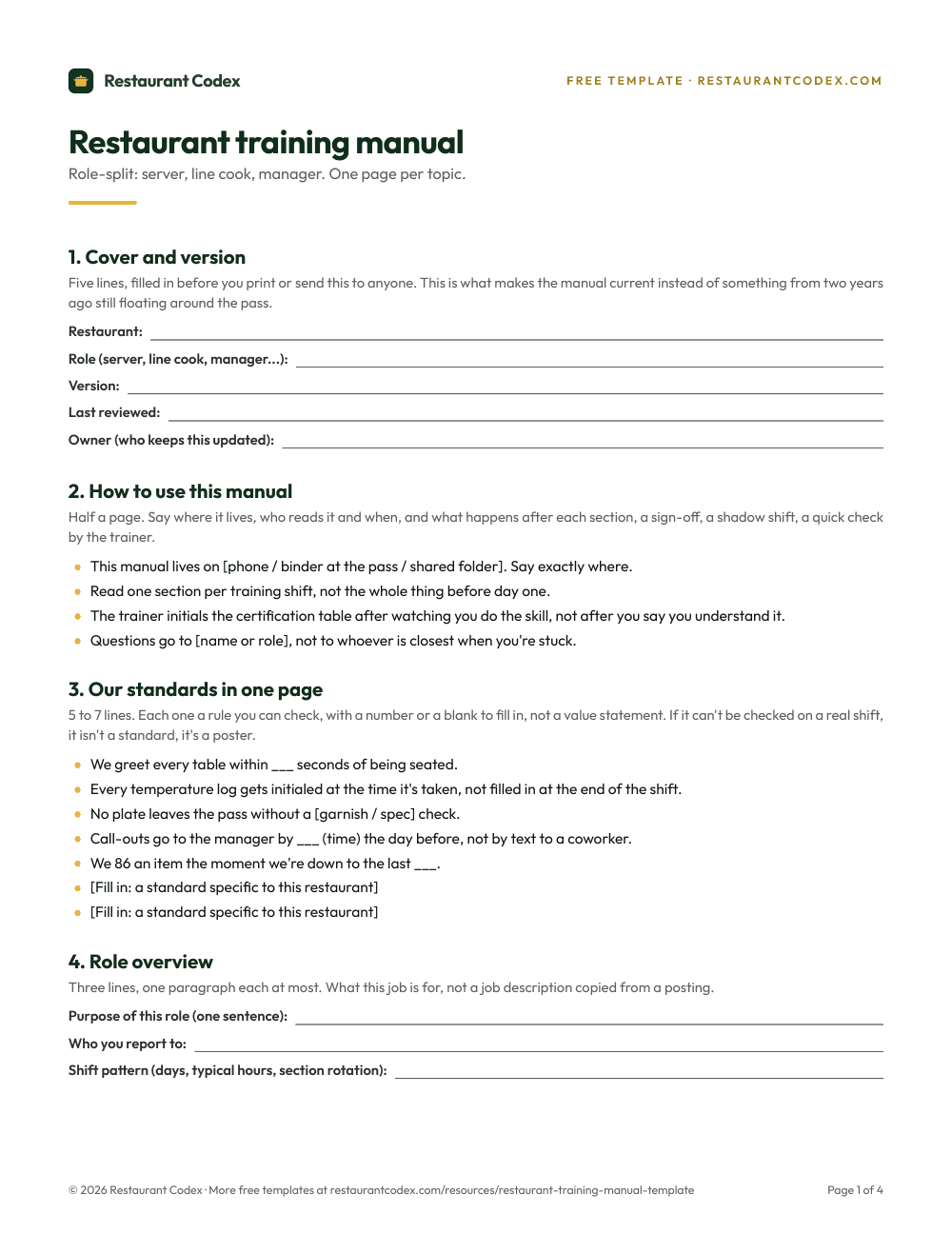
Restaurant training manual
Role-split: server, line cook, manager. One page per topic. · 12 sections
What's in the download and how you use it on a real shift
This is a template, not a finished manual. You supply the content, the twelve sections give you the shape and tell you what goes where and roughly how long each part should run.
Cover and version sit up top: restaurant, role, version number, last reviewed date, who owns it. That's not paperwork for its own sake. When a cook asks whether the braise recipe changed, "check the version number" answers faster than "let me go find the chef." Role overview follows, one sentence on what the job is actually for, who the person reports to, what the shift pattern looks like. Then the sections that carry the real weight: station setup as an eight-row table of what lives where and the par for each item, a ten-row steps-of-service or line-procedure table with the step, what good looks like, and the miss you'll actually see, food safety essentials, an allergen protocol, an eight-dish menu knowledge table, opening and closing tasks, and a certification table signed off skill by skill as it's checked, not all at once at the end of week one.
A trainer fills the content before a new hire's first shift. That's a few hours of work once, then small updates as things change. The new hire reads one section per training shift, and the trainer initials the certification table after watching the skill happen, not after a nod.
How to write a procedure that actually holds up
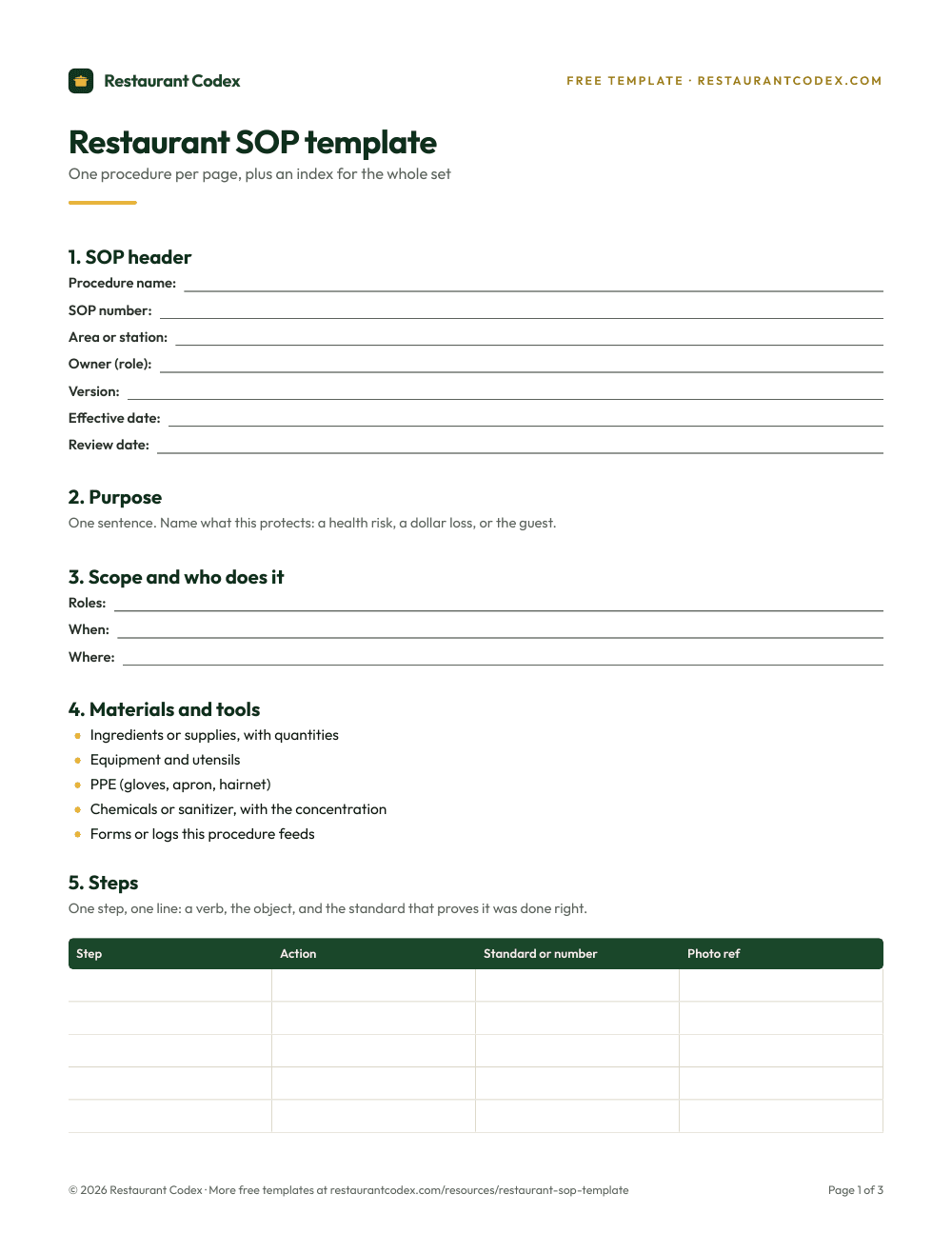
Most procedures fail for the same reason: they describe the action and stop there. "Check the walk-in temperature" tells someone what to do and nothing about what counts as right or why it matters. Three parts make a procedure someone follows past their first week: the action, the standard, and the why.
Action: check the walk-in at open and close. Standard: 41°F (5°C) or below, log the reading instead of estimating it. Why: above that line, the bacteria that cause foodborne illness multiply fast enough to matter within hours, and an inspector who finds an unlogged walk-in assumes it's never checked, not that it's checked and just unwritten.
Skip the why and you get someone who checks the temperature because they were told to, and stops the first day nobody's watching. Include it, and the same person checks it because they understand what it protects. That's the gap between a rule and a habit that survives a slammed Friday.
What goes in the manual, the SOP library, and the training plan
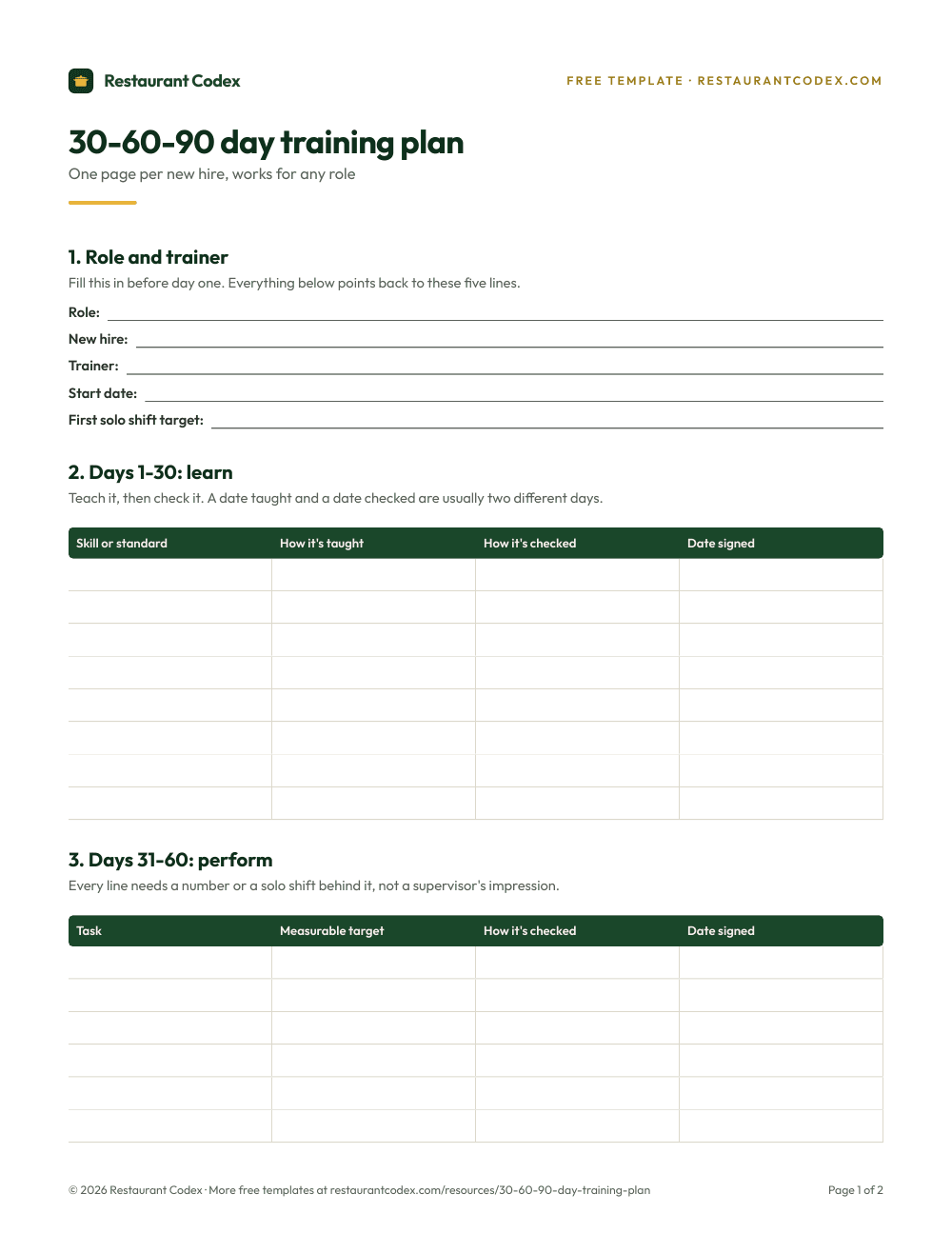
These are three different documents, and mixing them up is exactly how manuals turn into hundred-page catalogs nobody finishes. The training manual teaches: a reference read role by role, with the reasoning included, meant for a single start-to-finish pass and then occasional lookups. The SOP library is the opposite, single-topic, no explanation, the exact steps for one procedure posted at the point of use and checked against mid-shift, not studied in advance. The 30-60-90 day training plan is the schedule that ties them together: which manual sections and which SOPs land on which day, with a checkpoint and a sign-off at each stage.
Write a procedure once, with the why, in the manual, and let the SOP library carry the short version people glance at mid-shift. Copy it word for word into both places and the first edit to one version quietly breaks the other.
Keeping a training manual current
A manual that's accurate the day it's printed and wrong six months later is worse than no manual, because new hires trust it. Three things keep it honest: a version log recording every change with a date and who made it, one named owner, a chef, a GM, a training lead, not "whoever has time," and a rule that the manual gets reviewed every time the menu changes, not on a quarterly calendar that quietly drifts. A menu change that adds an allergen or drops a dish, with nobody updating the manual, is how a server tells a guest with a tree nut allergy that a dish is safe two months after it stopped being true.
Running one manual across more than one location
Multi-unit works best as a group manual plus a local page, not one document per store and not one rigid document with no room for a location's reality. HQ owns the standards: the recipes, the food safety numbers, the sign-off structure, the version log, identical across every location, so a trained server can move between stores without relearning the job from scratch. Each GM owns a short local page: the walk-in's actual layout, which vendor delivers on Tuesdays, the manager on duty's cell number, the details true at this address and nowhere else.
And if the line speaks Spanish, which it does in a lot of US kitchens, the manual needs a real Spanish edition, written for that kitchen, not translated once and filed away. Roughly 28% of the US restaurant workforce is Hispanic, up from 22% in 2010, per National Restaurant Association data. A manual only one bilingual manager can read isn't training the kitchen. It's training that manager to translate out loud, shift after shift, forever.
Where training manuals fall apart
Writing it once and never touching it again. A manual finished the week the restaurant opened and never opened itself again is the most common failure here, by a wide margin.
Starting from HR boilerplate instead of the actual job. A generic chapter on "teamwork" doesn't tell a line cook where the fish knife lives or what a medium steak looks like on this menu. Boilerplate belongs in the employee handbook; the training manual belongs to the job in front of the person reading it.
No photos. "Plate it clean" means nothing without a picture of clean. Every station setup and finished dish in this template earns a photo next to the standard, not a paragraph describing one.
No sign-offs. A manual with no certification table is a manual nobody can prove anyone read, which is exactly the question a health inspector or an insurance adjuster asks after something goes wrong.
English-only in a kitchen that runs mostly in Spanish. A manual that exists only in English isn't training a meaningful share of the people who need it. It's training whoever happens to translate it for them, on the fly, under pressure, with no guarantee they get it right.
How Restaurant Codex does this
Restaurant Codex keeps the manual, the SOP library, and the sign-off record in one place instead of three, so a certification table updates the moment a trainer checks a box on their phone, and an owner can see which stations at which locations still have gaps without asking every GM for a status update. It doesn't write the content for you. It just means the version that's live is the version people are actually reading.
Restaurant Codex
The same checklist, on every phone, with photo proof
Restaurant Codex runs this template as a live task with timestamps, photos and one view across every location. Bring it to a 30-minute working session and we'll set it up on your real operation.
Restaurant training manual
Role-split: server, line cook, manager. One page per topic. · 12 sections
By the Restaurant Codex team
Written with operators who run multi-location restaurant groups. Reviewed against the FDA Food Code and the sources listed below.
Sources
- FDA Food Code, cold holding at 41°F (5°C) or below, hot holding at 135°F (57°C) or above, and date marking for ready-to-eat food
- CDC, Clean Hands: handwashing steps and duration (at least 20 seconds)
- FDA, FASTER Act: sesame as the 9th major food allergen (effective January 1, 2023)
- National Restaurant Association, U.S. Restaurant Employee Demographics
- O*NET OnLine, Cooks, Restaurant (35-2014.00), Job Zone and preparation needed