"Cool it properly" is not a standard
A line cook tapes a note above the stock pot: "Cool soup down properly before storing." Six words, and every one is a guess. To the closer covering an unfamiliar shift, properly means the pot goes into the walk-in still steaming. To the sous chef who wrote the note, properly meant something else, but she's on a flight to Cancún. That's the gap between a house rule and a standard operating procedure. An SOP is one procedure with a standard in it: a verb, an object, a number that settles the argument. "Cool soup from 135°F to 70°F within 2 hours, then to 41°F or below within 4 more" is a standard. That's the FDA Food Code cooling rule, 6 hours end to end, in the words a cook uses.
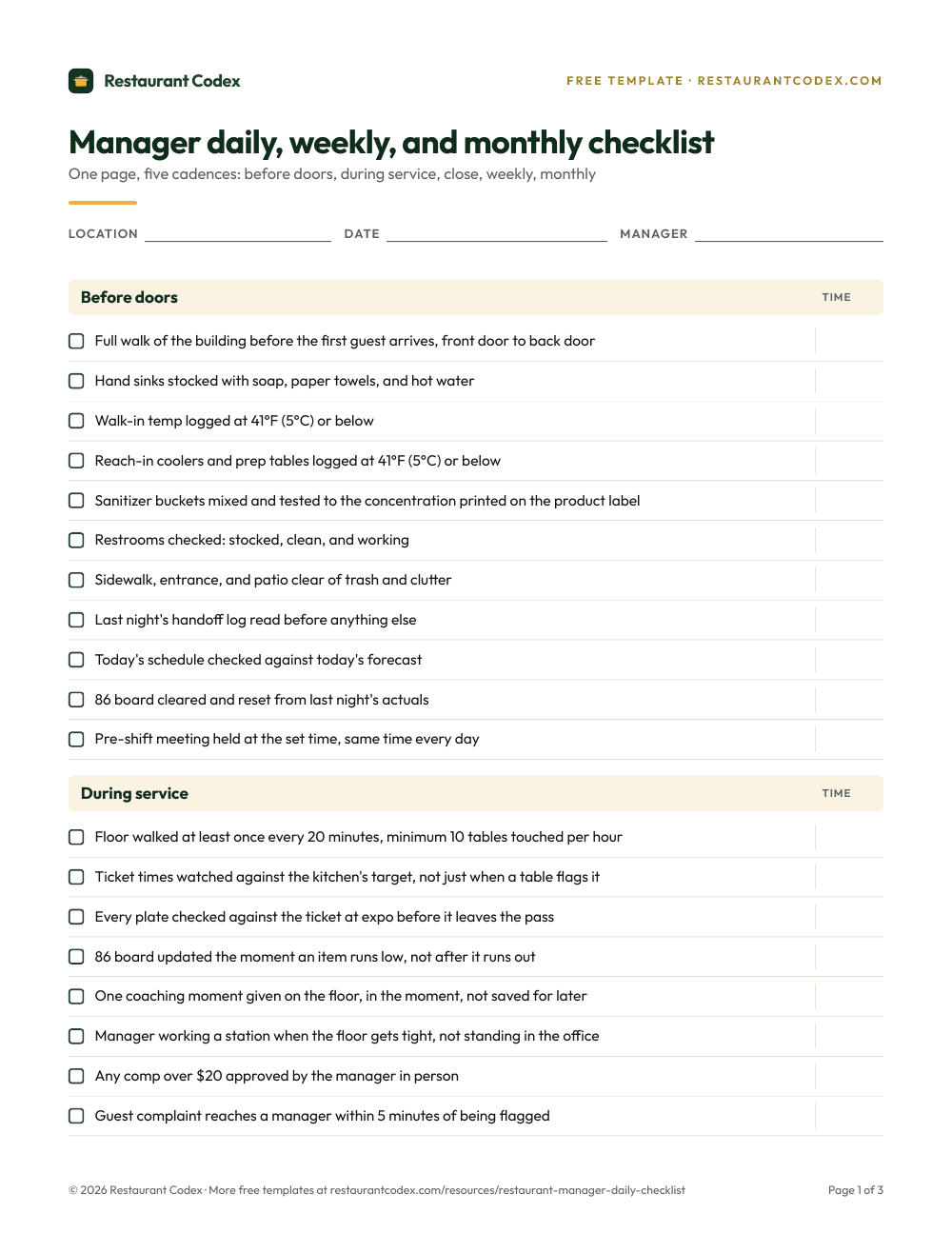
An SOP is not a checklist, and it's not the manual. The SOP is the standard itself, written once and revised the day something changes. The checklist is the daily proof the standard got followed today, initials next to a temperature at 6:45 this morning. The manual is the bound set of every SOP a restaurant runs, the shelf a new hire gets pointed at on day one. Skip the SOP and the checklist has nothing behind it; "check walk-in temp" never says what a pass looks like. Skip it and print the manual instead, and you get a binder nobody opens mid-rush.
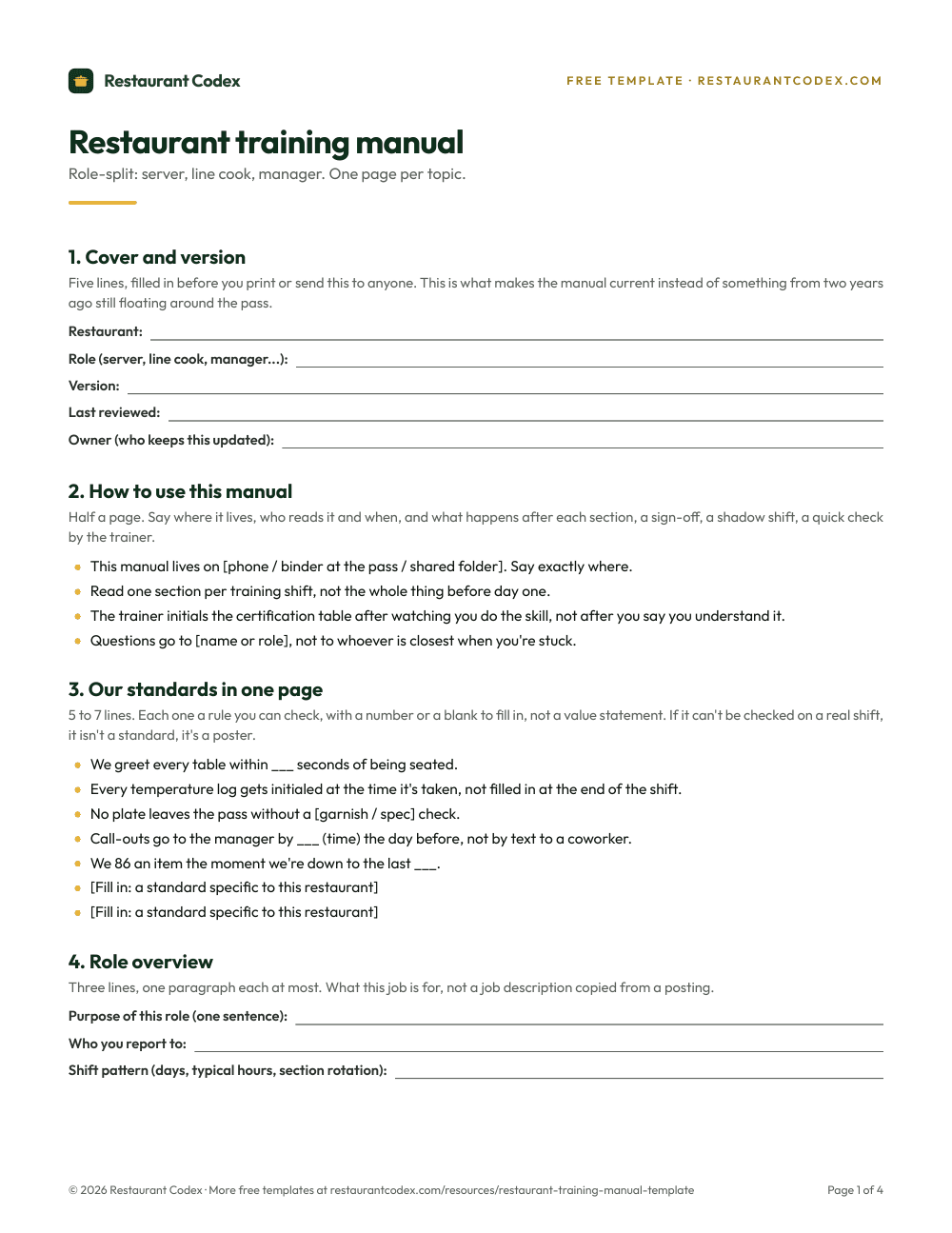
Restaurant SOP template
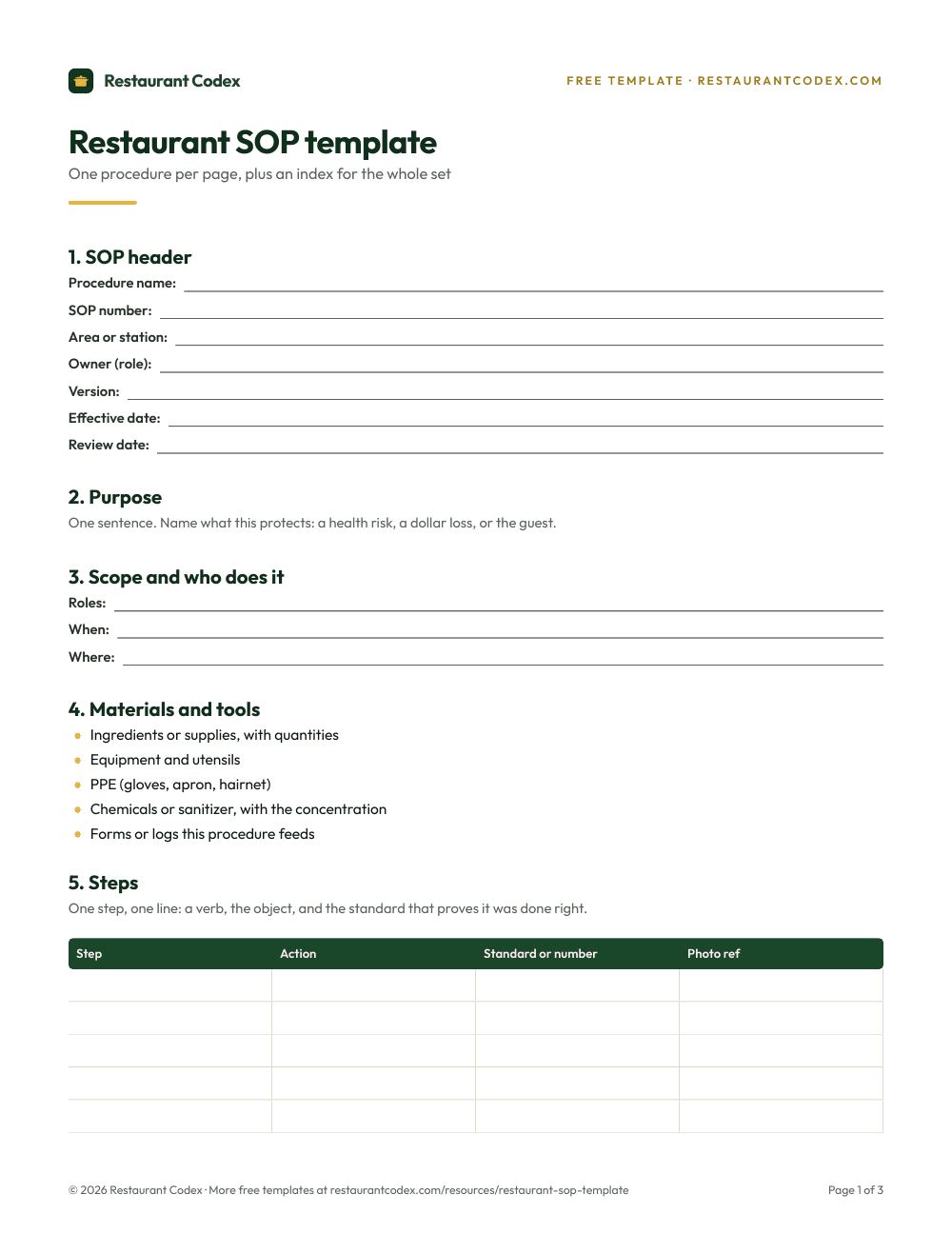
One procedure per page, plus an index for the whole set · 10 sections
What's on the page, and who actually touches it
The template is one page per procedure, not one binder for the whole restaurant. Whoever owns the task writes it: the kitchen manager drafts the dish room SOP, the GM drafts cash handling, written on a slow afternoon, not from memory the night before an inspection. The header does real work: procedure name and number, the station it governs, the owner, the version, the effective date, the review date. Purpose is one sentence naming what the SOP protects: a health risk, a dollar loss, or the guest. Scope says who does this, when, and where, so a new hire knows if closing covers the bar too.
Then materials, the steps table, critical control points, a table of common mistakes and fixes, a training sign-off, and a version log. The last page isn't a procedure at all. It's an index, every SOP numbered and grouped by area, so a manager can hand a new hire "read 100 through 108 before your first shift" instead of a stack of unordered paper.
Writing a step that actually means something
A step has three parts: a verb, an object, a standard. "Cool soup to 70°F within 2 hours, using an ice bath or shallow pans, not a covered pot in the walk-in" tells a cook what to do and how to know it's right. "Cool properly" tells them nothing. The steps table forces this one row at a time: step number, the action, the standard or number that proves it, and a photo reference. A picture of the ice bath set up right settles more arguments than a paragraph.
Critical control points pull two or three of those steps back out: where a miss is a health department writeup, where it's a dollar loss, where an auditor looks first. Cold holding at 41°F or below and hot holding at 135°F or above show up on almost every food SOP; the FDA Food Code sets them as the boundary between safe and not. The mistakes table names the failure next to the fix, not a vague warning: "sanitizer bucket refilled once at the start of the shift" next to "test strip every hour, refill when it reads under strength." Training and sign-off closes the loop a posted page can't: nobody runs the procedure solo until someone with the authority has watched and signed the line. On the food safety SOPs it helps if that trainer holds ServSafe Manager, the National Restaurant Association certificate ANAB accredits.
The 20 SOPs to write first
A restaurant with no SOPs doesn't need forty on day one. It needs these twenty: four for the daily rhythm, six for food safety, four for cash, two for the guest, four for the day something breaks.
| SOP | Why it's first |
|---|---|
| Kitchen opening | Same starting point at every station |
| Kitchen closing | The line tomorrow's opener has to trust |
| Receiving a delivery | Stops a bad case at the door |
| Line check | Catches the problem before the first ticket |
| Cooling cooked food | 135°F to 70°F in 2 hours, 41°F by hour 6 |
| Reheating for hot holding | 165°F, the backstop for a slow cool |
| Date marking and rotation | 41°F or below, 7 days, prep day is day 1 |
| Allergen order handling | One sequence keeps the plate clean |
| Handwashing | 20 seconds, the first thing dropped when busy |
| Dish machine setup and test | An untested machine is a plate from an outbreak |
| Cash drawer count | Every count matches, or someone says why |
| Comp and void approval | Turns a favor into a number |
| Guest refund | One process, the same answer every time |
| Nightly deposit | Counted twice before it leaves the building |
| 86 an item | Off the board before the next ticket prints |
| Guest complaint recovery | What a server does before it's a review |
| Employee injury report | Protects the employee first, the business second |
| Trash and grease pickup | The pickup you schedule, not the one you get |
| Pest sighting response | One sighting handled wrong becomes a closure |
| Walk-in breakdown response | The plan for when everything else stops |
Keeping an SOP alive
A binder is not evidence anything is alive. The review date is why that row exists: pick one, six months out is reasonable for food safety, and put a name next to it. When it arrives, someone reads the SOP against how the kitchen runs now, not how it ran when it was written. The version log is the paper trail: every change gets a date, a line and a name, so a manager knows in five seconds whether a posted copy is current. Photos do more work here than most operators credit them for. "Portion into shallow pans" is still an opinion. "Fill to the line in the photo, no deeper" is a standard a cook can check at a glance.
Running the same numbers across every kitchen
A multi-location operator needs two kinds of SOP. A group SOP is the same everywhere: the cooling curve, the allergen sequence, the sanitizer concentration, anything with a number a health inspector or a lawyer could hold the company to. A local SOP is a footnote a GM adds without touching the standard: which door the truck uses, who to call for trash pickup, when the walk-in gets its deep clean. The number ties it together. SOP 104 means cooling everywhere, so a cook transferring from store 4 to store 9 already knows what that number is.
Where SOPs actually fail
Five mistakes show up constantly. The first is the paragraph: an SOP written like a memo that nobody can follow mid-rush, because following it means reading it twice first. The second is no standard on the line. "Clean thoroughly" and "check for freshness" are opinions, not steps; a real step has a number or a pass-fail test attached. The third is the binder in the office, drawers away from the station it governs; a cook who has to leave the line to check a procedure stops checking it. The fourth is one person writing all of them, then leaving; six weeks later nobody can find the source file. The fifth is the SOP nobody reviewed after the menu changed. A cooling procedure written for chili doesn't cover a sous vide item, but the laminated sheet still says chili.
How Restaurant Codex handles this
On paper, an SOP is only as alive as its review date and version log, and both depend on someone remembering to check. Restaurant Codex keeps the same structure in a knowledge base: a photo attached to the step it illustrates, a review date that actually reminds someone, and one place to see which stores are still running version 1 of a procedure that's on version 3 elsewhere. None of that replaces a well-written step. It just keeps one from going stale.
Restaurant Codex
The same checklist, on every phone, with photo proof
Restaurant Codex runs this template as a live task with timestamps, photos and one view across every location. Bring it to a 30-minute working session and we'll set it up on your real operation.
Restaurant SOP template
One procedure per page, plus an index for the whole set · 10 sections
By the Restaurant Codex team
Written with operators who run multi-location restaurant groups. Reviewed against the FDA Food Code and the sources listed below.
Sources
- FDA Food Code 2022, Chapter 3: cooling (3-501.14), reheating for hot holding (3-403.11), hot and cold holding (3-501.16), date marking (3-501.17)
- FDA Food Code 2022, Chapter 2: handwashing procedure and timing (2-301.12)
- ServSafe Manager Certification, ANAB-accredited under Conference for Food Protection standards, administered by the National Restaurant Association