An inspector who walks into your kitchen checks the hand sink, the walk-in and a sanitizer bucket before saying much more than hello. Whatever those three things look like on an ordinary Tuesday is close to your actual grade, no matter what got scrubbed the night before a scheduled visit.
How to run the audit
The download is one sheet, 53 lines across seven sections, with fields at the top for location, date, who audited, and a score: how many of 53 passed. Print it. Don't fill it in from memory after the walk; carry it down the line and mark each box as you check it, with a short note next to anything that fails.
Run it weekly, and rotate who holds the clipboard. A sous chef audits the GM's line one week. A manager from another store does it the next. The owner walks it in person once a quarter. The sheet lives wherever your shift paperwork already lives, a binder by the office or a shared folder, and it stays on file rather than getting tossed once the score comes back clean.
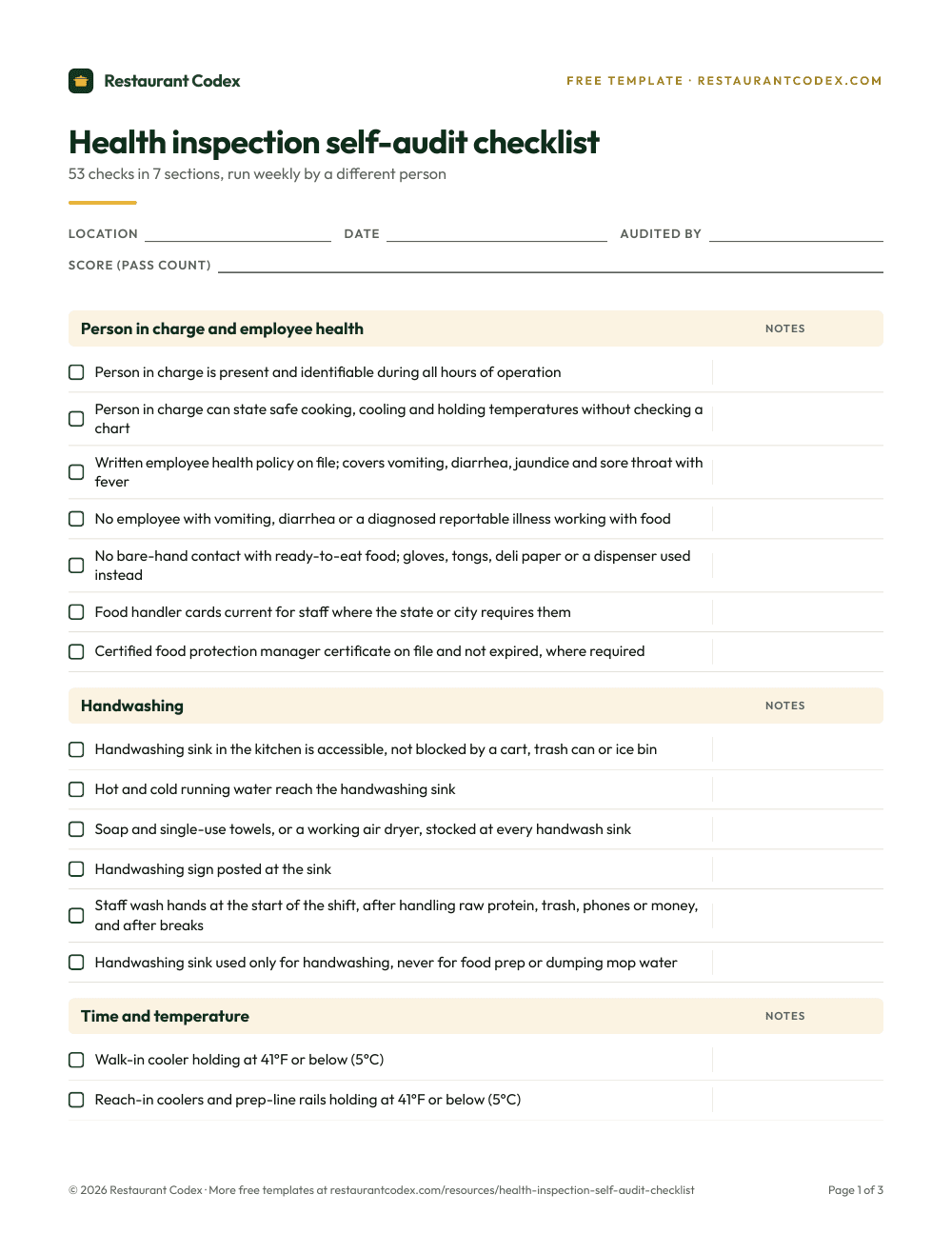
Health inspection self-audit checklist
53 checks in 7 sections, run weekly by a different person · 53 items
How inspections are actually scored
Every US health inspection runs off some version of the FDA Food Code, and the 2022 edition sorts violations into three tiers. Priority items are the ones most directly tied to making someone sick: cold holding, cooking temperature, an employee working sick. Priority foundation items support a priority item without being one on their own, like a working thermometer or sanitizer test strips on hand. Core items don't cause illness by themselves but point to a kitchen that isn't run tight: a stained ceiling tile, a burned-out light shield, a torn screen door.
Your local health department adopted that code on its own schedule and layered its own scoring on top. Georgia's health department didn't finish adopting the 2022 Food Code until February 2025, years after the edition was published federally, which is normal, not a delay unique to Georgia. Some cities hand out a letter grade for the window. Some post a numeric score online. Some just log pass or fail with a violation list and a re-inspection date. Don't assume the point values or grading scale from a video shot in a different state match yours. What stays constant almost everywhere: priority items cost more than core items, and a hand sink you can't reach is a priority-adjacent problem in any jurisdiction.
The first five minutes tell an inspector most of what they need to know. They find the hand sink and check it's stocked, unblocked and running hot water. They open the walk-in and read the thermometer, or pull one off their belt if yours is missing. They dip a test strip in whatever sanitizer bucket is sitting on the line. Three checks, thirty seconds, and they already have a read on the rest of the visit. Run your own audit in the same order: hand sink, walk-in, sanitizer bucket, before you look at anything else on the sheet.

What actually fails, and how to write it up
Run this audit across ten kitchens and the same five things fail more than everything else combined: a hand sink with a bus tub parked in front of it, a sauce container with no date on the lid, a reach-in running a few degrees warm because the door gets propped during a rush, a sanitizer bucket gone weak since nobody remixed it after lunch, and raw chicken stored above the salsa because the cooler is short on shelf space. None of these cost money to fix. They cost someone noticing.
That's what the notes column is for. A corrective-action note isn't the word "fixed." It says what was wrong, what you did about it right then, and what changes so it doesn't happen again: reach-in at 46°F, product moved to the walk-in on ice, service called, compressor fan found iced over. The last part is the one people skip. Skip it and the same reach-in fails again next month, and you've learned nothing from the first time.
Why the numbers are what they are
Time and temperature carries the most weight on the sheet for a reason: cold food above 41°F (5°C) or hot food below 135°F (57°C) sits in the exact range bacteria need to multiply, and it's the fastest route from a normal shift to a complaint. Poultry has to hit 165°F (74°C), ground meat 155°F (68°C), whole cuts and fish 145°F (63°C), because grinding or tenderizing meat can push surface bacteria into the middle of it, where a quick sear on the outside never reaches. Cooling gets its own two-stage rule: 135°F down to 70°F (57°C to 21°C) within two hours, then to 41°F (5°C) or below within four more, because a stockpot left to cool on a rack can sit in that danger range for most of a shift without anyone noticing until it's too late to matter. Date marking runs on the same logic from the other end: a container of cooked rice that's fine on day six can turn on day seven, and nobody can eyeball which day it is.
Cross-contamination and storage exist because a chicken cooked to 165°F doesn't help you if raw chicken juice already dripped onto tomorrow's prep on the shelf below. Cleaning and sanitizing catch the surface itself, not just what lands on the plate. Facilities and records are the two sections operators most often shrug off, and inspectors weight them differently than most owners expect: one chipped ceiling tile won't close you down, but a facility that's let ten small things slide usually has bigger ones underneath, and a missing pest control log is often what makes an inspector start checking everything else more closely.
Mistakes we see
A few patterns repeat across almost every group that runs a version of this.
Auditing only the week before the inspector is due. If the audit only happens under pressure, the sheet measures your cleanup crew, not your kitchen on a normal day.
The GM auditing their own store, every time. They already know where the reach-in runs warm and where not to look, which isn't dishonesty so much as blindness that builds up from working the same line every shift.
No score written down. A page of checked boxes with no number at the top can't be compared to last week, or to the store across town.
No photos attached to a failed item. A note that says "fixed" six months later, with nothing to point to, means nothing to the next person who reads it.
Fixing the problem without changing what caused it. Moving the reach-in's contents to the walk-in solves today's cold-holding problem. It doesn't tell you why the door kept getting propped open, or fix the SOP so the next person doesn't do the same thing.
Running this across more than one location
Past a couple of locations, standardize the sheet and the cadence: the same 53 items, the same weekly schedule, the same rotation rule, no store writing its own version. What each GM adapts is the walk order, since a cramped kitchen and a sprawling one don't move through the same path in the same amount of time.
Compare stores by score over time, not by a single week's number. One store losing two points a month for three months running is a pattern, not a bad week, and it's usually the same three or four lines repeating. That's the signal to look for: the same violation showing up on back-to-back audits at one location, or a score that drops and stays down instead of bouncing back the following week. When that happens, a district manager should visit in person rather than wait for the next scheduled check-in. The repeat is what matters, not the first miss.
Restaurant Codex runs this same audit digitally: a manager checks it off on a phone while walking the line, a photo attaches to anything that fails, and the timestamp is automatic instead of guessed at the end of a shift. Scores roll up across every location in one view, so a pattern across three stores shows up before a district manager has to go looking for it.
Restaurant Codex
The same checklist, on every phone, with photo proof
Restaurant Codex runs this template as a live task with timestamps, photos and one view across every location. Bring it to a 30-minute working session and we'll set it up on your real operation.
Health inspection self-audit checklist
53 checks in 7 sections, run weekly by a different person · 53 items
By the Restaurant Codex team
Written with operators who run multi-location restaurant groups. Reviewed against the FDA Food Code and the sources listed below.