What's in the schedule and how it runs on a shift
A restaurant can close spotless every night and still fail its health inspection, because "clean," "sanitized," and "looks fine" are three different things to the person holding the clipboard. Most citations live in that gap: a cutting board that looks fine but never touched sanitizer, a floor drain nobody's pulled in a month, a hood filter overdue for its professional cleaning because nobody put a date on it.
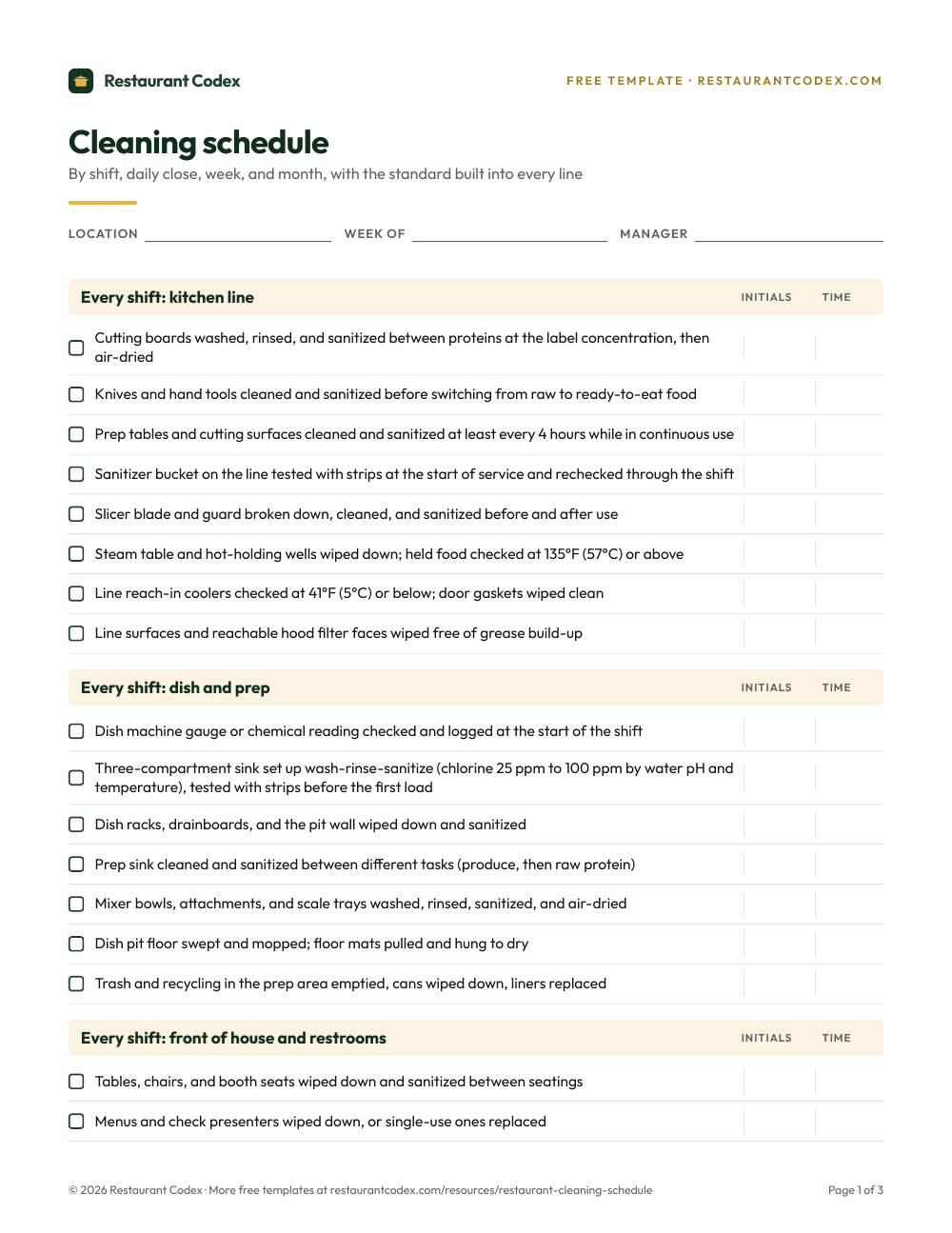
This schedule closes that gap. It's split by how often each task needs doing, every shift, daily close, weekly, monthly or quarterly, instead of one long list, and every line carries its own standard: the temperature, the ppm, whether it's "clean" or "clean and sanitize." Nobody has to guess at the number.
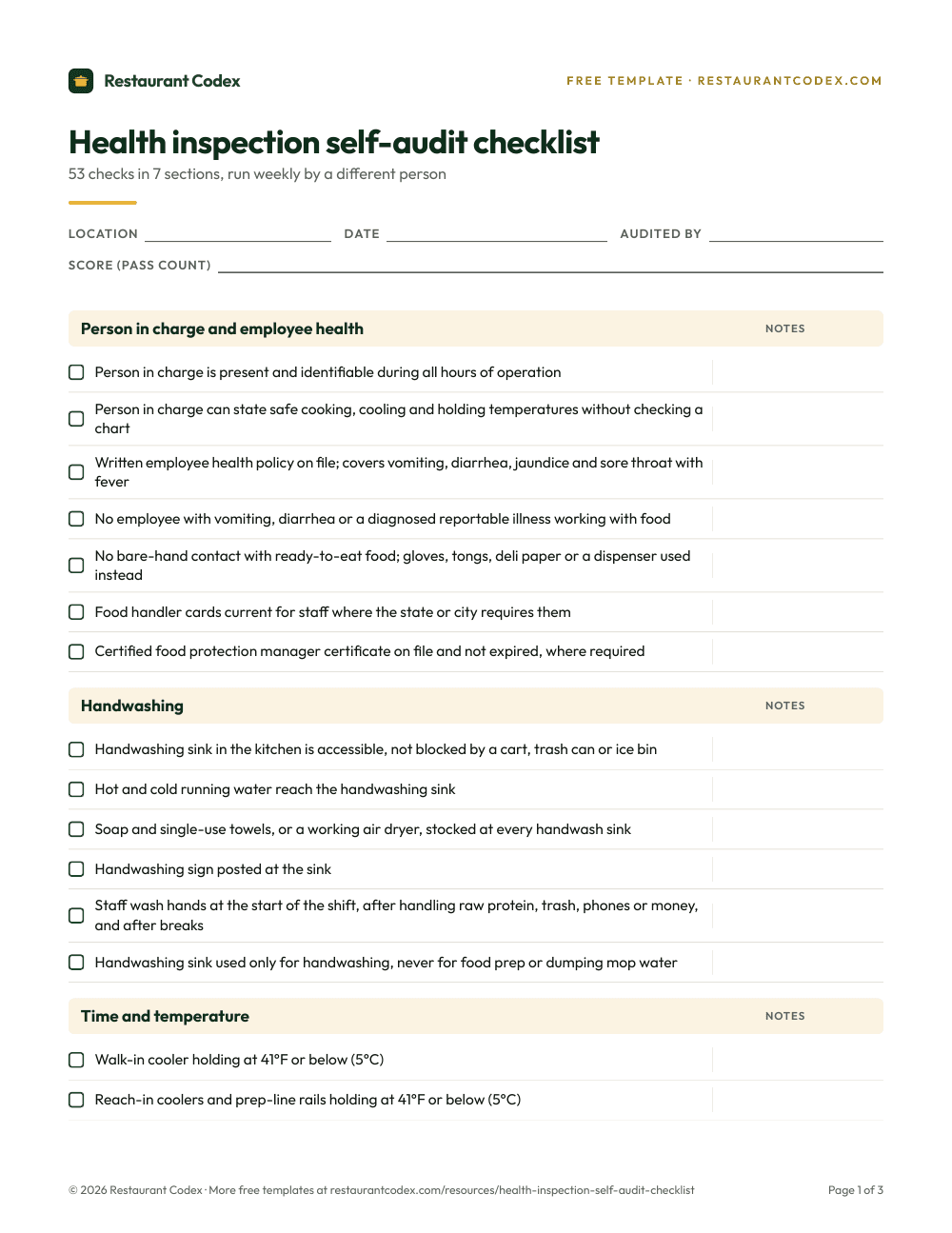
On a real shift it lives on a clipboard by the walk-in or on a tablet at the pass, and different people fill in different parts of it. The line cook wipes the flat-top at close and initials that section themselves. The prep cook does the same for the prep sink. The closing manager doesn't re-clean any of it; they walk the kitchen with the sheet at the end of the night, confirm the initials match what they can see and smell, and sign the bottom. That signature is what turns a checklist into a record, the kind you hand an inspector who asks how you know the kitchen is clean, not how you feel about it.
Cleaning schedule
By shift, daily close, week, and month, with the standard built into every line · 55 items
Clean, sanitized, and "looks fine"
"Clean" means the visible soil, food debris, or grease film is gone. "Sanitized" means a surface that's already clean has also been treated with a chemical or with heat that knocks the bacteria count down to a safe level, and that only works if the sanitizer sits on the surface for its contact time instead of getting wiped dry the second it's sprayed. "Looks fine" isn't either one. A stainless table can be wiped free of anything visible and still carry enough bacteria to make someone sick.
That's why the schedule separates "clean" tasks (sweep the floor, empty the trash, dust a light fixture) from "clean and sanitize" tasks (the cutting board, the prep table, anything that touches food), and why sanitizer strength gets checked with a paper test strip instead of trusted by smell. Chlorine solutions run in the 50 to 100 ppm range in most kitchens; the code allows anywhere from 25 to 100 ppm depending on the water's pH and temperature, which is why your strips and your sink's operating range should match. Quaternary ammonium ("quat") sanitizers don't have one fixed number in the code at all. The working concentration is whatever the product's own EPA-registered label says, which is why the label belongs on the wall next to the sink. Either way, a bucket nobody's tested since Tuesday is a bucket you're trusting on faith.
What actually drives the frequency
| What gets checked | Why it matters | The standard |
|---|---|---|
| Hand sinks | Blocked, or filled with ice and produce instead of used for hands | Accessible at all times, used for nothing else |
| Sanitizer strength | A bucket that "looks like" sanitizer can be plain water by hour six | Chlorine 25 ppm to 100 ppm depending on water pH and temperature; quat at the concentration on its label, both checked with strips |
| Food-contact surfaces | Bacteria on a board or table keeps multiplying between wipes | Cleaned and sanitized at least every 4 hours in continuous use, or every 24 hours if held at 41°F (5°C) or below |
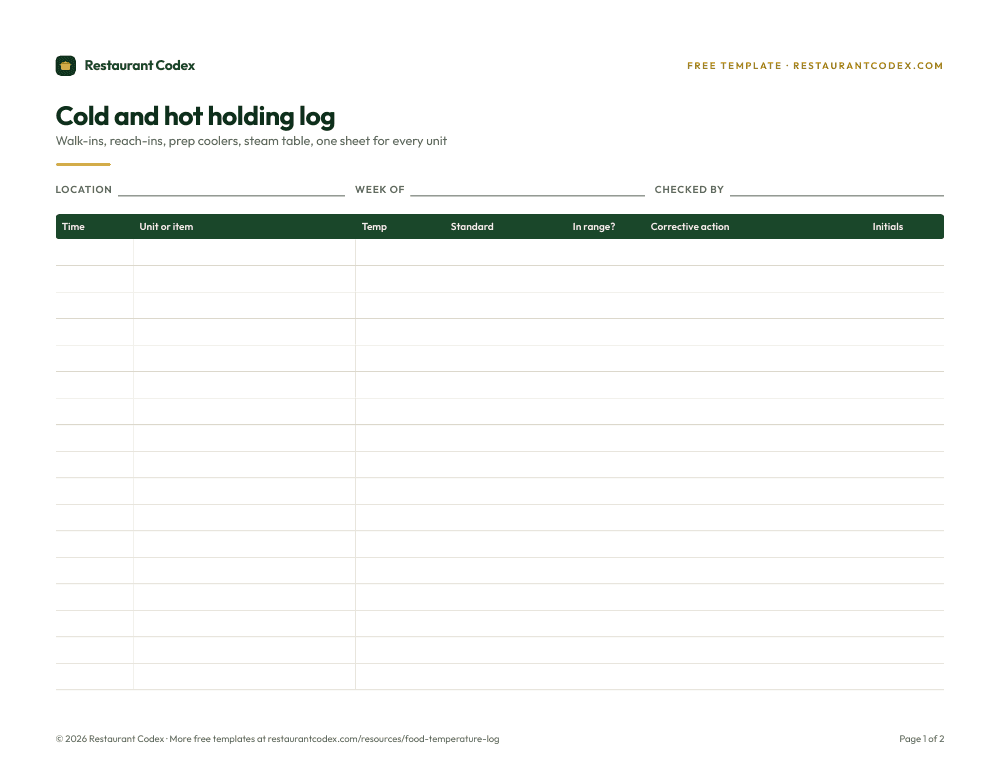
| Cooling equipment | A walk-in running warm turns a cleaning walk into a food-safety failure | Cold holding at 41°F (5°C) or below; hot holding at 135°F (57°C) or above |
| Floors and drains | Standing water and grease buildup are pest bait | Swept, mopped, and scrubbed on the schedule, not when someone notices a smell |
| Pest evidence | Droppings or gnaw marks near a drain can end a visit in minutes | Dated pest control visits with the technician's report on file |
The four-hour line is the one most operators are already half-following without knowing its name. Under the FDA Food Code, food-contact surfaces used with food that needs time and temperature control have to be cleaned and sanitized at least every four hours if they're sitting at room temperature between uses. Hold that same surface at 41°F (5°C) or below instead, an iced prep rail, for instance, and the code gives you until the next day. That's not an arbitrary split: the cold is doing part of the sanitizing work by slowing bacteria growth, so the surface needs the chemical step less often.
Assign it to a station, not to "everyone"
"Everyone's responsible for cleaning" means nobody is. The version of this schedule that survives a real Friday night has a station's name next to each section, not a hope that whoever's free will get to it. The line owns the line, every shift, not just at close. Dish owns the three-compartment sink and the floor around it. Prep owns their own sink and station. Someone specific owns the restrooms during service, checked on a walk-through partway through the shift, not just opened clean and left alone until close. Wherever a section doesn't have a name on it, that's the first place it slips.
The schedule only holds up if someone other than the person who did the task checks it. That's the manager's walkthrough: at close, they walk the kitchen with the sheet, not re-cleaning anything, just confirming the initials match reality, then signing the bottom themselves. A sheet full of initials nobody ever spot-checked is a sheet you're filling out for nobody.
Where this breaks down
One master list taped by the walk-in, covering the whole restaurant, is the most common way to kill a cleaning program. Thirty people can't find their one line inside eighty others, so nobody looks closely at any of it. Split it by station and shift, the way this template does.
No test strips on hand is the second failure. A sanitizer bucket that's never been checked with a strip is a guess dressed up as a procedure, and a bucket that "smells strong enough" is often nowhere near the working range.
Deep cleans that only live on a mental calendar are the third. The walk-in shelf strip-down, behind the line, the hood system. If it's not a dated line on the schedule with a name attached, it happens right before the health inspector calls to book a visit, not on any regular rhythm before that.
Nobody owning the restrooms during service is the fourth, and it's the one guests actually notice before anything in the kitchen. They get cleaned at open and close and ignored for the six hours in between, which is exactly when they get dirty.
Hood cleaning gets left to memory more than anything else on this list, because it's contracted out and easy to assume the contractor is tracking the date. NFPA 96 sets the actual frequency by cooking volume and fuel type, not one fixed number, but a schedule and a posted certificate are what an inspector or your insurer will ask for, and "we think it was sometime in spring" isn't either one.
Running this across more than one location
With one restaurant, the schedule lives on a clipboard and everyone knows what "clean" means around here. With five or fifteen locations, it can't stay tribal knowledge. HQ standardizes the core: the sections, the sanitizer numbers, the four-hour rule, the same restroom-check rhythm, so a manager transferring between stores isn't relearning the basics. Each GM adds what's local: the store with a wood-fired oven needs an ash and flue line the others don't, the one with a patio needs an outdoor section, the one sharing a strip-mall dumpster needs its own pest note. What HQ should be able to do without visiting is compare completed sheets across stores by week, because a location that quietly stops turning in full sheets is usually the same one about to have a bad inspection.
How Restaurant Codex handles this
Restaurant Codex runs the same structure on a phone instead of a clipboard: a manager taps each line instead of initialing it, a photo attaches to anything that needs proof (the hood certificate, the pest report), and the timestamp records itself instead of getting filled in from memory at night's end. HQ sees every location's week in one view instead of collecting clipboards store by store.
Restaurant Codex
The same checklist, on every phone, with photo proof
Restaurant Codex runs this template as a live task with timestamps, photos and one view across every location. Bring it to a 30-minute working session and we'll set it up on your real operation.
Cleaning schedule
By shift, daily close, week, and month, with the standard built into every line · 55 items
By the Restaurant Codex team
Written with operators who run multi-location restaurant groups. Reviewed against the FDA Food Code and the sources listed below.
Sources
- FDA Food Code 2022, § 3-501.16 Potentially Hazardous Food, Temperature Control (Cold and Hot Holding), as codified at Washington Administrative Code 246-215-03525
- FDA Food Code 2022, § 4-602.11 Cleaning Frequency of Equipment Food-Contact Surfaces and Utensils, as codified at WAC 246-215-04605
- FDA Food Code 2022, § 4-501.114 Manual and Mechanical Warewashing Equipment, Chemical Sanitization, as codified at WAC 246-215-04565
- FDA Food Code 2022, § 5-205.11 Using a Handwashing Sink, as codified at WAC 246-215-05270
- NFPA 96, Standard for Ventilation Control and Fire Protection of Commercial Cooking Operations, Ch. 12, as adopted in the Washington State Fire Code (WAC 51-54A-0606)