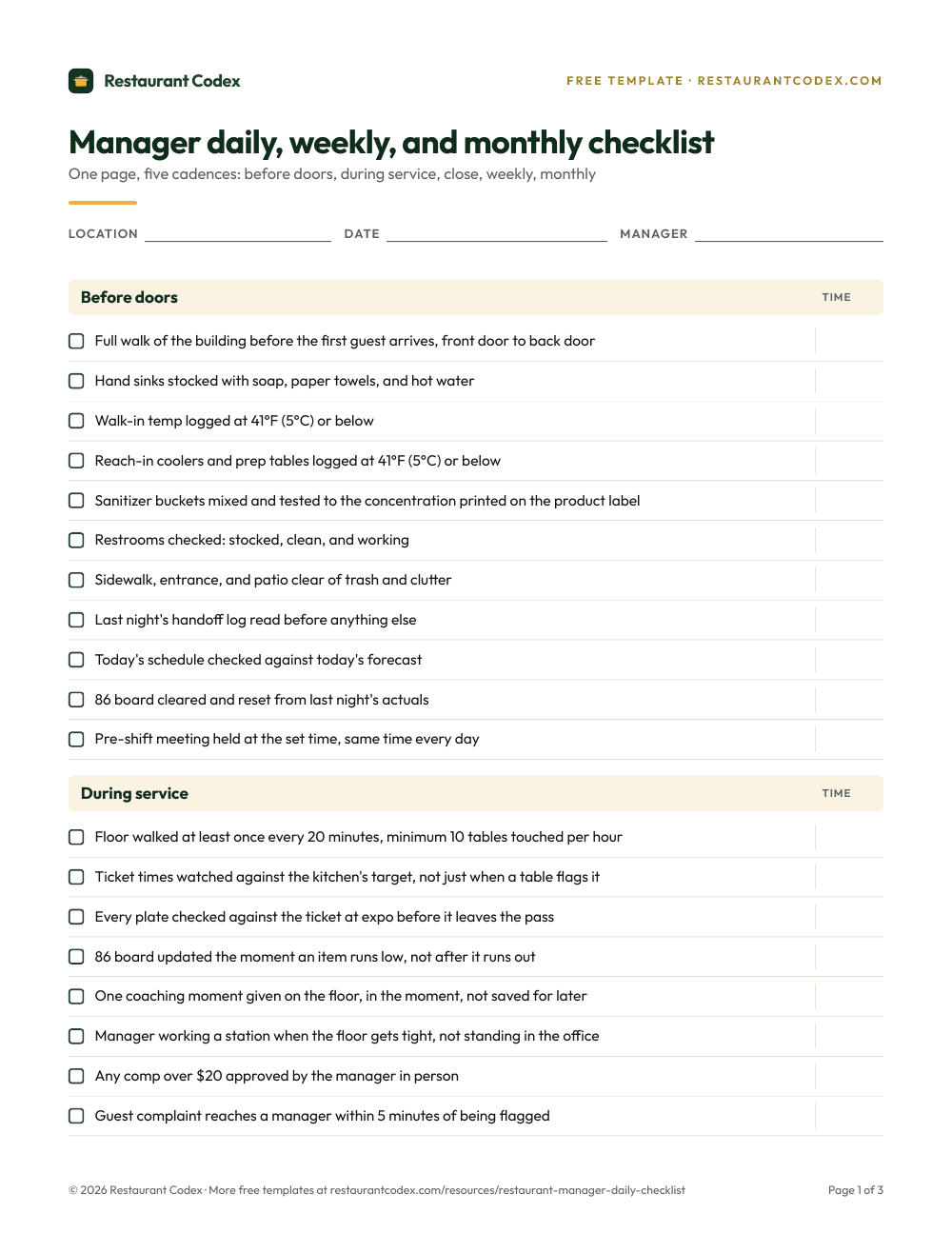
A cooler drifting to 52°F (11°C) overnight doesn't set off an alarm. It shows up as a case of thawed shrimp at 6am, or a health inspector's red mark three weeks later when nobody remembers what happened that night. A till that's $180 light doesn't announce itself either, not until the count is off three closes in a row and there's no signature trail to say who was on the drawer. The fix for both is the same unglamorous sheet: one page, filled out in real time, by the person actually doing the work.
What's on the sheet, and who actually touches it
The download below is one checklist built for a full-service shift, split into six blocks: opening back of house, opening front of house, a pre-service line check that both sides do together, closing front of house, closing back of house, and a manager close. Each line has three things next to it: a box to check, initials, and a time. That's on purpose. "Done" without a name and a clock is just a guess six weeks from now when you're trying to reconstruct a bad night.
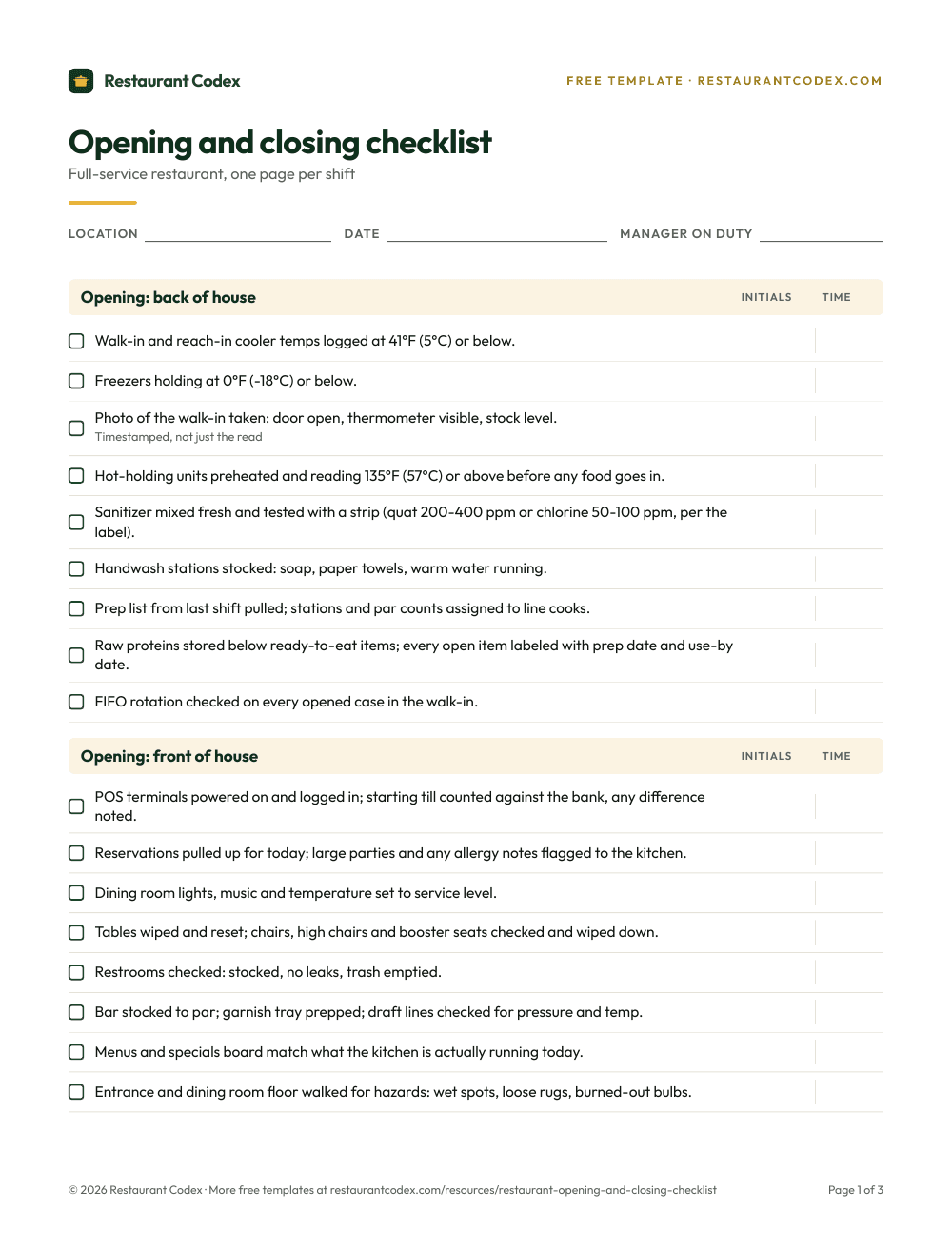
Opening and closing checklist
Full-service restaurant, one page per shift · 52 items
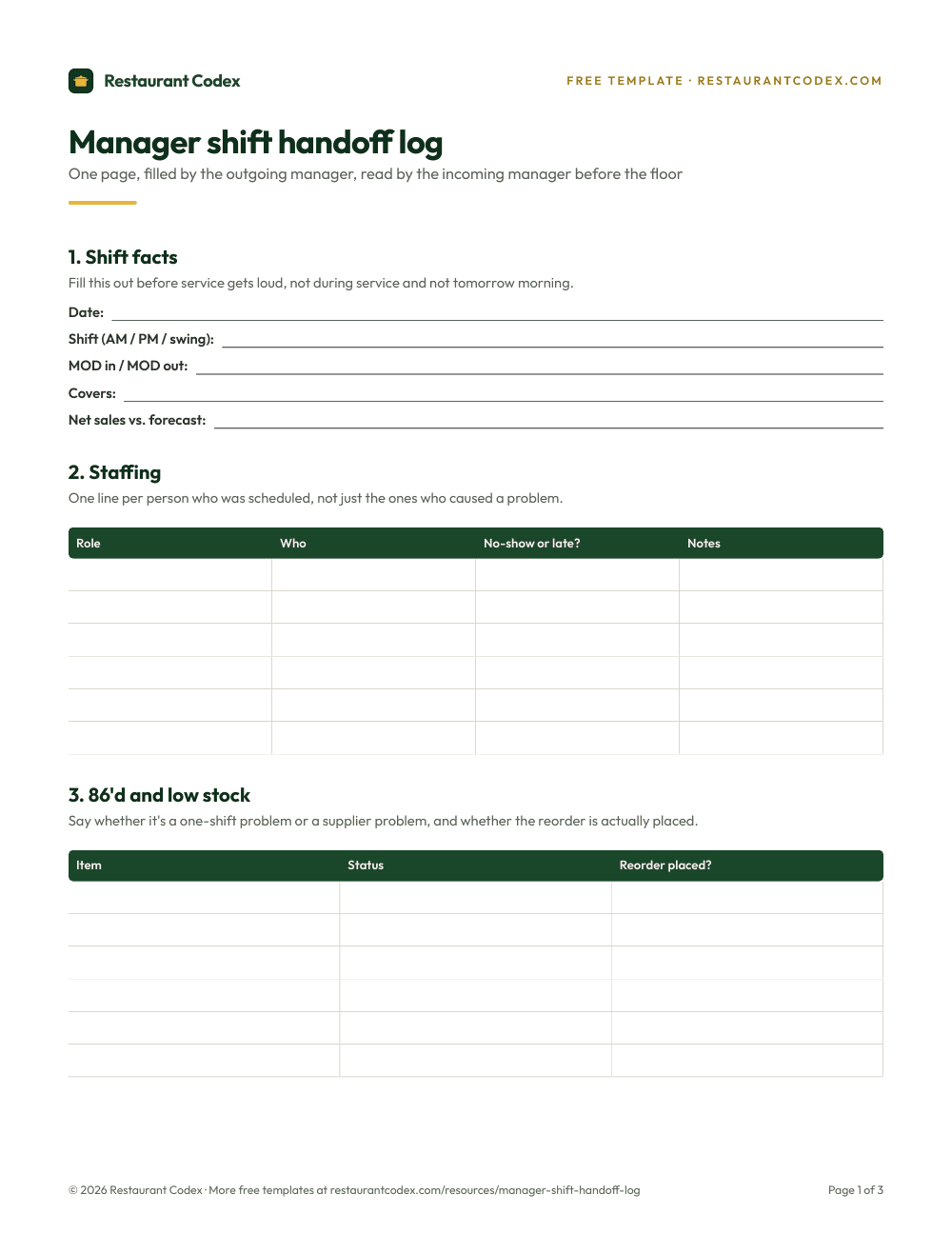
On a normal Tuesday, the opening cook initials the walk-in temperature line at 6:15am on the way to fire the first ticket, not after prep is done. The FOH opener signs off the dining room and bar lines around 10:30, an hour before doors. Pre-service gets initialed by whoever runs the line check, usually the chef or sous, right after the pre-shift meeting. At close, the manager owns the whole bottom half: cooling, the till, the building walk, and a signature on the header block before the sheet goes in the folder with the rest of the quarter. If you want a longer, narrative version of that end-of-shift handoff, the manager shift handoff log is built for that; this sheet stays short on purpose.
Why each line earns its place
Every item on this sheet exists because something specific goes wrong without it. Opening BOH starts with cooler and freezer temps because cold holding at 41°F (5°C) or below is the line between food that's fine and food that's a liability, and hot holding at 135°F (57°C) or above is the other side of the same rule (FDA Food Code, 2022). The walk-in photo isn't decoration. A timestamped picture of the door open and the thermometer reading is the difference between "we checked it" and proof you checked it, which matters if a health inspector ever asks for the last quarter of logs.
Sanitizer gets tested with a strip, not eyeballed, because a bucket that looks like water and a bucket that's actually at 200 ppm quat look identical. FOH opening covers the till count and the floor walk because both are cheaper to catch at 10am than to explain at 11pm. The pre-service block exists because a line cook's mise can pass a glance and still be short on an allergen swap nobody flagged, and since the FASTER Act made sesame the ninth major US allergen in 2023, that list is longer than most kitchens remember by habit. The line check catches it before the first ticket, not the first complaint.
Closing is where the money and the risk both concentrate. The two-stage cooling line, 135°F (57°C) down to 70°F (21°C) within two hours, then to 41°F (5°C) or below within the next four, exists because that's the window food has before it sits in a range where bacteria can multiply (FDA Food Code, 2022). Anything that misses the window gets thrown out, not saved for the freezer; the checklist forces that decision in the moment instead of leaving it to whoever opens the container next. The till gets counted twice, once against the POS batch and once as a physical count, with a second person watching both, because a shortage nobody can explain is a training problem if it's small and a theft problem if it's a pattern, and you can't tell which without a witness. Manager close is the one block nobody gets to skip: it reconciles the day, writes down what the opener needs to know, and puts a signature on the fact that someone actually looked.
Running this across more than one location
With two locations you can eyeball both closing sheets yourself. Past four or five, you can't, and that's where most single-location templates fall apart, because they assume one building and one owner reading the sheet. The way to run this across a group is to split ownership: HQ owns the header, the six section titles, the columns and the standards that don't change store to store, temperatures, sanitizer ppm, the two-person cash rule. Each GM adds a store-specific line or two under the section that needs it, a second walk-in, a patio close, a particular alarm code, whatever's local. What HQ should never let drift is the roughly 40 core lines that define "done" the same way at every store.
The other piece is comparing completion, not just content. A store that finishes its closing sheet in nine minutes flat, every night, for a month, is either extremely well-run or not actually checking anything, and the sheet alone won't tell you which. What you can see, once the sheets are consistent across stores, is which locations skip the same lines, and whether that's a training gap or a staffing one.
Mistakes that turn this into paperwork
The most common failure is the 11:59pm fill-in: a closing manager checks every box and signs every initial in the last five minutes before leaving, for a shift that actually ran four hours earlier. The times don't match reality and everyone on the team knows it, which teaches the whole staff that the sheet is theater. The fix isn't more supervision. It's initialing lines the moment you hit them, which is exactly why the sheet has a time column and not just a checkbox.
The second is one mega list covering an entire shift instead of six shorter ones tied to a role and a moment. Nobody finishes a 50-item list handed to them all at once at 5pm; they finish six 8-item lists handed to them at the point in the shift each one actually applies. Splitting the sections isn't cosmetic. It's the difference between a sheet that gets used and one that gets ignored by week two.
The third is no owner per line. A checklist that just says "close the bar" without saying whose job that is turns into three people assuming someone else did it, which is how a walk-in door gets left unlatched overnight. Every line needs a role attached to it, even when the role feels obvious to whoever wrote the template.
The fourth is skipping the walk-in photo because "we always check it anyway." That's true right up until the one night nobody does, and a photo with a timestamp is the only version of "we checked it" that holds up when someone's asking six weeks later, not six hours later.
How Restaurant Codex runs this
We built this same checklist as a live task inside Restaurant Codex instead of a paper sheet: each line gets a timestamp and, where it matters, a photo, the moment someone taps it done, and a GM or owner can see every location's open and close from one screen instead of walking into six different binders. The paper version works fine on its own. The app version just removes the 11:59pm fill-in as an option.
Restaurant Codex
The same checklist, on every phone, with photo proof
Restaurant Codex runs this template as a live task with timestamps, photos and one view across every location. Bring it to a 30-minute working session and we'll set it up on your real operation.
Opening and closing checklist
Full-service restaurant, one page per shift · 52 items
By the Restaurant Codex team
Written with operators who run multi-location restaurant groups. Reviewed against the FDA Food Code and the sources listed below.