The handoff that doesn't survive the first rush
Picture a Friday shift change. The outgoing manager tells the incoming one, standing in the doorway with her coat half on, four things at once: two servers called out, the walk-in compressor's been cycling strange all afternoon, table 12 got a comped round for a slow app, and somebody still needs to call the produce guy about the avocado shortage. That's four facts, said once, at 4:05pm, to someone who's also checking her phone and greeting the first table of the night. By 7:40, when the third ticket of the rush hits the pass, none of it survives. The compressor keeps cycling. Table 12's comp never makes it onto paper, so the P&L takes the hit with no story attached. Nobody calls the produce guy, and the avocados run out again Saturday.
The UK's Health and Safety Executive has spent decades on this exact failure mode in industries where a dropped detail kills people. Its shift handover guidance puts it flatly: many accidents have happened because communication failed at handover. A restaurant isn't a refinery. The fix HSE lands on is still the one that works behind a line, though: written down, not just said out loud, and read by the person receiving it before they touch anything else.
Manager shift handoff log
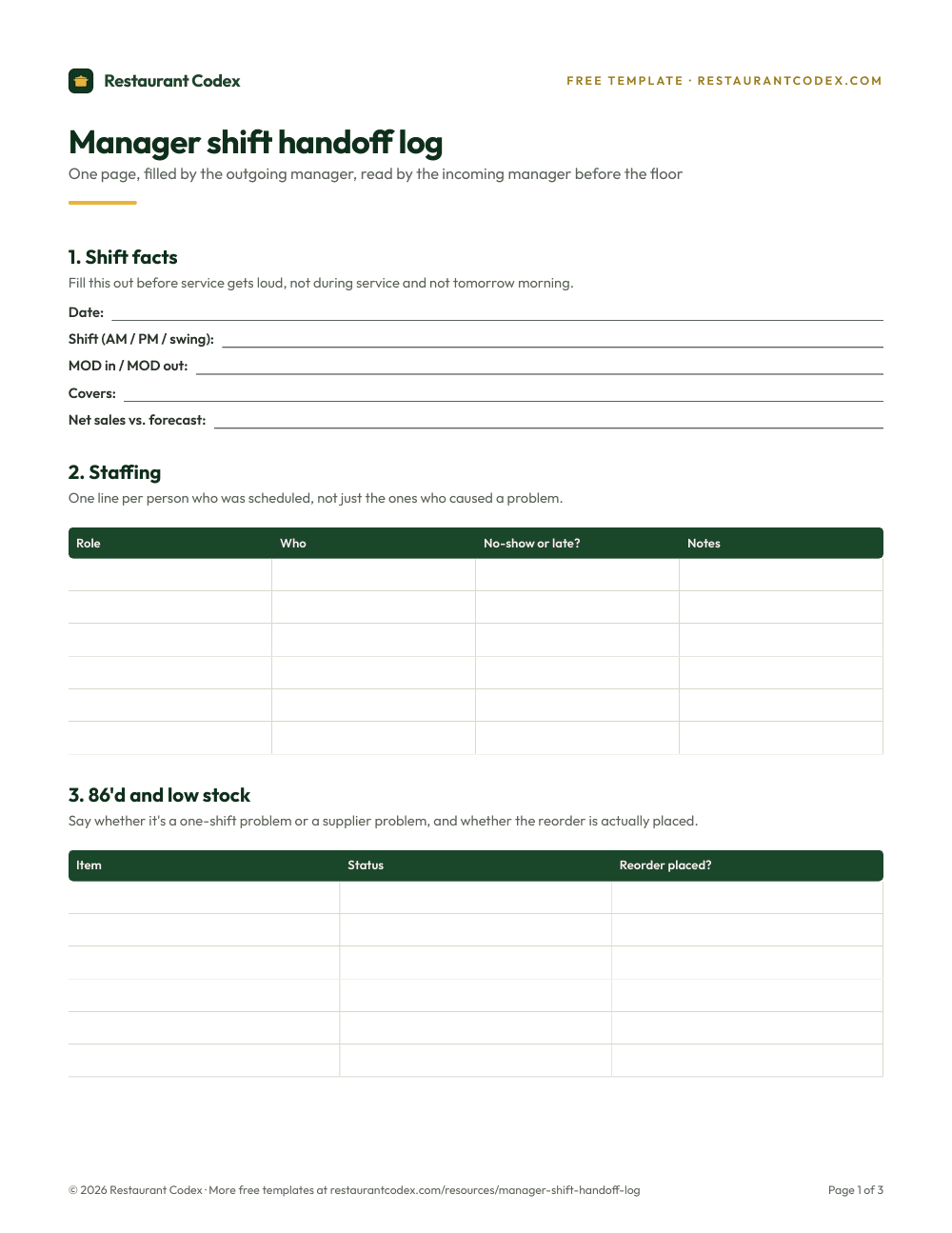
One page, filled by the outgoing manager, read by the incoming manager before the floor · 9 sections
How it actually gets used on a real shift
The outgoing manager fills this out in the last twenty minutes of the shift, while the details are still fresh, not from memory the next morning. It lives somewhere physical and boring: a clipboard by the office door, a binder next to the POS terminal, not buried three replies deep in a text thread. The incoming manager reads the whole page before doing anything else on the floor. Not after the first fire, before it. That one rule is what makes the rest of the form work.
Nine sections cover a full shift without turning into a diary. Shift facts anchor everything that follows: date, shift, who was on, covers, sales against forecast, so anyone reading it later knows what kind of night this was before reading another word. Staffing is one line per scheduled person across six rows, because "everyone showed and the section ran clean" is worth writing down too, not just the no-shows.
86'd and low stock forces a distinction most verbal handoffs skip: is this a one-shift problem (we ran the halibut out at 8) or a supplier problem (the produce order's been short three days running), and was the reorder actually placed or just talked about. Equipment and maintenance wants a ticket number or a vendor's name, because "called someone about the ice machine" gives the next manager nothing to act on. Guest issues and comps puts a dollar figure next to every comp and a follow-up next to every incident, even when the follow-up is "none needed." A comp line left blank is how a restaurant loses track of its own discounting.
Food safety notes stays short on purpose: temperature exceptions against the standard (cold holding at 41°F or below, hot holding at 135°F or above), the corrective action taken, and anything an inspector would ask about if they saw it. Cash and deposits gets two signatures, always. Tomorrow's opener needs to know caps at three items, because a list where everything is urgent tells the reader nothing is. Sign-off closes the loop: both managers' names, both signatures, the time it happened.
What a good line looks like, and what doesn't
"Reach-in #2 read 46°F at 3:00pm. Moved the proteins to the walk-in, called Ace Refrigeration, tech's booked for Thursday 9am, running off the walk-in only until then." That's a usable line. It has a number, a time, an action, a name, and a plan. A GM reading it a week later, or an inspector reading it during a visit, knows exactly what happened and what's still open.
"Fridge acting up again, dealt with it" is the same event, written useless. It doesn't say which fridge, what "dealt with it" meant, or whether the problem's fixed or just been pushed onto tomorrow's manager to rediscover. The distance between those two sentences is the entire point of having a form instead of a habit.
Who reads it, and when
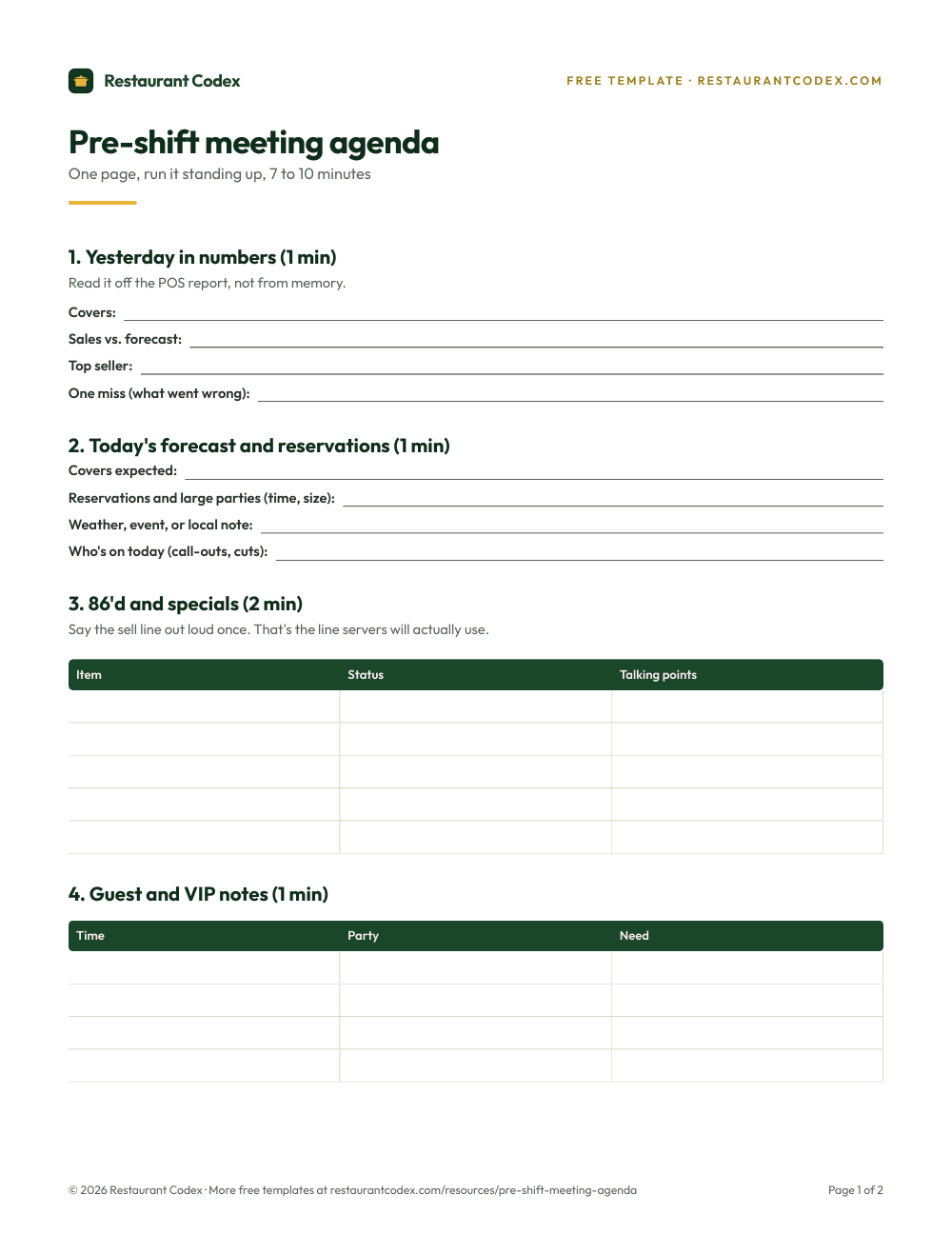
The incoming manager reads it first, before the floor, every single shift; that's non-negotiable. The GM reads the stack the next morning, scanning for a pattern a single shift can't reveal on its own, like reach-in #2 showing up for the third time this month, or the same server getting flagged for lates every Thursday. An owner running more than one location reads the sign-off and comp lines across stores once a week, not to referee a Tuesday but to see which locations run quiet and which ones keep generating the same equipment ticket. Pair it with a pre-shift meeting and a shift is covered on both ends: what the team needs to know going in, and what the next manager needs to know coming off.
Running the same page across five, ten, fifty stores
A shift handoff log gets more valuable the moment there's more than one kitchen involved. A single-unit owner can survive a format only they understand. A district manager covering five locations can't: if each store lays its handoff out differently, reading five of them a week turns into translating five dialects before any comparison is even possible. Standardize the sections and the fields across every location, and someone who's never set foot in store 4 can read its Tuesday handoff in under two minutes and tell whether that GM runs a tight shift or a loose one. What changes store to store is the content, not the shape: store 4's recurring 86 might be the fish special, store 9's might be a walk-in that's overdue for a service call. HQ owns the format. Each GM owns what goes into it.
Where handoffs go wrong
Four mistakes show up constantly. The first is the novel: a manager writes half a page of narrative because they want the next person to understand everything, and the next person reads none of it, because nobody has time to read a novel at 4pm before service. Bullet the facts; save the story for a real conversation if one's actually needed. The second is blame dressed up as a note: "server on section 3 slow again" tells the next manager to be irritated at somebody, not what to do about it. Write the fact instead. Table 14 waited 22 minutes for entrees, and let the GM decide what that means. The third is the comp line left blank because the comp felt small. Small comps add up faster than big ones precisely because nobody bothers tracking them, and a restaurant that can't account for its own discounting can't trust its own food cost number either. The fourth is the reorder box left unchecked: "we're low on X," with no "and I called the supplier," just guarantees the same shortage shows up again tomorrow, except now it's the incoming manager's job to discover it fresh.
How Restaurant Codex handles this
On paper, a handoff log is only as good as whether the next person actually opens it. Restaurant Codex keeps the same nine sections digital: the outgoing manager fills it on a phone at close, the incoming manager gets a notification instead of a clipboard to go hunting for, and an owner running several stores sees every location's handoff land in one feed instead of five separate binders on five separate desks. None of that is required to make the form work. Filled out honestly and read before the floor, the paper version does the same job.
Restaurant Codex
The same checklist, on every phone, with photo proof
Restaurant Codex runs this template as a live task with timestamps, photos and one view across every location. Bring it to a 30-minute working session and we'll set it up on your real operation.
Manager shift handoff log
One page, filled by the outgoing manager, read by the incoming manager before the floor · 9 sections
By the Restaurant Codex team
Written with operators who run multi-location restaurant groups. Reviewed against the FDA Food Code and the sources listed below.