Fifteen things, same order, every day
The best GM in a five-store group runs the same walk, in the same order, at close to the same time, every day. It doesn't look like the job people picture from outside, phone in one hand, chasing whichever fire is loudest. It looks almost boring. Same route through the building before doors open. Same numbers pulled off the POS report. Same close-out sequence at the end of the night. That repetition is the actual skill. A manager who's already made most of the day's decisions by habit has attention left over for the one thing that genuinely needs it.
This checklist is built around that idea: one page, five cadences (before doors, during service, close, weekly, monthly), and roughly fifty lines, each one a thing a person does, not a reminder to stay on top of things. A temperature. A time. A count. A name in the "done" column.
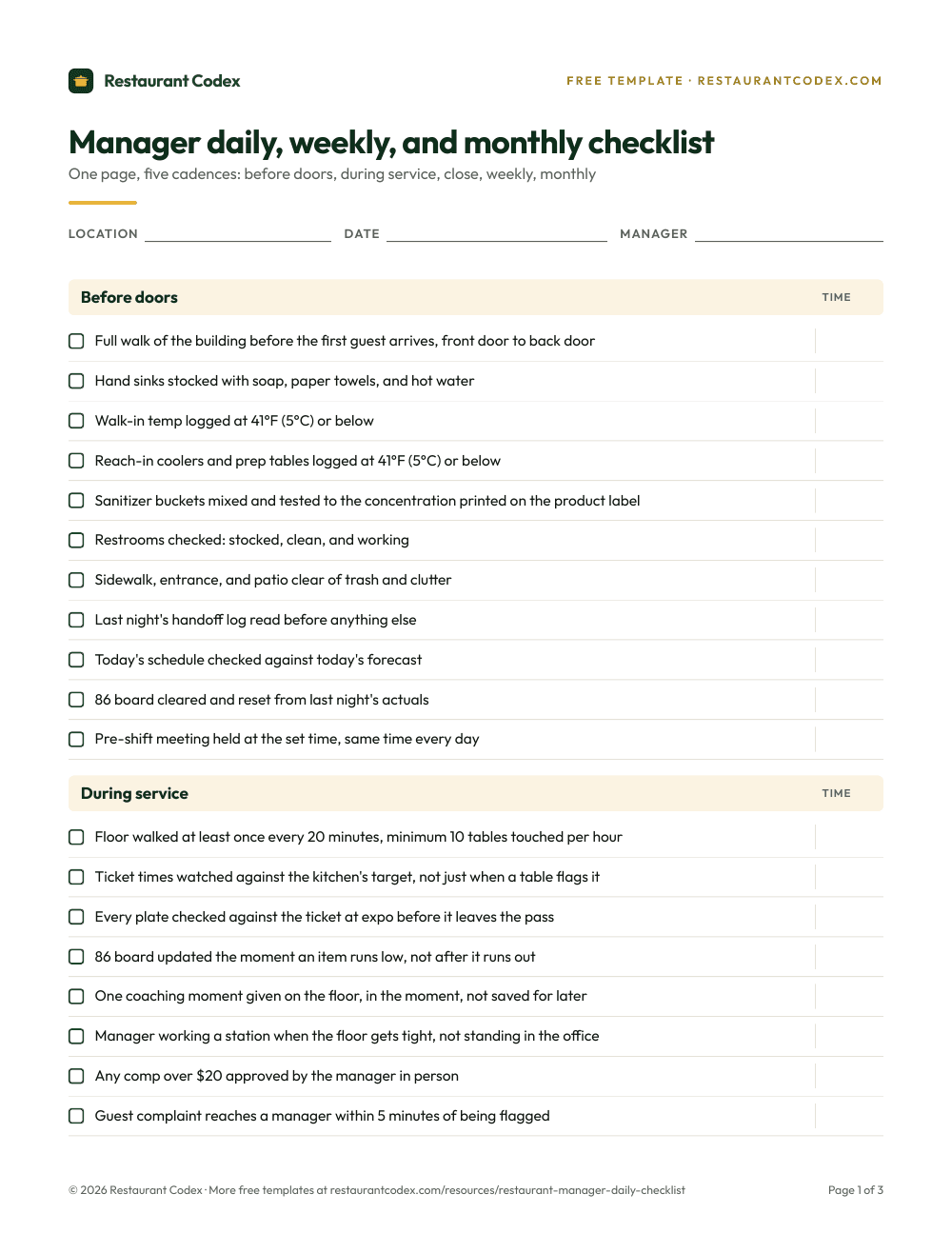
Manager daily, weekly, and monthly checklist
One page, five cadences: before doors, during service, close, weekly, monthly · 46 items
Who fills it out, and when
The manager on duty owns the sheet for their shift. Not a shift lead covering while the GM runs to the bank. The before-doors section gets checked while walking the building, not from a chair in the office afterward. The during-service lines get marked as they happen, not filled in from memory at 9pm because someone asked to see the sheet. The close section wraps the night. Weekly and monthly items live on the same page but get their own block of time, fifteen or twenty minutes on a set day, instead of getting squeezed between two other things and skipped when the week runs long.
Where the sheet lives matters more than it sounds like it should. A clipboard buried in a drawer gets filled out from memory the next morning, which defeats the point of having it. Keep it at the manager station or in a folder that's already open on the pass, somewhere it gets touched without anyone going to look for it.
The four numbers before the first table sits
A manager who can't say yesterday's sales, today's forecast, how much labor is scheduled against that forecast, and the top three sellers without checking anything is starting the shift a step behind. None of it takes more than two minutes off a POS report, and all four numbers change what the day actually looks like. A forecast running well under yesterday's means the 4pm cut list gets tighter. A top seller running low changes what gets flagged before it runs out, not after a table gets told no. Read last night's handoff log before pulling any of these. Half of what a manager needs to know already happened on somebody else's shift.
Three walks, not one
Most restaurants train the opening walk and the closing walk and stop there. The one in the middle is the one that actually catches a problem while there's still time to fix it.
The opening walk covers the building end to end before the first guest arrives: hand sinks stocked with soap and hot water, walk-in and reach-ins logged at 41°F (5°C) or below, sanitizer mixed and tested, restrooms clean and stocked, the sidewalk and entrance clear. The mid-shift walk happens during the rush, not around it: a lap of the floor roughly every twenty minutes, tickets watched against the kitchen's own target, expo checking every plate against the ticket before it leaves the pass, the 86 board updated the moment something runs low instead of after a table gets told no. The closing walk is the one everyone already knows: cash counted with a second person present, always, labor punched out checked against what was scheduled, a photo of the walk-in temp at close, the handoff log written before anyone leaves the building.
The weekly numbers, and the line most stores skip
Daily numbers describe one shift. Weekly numbers describe the store.
| Metric | Target | Source |
|---|---|---|
| Food cost | 28% to 35% of sales; full-service average sits at 32.4% | WhippleWood CPAs, citing National Restaurant Association 2026 data |
| Labor cost | Full-service median runs 36.5%; profitable operators hold closer to 34.2% | WhippleWood CPAs, citing BLS and National Restaurant Association 2026 data |
| Prime cost (food plus labor) | 55% to 65% of revenue | WhippleWood CPAs, 2026 |
Pulling those three numbers is only half the job. The variance line on the inventory count matters more than the total, since a total that looks fine can still hide a walk-in that's quietly short on protein every week. The waste log needs to be read line by line, not just totaled at the bottom, because a pattern, the same prep item tossed three Fridays running, is the whole reason to keep the log. A one-on-one with at least one key person happens weekly, not whenever there's time. Next week's schedule goes up by the day it was promised, every week, because a late schedule is how good people start looking elsewhere. A self-audit walks the same points a health inspector would check. Vendor invoices get coded and matched against what was actually delivered, not what was ordered. For the full math behind the food cost and labor lines, see the prime cost and weekly P&L tracker.
Monthly, the same manager pulls back further still: the full P&L reviewed line by line against last month and against budget, certification expiries checked before they lapse (food handler cards, ServSafe Manager, alcohol service), the deep-clean schedule signed off, menu items reviewed for what actually sold against what actually made margin, the hiring pipeline checked against the season ahead, and the equipment maintenance log checked for anything overdue.
Where the day goes without a list
Without a checklist, a manager's day gets eaten by whatever's loudest. A compressor that's been cycling wrong since Tuesday. A text from the owner asking why last week's number looked off. A server who needs to leave early and needs an answer right now. All three are real problems. None of them outrank the walk-in temp check or the weekly food cost review; they just make more noise. A list with a time block attached to each cadence gives a manager something to point to when the loud thing tries to eat the quiet, necessary one.
Where GMs get this wrong
Four mistakes show up in store after store. The first is running only the closing half of the job: cash counted, doors locked, call it a day, while the opening walk and the mid-shift lap never happen because nobody assigned them the same weight. The second is a sheet with checkmarks and no numbers on it. "Labor: done" tells a district manager nothing; "labor 37% against a 35% target, cut two hours off Thursday's dinner shift" tells them what actually happened and what to do about it. The third is the weekly and monthly sections that exist on paper but never get their own time on the calendar, so they get pushed to "when things calm down," which in a restaurant is never. The fourth, and the one that undoes the other three, is the owner filling out the GM's checklist for them, out of habit or out of distrust. A checklist somebody else fills out teaches nothing; the point is the manager building the habit.
Running the same checklist across five, ten, fifty stores
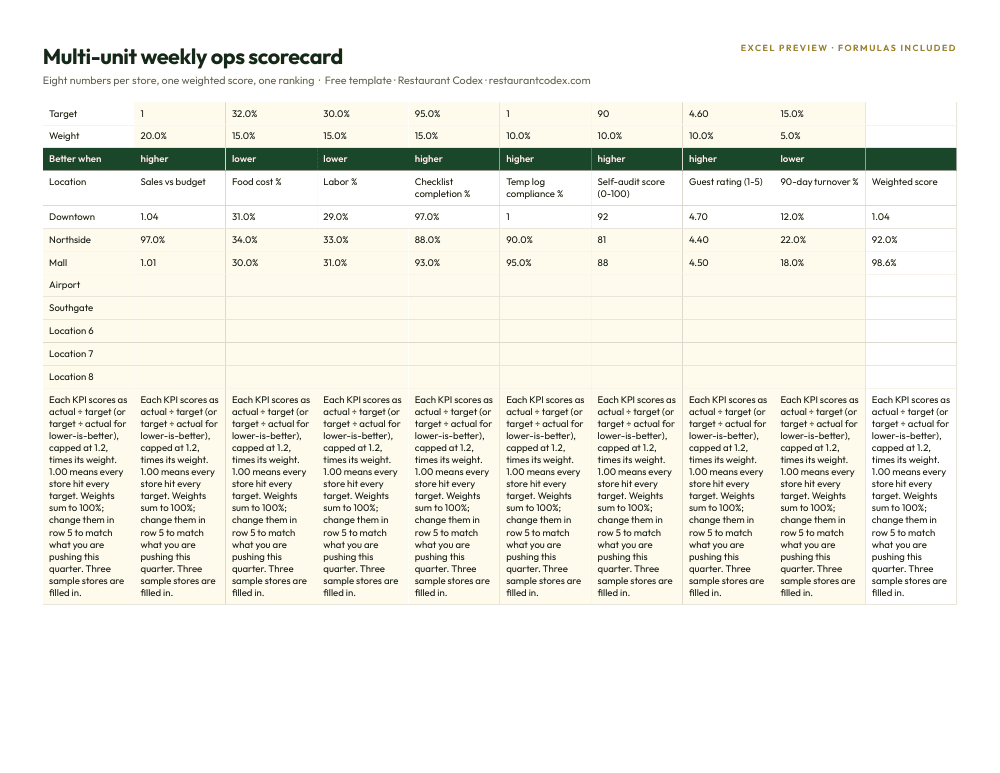
A district manager who reads five GM checklists on a Monday morning moves faster than one who calls five GMs and asks how the week went. A phone call gets a mood. A checklist gets a fact: which store hit its food cost target, which one's labor crept up, whose self-audit turned up a real gap versus a clean one. The checklist is the standard, the same page, the same cadences, the same numbers, at every location. The numbers are where the actual conversation happens: why one store's labor ran two points over while another's came in under, and what that GM is doing about it. HQ owns the format so every store's sheet reads the same way. Each GM owns the number that lands on it.
How Restaurant Codex handles this
On paper, this checklist works as well as the manager who actually runs it. Restaurant Codex keeps the same cadences digital: the daily and weekly items get checked from a phone during the actual walk, the weekly numbers pull straight from the POS and the schedule instead of getting retyped by hand, and an owner running several stores sees every GM's week land in one view instead of five separate clipboards on five separate desks.
Restaurant Codex
The same checklist, on every phone, with photo proof
Restaurant Codex runs this template as a live task with timestamps, photos and one view across every location. Bring it to a 30-minute working session and we'll set it up on your real operation.
Manager daily, weekly, and monthly checklist
One page, five cadences: before doors, during service, close, weekly, monthly · 46 items
By the Restaurant Codex team
Written with operators who run multi-location restaurant groups. Reviewed against the FDA Food Code and the sources listed below.
Sources
- FDA Food Code, cold holding at 41°F or below
- WhippleWood CPAs, Financial Benchmarks for Restaurants (food cost, labor cost, and prime cost, citing National Restaurant Association and BLS 2026 data)
- ServSafe Manager certification, accredited by ANAB-CFP, administered by the National Restaurant Association