Seven minutes, standing up, before the doors open
A pre-shift meeting that runs fifteen minutes loses the room by minute six. The ones that actually change how a shift goes are done in seven to ten minutes, everyone standing, and half of that time is numbers instead of talk.
That's the design behind this agenda: a running order with the minutes for each block printed right in the heading, so whoever's holding it can see they're behind before it drifts into a twenty-minute talk about attitude. TouchBistro and WebstaurantStore both put the useful range for a pre-shift meeting at five to fifteen minutes. Five is too tight to get through yesterday's numbers and the 86 list without rushing past them. Past ten, servers start checking out, thinking about their tables instead of you.
What's in the download and how to use it on a real shift
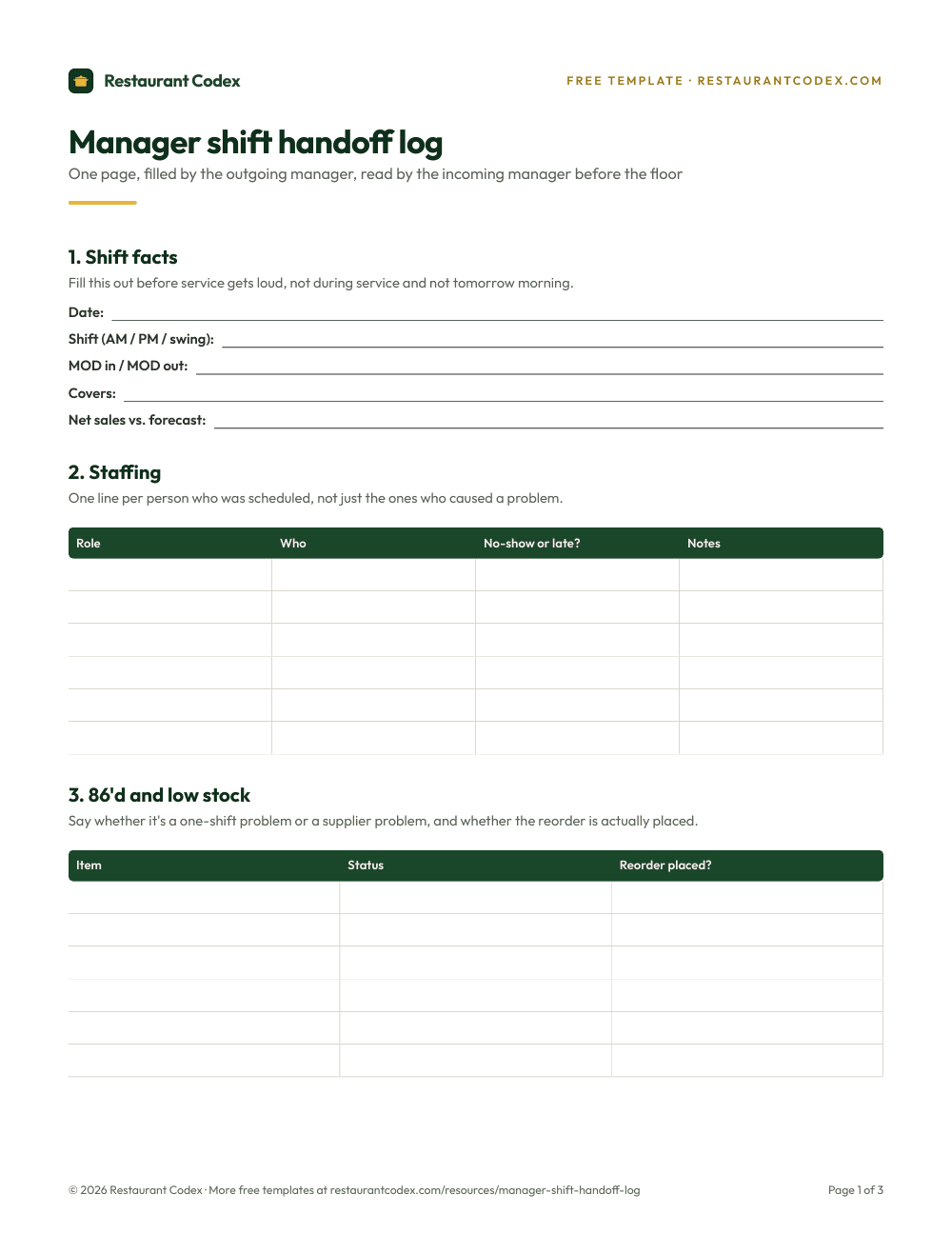
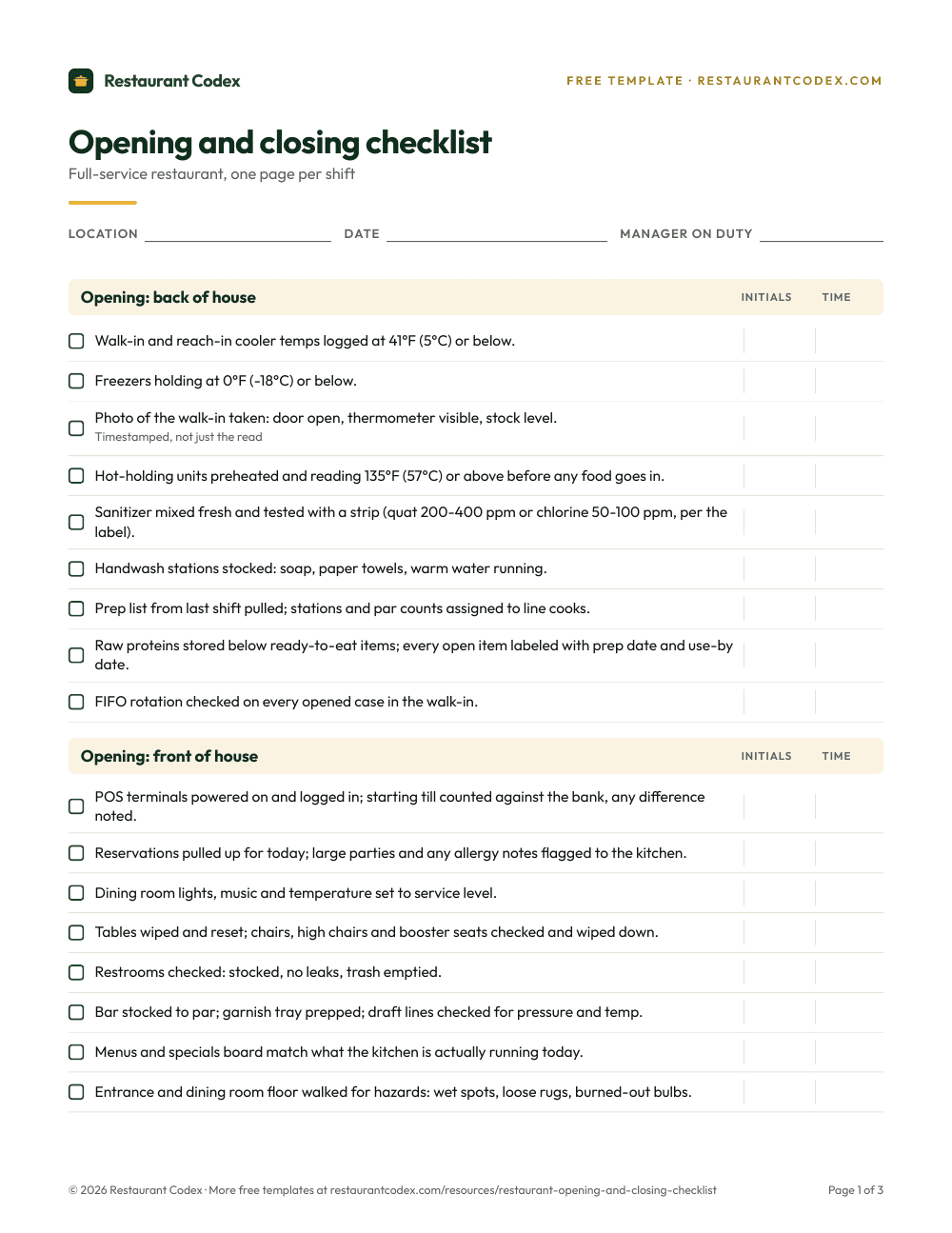
The download is one page. Print it, or pull it up on a tablet at the pass. Either way it's meant to be read from, not composed live in front of the team.
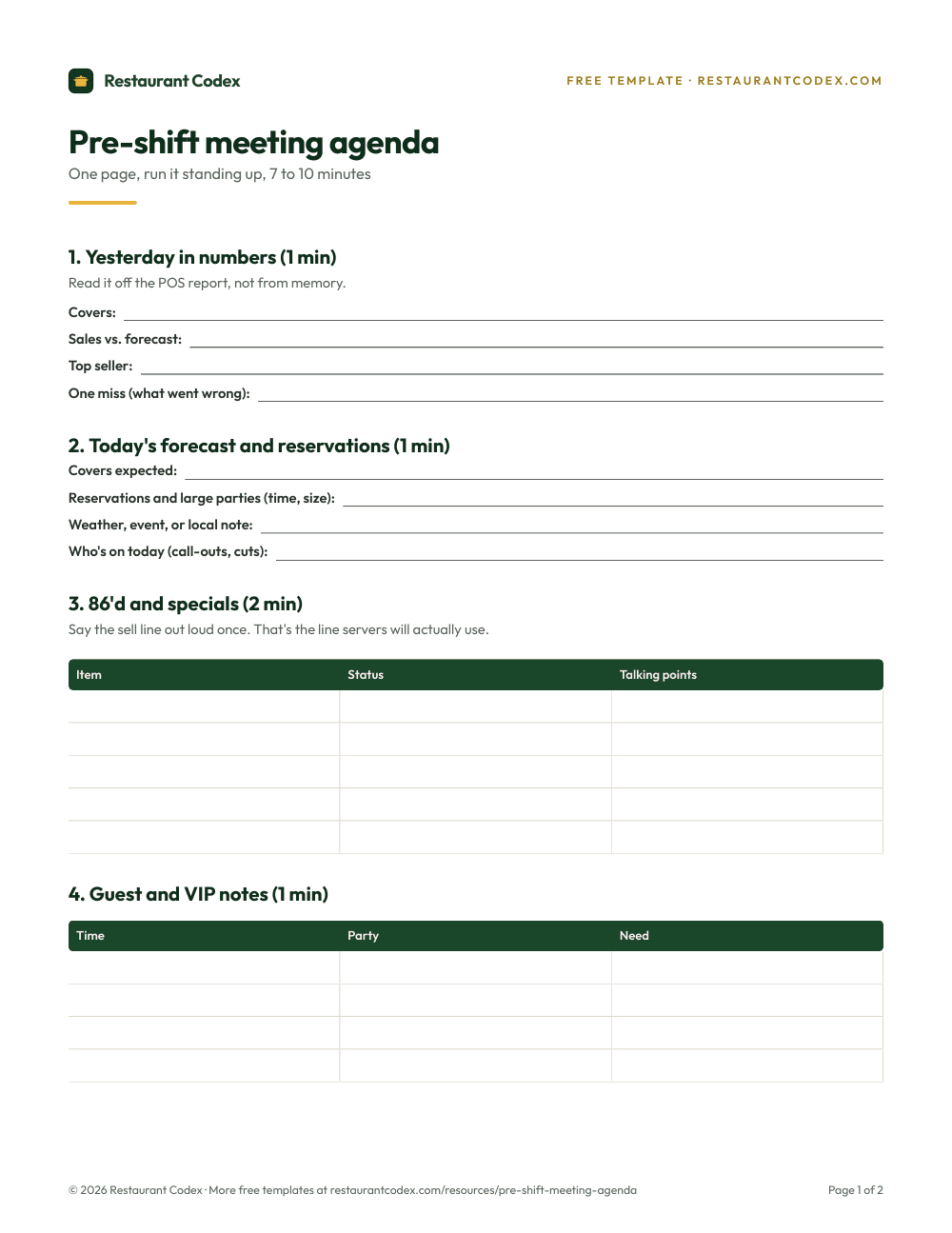
Pre-shift meeting agenda
One page, run it standing up, 7 to 10 minutes · 8 sections
The MOD or shift lead fills the top three blocks before the team gathers: yesterday's numbers off the POS close-out report, today's reservations off the book, and the 86 list off a two-minute call with the kitchen. That prep takes about five minutes at the desk, before doors. The meeting itself is reading down the sheet, section by section, out loud.
Whoever runs it holds the pen for sign-off at the bottom: their name, the date, and which shift. That sign-off matters more than it looks like it should. If a health inspector, an area manager, or an owner ever asks whether pre-shift happens every day, a stack of signed sheets answers that in a way a shrug doesn't.
Why each block earns its place
The order isn't arbitrary. Numbers come first because they set the tone: if covers were down and the mid-week special didn't move, that's useful information at minute one, not a surprise buried in a P&L review three weeks later. One miss gets its own field on purpose, not to hunt for blame, but because the same miss showing up three nights running is the thing worth fixing before Saturday.
Today's forecast and reservations come next: covers expected, any large party or VIP walking in at 7, and anything the team needs to know before it happens instead of during it. This is also where you flag a call-out or a cut, so the team knows who's actually working the floor tonight before someone gets surprised at the host stand.
The 86'd and specials block is the one people skip, and then they wonder why nobody sold the special. Five rows, one line each: item, status, and a talking point a server can actually say to a guest. "We got a case of branzino in Tuesday and the chef wants it gone by Friday" sells more branzino than the words "branzino special" ever will. That's the real job of this block. It turns a kitchen need, move the walk-in before it turns, clear a case before Thursday's truck, into something a server can say without sounding like they're reading a script.
Guest and VIP notes get four rows, because that's usually all there are on a given night: a regular's table preference, an allergy the kitchen already knows about but the new server doesn't, a birthday that needs a candle at the right moment. This block keeps a good guest from becoming an annoyed one over something the restaurant already knew.
One standard to reinforce is deliberately singular. Pick one thing: a food safety point (cold holding, an allergen protocol) or a service standard (bread timing, greeting a table before someone has to flag you down), say why it matters, and say how you'll check it tonight. The FDA added sesame as the ninth major food allergen under the FASTER Act, effective January 1, 2023. If your team hasn't had a real refresher on which menu items carry it without saying so, that's a fair pick for the week.
Assignments and sidework get the most rows, eight, because a mid-size floor usually needs that many stations covered by name, not by a schedule nobody rechecks at 4:45. Questions from the team close the meeting on purpose, not open it. By then everyone has the context to ask something specific instead of a vague "anything I should know?"
None of this disappears when the meeting ends. A GM who's any good keeps the signed sheets and flips back through them on a slow Tuesday afternoon. The same "one miss" three days running is a training gap, not bad luck. A standard that still needs reinforcing past week two probably isn't sticking, and repeating it louder isn't the fix.
Where most restaurants get it wrong
A few specific ways this goes sideways.
Turning it into a discipline session. The moment pre-shift becomes the ten minutes where the GM lists what went wrong and who did it, the team stops standing up straight and starts staring at the floor. Save the individual conversation for later, in private. Pre-shift is for the whole room and the shift ahead, not yesterday's mistakes replayed out loud.
Skipping it on busy days. This is backward. The busier the shift, the more the team needs thirty seconds on the 86 list and the VIP table before the first ticket prints. Skipping pre-shift on a slammed Friday is exactly when a server finds out about the birthday table from the guest instead of from you.
Running it without numbers. A pre-shift that opens with "okay guys, big night tonight" and nothing else is a pep talk, not a briefing. It doesn't give anyone something they can act on.
Nobody writes the 86 list down. It gets said once, out loud, fast, and half the floor either didn't hear it or forgot it by table three. Five rows on a sheet everyone can glance at during service fixes this for the cost of one Sharpie.
Running it across more than one location
Across more than one location, the agenda itself should be identical store to store: same eight blocks, same time budget, same sign-off. What changes is who fills it and what goes in the blanks. Each GM pulls their own numbers, their own 86 list, their own VIP notes. The one thing worth pushing from HQ is the standard of the week. Send it to every location on Monday, the exact same line, and that week's pre-shift sheet at every store should show the same standard in block five. That gives an ops director a fast way to check adoption across five or fifteen stores without visiting any of them: pull the sign-off stack, and see whether the standard is the one that actually went out, or whether a location quietly went back to whatever it was doing before.
How Restaurant Codex does this
Restaurant Codex runs this same agenda digitally: the numbers pull in from the POS instead of getting copied by hand, the standard of the week posts to every location at once, and sign-off is a timestamp instead of a signature that may or may not have happened. None of that changes what the meeting is. It just means an owner checking in from another state can see, in one view, whether pre-shift actually happened at every store this week.
Restaurant Codex
The same checklist, on every phone, with photo proof
Restaurant Codex runs this template as a live task with timestamps, photos and one view across every location. Bring it to a 30-minute working session and we'll set it up on your real operation.
Pre-shift meeting agenda
One page, run it standing up, 7 to 10 minutes · 8 sections
By the Restaurant Codex team
Written with operators who run multi-location restaurant groups. Reviewed against the FDA Food Code and the sources listed below.