What's on the sheet, and who fills it in
The lead cook builds tomorrow's list tonight, right before the walk-in gets buttoned up. They walk the line and the walk-in, write down what's actually there, and the sheet does the subtraction: par minus on hand equals what gets made. The opener picks up that finished list at 7 the next morning and works down it station by station, writing initials and a time on each line as it's done. Nobody guesses in the morning. The list already told them what to do the night before.
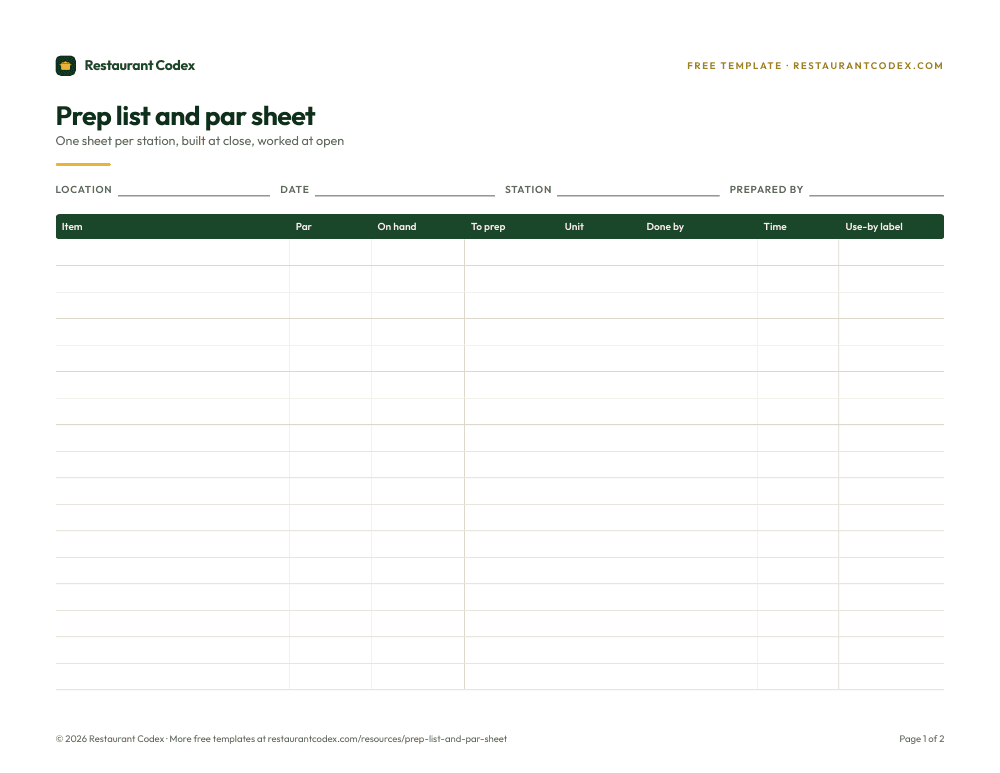
The header carries the location, the date, the station and who prepared it, so a stack of completed sheets from four stores sorts itself without anyone asking whose is whose. It lives clipped to the line, not in a binder in the office, because the person checking it against inventory needs to see it while they're standing at the station.
Prep list and par sheet
One sheet per station, built at close, worked at open · 8 columns
A prep list and a par sheet are the same sheet
A par sheet answers "how much of this should we have before service." A prep list answers "how much do I need to make right now." Most kitchens run these as two documents: a par number written on a whiteboard somewhere, and a separate handwritten list the closer makes from memory. That's two places for the same number to drift apart.
Put them on one row instead. Par is the target. On hand is what's actually there when the lead cook counts. To prep is the gap between them, and that's the only number the opener has to act on. A unit column stops "20" from turning into an argument about whether that's twenty quarts or twenty pans. A done-by column and a time column turn the sheet into a record of who made what and when. A use-by label column means nothing on the line outlives its safe shelf time without somebody noticing.

Setting par from real sales
A par number that isn't built from sales is a guess with a title. Pull four weeks of POS data by day of week instead of one flat number for the whole week. A Tuesday and a Saturday at the same restaurant can move at very different volumes, and a single par covering both either strands Saturday short or buries Tuesday in prep that ends up in the trash.
Average the last four Tuesdays, the last four Fridays, and so on down the week, then layer in a busy-day multiplier for what the rolling average won't catch on its own: a holiday weekend, a local event, a new menu item still ramping up. That multiplier is a judgment call the kitchen manager owns, not a formula the sheet spits out. Revisit the base average monthly. A restaurant's sales mix moves faster than most par sheets get updated.
Four stations, four different pars
Pars aren't one number per item across the whole kitchen. They're set station by station, against that station's actual volume and how far out its food holds. A full-service kitchen running four stations might land somewhere like this on a normal Friday:
| Station | Item | Par |
|---|---|---|
| Garde manger | Mixed greens, portioned | 40 portions |
| Garde manger | House vinaigrette | 3 qt |
| Sauté | Mirepoix, diced | 2 qt |
| Sauté | Pan sauce base | 1 qt |
| Grill | Burger patties, portioned | 60 ea |
| Grill | Marinated proteins | 15 lb |
| Pastry | Dessert shells, baked off | 30 ea |
| Pastry | Pastry cream | 2 qt |
Garde manger and pastry carry pars built two or three days out, because most of what they make holds. Grill and sauté run tighter and shorter, because a lot of what they touch is cut close to service or doesn't hold well past a shift. The station decides how far out a par can safely sit, not a house-wide rule applied to every line.
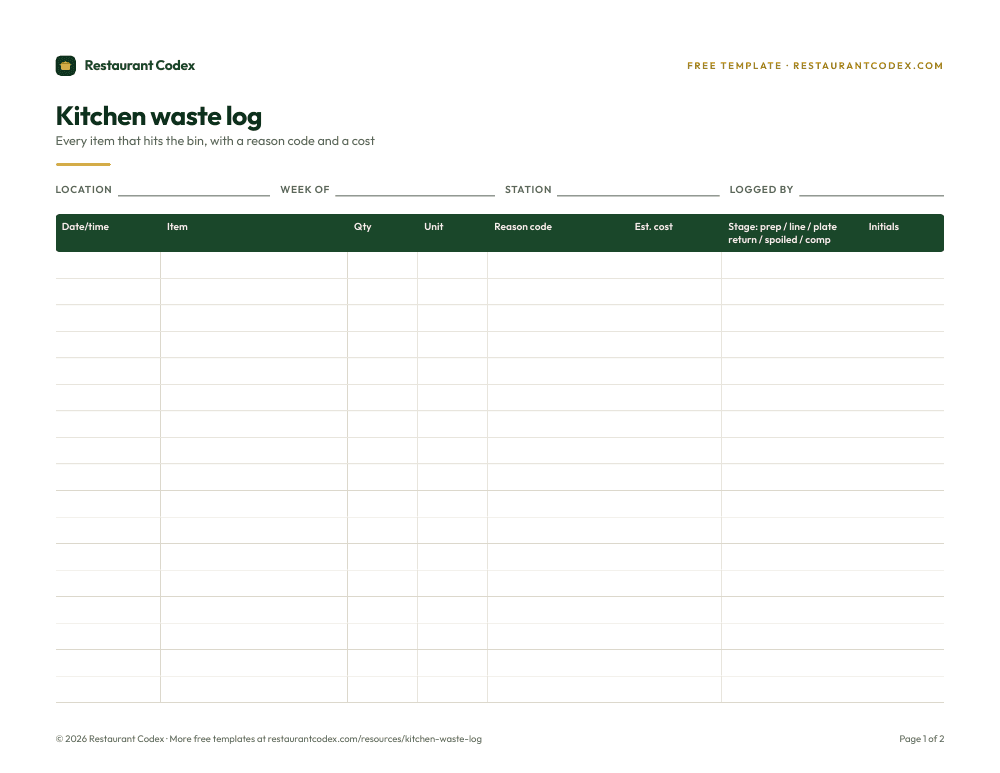
Waste says the par is too high, an 86 says it's too low
Two numbers tell you when a par is wrong, and they point in opposite directions. If an item shows up on the kitchen waste log two or three nights a week, the par sits above what the station actually sells, and the fix is to prep less, not to find a better way to throw the extra away. Food waste isn't a rounding error, either: EPA figures put food retail, food service and residential kitchens together at 66 million tons of wasted food in 2019, with about 60% of it landfilled. A station over-prepping every night is a small, fixable piece of that combined number.
An 86 before the rush ends says the opposite: the par undershoots real demand, or the busy-day multiplier didn't get applied on a day that needed it. Neither signal means "prep to full" is the fix. It means go back to the four-week average and move the number. And neither signal tells you why on its own, whether it's the par, the storage, or a cook cutting corners. It only tells you where to go look.
Mistakes that blow up a prep list
Prepping to "full" instead of to par. A cook who tops off every container to the brim regardless of what the sheet says is prepping to the size of the container, not to what the restaurant is going to sell.
Pars that never get touched after a menu change. A dish comes off the menu and the item that used to feed it stays on the sheet at the old par for months, quietly turning into waste every week nobody's looking at.
No use-by label on what gets prepped. A sheet with a use-by column only works if someone writes the date on the container to match it. Skip that step and FIFO stops meaning anything, because nobody can tell Tuesday's batch from Thursday's by looking at it.
Prepping on gut feel on a Friday. The busiest night of the week is exactly the wrong time to eyeball it. That's the night the four-week average and the multiplier earn their keep, not the night to skip them because everyone's slammed.
Running this across more than one location
HQ owns the method: the column layout, the four-week-average approach to setting par, the labeling and FIFO rule, the cooling times. Each store owns its own numbers, because a 40-seat neighborhood spot and a 200-seat flagship shouldn't share a par for the same menu item even if they share a menu. A chef or ops lead reviewing pars across the group once a month, next to each store's waste log and 86 count, is what catches the store still running a par from before last quarter's menu change, and the one quietly over-prepping every Sunday.
How Restaurant Codex handles this
On Restaurant Codex, the same sheet runs as a live task instead of a clipboard. The lead cook enters on-hand counts from a phone at close, the app does the par-minus-on-hand math, and the opener checks off each line with a timestamp instead of an initial. A chef reviewing four stores sees all four par sheets and all four waste logs in one place, not four clipboards in four kitchens.
Restaurant Codex
The same checklist, on every phone, with photo proof
Restaurant Codex runs this template as a live task with timestamps, photos and one view across every location. Bring it to a 30-minute working session and we'll set it up on your real operation.
Prep list and par sheet
One sheet per station, built at close, worked at open · 8 columns
By the Restaurant Codex team
Written with operators who run multi-location restaurant groups. Reviewed against the FDA Food Code and the sources listed below.