It's a diagnostic, not a punishment
A hotel pan of rice goes into the trash at 10:45pm, and nobody writes down why. It happens again Thursday, and again the following Tuesday, and by the time anyone notices, months of over-prepped rice have gone into the same bin unrecorded.
The EPA counted 66 million tons of wasted food across the food retail, food service, and residential sectors combined in 2019, with almost 60 percent of it landfilled. That's not a restaurant-only number: the EPA doesn't break out food service separately on that page, so an exact restaurant percentage is a guess. What the figure shows is the scale of the problem, and why the EPA's wasted food scale ranks prevention above donation, recycling, or disposal.
A kitchen waste log isn't a tool for catching the cook who dropped a plate. Used that way, it stops working inside a week, because nobody logs what might get them in trouble. Used as a diagnostic, every item that hits a bin gets a reason attached, and the log shows where the kitchen is bleeding: too much prep, sloppy line work, food coming back from tables, or product dying in the walk-in. Four problems, four fixes, and you can't tell them apart without the reason code.
Kitchen waste log
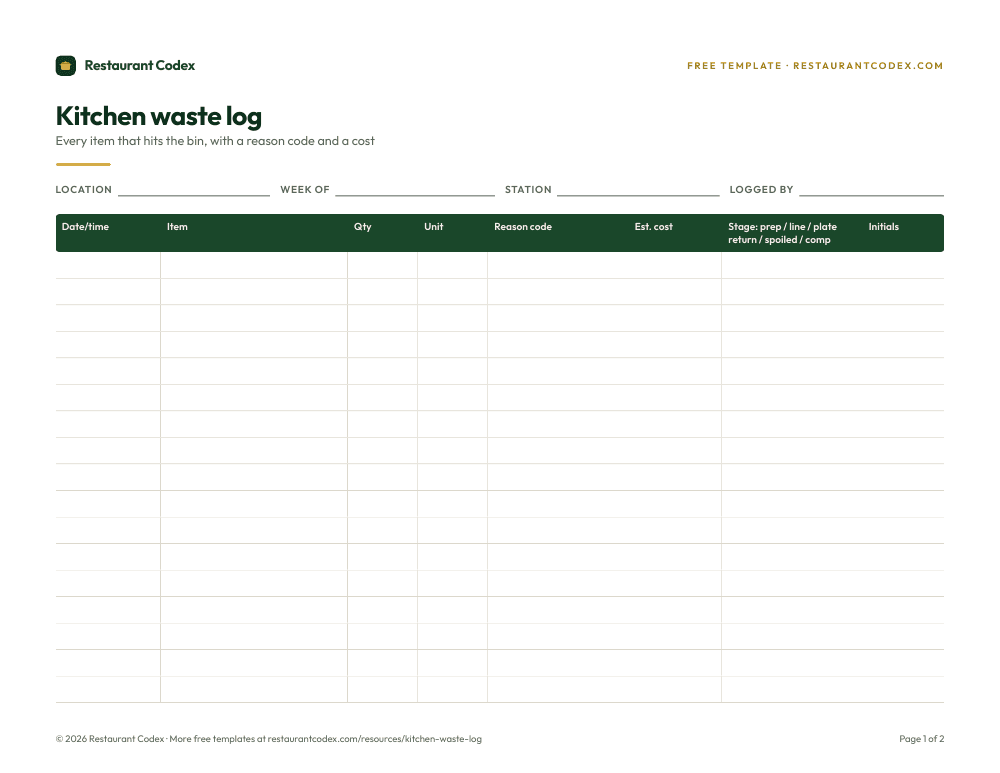
Every item that hits the bin, with a reason code and a cost · 8 columns
What's in the download and how it works on a shift
Four header fields: location, week of, station, logged by, so a stack of sheets from five stations reads as one week's picture instead of five scraps of paper. Eight columns follow: date/time, item, quantity, unit, reason code, estimated cost, stage, and initials.
Stage and reason code aren't the same axis, on purpose. Stage says where in the workflow the item died: prep, line, plate return, spoiled, or comp. Reason code says why: OVERPREP, SPOILED, DROPPED, WRONG ORDER, RETURNED, TRIM, EXPIRED, or COMP. A returned plate might carry reason code RETURNED because the guest just didn't want it, WRONG ORDER because the ticket got misread, or TRIM because the fish was underportioned. Same stage, three fixes.
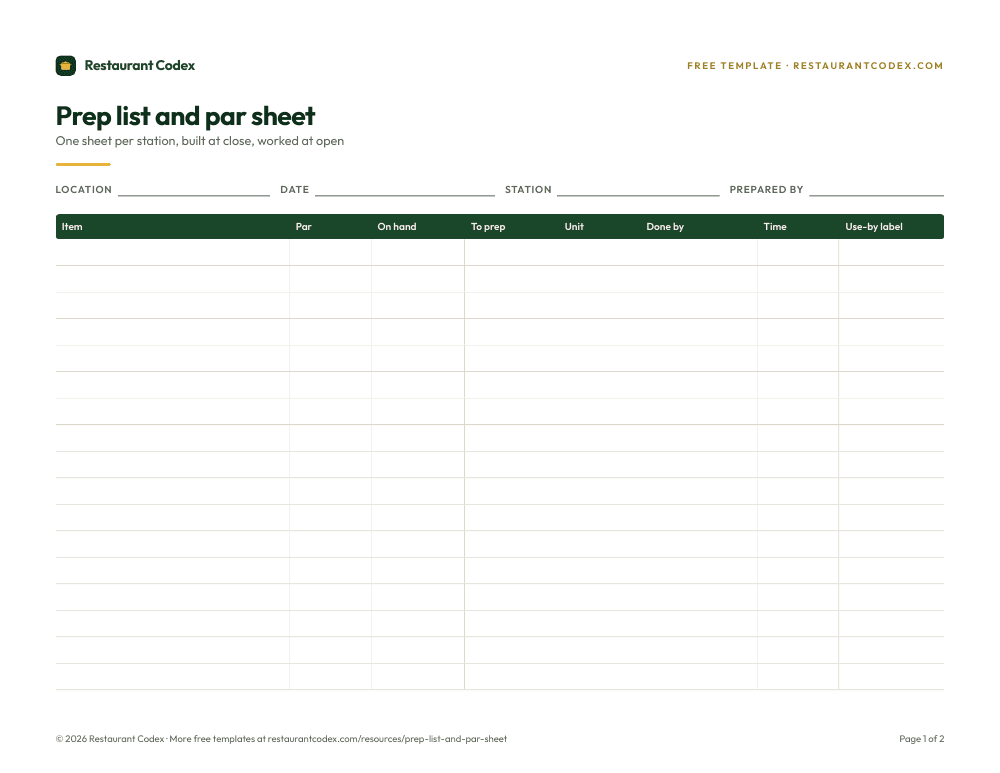
Whoever's at the station logs the line before the item goes in the bin, not from memory at close. That's the rule printed at the bottom of the sheet, and it's what makes the whole thing worth anything: trim written down after the fact mostly doesn't get written down at all. A sheet lives at each station, or the whole log sits on a clipboard at the pass in a smaller kitchen. The sous chef or closing manager collects and totals them at week's end.

The four places food dies
Every line in the log falls into one of four places, and each points at a different fix.
Prep over-production, OVERPREP, is rice, sauce, and protein that never sold and got tossed at close. It's a pars problem before anything else: someone's prepping to a number that doesn't match what actually sells Tuesday versus Saturday. If the same item shows up under OVERPREP three nights out of five, pull the actual par down on the prep list for that day and watch whether the line shrinks.
Line mistakes, DROPPED and WRONG ORDER, are plates that never made a table because someone read the wrong ticket or lost one off the pass. It's a training and station-setup problem: a new cook solo on a station for the first time, a printer hard to read from the expo. The fix is scheduling and training, not the trash can.
Plate returns, RETURNED, made it to the table and came back anyway, which isn't about the kitchen alone; it's whether the kitchen and the dining room agree on what the dish is supposed to be. Too salty three times in a week means the recipe card's seasoning is off. A dish that comes back because the guest didn't know it had shellfish in it is an allergen problem wearing a waste-log disguise.
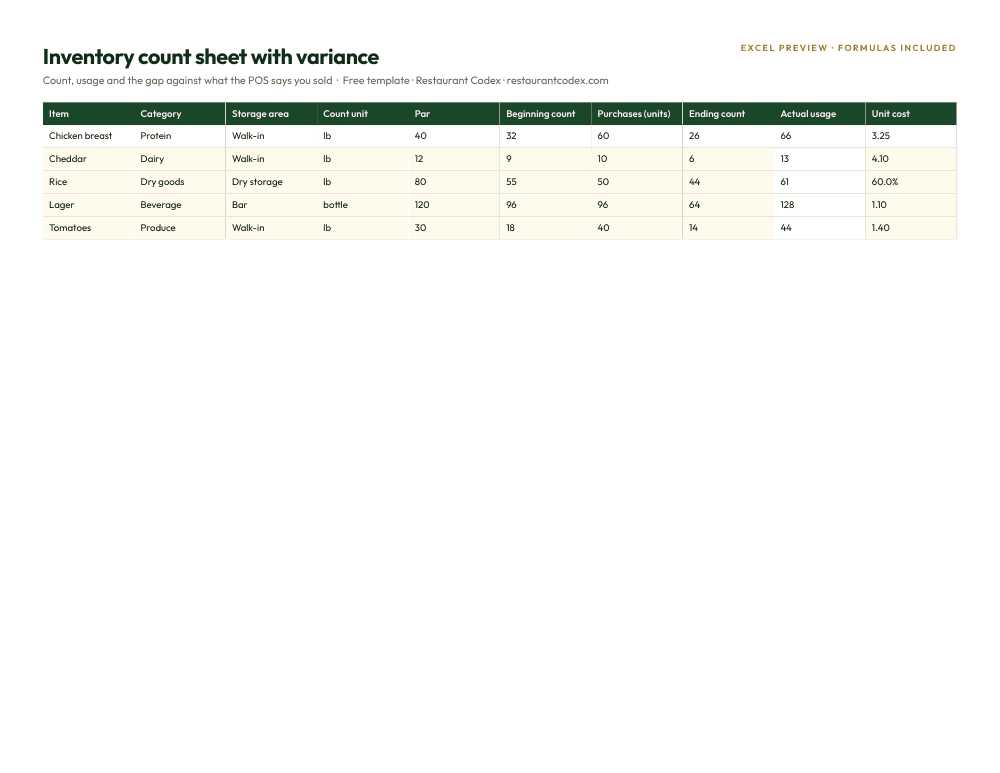
Spoilage in storage, SPOILED and EXPIRED, died in the walk-in or dry storage before anyone used it. It's an ordering and FIFO problem: too much bought relative to how fast it turns, or product buried behind a newer case instead of pulled first. Read it against an inventory count sheet; tomatoes that spoiled Tuesday should show up as a gap between what the last count said was on hand and what got used.
TRIM and COMP sit outside those four on purpose: TRIM is a knife-skills signal, more below, and COMP is guest recovery, a cost you're choosing to eat rather than one that got away.
Running a two-week audit
A waste log only pays off if someone reads it, and the read that works is a two-week window, not a running pile nobody opens.
Log every station, every shift, for two weeks: long enough to catch a slow Monday, a slammed Saturday, and one full ordering cycle for anything bought weekly. Sort by reason code, then by item within each code. One code usually accounts for most of the damage, and one or two items for most of that code.
Make the three changes specific: "drop the Friday rice par from 40 portions to 30," "run a 10-minute knife-skills refresher on the herb station Monday," "move the fish delivery from Tuesday to Wednesday." Run the log two more weeks and check whether those lines shrink. If they don't, the diagnosis was wrong, not the log.
Costing a line
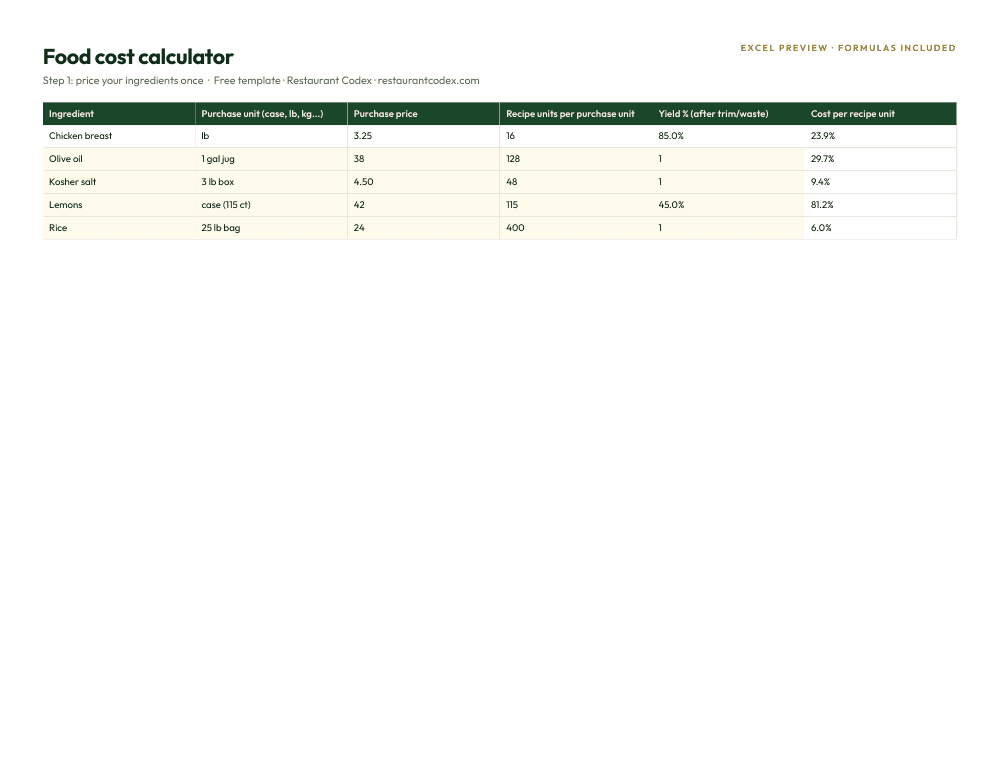
The estimated cost column is quantity times unit cost. A case of protein at 60 dollars for 20 portions runs 3 dollars a portion, so four portions tossed under OVERPREP cost 12 dollars on that line. It doesn't need to reconcile to the penny against a P&L; it needs to be close enough that a week totaled by reason code shows where the money went, not just which bin ended up heaviest.
Pull the unit cost from the same invoice price used on the inventory count sheet, so the two documents agree instead of pricing the same case two ways.
Where kitchens get this wrong
No reason codes. Half the kitchens that try this write down what got thrown out and skip the why, turning the log into a list instead of a diagnostic. Volume alone doesn't say whether to fix pars, training, or a supplier.
Logging only the big stuff. A cook notes the salmon fillet that got dropped and skips the garnish trimmed off every plate all night. Small TRIM, logged consistently, adds up to more than the occasional dropped protein.
Blaming the cook. Read someone's name off the log in a meeting and use it against them, and the waste doesn't go away next shift; it just moves from the log into the dumpster outside without a record.
Never connecting it to the prep list. A GM who reads the log alone sees OVERPREP every week and never touches the par causing it. The prep list and par sheet and the waste log are supposed to talk to each other; the log is the evidence, the prep list is where the fix gets written.
Never reading it. The most common failure, and the least interesting one: sheets filled out diligently for a month, then filed in a drawer. A log nobody reads does exactly as much as a log nobody kept.
Running it across more than one location
Standardize the reason codes across every store; the mistake is letting each GM invent their own shorthand. If one location logs "86" for spoiled fish and another writes "bad," an ops director comparing five or fifteen locations is translating slang, not reading data. Every store uses the same eight codes, no exceptions.
Once the codes match, the comparison gets interesting. A store running three times the TRIM waste of its sister locations doesn't have a food cost problem, even though it shows up as one on a P&L first; it has a knife-skills problem, fixable with an afternoon of training, not a renegotiated vendor contract. A store where SPOILED dominates and the others barely register it is telling you something about its ordering or its walk-in, not its cooks. The same eight words, comparable across the group, turn fifteen piles of paper into one picture of where the money is going.
How Restaurant Codex does this
Restaurant Codex runs the same log digitally: a photo of the item before it hits the bin, a timestamp instead of a guess, and every location's reason-code totals in one view instead of fifteen spreadsheets. None of that changes what the log is for. Same eight codes, same rule: log it before it goes in the bin, every time, no blame.
Restaurant Codex
The same checklist, on every phone, with photo proof
Restaurant Codex runs this template as a live task with timestamps, photos and one view across every location. Bring it to a 30-minute working session and we'll set it up on your real operation.
Kitchen waste log
Every item that hits the bin, with a reason code and a cost · 8 columns
By the Restaurant Codex team
Written with operators who run multi-location restaurant groups. Reviewed against the FDA Food Code and the sources listed below.