What you get and how it runs on a shift
A cooler that creeps to 46°F for three hours doesn't set off an alarm. It shows up as a number on a clipboard nobody looked at, and it becomes a problem when a health inspector pulls the sheet six weeks later and asks why nobody caught it. This download is two logs, not one: a holding log for every cold and hot unit in the building, and a cooling log for anything you cook and then chill. Print both or run them on a tablet; the numbers matter more than the format.
The holding log lives on a clipboard by the walk-in or taped inside a cabinet door, wherever the person doing the check can reach it without crossing the whole kitchen. Whoever's on that section checks their units on the way past, at least every four hours, writes the actual number, circles yes or no on "in range," and initials. If a unit is out, they write what they did about it in the same row, right then, not at the end of the shift. The cooling log starts the moment a pot comes off the stove: the cook who pulled it logs the start time and start temperature, then comes back at the two-hour and six-hour marks to check it again. The closing manager reviews both sheets before signing out and files them; keep 90 days on hand, since that's the stretch most health departments ask to see.
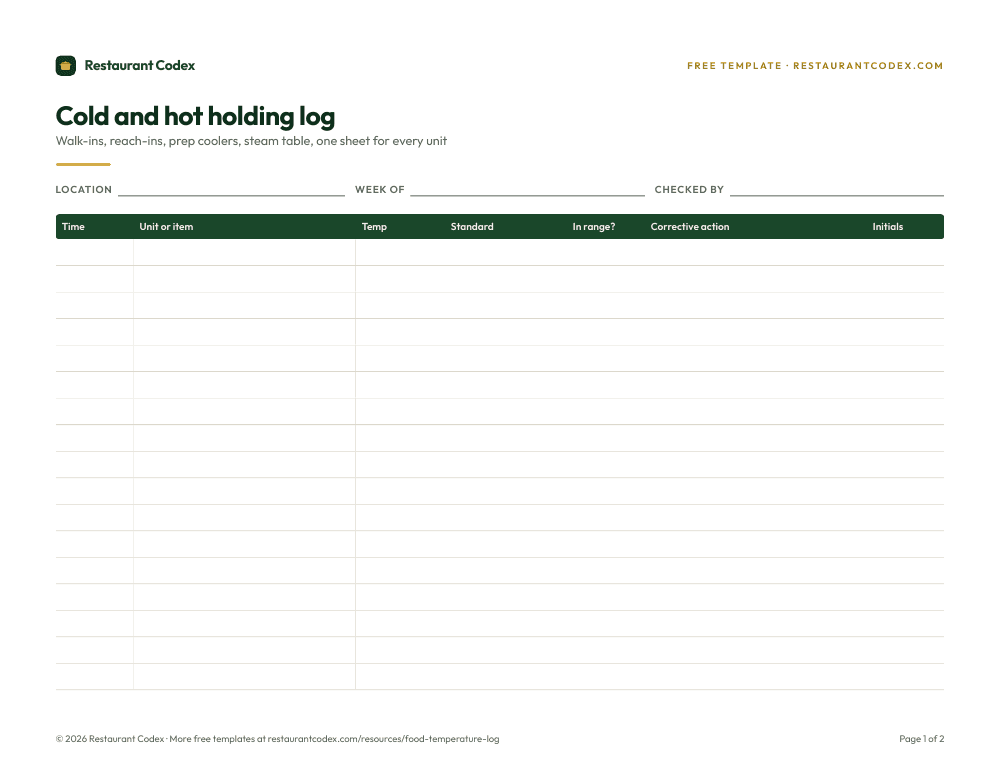
Cold and hot holding log
Walk-ins, reach-ins, prep coolers, steam table, one sheet for every unit · 7 columns
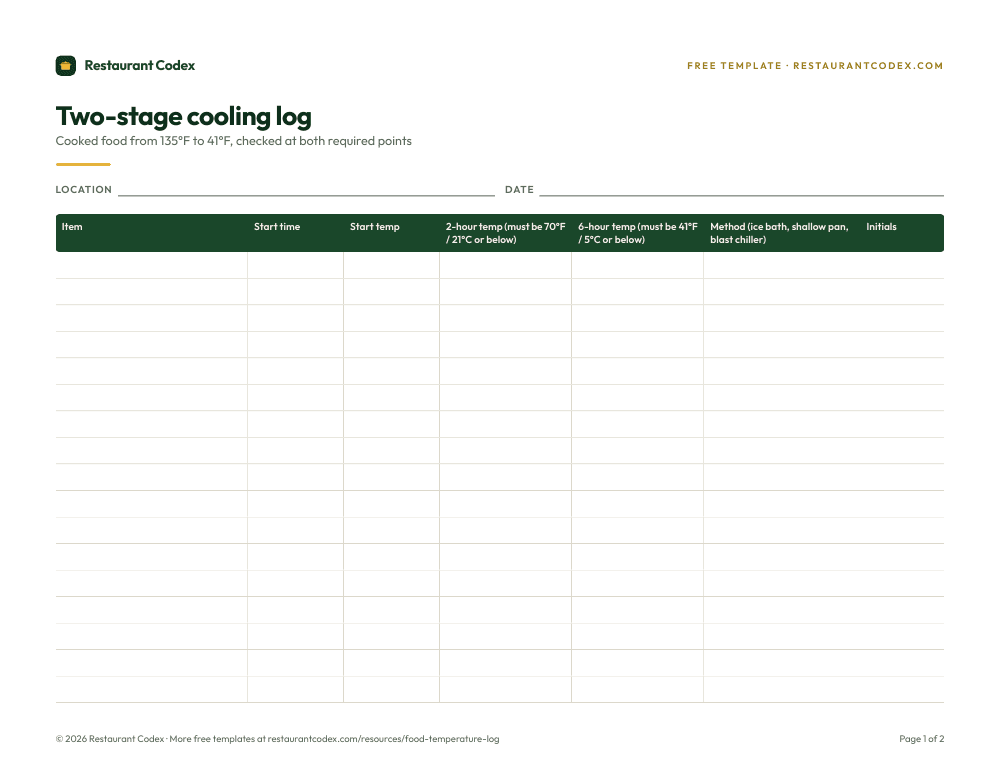
Two-stage cooling log
Cooked food from 135°F to 41°F, checked at both required points · 7 columns
The numbers, and where they come from
Every figure on these sheets comes from the FDA Food Code 2022: cold holding at 41°F (5°C) or below, hot holding at 135°F (57°C) or above (§ 3-501.16). That's the line for anything the Code classes as TCS, Time/Temperature Control for Safety food, meaning it can support bacterial growth if it sits in the wrong range: cooked proteins, cut produce, dairy, rice, beans, the usual suspects. Between 41°F and 135°F is what health departments call the danger zone, and the Food Code sets those two numbers as the boundary, not a suggestion.
Checking every four hours isn't arbitrary either. The Food Code's time-as-a-public-health-control provision (§ 3-501.19) treats four hours as the outer limit a TCS food can sit outside its holding temperature before it has to be discarded. Check on that same four-hour cadence and you catch a slow drift with time left to fix it, move the product, or call for service, before you're standing over a cooler full of food you're required to throw out.
Two numbers show up wrong across a lot of the templates you'll find searching for this. One default sets cold holding at "below 40°F," a degree tighter than the actual rule, which just means you'll flag units that are legally fine. Another sets it at 8°C, which is 46.4°F: that's the UK/EU chilled food standard, not the FDA's, and it's loose enough to pass a cooler that's five degrees into violation territory under US code. Neither is a rounding error you can shrug off on a document you might hand an inspector. 41°F (5°C) is the number, from the Food Code, full stop.
Calibrate the thermometer or the log is fiction
Every number on both sheets depends on one thing nobody checks often enough: whether the thermometer itself is telling the truth. The ice-point method takes two minutes. Fill a cup most of the way with ice, top it with water, stir it, and let it sit thirty seconds. Push the probe into the middle without touching the sides or bottom of the cup. It should read 32°F (0°C). If it's off by more than the manufacturer's stated tolerance, adjust the calibration nut on a dial probe, or note the offset and work with it on a digital one that doesn't adjust. Do this weekly, and any time a probe gets dropped, run over, or left in a hot dish machine. ServSafe teaches this exact method for a reason: it's the cheapest insurance in the kitchen, and it's the first thing an inspector asks about if a number on your log looks off.
Writing a corrective action that means something
"Fixed" is not a corrective action. A corrective action names what was wrong, what you did about it, and what happened to the food.
That one sentence tells a health inspector, and you, exactly what happened. If food sat above 41°F for more than four hours, the corrective action isn't a repair ticket, it's a decision to discard, and the log should say that in as many words. Leave the column blank and the check itself is worthless. It just proves you looked at a broken cooler and wrote the number down.
Cooling: the log most kitchens actually fail
Holding logs are the easy part. Cooling is where operators lose the plot, because the rule has two checkpoints and a shift doesn't wait around for either of them. The Food Code (§ 3-501.14) requires cooked TCS food to drop from 135°F to 70°F within two hours, then from 70°F down to 41°F or below within an additional four hours, six hours total from the pot coming off the heat. A five-gallon stockpot of chili left to cool on its own in the walk-in can sit in the middle of that range for most of a shift; the center of the pot is still warm long after the surface reads cold. That's what the ice bath, the shallow-pan split, and the blast chiller are for: more surface area, faster heat loss, less guessing.
If either checkpoint is missed, you have two options, not three. Reheat the food to 165°F (74°C) one time (§ 3-403.11) and use it that day, or throw it out. You can't put a stalled batch back in the cooler and hope the second half of the window catches up; that's exactly the window the rule is designed to close.
Mistakes we keep seeing
Writing the number down before opening the door. It happens on a rushed close, and it turns a real check into a guess with a signature on it.
The same number every time. A sheet with "38" in every cell for three weeks doesn't read as a well-run kitchen to an inspector. It reads as a log nobody's actually checking, even on the nights the cooler really is holding steady.
A thermometer nobody's calibrated since the day it came out of the box. See above.
No corrective action column, or one that's there and never used. Either way, the first out-of-range reading with nothing written next to it is the line an inspector circles.
The log lives in a binder in the office, three shifts behind, checked once a month when someone remembers. A log nobody looks at between inspections isn't managing risk. It's paperwork for a file.
Running this across more than one location
One standard, one log, applied the same way in every kitchen, is the part a single-location owner doesn't need and a five-unit operator can't run without. HQ sets the standard, 41°F, 135°F, four-hour checks, the same corrective-action format, and doesn't touch anything else; each GM adapts which units they actually have and where the clipboard lives in their building. What changes is how you read it. A district manager covering a dozen stores doesn't want twelve binders full of 38s. They want the four units, out of forty, that logged an out-of-range reading this week, and whether the corrective action on each one actually closed it out. Same sheet, read as an exception report instead of a stack of paper.
How Restaurant Codex handles this
Restaurant Codex turns both of these logs into a two-tap check on a phone: the temperature, a photo of the thermometer, the timestamp, logged automatically, with a corrective action prompt that won't let a shift close until an out-of-range reading gets one. Every location rolls up to one view, so an out-of-range reading at store six shows up before a district manager has to ask for it.
Restaurant Codex
The same checklist, on every phone, with photo proof
Restaurant Codex runs this template as a live task with timestamps, photos and one view across every location. Bring it to a 30-minute working session and we'll set it up on your real operation.
Cold and hot holding log
Walk-ins, reach-ins, prep coolers, steam table, one sheet for every unit · 7 columns
Two-stage cooling log
Cooked food from 135°F to 41°F, checked at both required points · 7 columns
By the Restaurant Codex team
Written with operators who run multi-location restaurant groups. Reviewed against the FDA Food Code and the sources listed below.
Sources
- FDA Food Code 2022, § 3-501.16 Potentially Hazardous Food, Temperature Control (Cold and Hot Holding)
- FDA Food Code 2022, § 3-501.14 Cooling
- FDA Food Code 2022, § 3-403.11 Reheating for Hot Holding; § 3-501.19 Time as a Public Health Control
- ServSafe (National Restaurant Association), Food Safety Resources Library