The server on a Friday night
It's 8:15 on a Friday and table 14 asks if the mochi doughnuts have sesame in them. The server doesn't know, glances at the ticket line, and picks one of three bad options: guesses yes because doughnuts sometimes have sesame seeds on the outside, guesses no because the menu doesn't mention it, or walks back to the kitchen to ask the chef, who's expediting six tickets at once and answers over her shoulder without checking the label on tonight's oil. None of those is actually an answer. A guest with a sesame allergy needs one thing: a person at the table who knows, in under thirty seconds, whether that dish is safe. "Ask the chef" only works when the chef isn't the bottleneck for every table in the room at the same time.
An allergen matrix fixes the bottleneck before the question gets asked. Every dish on the menu gets one row, checked ingredient by ingredient against the 9 major U.S. allergens, before service starts, not during it. The server pulls the sheet or the laminated card, finds the row, reads the answer. Thirty seconds, no walk to the kitchen, no guess.
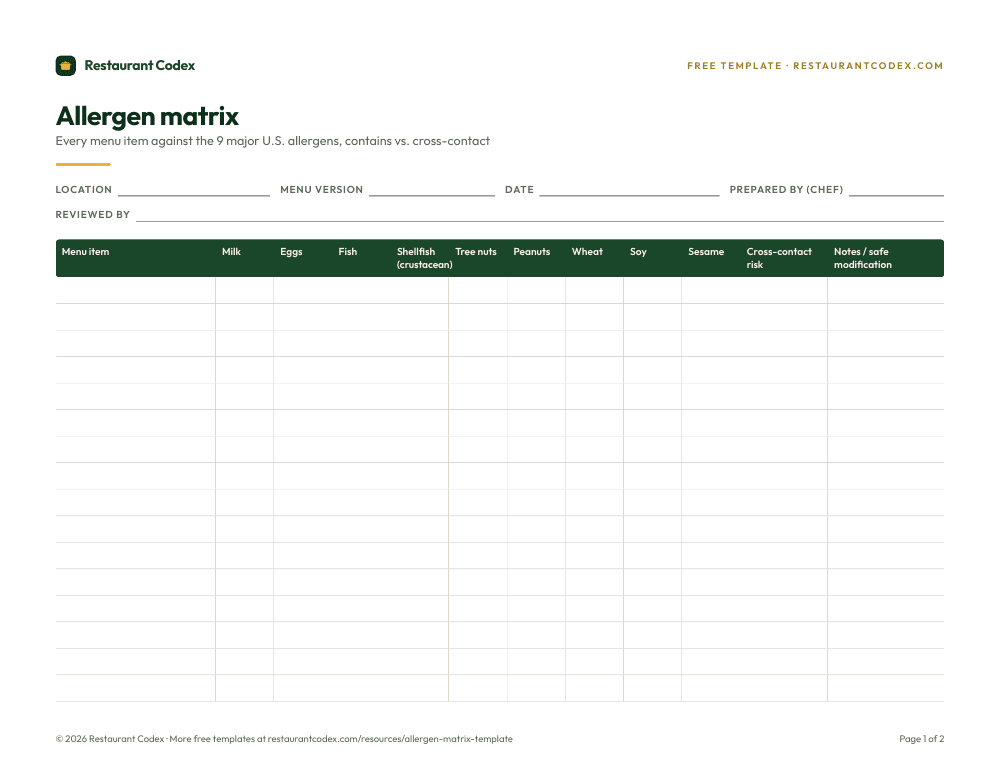
Allergen matrix
Every menu item against the 9 major U.S. allergens, contains vs. cross-contact · 12 columns
Building it: check the dish down to the oil it's fried in
A matrix earns its keep at the ingredient level, not the dish level. "Caesar salad" looks harmless until someone checks the dressing and finds anchovy, which is fish, and parmesan, which is fine, but the crouton is baked with wheat flour and shares a fryer with the calamari. The line cook who's been making that dressing for two years knows all of this by memory. The server who started last Tuesday doesn't, and the matrix is what closes that gap.
Building the sheet means walking every menu item and checking four places most operators skip: the sauce, the oil, the garnish, and whatever touches the plate last. A burger bun might carry sesame seeds. A vinaigrette might use soy lecithin as an emulsifier. A "vegetarian" side might get finished with the same tongs that just handled the shrimp. None of that shows up in a dish's name, and checking it once isn't enough: the day a supplier changes an ingredient without warning, the same brand of soy sauce or the same bun but from a different plant, sometimes with a different formula, the check needs to happen again. Chefs who trust the matrix once and never touch it again are the ones who get caught by a reformulation six months later.

Contains, and cross-contact: two different promises
The matrix separates two questions that feel like one. "Does this dish contain milk" is a contains question, answered Y or left blank, based on what's actually in the recipe. "Could this dish have touched milk on its way to the table" is a cross-contact question, answered X when the risk is real, a shared griddle, a shared fryer, a cutting board that had butter on it ten minutes ago. A dairy-free dish cooked on a griddle that just had butter melted on it is still a cross-contact risk even though milk never went into the recipe.
That distinction changes what a kitchen can promise. A guest with a mild sensitivity might accept a cross-contact risk if the kitchen uses a dedicated pan or wipes the grill first. A guest with a severe, anaphylaxis-level allergy generally can't accept either column marked, contains or cross-contact, and the kitchen needs to know which situation it's in before it starts cooking, not after the dish is already on the pass.
The modification column, and what a safe answer sounds like
Every row ends with a notes and modification column, and it's the column that turns a chart into something a server can actually use. A safe answer names the swap: "the burger without the sesame bun, on a plain roll pulled from the same rack as the gluten-free bread," not "I think we can probably do that." Vague reassurance is worse than an honest no, because a guest who hears confidence acts on it.
Who owns the sheet, and when it gets rebuilt
The chef or kitchen manager builds and signs the matrix, because they're the one who actually knows what's in the walk-in and the dry storage. The GM or owner reviews and signs off, because a second set of eyes catches what a busy kitchen misses. Both names go in the header, next to the menu version and the date, because who verified this matters as much as what it says the day something goes wrong.
It gets rebuilt on two triggers, and only two: a menu change, and a supplier change. Not quarterly, not "when we remember." A new dressing, a new bread vendor, a new case of oil from a different distributor, any of those is a trigger, even when the dish's name on the menu doesn't change at all.
Training servers to use it, and to escalate
A matrix nobody reads is a binder. Walk the whole team through it at a staff meeting the first time it goes up and every time it changes, not as a one-line mention on a pre-shift. Keep a laminated copy at the host stand or the POS station, somewhere faster to reach than the kitchen. And teach the one rule that matters more than any column: when a guest's question doesn't have a clean answer on the sheet, the server says "let me check with the kitchen" and actually does it, instead of guessing to keep the table moving. A wrong guess doesn't cost a table its patience. It can cost a guest a trip to the hospital.
One matrix per menu, not one per store
Run more than one location and the matrix belongs to the menu, not the building. If every store runs the same core menu, one matrix covers all of them, and a location doesn't get to freelance its own answer because a manager remembers it differently. What does vary store to store is the supplier: the bakery that supplies buns to your downtown location might not be the one that supplies your airport location, and a regional substitution can quietly add or drop an allergen the corporate matrix never accounted for. Flag those local swaps as a footnote against the affected rows, and put a version number on every printed copy, because a manager working off menu v11 while the kitchen's already running v13 is exactly how a matrix stops matching reality.
Where this goes wrong
The fryer gets missed more than anything else. A kitchen breads and fries a wheat product, a gluten-free product, and a shellfish product in the same oil, and nobody marks the cross-contact risk on any of the three rows, because "it's the fryer we've always used" doesn't feel like new information. It is.
A "gluten-free" item with no real prep process behind it is the next one. Calling something gluten-free without a dedicated board, a dedicated fryer, or at minimum documented handling steps is a promise the kitchen can't back up if it's ever questioned.
Then the matrix goes stale. A supplier swaps a product, nobody updates the sheet, and it keeps answering questions about an ingredient that isn't in the building anymore.
The one that costs the most, though, is a server guessing under pressure instead of checking, because checking feels slower than table 14 wants it to be. It's still faster than what happens if the guess is wrong.
How Restaurant Codex handles this
On paper, the matrix works as well as the laminated card that's actually within reach when someone asks. Restaurant Codex keeps the same rows and columns digital, tied to the live menu version, so a supplier swap or a new dish updates one record instead of forcing someone to reprint and relaminate a stack of cards across every location. A server pulls it up on the same device they're already using for the ticket, and a multi-unit owner can see, from one screen, which locations are still running last month's version.
Restaurant Codex
The same checklist, on every phone, with photo proof
Restaurant Codex runs this template as a live task with timestamps, photos and one view across every location. Bring it to a 30-minute working session and we'll set it up on your real operation.
Allergen matrix
Every menu item against the 9 major U.S. allergens, contains vs. cross-contact · 12 columns
By the Restaurant Codex team
Written with operators who run multi-location restaurant groups. Reviewed against the FDA Food Code and the sources listed below.