The dish that tastes different depending on who's on the line
A guest orders the salmon on a Tuesday and again on a Saturday, two different cooks on the station. If the recipe lives only in the head of whoever trained those two cooks, the plates won't match. Maybe the sauce runs thicker on Saturday because that cook reduces it longer out of habit. Maybe the portion is forty grams smaller because "a handful of greens" means something different to each of them. The guest doesn't complain. She just doesn't come back a third time, and nobody at the restaurant finds out why.
A recipe card closes that gap. It's not an inspiration document, it's a contract between the kitchen and the guest: this dish, made to this spec, tastes and looks the same no matter who's holding the tongs.
Recipe card and plating spec
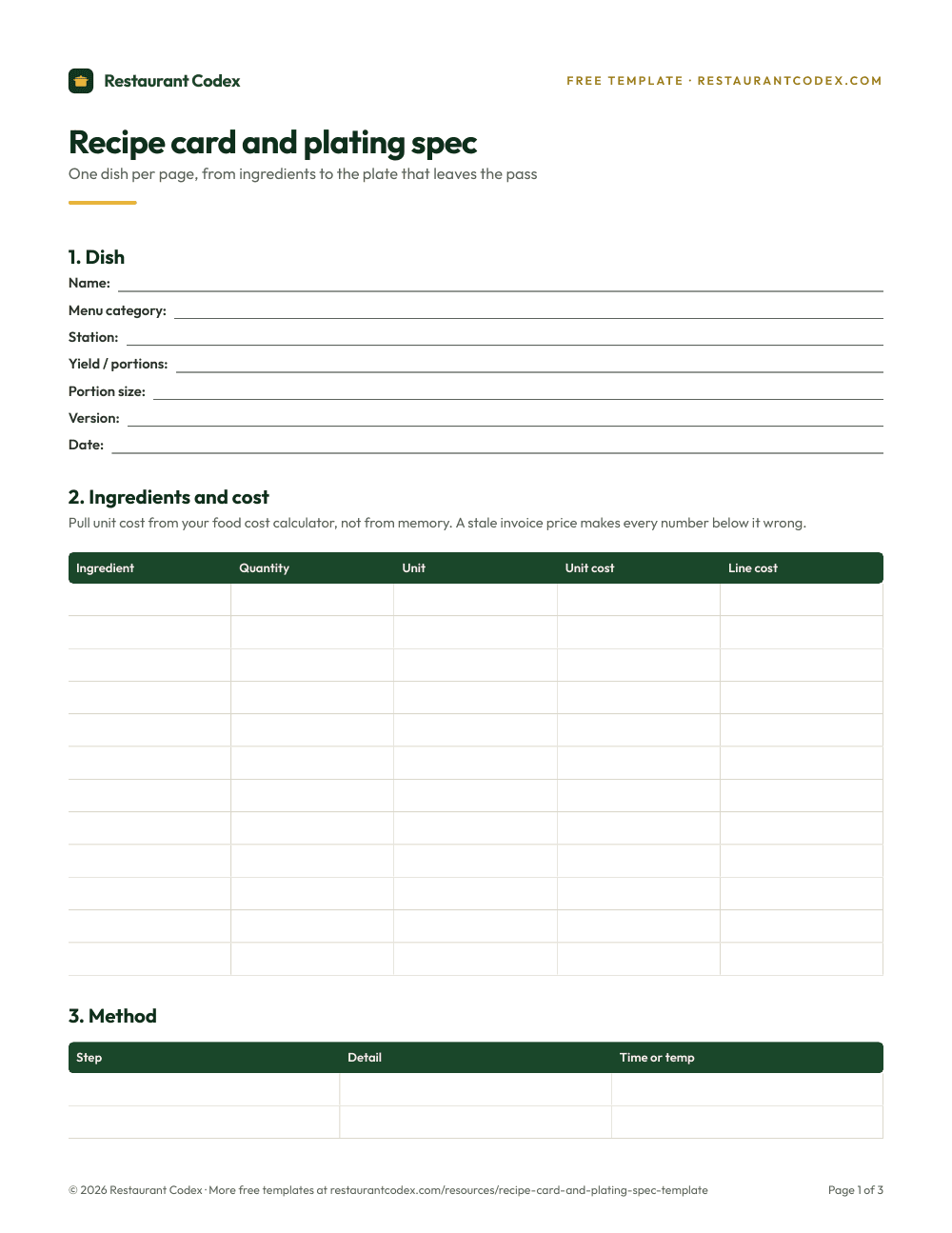
One dish per page, from ingredients to the plate that leaves the pass · 8 sections
What's on the card and how it gets used on a real shift
The chef fills this out once, when the dish is developed or standardized, and it lives in a binder on the line or laminated at the station, not in a shared drive nobody opens mid-service. A new cook learns the dish from this page. A cook who's run the station for two years still checks it when an ingredient lot changes how something cooks, or when they haven't made the dish in a month.
Dish identifies what's being made and which version: name, menu category, station, yield and portion count, portion size, a version number, a date. The version field matters more than it looks. A recipe card with no version number is a card nobody can be sure they're reading the current copy of.
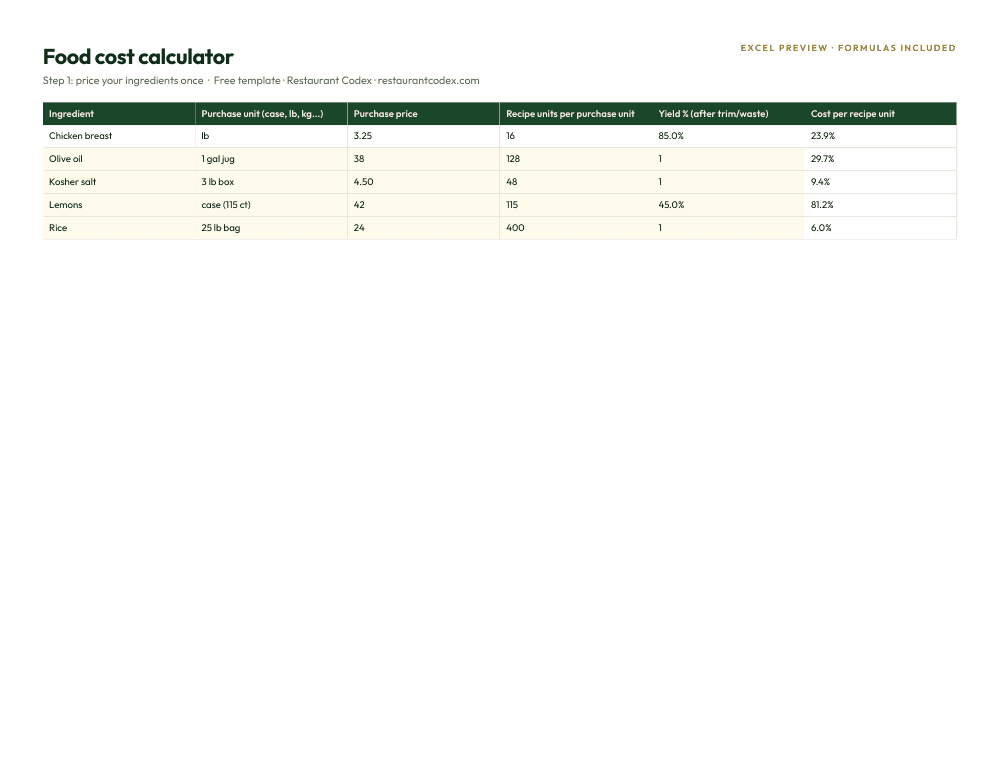
Ingredients and cost is where "a handful of greens" becomes 40 grams of arugula, across twelve rows of quantity, unit, unit cost and line cost. Unit cost comes from your food cost calculator, pulled from a recent invoice, not guessed from what garlic cost six months ago. Weight over volume wherever it matters: a handful varies by hand, but 40 grams is 40 grams on any scale.
Method breaks the cooking into eight steps, each with a detail and a time or temperature, a sequence a cook can glance at with a pan already in hand rather than a paragraph they have to parse mid-rush.
Plating spec is the section almost no free template gets right. A written description of where the sauce goes is a translation exercise, and every cook renders it a little differently. A photo of the finished plate, shot from directly above under the pass light, skips the translation step. Add the vessel, the garnish, where the sauce sits and the finishing touch, plus four rules that hold across every dish: what the guest sees first sits center or forward, every component has exactly one place it lives, wipe the rim before the plate leaves the pass, and hot food goes out on a hot plate.
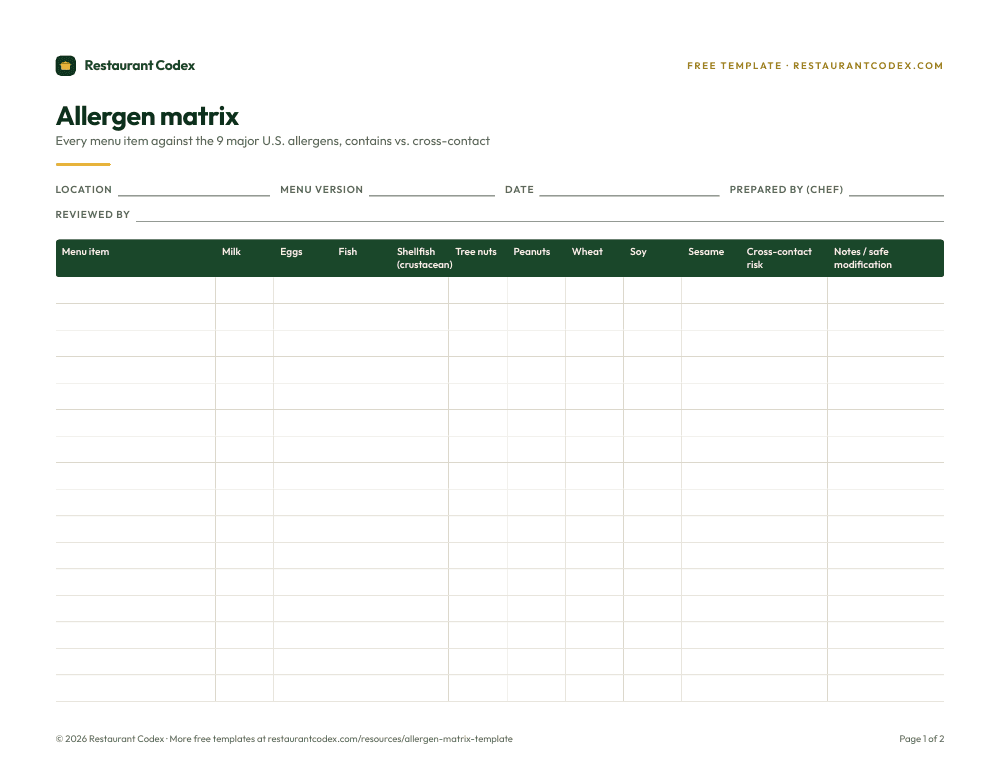
Allergens lists which of the nine major US allergens the dish contains: milk, eggs, fish, crustacean shellfish, tree nuts, peanuts, wheat, soybeans and sesame, the last one added under the FASTER Act starting January 1, 2023. Next to that, cross-contact risk (does this station also handle shellfish) and a safe modification a server can actually offer instead of guessing.
Holding, storage and shelf life puts a number on how long the dish can sit before it's a liability: hold temp (135°F or above hot, 41°F or below cold), max hold time, where it's stored, and what the use-by label says. Not suggestions, the same standard a health inspector checks against.
Costing summary rolls the ingredient table into four numbers: recipe cost, cost per portion, menu price, and the resulting food cost percentage against a target. Sign-off closes the loop with the chef's name and the date, a record of who approved this exact version.
Where the costing numbers actually come from
Cost per portion is the ingredient total divided by yield. That's arithmetic, not judgment. The judgment call is the target percentage you divide into. WhippleWood CPAs, reading National Restaurant Association 2026 data, puts the full-service food cost target between 28% and 35% of the menu price and the current average at 32.4%. A dish that costs $9 to plate prices at $30 against a 30% target, and closer to $25.70 against a 35% target. Neither target is universal: a steakhouse running a $9 protein cost expects a tighter percentage than a pasta dish at the same dollar cost, because price tolerance and perceived value aren't the same thing. The card doesn't make that call. It makes the math visible so the call is a decision instead of a guess.
The plating spec is the difference between a $12 plate and a $22 plate
Two kitchens can spend the same $6 on the same eight ounces of protein and two vegetables. One plates it flat in the center, sauce poured over the top. The other sets the protein off-center, sauce painted in a line underneath instead of pooled on top, the vegetable stacked with height, finishing oil placed with a spoon instead of dumped from a bottle. The ingredient cost is identical. The guest's read of value is not. A restaurant charging $22 for a plate that looks like a $12 plate loses that argument before the food is tasted. The plating spec isn't decoration on the card, it's the part of the document that protects the price you're charging.
Version control, or why "the recipe changed" needs a paper trail
Recipes change. A vendor swaps a product, a chef refines a technique, a cost spike forces a substitution. None of that is the problem. The problem is when the change happens as a conversation on the line that never makes it back to the card, and six months later three versions of the same dish are running depending on who trained whom. Every change gets a new version number and a new date, and the old page comes out of the binder instead of sitting there to confuse the next cook who flips to it. Whoever owns the menu approves the change before it reaches the floor, not after a guest already ate the unapproved version.
Running the same dish across twelve kitchens
A single restaurant can run on a good chef's memory for a while. A group running five, ten, fifty locations can't, because that chef is standing in exactly one kitchen at a time. The card is what travels to the other eleven. It's also what lets HQ tell a location that's drifted from the standard apart from one that's simply run by a careless cook: if the photo, weights and method are all on paper, a district chef can check a plate against the card in the time it takes to plate one dish, instead of tasting and guessing. HQ standardizes the recipe, the weights, the method, the plating photo and the allergen line. Each location adapts sourcing within limits: if store 6 can't get store 1's fish supplier, the substitution and its cost impact go back onto the card as a new version, reviewed and signed off, not run quietly for three weeks before anyone upstream notices the food cost moved.
Where recipe cards fall apart
Five mistakes account for most of the damage. The recipe lives in one cook's head, and when that cook calls out sick or leaves, the dish leaves with them. There are no weights, just volumes and vibes, a splash, a handful, to taste, which guarantees the dish tastes different depending on whose hand did the measuring. There's no photo, so the plating spec is a paragraph every cook interprets a little differently, and the drift compounds over weeks until nobody remembers what the dish first looked like. There's no allergen line, which isn't a paperwork gap, it's a guest who trusts your server's answer and ends up in the ER because nobody wrote down that the sauce has fish in it. And the card's dish name doesn't match what's on the POS or the menu, so when a manager pulls a report showing "Grilled Salmon" sold 40 times last week, the only card on file is "Salmon Filet - Dinner," which may or may not be the same dish.
How Restaurant Codex handles this
On paper, a recipe card is only as current as the last time someone updated the binder. Restaurant Codex keeps the same eight sections digital, the plating photo attached to the card itself instead of taped to a cooler door, version history showing who changed what and when, and unit costs pulled from the same food cost data across every location instead of a spreadsheet someone forgot to update. None of that is required to make the card work. Filled out completely and followed on the line, the paper version does the same job.
Restaurant Codex
The same checklist, on every phone, with photo proof
Restaurant Codex runs this template as a live task with timestamps, photos and one view across every location. Bring it to a 30-minute working session and we'll set it up on your real operation.
Recipe card and plating spec
One dish per page, from ingredients to the plate that leaves the pass · 8 sections
By the Restaurant Codex team
Written with operators who run multi-location restaurant groups. Reviewed against the FDA Food Code and the sources listed below.
Sources
- FDA Food Code 2022, § 3-501.16 Time/Temperature Control for Safety Food, Hot and Cold Holding
- FDA, Food Allergies (9 major allergens under FALCPA and the FASTER Act, sesame added effective January 1, 2023)
- WhippleWood CPAs, Financial Benchmarks for Restaurants, citing National Restaurant Association 2026 State of the Industry data