How do you manage multiple restaurant locations?
You manage multiple restaurant locations by fixing a short list of things that can never vary store to store, giving GMs real authority over everything else, and measuring every location on the same numbers so a drift shows up before it costs you a store. The usual failure isn't one bad month everybody sees coming. It's one location quietly sliding away from the standard for six months while headquarters is busy running the other four.
That drift is the real job of running a group. A five-unit chain's food cost can average a healthy 31%, comfortably inside the National Restaurant Association's 28% to 35% range, while store two runs 27% and store four runs 36%. The blended number looks fine on the P&L. Store four is either over-ordering, under-pricing a new item, or losing product somewhere, and averaging it with three healthy stores is exactly how nobody finds out which.
Two decisions matter more than any software choice. First: what's brand-non-negotiable, recipes, cold-chain temperatures, cash policy, how a server answers an allergy question, versus what a GM can genuinely adjust, a vendor, a staffing model, a local special. Second: who owns updating the non-negotiable list, and how, so "the standard" isn't three slightly different documents saved on three different GMs' phones.
None of this scales through the owner personally visiting every store. An operator who tries to be the standard by showing up in person tops out around five or six locations, and only if the drives are short. The standard has to survive the owner not being in the building that day, or the group has a ceiling built into it before it ever opens a second location.
What has to be identical everywhere, and what can flex by store
Anything with a legal or safety consequence has to be identical, no exceptions for concept, region, or store size. The FDA Food Code sets cold holding at 41°F or below and hot holding at 135°F or above, the same number at a downtown flagship and a strip-mall satellite.
Past safety, the brand-critical list stays short on purpose: the recipes and plating a guest expects to match at any location, the cash-handling and close-out steps, the exact words used on an allergy question, the dollar amount a server can comp without calling a manager. Keep that list under roughly a dozen items.
Everything else belongs to the GM: which vendor gets this week's order, how the schedule gets built around a slow Tuesday, which two items run as specials off the printed menu. Groups that try to centralize vendor choice or staffing models usually learn the hard way that a downtown dinner rush and a strip-mall lunch rush don't run on the same clock, and forcing both to pretend otherwise makes each one worse.
What software do multi-location restaurants need for consistency?
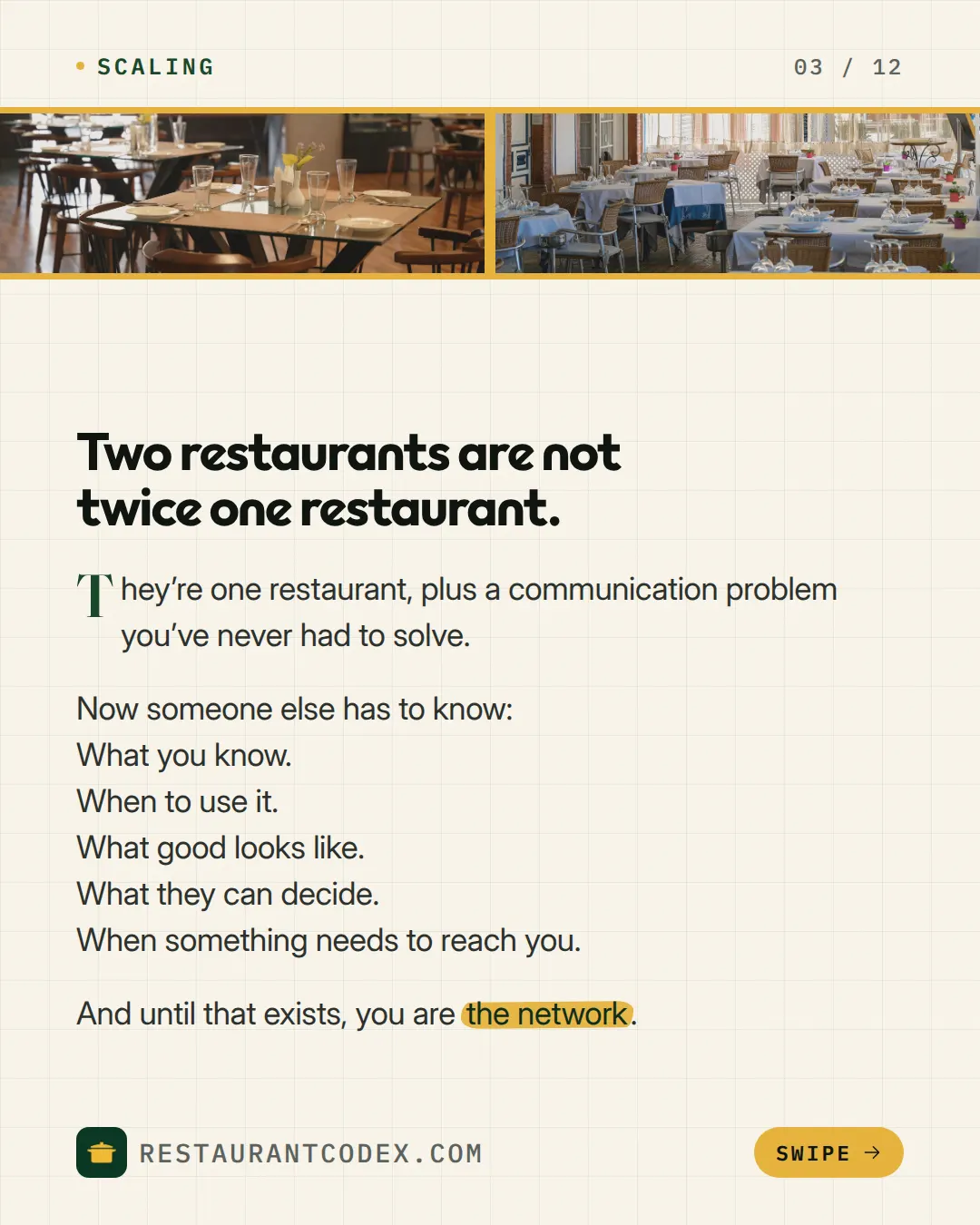
Multi-location restaurants need software that gets a standard update to every store on the same day and tells headquarters, without a phone call, which store hasn't acted on it. A recipe in a binder or a PDF emailed to a dozen GMs isn't a standard. It's a suggestion with a distribution list.
The stakes are higher than they look, because the industry doesn't hold still long enough for a paper system to keep up. The accommodation-and-food-services sector's monthly separation rate ran at 5.2% for the month of July 2026, an annual pace north of 60% against roughly 43% economy-wide, per the Bureau of Labor Statistics' JOLTS data. At that pace, "everyone already knows the standard" is never actually true at any store on any given week; software has to assume a third of the floor is new.
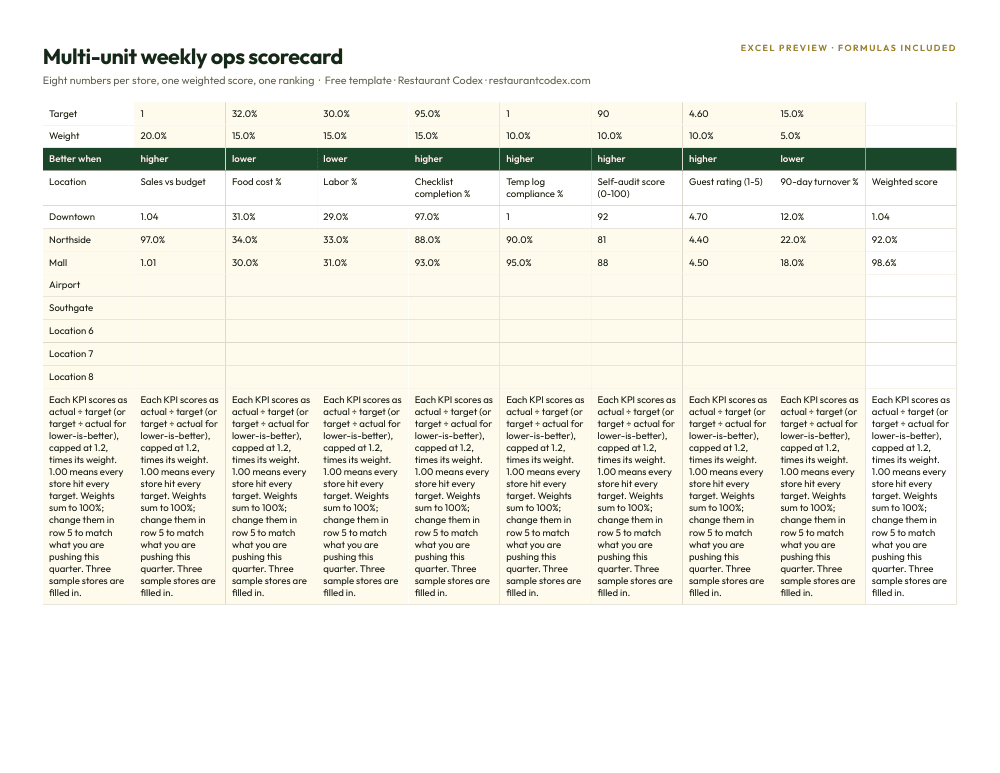
Three things matter more than which vendor's logo sits on the login screen. One, a single, versioned source of truth for recipes, SOPs and training, so a GM can't keep quietly running last quarter's allergy script because their store never got the update. Two, task and checklist completion that's provable with a timestamp or a photo, not just self-reported. Three, a dashboard that puts every location on the same ruler, food cost against food cost, checklist completion against checklist completion, so the conversation about store four starts from a number instead of a hunch. In practice that means a GM opens one screen and sees the same eight or ten numbers for every store in the group, not three separate systems exported into a spreadsheet the night before a Monday meeting. That's the same job an operations system and a shared knowledge base split between them.
What belongs on a restaurant daily operations checklist?
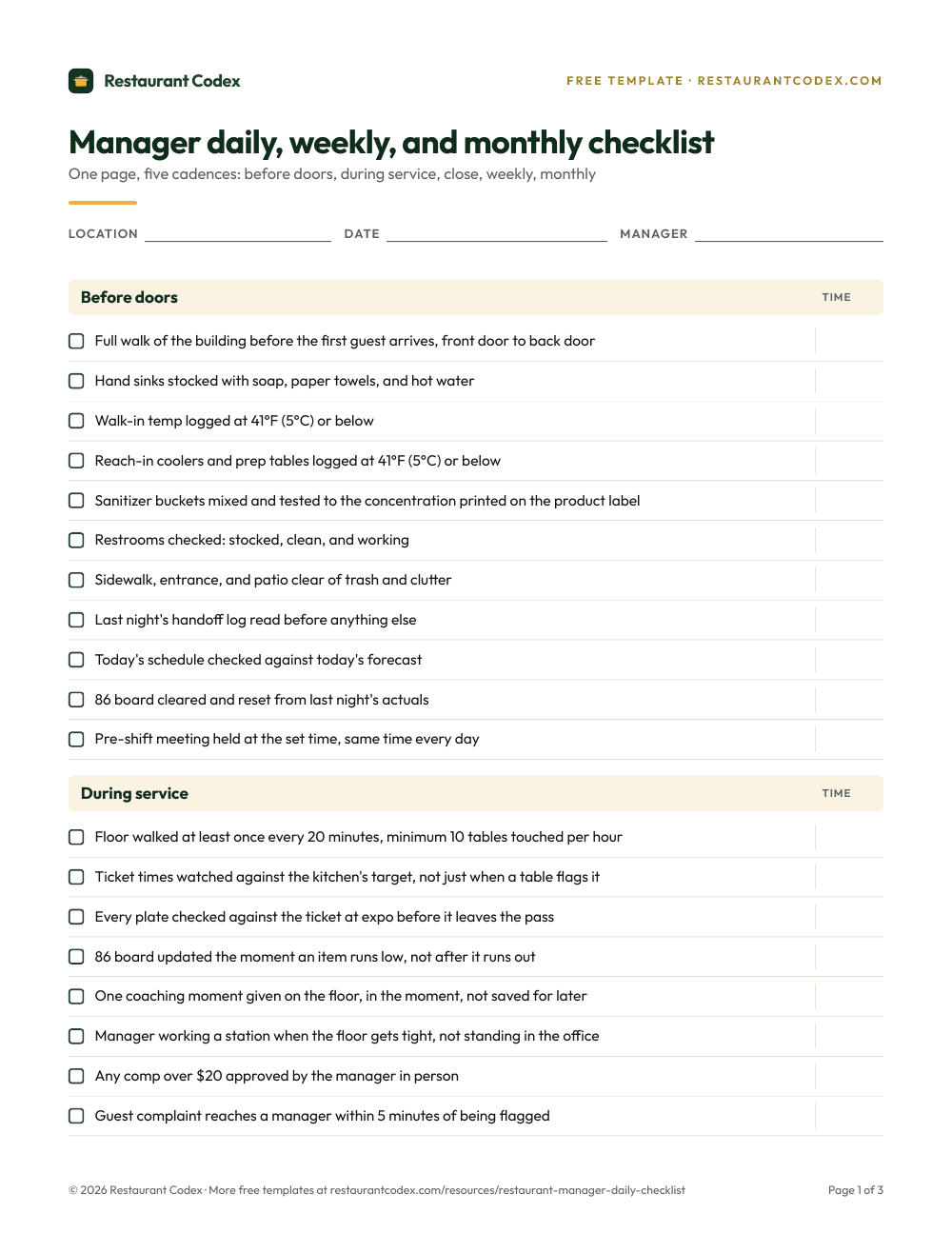
A restaurant daily operations checklist splits four ways, FOH opening, BOH opening, mid-shift and close, with no more than about 25 critical items per role so it still gets finished on the group's worst day. One list trying to cover FOH, BOH and management across open, mid-shift and close turns into ten pages nobody reads start to finish, and an unread checklist gets checked off without being done.
FOH opening covers guest-ready dining rooms, beverage-station readiness, side-work assignments and the allergy line to the kitchen. BOH opening covers cold-chain temps against that same 41°F line, line mise en place, sanitizer levels and prep against par. Mid-shift stays deliberately thin: restroom checks, line organization, a spot-check on anything holding hot or cold. Close resets the building to a safe baseline: anything held overnight gets cooled and labeled, waste gets logged, equipment shuts down correctly, cash reconciles, doors lock.
Keep each role's list under roughly 25 critical items. Past that point, people start pencil-whipping it, initialing lines they didn't actually check, because finishing the paper quietly became the job instead of finishing the work. If a role genuinely needs more than 25 items covered, that's a sign to split the role or move the deeper tasks to a weekly rotation instead of a daily line.
A worked example: six stores, one Monday morning
Take a six-store group reviewing last week's numbers on a Monday morning. Blended across all six, food cost reads 30.5% and labor reads 35.3%, both comfortably inside the National Restaurant Association's healthy ranges. Prime cost blends to 65.7%, just over Restaurant365's 60% to 65% ceiling for full-service, close enough that it doesn't jump out at anyone glancing at one number.
| Store | Food cost | Labor | Prime cost |
|---|---|---|---|
| 1 | 29.0% | 33.5% | 62.5% |
| 2 | 28.2% | 32.8% | 61.0% |
| 3 | 34.8% | 35.0% | 69.8% |
| 4 | 30.5% | 34.9% | 65.4% |
| 5 | 29.5% | 41.2% | 70.7% |
| 6 | 30.8% | 34.1% | 64.9% |
| Group average | 30.5% | 35.3% | 65.7% |
Broken out, two stores tell a different story than the average. Store 3 is running food cost at 34.8%, just under the 35% ceiling and trending up for three weeks straight. Store 5 is running labor at 41.2%, close to five points over the 36.5% full-service median, because a new GM has been over-scheduling out of nerves instead of trusting the forecast.
Neither store is in crisis. Both are, at the blended level, invisible. An owner looking only at the six-store average has no reason to call either GM this week. Looking store by store, the conversation with store 5 is a fifteen-minute schedule review today, not a P&L emergency in six weeks.
What changes financially once you're running more than one store
The math per store doesn't change when you add a second location. Food cost, labor cost and prime cost still get measured the same way, against the same targets, at every store. What changes is that one missed target stops being a single P&L problem and starts being a pattern question: is store 5's labor overage a one-off bad week, or the same mistake store 2 made in its first quarter, never written down anywhere for the next GM to avoid.
Profitability makes the stakes concrete. Only 42% of U.S. restaurants were profitable in 2024, per the National Restaurant Association's 2026 State of the Industry data. A group running five stores at that industry-wide rate isn't really running one business with five outlets, it's running five separate bets, and the industry's own numbers say more of those bets lose money than make it. The one edge a group has over five unrelated independents is catching a store sliding toward the wrong side of that number weeks before an independent owner, working alone with a profit margin calculator and a gut feeling, would notice.
Labor tracks the same pattern as food cost. The full-service median runs 36.5% of sales and profitable operators hold it closer to 34.2%, per the same National Restaurant Association 2026 data. They tend to be the operators who catch a schedule built on nerves instead of forecast within the week it happens, not months later in a financial review that's already too late to help the store that needed it.
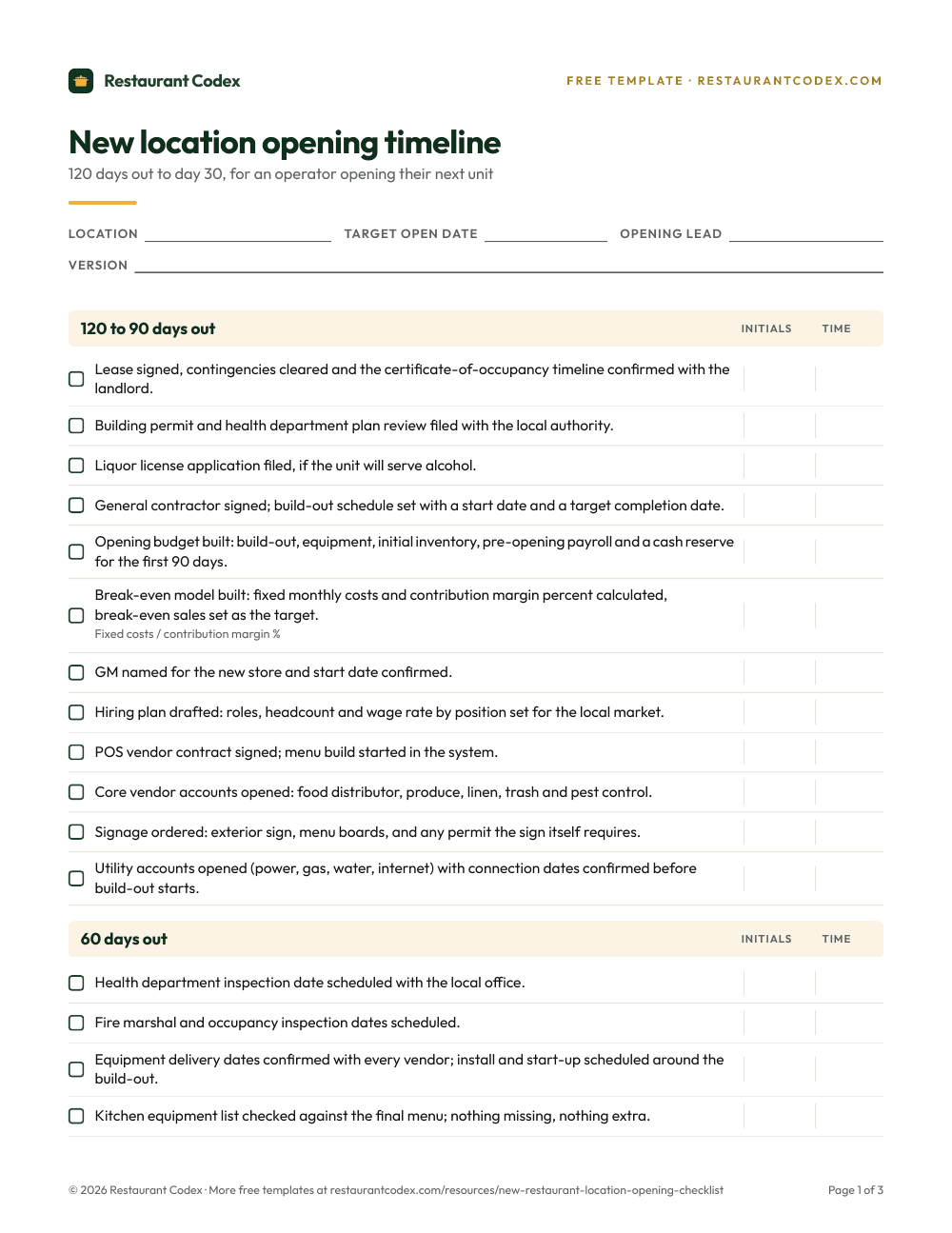
That's also the real case for opening a third or fourth location at all. A store that hits its numbers doesn't just prove the concept works, it proves the standard is transferable, which is the actual asset a growing group is selling to itself every time it signs another lease.
Where multi-location groups lose control
The single most common way a group loses control is treating the standard as a document instead of a process: a PDF gets written once, emailed around, and never revisited while actual practice at each store drifts from it within a year. Four more mistakes account for most of the rest.
The second is centralizing the wrong things. Corporate mandates one vendor or one staffing template across stores with genuinely different volumes and neighborhoods, and GMs either comply badly or quietly route around it, which does more damage than never mandating it in the first place.
The third is measuring stores on different rulers. One GM's food cost includes a manager's comp meal, another's doesn't; one counts a house account as revenue, another books it as a discount. The numbers look comparable in a spreadsheet and aren't, and every decision built on comparing them is built on nothing.
The fourth is tribal knowledge that never gets written down: the walk-in that runs two degrees warm, the vendor who's late every third Thursday, the local health inspector who flags things nobody else does. That knowledge leaves with the GM who quits, and the next one rediscovers it the hard way, usually mid-shift.
The fifth is having no verification loop at all. A checklist gets built and rolled out, and nobody ever checks whether it's getting done or just initialed. A standard that's never audited turns into a suggestion within a quarter, no matter how carefully it was written the first time.
Where Restaurant Codex fits
Restaurant Codex is built around orgs, locations and roles, so a recipe, an SOP or a training update publishes once and every store inherits it the same day, with a record of who's completed it and who hasn't. The daily checklist, the shift handoff and the weekly scorecard all live in one place instead of a binder per store and a group text for the rest. None of that is required to run a multi-location group well. It's what the group above did anyway, minus the phone calls.
Restaurant Codex
The same checklist, on every phone, with photo proof
Restaurant Codex runs this template as a live task with timestamps, photos and one view across every location. Bring it to a 30-minute working session and we'll set it up on your real operation.
By the Restaurant Codex team
Written with operators who run multi-location restaurant groups. Reviewed against the FDA Food Code and the sources listed below.
Sources
- National Restaurant Association 2026 data via WhippleWood, Financial Benchmarks for Restaurants
- Restaurant365, How to Calculate Prime Cost in a Restaurant
- FDA Food Code 2022, cold holding 41°F or below / hot holding 135°F or above
- FRED (Federal Reserve Bank of St. Louis), Total Separations: Accommodation and Food Services (JTS7200TSR)