How do you run a restaurant shift meeting?
A restaurant shift meeting, also called a pre-shift or a lineup, is a short standing huddle before doors that aligns the floor on what's different tonight, not a lecture and not a training session. Most guidance on this, including TouchBistro's pre-shift meeting template, puts a huddle at 5 to 15 minutes; run it longer and you start losing the room before doors even open (TouchBistro, Pre-Shift Meeting Template Guide).
A huddle that actually works answers four questions, in this order. What's different tonight: a private event, a large party, a promo running, a staffing gap, an oven that's been acting up all week. What can't break: allergen communication, the day's 86s, VIP steps of service, any cash or security quirk that's live right now. Who needs help: the new cook on saute, the server covering an extra section, the bartender running an unfamiliar build for the first time. What does done look like by close: a sell-through target on tonight's feature, a table-turn goal, the cleanliness bar for that particular night.
Keep it standing. A huddle where people sit down tends to run twice as long, because sitting invites the second story nobody has time for. One voice leads it, usually the manager on duty, or expo on a heavy kitchen night, while everyone else listens and asks rather than takes turns narrating. A teachable moment gets thirty seconds from one person, not the whole circle.
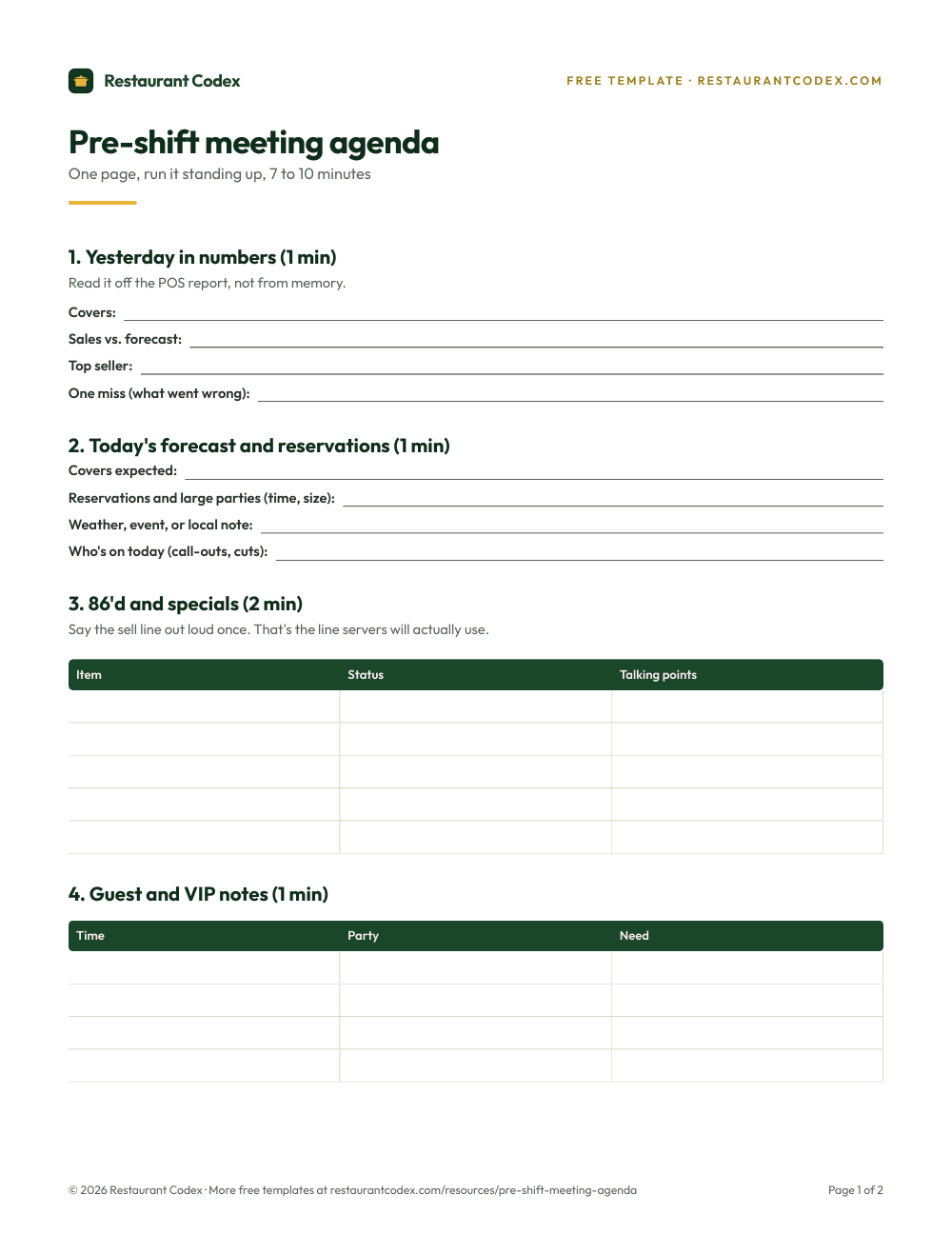
Close the loop in a system, not in memory. If the fryer's been temperamental, if a guest recovery needs a follow-up call tomorrow, if prep came up short on a key item, that becomes a task with an owner and a due time before the first table sits, not a mental note that's gone by 9pm.
What are restaurant shift handoff best practices?
A restaurant shift handoff works when the outgoing lead delivers a short list of facts instead of impressions, and the incoming lead acknowledges receiving them in writing instead of with a nod on the way out the door. The facts that matter: cold-chain status and anything close to its threshold, active 86s and when they're expected back, equipment behaving oddly, a guest-recovery promise made and not yet fulfilled, a training or behavioral flag that needs follow-up, and any cash or safe exception under house policy.
Ban the hallway handoff during a rush unless it's backed by something written down. "I told them about the walk-in" isn't a handoff if the person you told was slammed on the line and caught half of it. A verbal pass with nothing behind it turns into an argument two days later about who said what.
Structure removes most of the drama. A Friday-to-Saturday transition, a brunch-to-dinner swap, and a BOH-to-expo handoff each have their own recurring shape, and a template for each prompts the fields people forget under pressure: the fryer quirk, the walk-in alarm that tripped twice, the vendor that short-shipped limes, the table that isn't technically a VIP but needs a quiet check-in anyway.
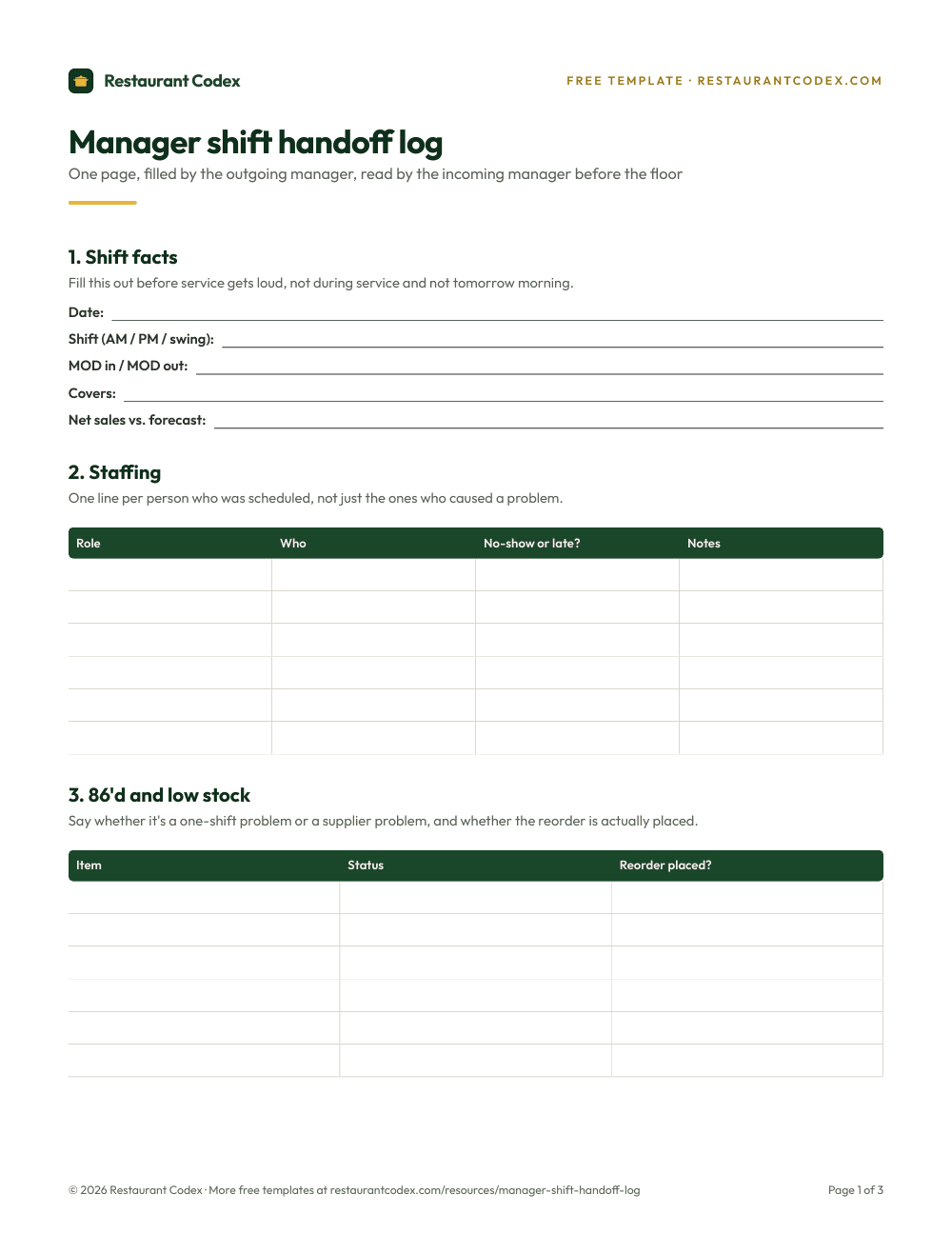
The receiving lead's acknowledgment matters as much as the outgoing lead's notes. A handoff nobody confirms receiving is just a note someone left for themselves. When both sides sign or check off the pass-down, accountability sits with two people instead of turning into a blame match the next time something goes wrong.
How do you improve kitchen line management?
Kitchen line management comes down to keeping five things fixed before the first ticket fires: honest prep gates, staging rules that remove interpretation, one expo voice, calm standard call language, and an honest 86 the moment an item stops being viable. It's choreography under stress, and the goal is predictable flow, not heroic volume on a Friday night.
Prep gates go first because they're objective, not a feeling. If mise is short or a station isn't stable, fix it before the board lights up, or the kitchen pays for it twice during the rush instead of once during setup. Staging rules remove the guesswork that turns into arguments: where a plate sits between the char station and pickup, how long it waits before it needs a refire instead of a garnish touch-up, how a modifier lands in the right cook's head without someone shouting down the line to confirm it.
Expo runs air traffic control. One primary voice, one call language everyone's trained on until it's reflex, and honest communication the second an item isn't viable. Coach a team to hide a delay instead of calling it early and you get the exact cascading ticket pileup that training was supposed to prevent, because the guest finds out anyway, just forty minutes later and angrier about it.
There's a food-safety edge to line pacing, not just a quality one. Hot-held food has to stay at 135°F (57°C) or above (FDA Food Code, 2022), and a backed-up pass isn't just cold and sad on the plate. It's food drifting toward a range the health code doesn't allow it to sit in. A line that moves is a compliance tool as much as a service one.
Coach calm communication the way you'd coach knife technique: short phrases, priority order, respect for whoever's on the other end. LMS micro-lessons paired with plating photos in a shared reference beat yelling louder as a training plan, and they're the kind of thing that survives a staffing change.
What should be on a restaurant opening and closing checklist?
A restaurant opening and closing checklist needs role-based sections, not one master list: opening back of house, opening front of house, a pre-service line check both sides do together, and a closing sequence covering cooling, cash, equipment shutdown and a manager close, each line with an owner and a time next to it. One 50-item list handed over at 5pm doesn't get finished. Six shorter lists, each handed over at the point in the shift where it actually applies, do.
Opening BOH typically owns walk-in and reach-in temperatures, line mise, fryer and flat-top readiness, and sanitizer strength tested with a strip, not eyeballed. Cold holding has to sit at 41°F (5°C) or below, and hot holding at 135°F (57°C) or above; those two numbers, and the two-stage cooling rule behind them, 135°F (57°C) down to 70°F (21°C) within two hours, then to 41°F (5°C) or below within the next four, come from the FDA Food Code, not house preference (FDA Food Code, 2022). Opening FOH owns the dining room, beverages, POS readiness, a floor walk, and any allergen setup the kitchen needs communicated before the first table sits. Since the FASTER Act made sesame the ninth major US allergen effective January 1, 2023, a pre-service line check still built around eight allergens is out of date (FDA, FASTER Act).
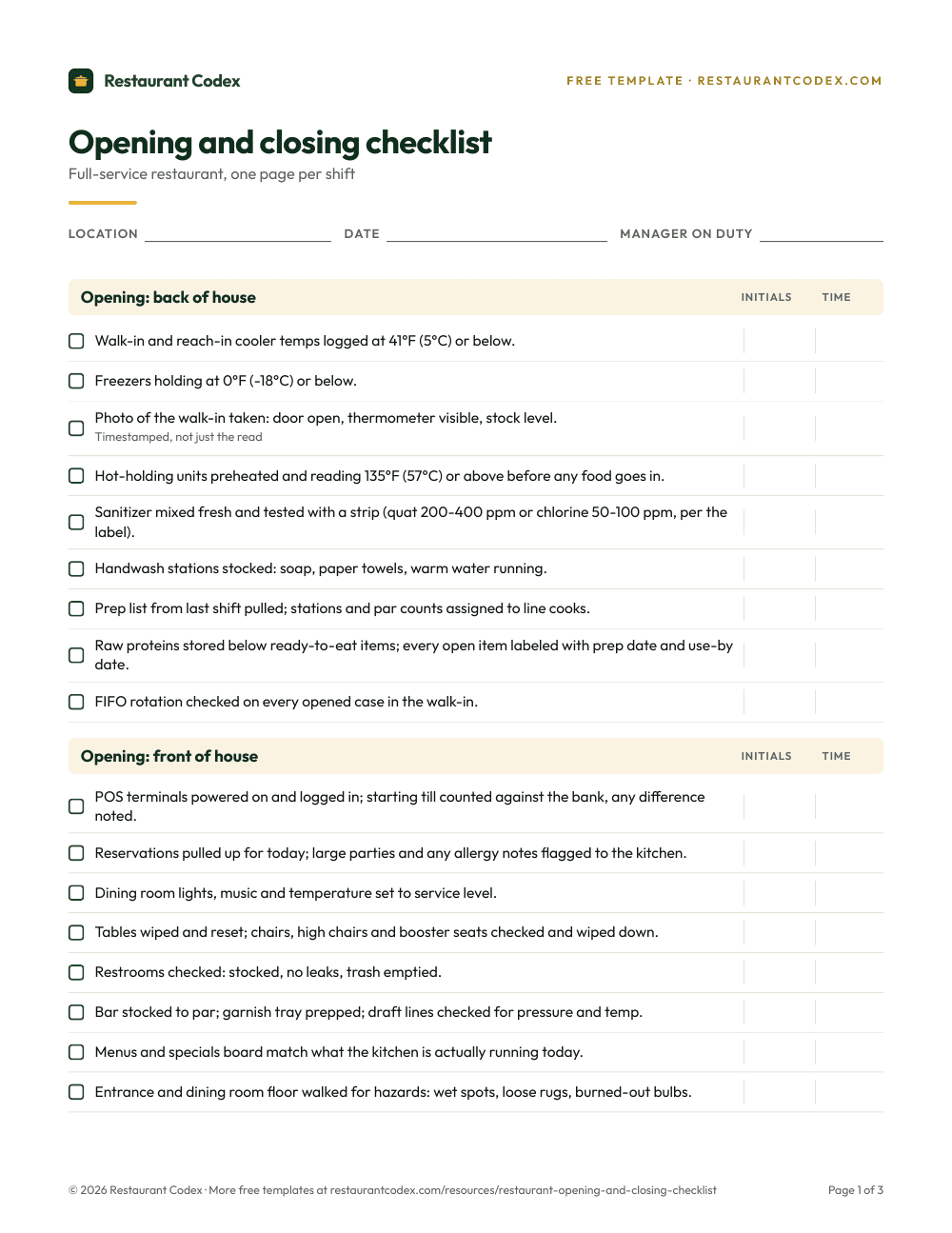
Closing is where restaurants lose money and invite violations, and it earns more structure than opening does, not less. Standardize breakdown, the cooling and labeling rules above, waste capture, oil filtration where it applies, cash procedures with a two-person check where policy requires it, alarm set, lockup, and a final photo walk of the spots that cause arguments later. Keep deep-cleaning rotations separate from the nightly close, or close stops being finishable inside a normal shift.
A Friday close, worked through
Take a full-service restaurant on a normal Friday. Pre-shift runs at 4:30, ten minutes, standing, covering a rehearsal dinner in the private room, a fryer that's been cycling oddly, and a floor gap because a server called out. A mid-shift handoff happens at 9 when the closing manager comes on.
| Time | What happens | Who owns it |
|---|---|---|
| 4:30pm | Pre-shift huddle, 10 minutes, standing | Manager on duty |
| 5:00pm | Doors open | Whole floor |
| 9:00pm | Mid-shift handoff to the closing manager | Outgoing and incoming lead |
| 11:00pm | Close begins: cooling logged in real time, till counted twice | Closing manager |
| Midnight | Manager close signed, sheet filed | Closing manager |
The 9pm handoff is where the shift either holds or slips. The outgoing lead notes the walk-in read 43°F (6°C) at 8pm, two degrees over, already flagged for the technician. Written down and acknowledged, the closing manager plans around it. Left verbal in a rush, the closing manager finds out at 11:45 with no time left to move product before the cold-chain window actually matters.
Money sits behind this, not just risk. Full-service labor runs a median 36.5% of sales and profitable operators hold it closer to 34.2% (NRA 2026 restaurant benchmarks, via Whipplewood). In our experience the gap is rarely raw hours. It's chaos to staff around: refires, comped tables from a missed handoff, people standing in a huddle that ran twenty minutes instead of ten. A tight shift rhythm is a labor-cost lever as much as a service one.
Running shift management across multiple locations
Across several locations, headquarters owns the shape of the four rituals and each GM owns what's local to their building, and the group compares completion rather than content. At two locations an owner can sit in on both huddles and read both closing sheets personally. Past four or five that breaks, which is exactly where single-location templates fall apart, because they assume one building and one person checking the work.
HQ should own the structure that doesn't change store to store: the four huddle questions, the six checklist sections, the 41°F (5°C) cold-holding threshold, the two-person cash rule, the handoff fields nobody's allowed to skip. Each GM adds what's actually local: a second walk-in, a patio close, a specific alarm code, a staffing quirk that store deals with and others don't. What HQ shouldn't let drift is the core lines that define "done" the same way everywhere.
The other half is comparing completion, not just content. A store that finishes its close in nine minutes flat, every night, for a month, is either extremely well run or not actually checking anything, and the sheet alone won't say which. Once the rituals run the same shape across stores, what shows up is which locations skip the same lines, and whether that's a training gap or a staffing one. That's the piece a multi-location group needs that a single-unit owner mostly doesn't, and it's worth tracking on the same weekly review as a manager's daily checklist.
Mistakes that turn shift rituals into busywork
The huddle becomes a lecture. Ten minutes standing turns into twenty sitting once someone starts telling a story, and by week three the team starts arriving two minutes late on purpose to skip it.
The handoff stays verbal during a rush. "I told them" isn't a handoff if the person you told was slammed and only caught half of it. Two days later nobody agrees on what was actually said, and the blame lands wherever it's loudest.
Expo hides a delay instead of calling it. Training a line to protect the guest from bad news creates the exact ticket pileup and furious table it was meant to prevent, just later and worse.
The checklist gets filled in from memory at 11:59pm. Every box checked and every initial signed in the last five minutes before someone leaves teaches the whole team the sheet is theater, not a record, which is exactly why a time column next to each line matters more than the checkbox does.
No line has an owner. "Close the bar" with nobody's name on it turns into three people assuming someone else did it, which is how a walk-in door gets left cracked open overnight.
How Restaurant Codex ties shift management together
We built the huddle, the handoff, the checklist and the line notes as one connected system instead of four separate habits. A pre-shift task pulls that night's 86s and VIPs automatically, a handoff note becomes a task with an owner the moment it's written, and every opening and closing line gets a timestamp and, where it matters, a photo, so a GM or owner can see every location's shift from one screen instead of four binders and a group text.
Restaurant Codex
The same checklist, on every phone, with photo proof
Restaurant Codex runs this template as a live task with timestamps, photos and one view across every location. Bring it to a 30-minute working session and we'll set it up on your real operation.
By the Restaurant Codex team
Written with operators who run multi-location restaurant groups. Reviewed against the FDA Food Code and the sources listed below.