How do you improve food safety compliance in a restaurant?
Compliance improves when every rule becomes a task with a name, a time and a number attached, not a laminated poster nobody reads twice. Start by listing the controls that actually apply to your menu: receiving temperatures, cold holding, cooking, hot holding, cooling, reheating, sanitizer strength, date marking, allergen handling and employee illness reporting. Turn each one into a task pattern: who does it, when, what they measure, what they do if the number is wrong, and what proof they leave behind.
Train to the exact numbers the tasks use. If the training video shows one cooling method and the line runs another, the program was never real, it just looked real on paper. Review weekly with a short scoreboard: tasks missed, repeat deviations, corrective actions that never closed out, and self-audit scores moving up or down. Put a name next to every line on that scoreboard, because a metric nobody owns doesn't move.
Digitizing the checks doesn't replace training or a chef's judgment about what's risky on a given menu. It replaces the argument over what actually happened at 11:40 on a Tuesday close, because a timestamp and a photo settle a dispute two people's memories can't.
What should a restaurant food safety audit checklist include?
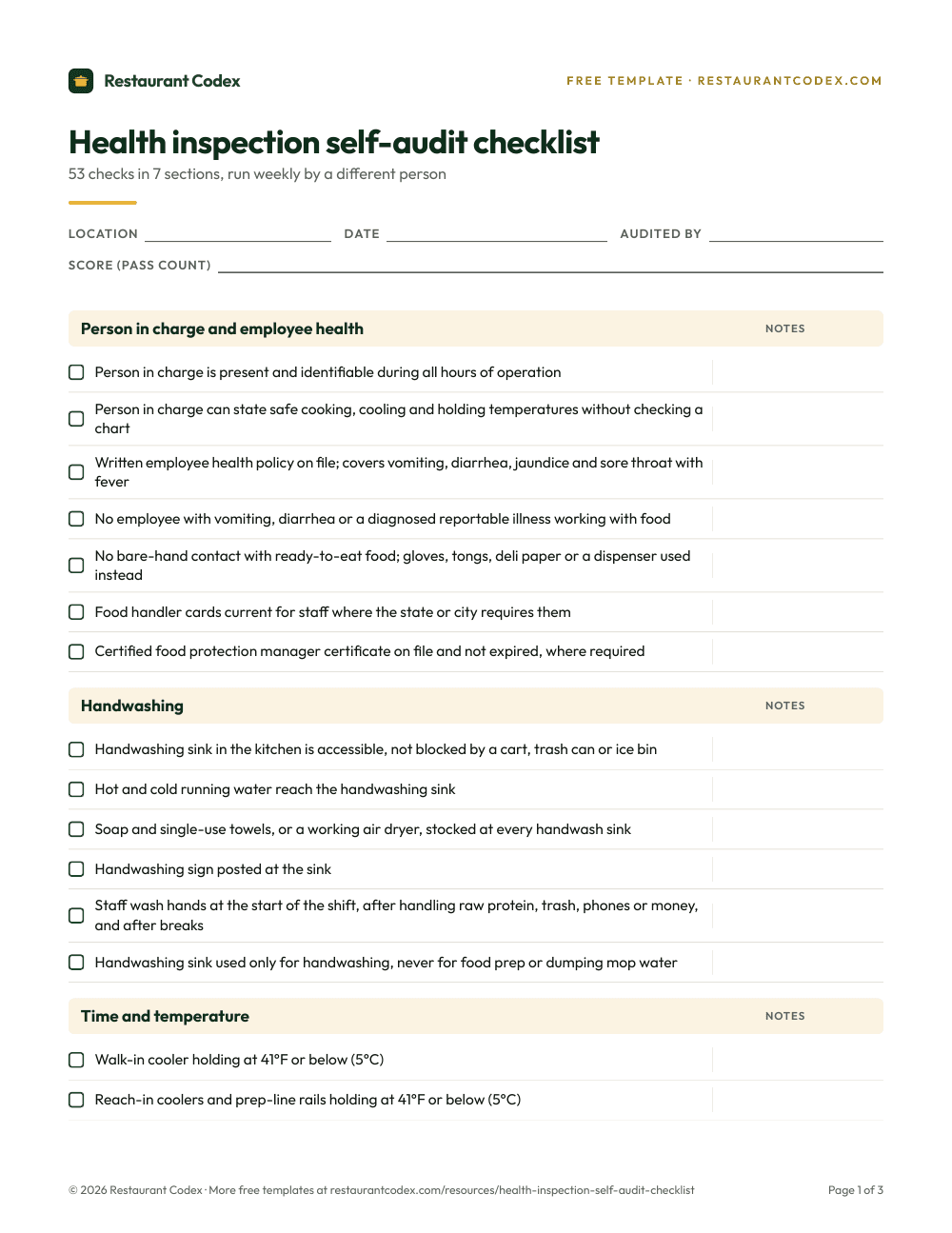
A self-audit should walk the same path an inspector walks, the flow of food from the back door to the plate, not a list organized by department. Start at receiving: truck temperature, package integrity, whether the delivery date matches the invoice. Move to storage: raw stored below ready-to-eat, first-in-first-out actually followed, cold units holding at 41°F (5°C) or below, every open container date marked. Check thawing methods, because thawing on the counter is still the most common shortcut on a rushed night.
Then prep and service: bare-hand contact with ready-to-eat food, glove changes between raw and cooked, a working thermometer within reach of the line. Cooking and hot holding: hot units holding at 135°F (57°C) or above, not judged by how a pan looks. Cooling and reheating deserve their own line items, since tired teams cut corners there first. Cleaning and sanitizing: test strips in date, sanitizer mixed to strength, not just topped off. Facility: hand sinks stocked and reachable, not blocked by a bus tub. Employee health: a manager who can state the illness-reporting policy without looking it up.
Score it. A single low mark on a Tuesday is usually training. The same line failing three weeks running is a system problem, not a person problem.
Cold, hot and cooling: the numbers a program is built on
The FDA Food Code 2022 sets cold holding at 41°F (5°C) or below, hot holding at 135°F (57°C) or above, and a two-stage cooling rule of 135°F down to 70°F within 2 hours, then 70°F down to 41°F or below within 4 more, 6 hours total from the pot coming off the heat. Those three carry more weight on an inspection than everything else on the sheet combined, because they sit closest to actually making someone sick. Food held between the holding numbers sits in what health departments call the danger zone.
That split exists because a stockpot doesn't cool evenly. The surface can read cold while the center is still warm enough to support bacterial growth for hours. An ice bath, a shallow-pan split or a blast chiller adds surface area and speeds the drop; a full pot left on a shelf in the walk-in usually misses the first checkpoint.
| Control | FDA Food Code 2022 standard | Where it usually fails |
|---|---|---|
| Cold holding | 41°F (5°C) or below | Door propped during a rush, unit not rechecked after |
| Hot holding | 135°F (57°C) or above | Steam table set to "warm," never checked with a probe |
| Cooling, stage 1 | 135°F to 70°F within 2 hours | Full pot cooling whole instead of split into shallow pans |
| Cooling, stage 2 | 70°F to 41°F or below within 4 more hours | Missed because stage 1 already ran late |
How do you manage allergens in a restaurant?
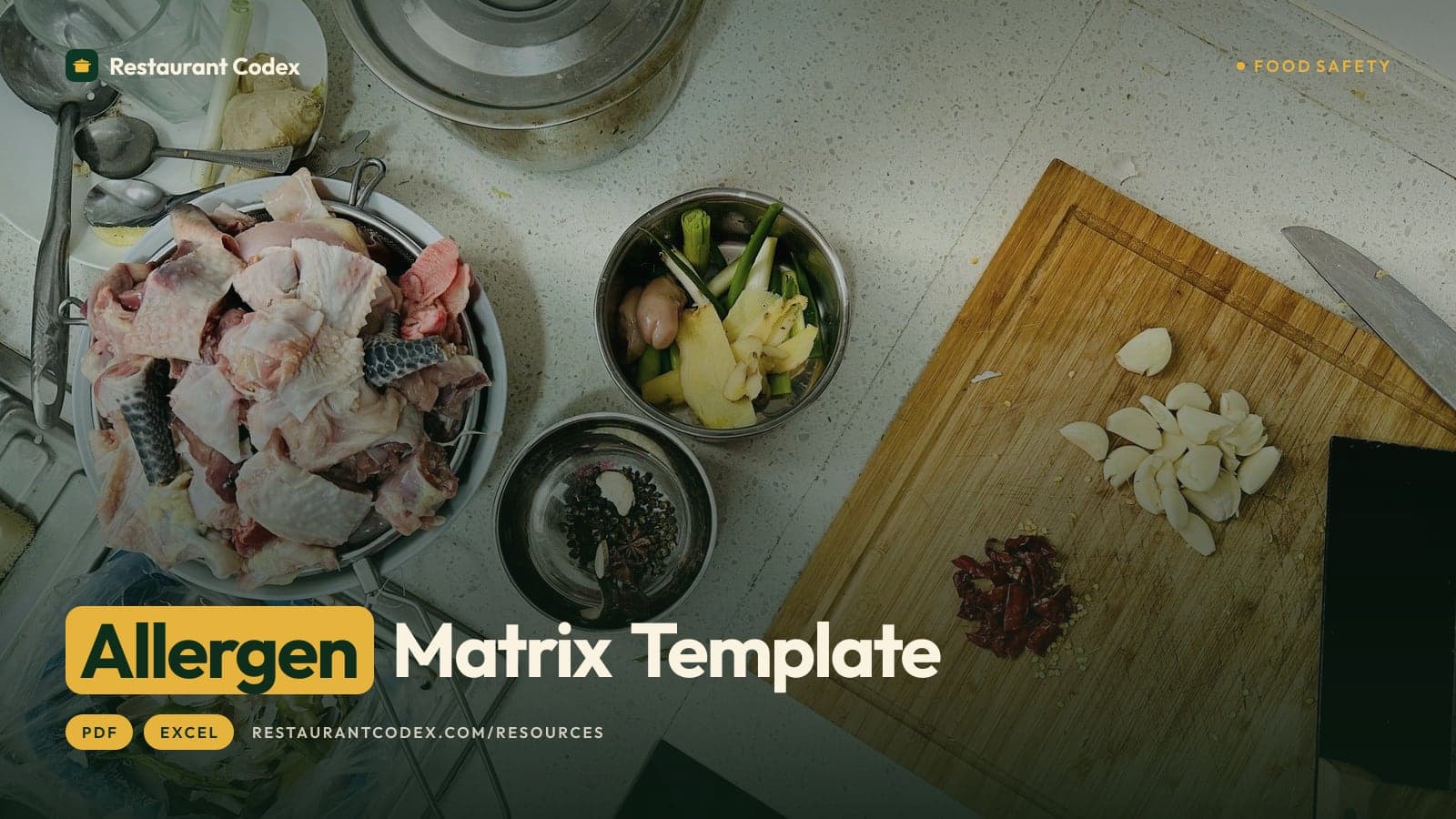
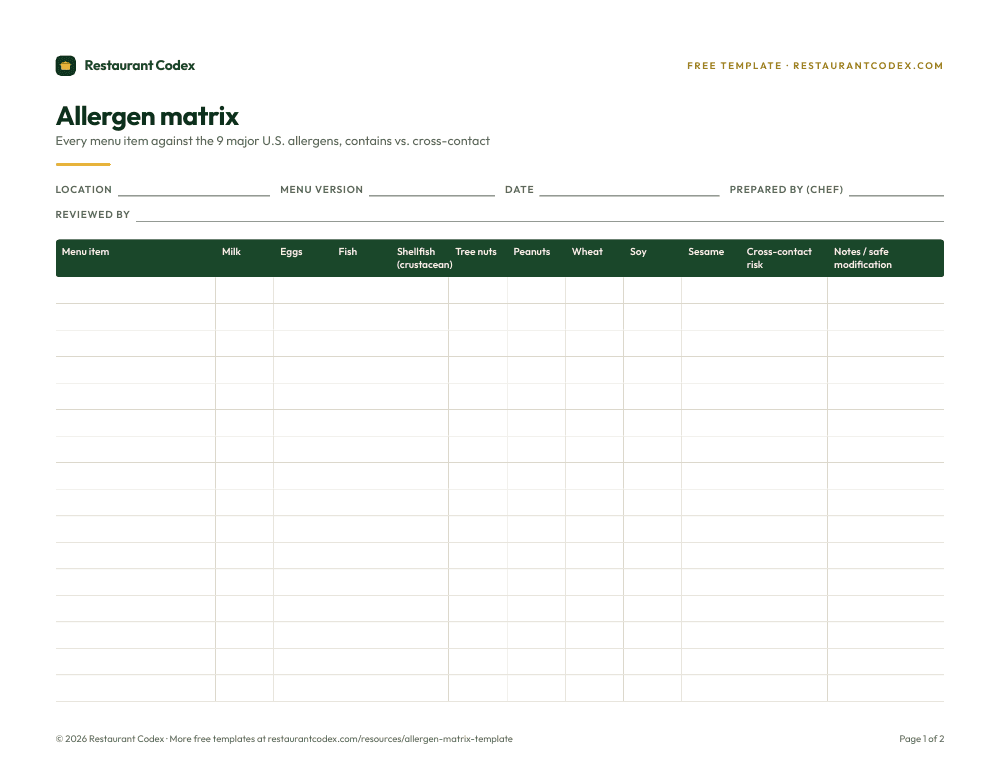
Allergen management is closing the gap between what the kitchen knows and what the server says at the table, before service starts, not during it. The FDA recognizes 9 major food allergens: milk, eggs, fish, crustacean shellfish, tree nuts, peanuts, wheat, soy and sesame, with sesame added as the ninth by the FASTER Act, effective January 1, 2023. A matrix that lists every menu item against those nine, checked at the ingredient level rather than the dish name, is what lets a server answer a guest in under thirty seconds instead of walking back to ask the chef mid-rush.
Two different questions live on that matrix. Does the dish contain the allergen as a real ingredient? And could it have touched the allergen on its way to the table, a shared fryer, a shared cutting board, the same tongs? A guest with a severe allergy generally can't accept either answer marked yes.
Treat every substitution as a system event. A new bread vendor, a new case of oil, a swapped dressing, any of those can add or drop an allergen without the dish's name on the menu ever changing, and the matrix has to update that same day, not at the next menu reprint.
How do restaurants apply HACCP principles with digital tools?
HACCP, hazard analysis and critical control points, is a thinking system: find where a process can fail, set a measurable limit at that point, watch it, fix it when it slips, and keep a record an inspector can follow without asking you to explain it. It runs on seven steps: hazard analysis, identifying critical control points, setting critical limits, monitoring, corrective action, verification and recordkeeping, the same structure the FDA Food Code builds its HACCP-based procedures around.
Digital tools are strongest on the back half of that list, monitoring and records. A critical limit becomes a task with a clock: a cold-holding check due every few hours, a cooling checkpoint due at the two-hour mark, a sanitizer test due before service. The system can require the corrective action your plan already names the moment a reading crosses a limit, rather than leaving it to whoever's on shift to remember what the SOP says.
What digital tools don't do is decide which points in your process are actually critical. That judgment, whether a given prep step needs a control point at all, still belongs to someone who understands the menu and the kitchen. Software enforces a plan once a person has written it; it doesn't write the plan.
Why digitize restaurant temperature logs?
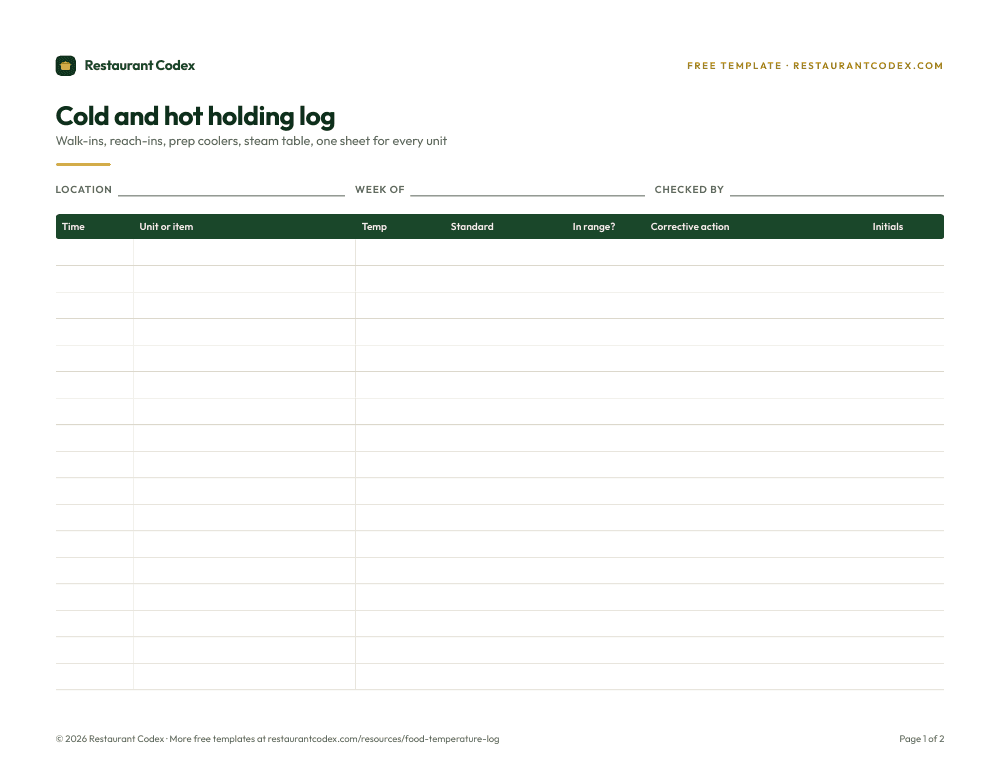
Digitizing temperature logs closes three specific holes paper leaves open: numbers written down after the fact instead of at the unit, handwriting nobody can read six weeks later, and pages that go missing the day an inspector or a guest's attorney asks for them. A digital log timestamps the entry, attaches whoever's logged in, and can require a photo of the reading, which settles a dispute that two people's memory of a Tuesday close never will.
The bigger gain is the corrective-action prompt. When a reading crosses 41°F or 135°F, the system can require the same step your written plan already names before the shift can close: move the product, call for service, tag the unit out. That turns a log from paperwork filled in after the fact into a control that catches a problem while there's still time to fix it. Searchability matters too. When a guest reports getting sick or a cooler fails at 2 a.m., a digital history answers "what happened and when" in seconds instead of a search through a binder.
How do you stay ready for a health inspection?
Readiness is what your kitchen looks like on an ordinary Tuesday, not the night before a scheduled visit, because most inspections are unannounced. That means logs completed at the time, not backfilled; a manager who reviews incomplete tasks before the rush instead of after; and a record any manager on duty can pull in under a minute, a binder or a tablet export, not a scavenger hunt through last month's paperwork.
Run a weekly self-audit and score it, then prioritize repeats over one-off misses. A cooling checkpoint that fails once in a quarter is probably a bad night. The same checkpoint failing three audits running is a program problem, and it needs a fix at the SOP level, not another reminder to the same person.
Assign roles before an inspector ever walks in: who walks the visit with them, who pulls records on request, who fixes a simple item on the spot without turning it into a debate, and who keeps the rest of the floor running normally instead of everyone stopping to watch.
A worked example: the stockpot that almost failed
Thursday dinner service, a five-gallon pot of chicken stock comes off the burner at 6:10 p.m. reading 138°F. The cook logs the start time and temperature, then gets pulled onto the line for forty minutes. By 8:10, two hours later, the pot should read 70°F or below. It doesn't; it's sitting at 96°F, left whole on a walk-in shelf instead of split into shallow pans. The stage-one checkpoint has failed.
Under the Food Code's two-stage rule, there's no partial credit for a slow cooldown. The kitchen has two choices: reheat the stock to 165°F one time and use it that same day, or discard it. A digital log with a required checkpoint would have flagged the 8:10 reading the moment it was entered and blocked the shift from closing without a corrective action attached. A paper log, filled in from memory at the end of the night, would have shown a clean two hours later and a story nobody could check.
Mistakes that sink a food safety program
The one that sinks a program fastest is logging the number before actually checking the unit. It happens on a rushed close, and it turns a real check into a guess with initials on it. Four more patterns repeat across almost every kitchen that struggles here.
A thermometer nobody's calibrated since it came out of the box. Every number on every sheet depends on that thermometer telling the truth, and an inspector will ask.
An allergen matrix built once and never touched again, still accurate for a menu that changed three suppliers ago.
A corrective-action column that says "fixed" and nothing else. It tells nobody, including next month's version of you, what actually happened.
Auditing only the week before the inspector is due. That measures a cleanup crew's week, not the kitchen's normal Tuesday, which is the version that actually matters.
Running food safety compliance across multiple locations
One set of numbers, applied the same way in every kitchen, is the part a single-location owner rarely thinks about and a multi-location operator can't run without. Headquarters sets the standard, 41°F, 135°F, the two-stage cooling rule, the same corrective-action format, and doesn't touch anything else. Each GM adapts which units they actually have, where the clipboard or tablet lives, and how their kitchen's layout changes the walk order.
What changes most is how the data gets read. A district manager covering a dozen stores doesn't want twelve binders full of numbers that all say the units are fine. They want the three stores out of twelve that logged an out-of-range reading this week, whether the corrective action closed it out, and whether the same line item failed at the same store last month too. One store missing a cooling checkpoint once is a bad night. Three stores missing it the same week is a training gap, and it needs a fix pushed to every location, not three separate conversations.
How Restaurant Codex fits
Restaurant Codex turns the checks in this guide into tasks with a clock attached, on a phone: a temperature reading, a photo, a timestamp, a corrective-action prompt that won't let a shift close until an out-of-range reading gets one. The Knowledge Base holds the written program next to the task that depends on it, so a cooling limit and the SOP behind it live in the same place, and every location rolls up to one view so a pattern at store six shows up before a district manager has to go looking for it.
Restaurant Codex
The same checklist, on every phone, with photo proof
Restaurant Codex runs this template as a live task with timestamps, photos and one view across every location. Bring it to a 30-minute working session and we'll set it up on your real operation.
By the Restaurant Codex team
Written with operators who run multi-location restaurant groups. Reviewed against the FDA Food Code and the sources listed below.
Sources
- FDA Food Code 2022 (cold holding, hot holding, two-stage cooling, reheating to 165°F)
- FDA, FASTER Act: Sesame Becomes the 9th Major Food Allergen (effective January 1, 2023)
- FARE (Food Allergy Research & Education), The 9 Major Food Allergens
- ServSafe (National Restaurant Association), Food Safety Resources Library