How do you create restaurant SOPs?
You create a restaurant SOP by writing one page for one procedure: a verb, an object, and a standard specific enough that a manager can check someone against it, not against memory. Start with what carries risk or money, allergens and cross-contact, cooling and reheating, cash handling, and whatever your last health inspection flagged. Everything else can come later.
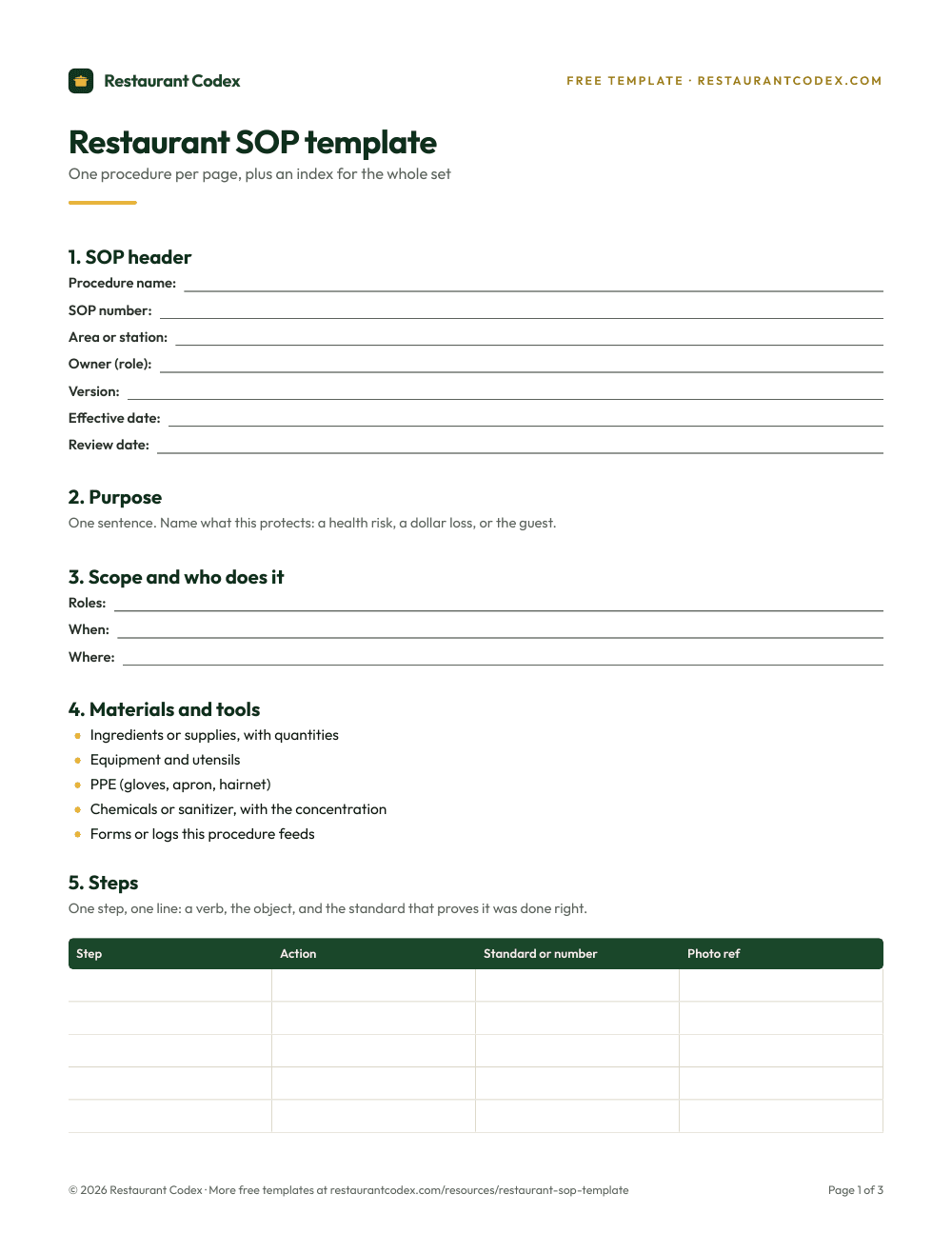
Format it for someone standing at a station, not for a binder in the office. One sentence for purpose, naming what the SOP protects. One line for scope: who runs this, on which shift, in which area. Then numbered steps, each with a verb, an object, and the number or test that proves it's done right. "Portion soup into pans no deeper than 2 inches, then start the timer" is a step. "Cool soup down properly" is a wish. The FDA Food Code backs the specific version: cooked food has to move from 135°F to 70°F within 2 hours, then to 41°F within 4 more, 6 hours total, or it doesn't get slow-chilled, it gets thrown out (FDA Food Code 2022, 3-501.14).
Every SOP also needs a failure path. What happens when the temp reads high. What a server does when a guest reports an allergy after the ticket already fired. Skip that part and the SOP only covers the day nothing goes wrong, which isn't the day anyone needed it.
Test it before you file it. Hand the draft to someone who didn't write it and wasn't in the room. If they can't run the procedure alone, it isn't finished, it just looks finished.
What's the difference between an SOP, a checklist, and a training document?
An SOP states the standard, a checklist proves the standard got followed today, and a training document builds the skill to follow it in the first place. Three different jobs, and a restaurant that tries to make one PDF do all three usually ends up with a document too long for a new hire and too vague for an auditor.
| SOP | Checklist | Training document | |
|---|---|---|---|
| Answers | What's the standard | Did it happen today | Can this person do it alone |
| Length | One page | Fits a clipboard or a phone screen | As long as the skill takes |
| Lives | Knowledge base, at the station | Operations, on shift | LMS, before the first solo shift |
| Retired when | The procedure changes | The shift ends | The employee is signed off |
The training document is where a certification like ServSafe Manager actually shows up. It's ANAB-accredited under Conference for Food Protection standards and administered by the National Restaurant Association, and it's a reasonable bar for whoever signs off that a new manager actually understands a food-safety SOP, not just that they read it. A checklist can't teach that. It can only confirm the temp got taken. Our staff training guide covers how to build the lesson itself once the SOP behind it is solid.
How do you document restaurant processes?
You document a process by watching it happen, not by writing down how it's supposed to go. Shadow an opening, a peak, and a close, and write down where two people run the same station two different ways. That gap between them is your priority list, not a guess.
Start with ten, not forty: opening, closing, receiving, line check, cooling, reheating, date marking, allergen handling, cash shorts, and whatever moment your kitchen has actually gotten wrong before. Date marking is a good example of a process worth documenting precisely instead of loosely: a prepped item held at 41°F or below gets a discard date within 7 days, and the prep day counts as day 1 (FDA Food Code 2022, 3-501.17). Written as "label everything" instead, that rule gets followed differently by every cook on the schedule.
Write the steps at the reading level of the newest person on the roster, and film anything spatial, like machine assembly or a knife cut, instead of describing it in three paragraphs nobody rereads. Assign an owner and a review date before you file it, or the document is dead the day the menu or the equipment changes and nobody notices.
Then test it the same way you'd test an SOP: hand it to a cook or a server who wasn't in the room when it was written. If they can't finish the task alone, the document isn't done.
A worked example: writing a cooling SOP start to finish
Here's what the format looks like filled in, using cooling stock, since it's the procedure most kitchens have loosest.
Header: SOP 105, Cooling Cooked Food, owner is the sous chef, version 2, effective this quarter, review date six months out. Purpose, one line: prevents bacterial growth in food held too long in the range where it multiplies fastest. Scope: BOH, every shift, applies to any cooked item not served within the hour.
Steps: portion into pans no deeper than two inches, or use an ice bath, not a covered pot in the walk-in. Start a timer at 135°F. Check and log at the 2-hour mark; it has to read 70°F or below. Transfer to the walk-in and check again at the 6-hour mark from the original pull; it has to read 41°F or below (FDA Food Code 2022, 3-501.14). Failure path: if it's not at 70°F by hour two, it doesn't get a second chance at slower cooling. It gets thrown out, and that gets logged too, because a pattern of failed cools is a bigger problem than one batch of stock.
That's the whole SOP. One page, a number at every step, and a rule for what happens when a step is missed.
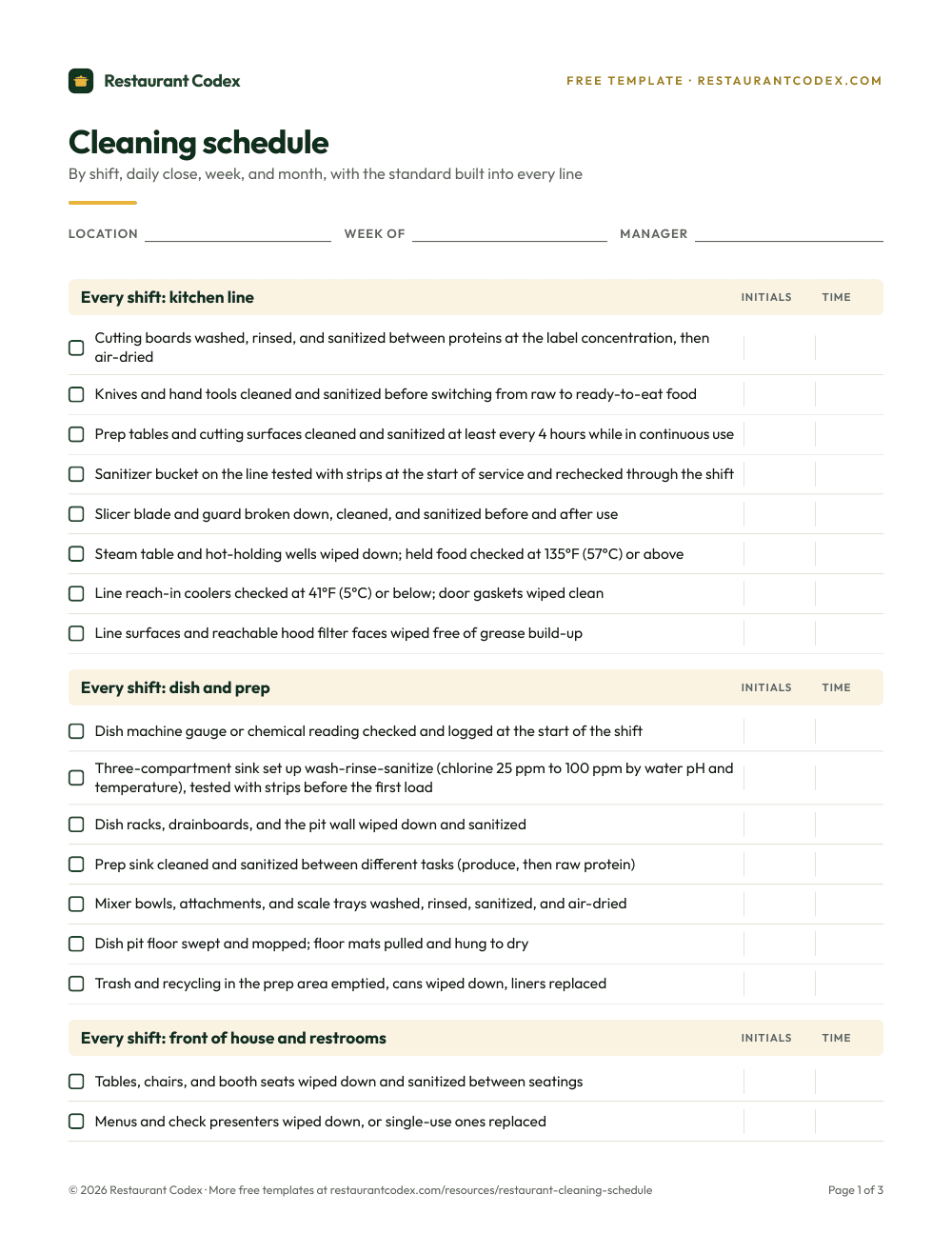
How do you set up a restaurant cleaning schedule?
A restaurant cleaning schedule works when the tasks are split by how often they actually need doing, not when everything gets labeled "daily" and nothing gets finished. Three layers cover most kitchens: every shift, every week, and every month or quarter.
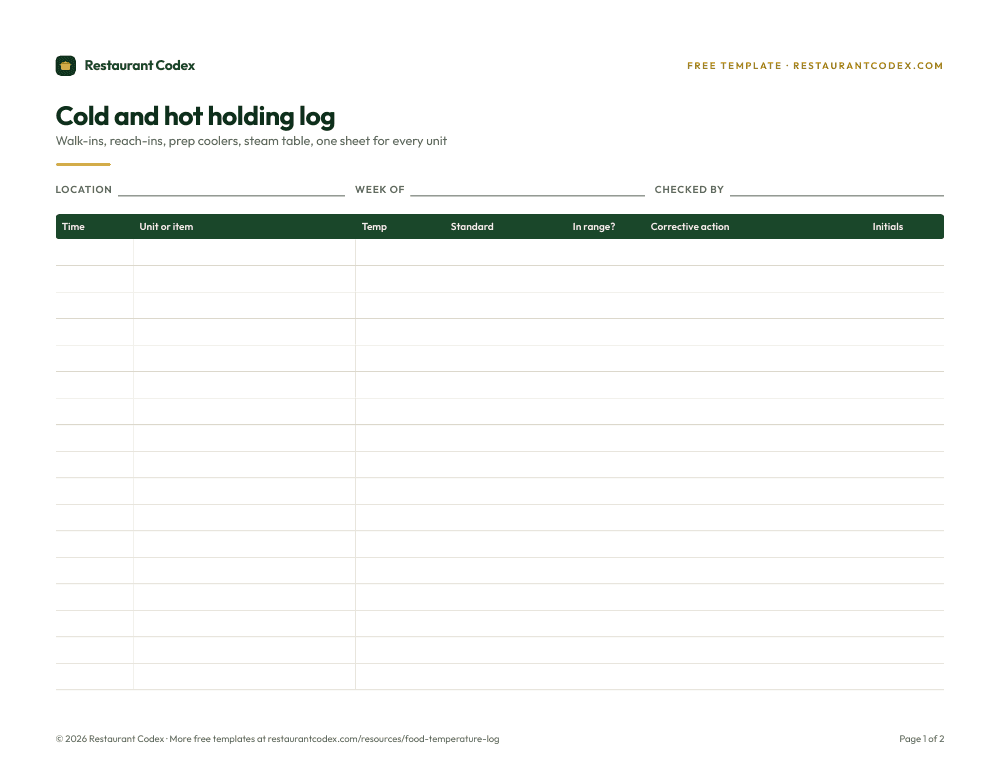
Every shift: sanitizer buckets tested and refilled, not just filled once at the start, prep surfaces between uses, line wipe-downs, and a restroom check tied to a specific time, not "sometime tonight." Every week: reach-in gaskets, ice machine interiors, dry storage organization, the things that don't get dirty in one shift but do in five. Every month or quarter: hood and flue work, fryer boil-outs, behind-equipment pulls, a full walk-in scrub. A reach-in gasket that's gone soft is also a cold-holding problem, since a door that doesn't seal drags the unit above the 41°F line the Food Code sets for holding TCS food (FDA Food Code 2022, 3-501.16), so the weekly check earns its place on the same page as the temperature log, not a separate one.
Vendor-owned equipment, hood cleaning, grease trap pumping, still needs an internal line, not just a signed invoice. The invoice proves a vendor showed up. It doesn't prove the job matches your standard, and the first time someone checks is a bad time to find out it doesn't.
What should a restaurant hygiene SOP cover?
A restaurant hygiene SOP names the exact moments a hand gets washed, not a general reminder to wash hands. The FDA Food Code sets the handwashing procedure and the points it applies (FDA Food Code 2022, 2-301.12); a usable SOP turns that into a list a new hire can actually follow: entering the kitchen, after handling raw protein, after taking out trash, after touching a phone, after a break, before putting on a new pair of gloves.
Gloves are a tool, not a shortcut around washing. Define when they're required and when they get changed, and say plainly that a glove change doesn't replace a wash when the task crosses a contamination line, raw to ready-to-eat, for instance.
Cover the allergen side here too, not as an afterthought. Since January 1, 2023, sesame has been the ninth major food allergen recognized in the United States, under the FASTER Act, which means any hygiene or prep SOP still listing eight is wrong, not just outdated. An illness policy belongs in the same document: name the reportable symptoms and the manager's decision path, and say clearly that reporting isn't punished. A cook who's afraid to say they're sick will hide it until a guest is the one who finds out.
Round it out with uniforms, hair restraints, jewelry limits, and how a wound gets covered before someone's back on the line. Our food safety compliance guide covers the audit side of the same standards.
Where restaurant SOPs go wrong
The most common way an SOP fails is being written like a memo: a cook mid-rush won't read a paragraph twice to find the number they need, and an SOP that reads like an email doesn't get followed like a standard. Three more mistakes show up in almost every kitchen that's tried this.
The second is a step with no standard in it. "Clean thoroughly" and "check for freshness" are opinions. A real step has a number or a pass-fail test attached, the kind a manager can check without asking the cook to explain themselves.
The third is a single author who leaves. One person writes all twenty SOPs on a slow month, then moves on, and six weeks later nobody can find the source file, let alone edit it. The fourth is the SOP nobody revisits after something changes. An allergen SOP written before 2023 still treats sesame as safe to leave off the list, because it predates the FASTER Act that made it the country's ninth major allergen. The laminated sheet on the wall doesn't know the rule changed.
Running the same SOPs across a multi-location group
A group with more than one location needs exactly two kinds of SOP: one that's identical everywhere, and one that's a local footnote on top of it. The group SOP covers anything with a number a health inspector or a lawyer could hold the company to, the cooling curve, the cold-holding threshold, the allergen sequence, the sanitizer concentration. The local SOP covers what actually differs by address: which door the delivery truck uses, who to call for a broken ice machine, this week's deep-clean day.
The number is what holds it together. SOP 104 means the same cooling procedure at every location, so a cook transferring from store 4 to store 9 isn't relearning a system, just a building. It's also what lets a district manager audit five kitchens in a day without re-reading five different documents that happen to cover the same task.
Certification is the other lever that scales better than trust alone. Requiring every kitchen manager to hold a ServSafe Manager credential, the same ANAB-accredited certification the National Restaurant Association administers, is a cheap way to know the person signing off on a new location's SOPs actually understands the standard behind the number, not just the number itself.
How do you choose a restaurant documentation stack?
A restaurant documentation stack needs four things working together: version-controlled SOPs, tasks that require proof they happened, training a new hire can finish on a phone between shifts, and search that returns an answer in seconds on the line, not a scavenger hunt through shared-drive folders. Start from what each role actually needs, not a feature list. A line cook needs today's spec fast. A manager needs to see whether a hygiene check happened, not just that it was scheduled. A trainer needs to edit a step once and have the SOP, the checklist, and the training module all update together.
Every extra login is a place content forks. The version on one tablet says 41°F, the printed sheet taped to the walk-in door still says 40°F from before the last update, and nobody can say which one is current without checking both. Whatever a group picks has to hold the same numbers everywhere they show up, the same 41°F and 135°F on the phone, the printout, and the training quiz (FDA Food Code 2022, 3-501.16), because the day those three disagree is the day an inspector finds it before you do.
Where Restaurant Codex fits
Restaurant Codex keeps the same three pieces linked instead of separate: SOPs live in the knowledge base with a photo on the step that needs one, checklists run in operations against the same standard, and training in the LMS points back to the SOP it's built from, so an edit to one updates what a new hire sees in all three. It doesn't replace a well-written step. It just keeps the copy on the wall from quietly going stale.
Restaurant Codex
The same checklist, on every phone, with photo proof
Restaurant Codex runs this template as a live task with timestamps, photos and one view across every location. Bring it to a 30-minute working session and we'll set it up on your real operation.
By the Restaurant Codex team
Written with operators who run multi-location restaurant groups. Reviewed against the FDA Food Code and the sources listed below.
Sources
- FDA Food Code 2022, Chapter 3: cooling (3-501.14), reheating for hot holding (3-403.11), hot and cold holding (3-501.16), date marking (3-501.17)
- FDA Food Code 2022, Chapter 2: handwashing procedure and timing (2-301.12)
- FDA, FASTER Act: Sesame as the 9th Major Food Allergen, effective January 1, 2023
- ServSafe Manager Certification, ANAB-accredited under Conference for Food Protection standards, administered by the National Restaurant Association