How do you train restaurant staff effectively?
You train restaurant staff in three layers, proving each one before moving to the next: non-negotiables first, station skills second, supervised solo work third. Skip the proof step and you've only measured attendance.
The first layer covers what every role needs, regardless of station: basic safety, harassment and conduct policy, the time clock and uniform rules, how to flag an allergy before it reaches the kitchen, and the two or three brand behaviors guests actually notice, a greeting, check-back timing, how a mistake gets recovered at the table. None of it requires a POS login or a knife.
Station skills come next, taught in short bursts rather than a marathon shadow week. A new line cook who spends five straight days trailing the same cook learns that cook's habits, not the station's standard, and falls apart the first night that cook is off. Thirty minutes on mise en place, thirty on the recipe cards for that station, a supervised run, then the next skill.
Every layer ends in proof, and the proof has to match what's being tested. A quiz catches menu facts and policy. A demonstration, someone doing the cut or running the machine while a trainer watches, catches motor skill. A coached table or a coached rush catches timing, the thing a quiz can't touch. Skip this step and "trained" quietly comes to mean "was in the room."
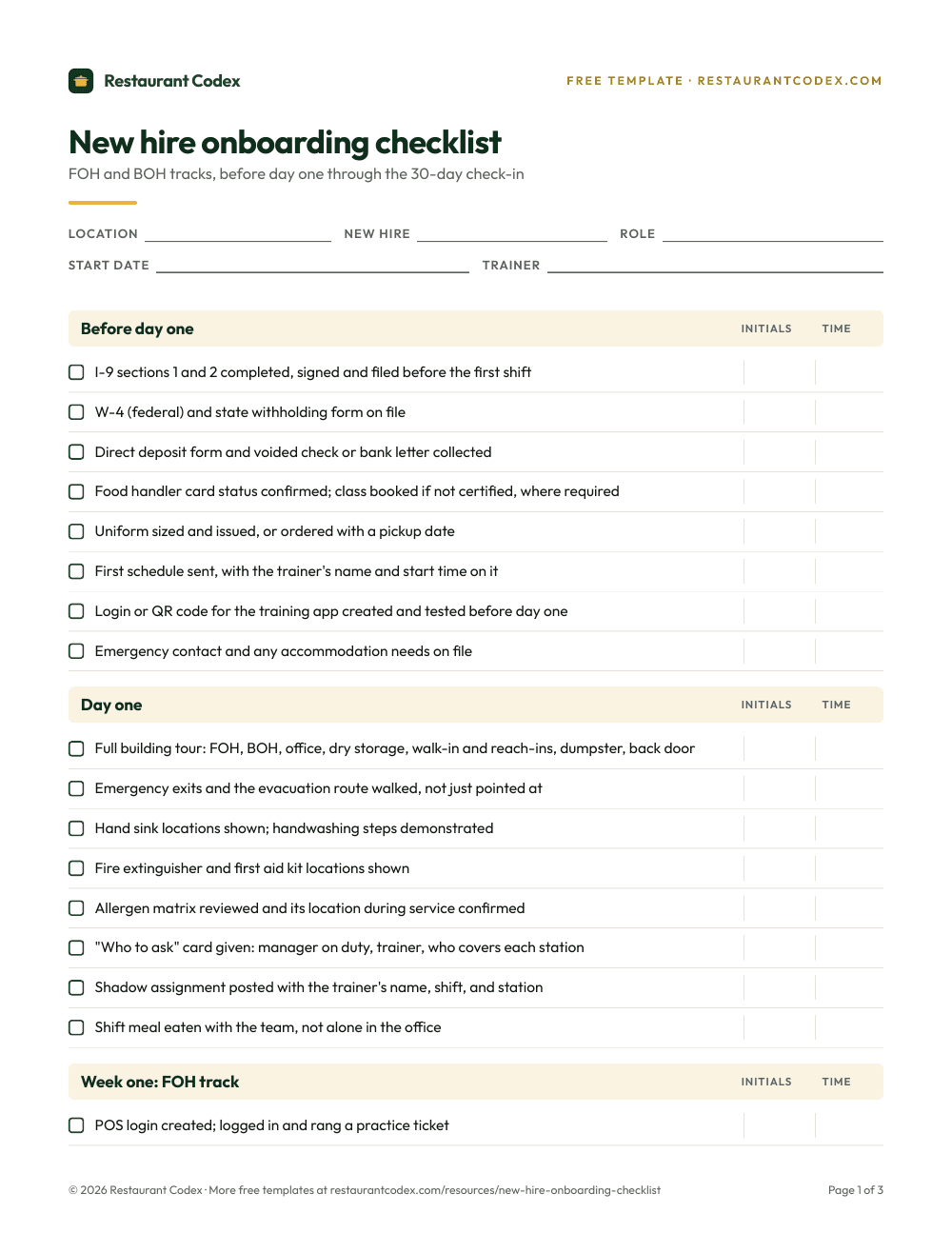
The stakes are real enough to justify the structure. The Bureau of Labor Statistics' JOLTS series for accommodation and food services put total separations at about 65.3% across 2025, against roughly 43.4% for the economy as a whole. A share of that walks out in the first month, usually because the only plan anyone wrote down was "shadow someone busier than you for a few shifts." O*NET classifies restaurant cooks in Job Zone 1-2, on-the-job training running anywhere from a few days to a year depending on the role, which is exactly the range that makes an undefined plan risky. Treat the first two weeks like a launch with a written path, not a vibe. A new hire onboarding checklist covers the paperwork and access that need to happen before any of this starts.
How do you build a staff training program for restaurants?
A restaurant staff training program is a competency matrix per role, not a pile of shift shadows: the skill, the lesson that teaches it, the assessment that proves it, and the trainer who's allowed to sign off.
Build it in three tiers. Survival skills land in week one, the handful of tasks someone needs so they're not a liability on the floor or the line. Steady state lands by roughly week four: running a section or a station without a trainer standing next to them. Stretch skills sit above that, for people headed toward a lead or trainer role themselves. Here's what that looks like across three common roles.
| Role | Week 1: survival | Week 4: steady state | Stretch: promotion-ready |
|---|---|---|---|
| Server | POS basics, table numbering, allergen protocol | Runs a full section solo, hits the kitchen's ticket-time standard | Trains a new hire, runs a pre-shift briefing |
| Line cook | Station mise en place, recipe cards for that station | Holds the station through a full rush without help | Covers a second station, reads the expo board |
| Shift lead | Opening and closing checklist, cash procedures | Runs a full shift without escalating routine calls | Signs off new hires, makes comp decisions within policy |
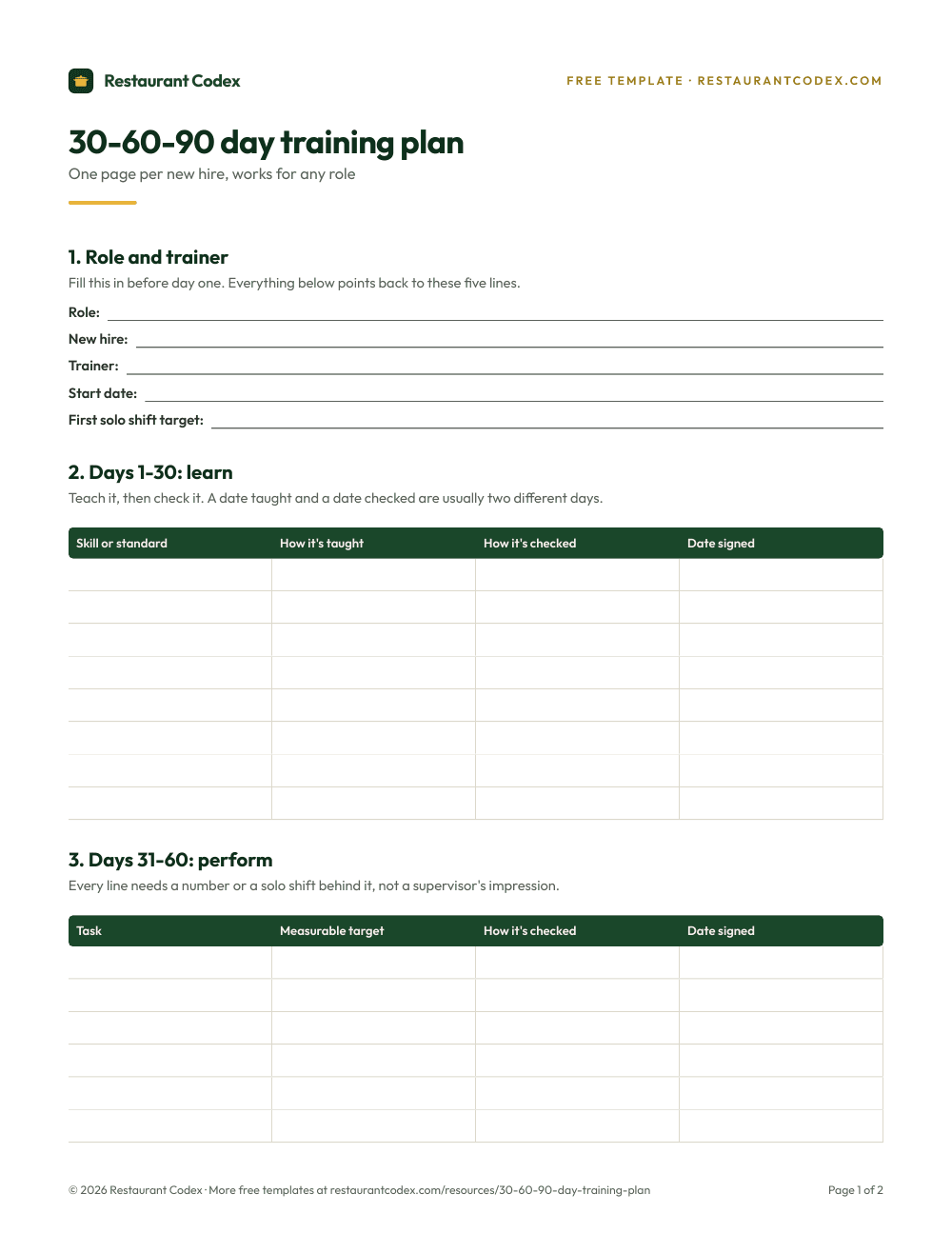
Trainers matter more than curriculum. Two trainers teaching the same station two different ways isn't cross-training, it's two dialects competing for the same job, and a new hire ends up speaking whichever one they learned first. Have trainers extend the SOPs the kitchen already runs on, not a personal version of them, and record a short clip for a noisy or hard-to-describe task if a live demo keeps getting interrupted mid-shift. A written 30-60-90 day training plan turns this matrix into three dated checkpoints instead of a chart nobody revisits.
How do you create a restaurant training manual?
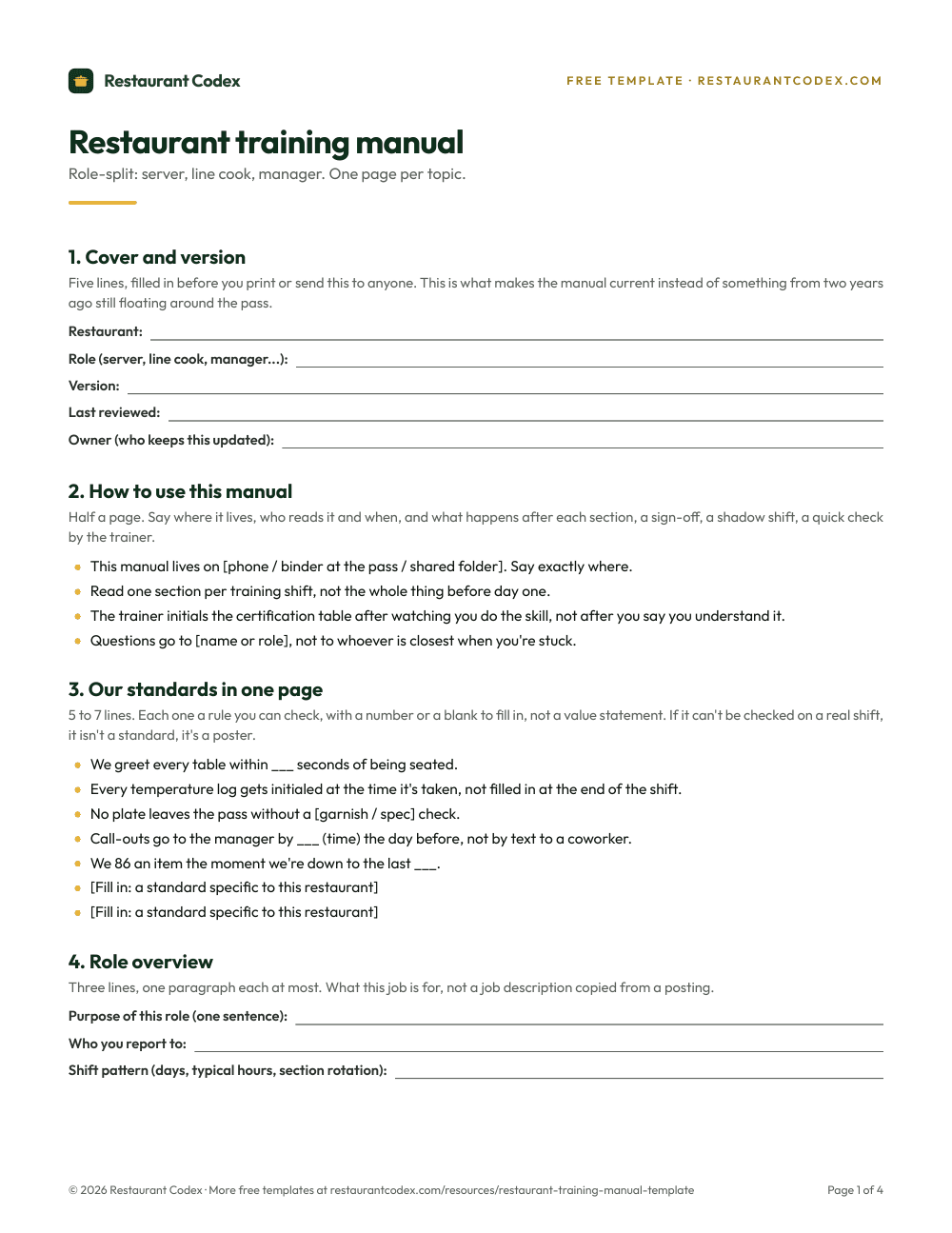
A restaurant training manual works as a competency map, not a document to read cover to cover: name the outcome, break it into lessons short enough to fit between shifts, and pair every lesson with the SOP language the kitchen or floor already uses.
Start from what a person should be able to do after two weeks, not what they should have read. A server who can run steps of service, answer an allergy question in the restaurant's approved language, and recover a mistake without a manager stepping in has cleared the bar. A stack of read PDFs hasn't proven any of that, no matter how thorough it looked.
Pull the language straight from the same SOPs the floor uses for closing, allergens, and safety. If a trainer improvises their own version, the manual and the actual shift stop matching, and you've rebuilt the tribal knowledge the manual was supposed to replace. Our guide on writing restaurant SOPs covers how to write those source documents so the manual has something solid to pull from.
Assess after every lesson, not at the end of the manual: a quiz for facts, a demo for a motor skill, a coached shift for timing. Version the manual the way you'd version code. A menu release needs a manual delta the same week, not a group text that gets buried by Friday. Assign one owner and a review date per section so "someone will update that eventually" isn't the plan.
Why is cross-training important in restaurants?
Cross-training is labor insurance: it means one callout doesn't collapse service because exactly one person can run the espresso machine or catch expo.
Train it in layers, not all-access. A server picks up beverage support before expo. A line cook learns pantry before sauté, and only under observation the first few times. Cross-training with no order to it produces dangerous improvisation, someone running a fryer they've watched twice, not resilience.
Document what someone can actually do in small, specific units tied to a module, a demo and a supervised shift, not a general note that they "helped out on grill once." "Sorta knows grill" is how you get an undercooked plate and a manager finding out mid-rush instead of before the shift started. One additional station by the sixty-day mark of a new hire's ramp is a reasonable target; three at once usually means none of them are solid.
It pays off past coverage, too. A server who understands how long a dish actually takes stops promising a table an impossible modifier. A cook who understands how table turns work flags an 86 before the floor finds out the hard way from a guest. Cross-training tends to show up first as fewer scheduling emergencies; our onboarding and turnover guide covers how that connects to who stays past year one.
How do you measure restaurant training effectiveness?
You measure restaurant training effectiveness with two sets of numbers: leading indicators you can act on this week, and lagging indicators that only show up in the P&L later.
Leading indicators are the early warning signs: onboarding tasks completed on schedule, quiz scores and how many retries they took, time to a first solo shift, the quality of a trainer's sign-offs when you spot-check them, and whether a safety task actually gets followed on shift after training says it was covered.
Lagging indicators confirm whether training held: guest complaints tagged to training, comp and void patterns, allergen incidents, injury near-misses, health department notes that reference employee practice, and how much service scores vary between stores running the identical curriculum.
Benchmark within your own company before you benchmark against anyone else's number. The same training path should produce roughly the same time to competency across stores running the same curriculum, unless staffing levels differ on purpose. When one location lags every other one by weeks, that's rarely bad luck with new hires. It's almost always the trainer, or the schedule. Whatever LMS holds your course data should make these comparisons a filter, not a spreadsheet you build by hand once a quarter.
What a training gap actually costs
Training gaps show up as turnover and comps before they show up as a line item, and both are measurable enough to make the case for fixing them.
Replacing an employee costs somewhere between 50% and 200% of that role's annual salary, according to SHRM's research on replacement cost; the range depends heavily on how specialized the role is and how long it takes someone new to reach full speed. Against that backdrop, food service's separation rate, about 65.3% across 2025 per the BLS JOLTS series, against roughly 43.4% for the economy overall, isn't a staffing problem you can hire your way out of. Some of it is unavoidable in an industry built on part-time and seasonal work. A meaningful share of it is people who never got a real first month.
Certification lapses carry their own cost, usually a citation instead of a number on a P&L. ServSafe, run by the National Restaurant Association, is the most widely used food safety credential in the industry, and its Manager exam carries ANAB-CFP accreditation, one reason most health departments accept it without pushback. A program that tracks issue and expiry dates in the same place it tracks training catches a lapsed cert before an inspector does.
Running training across more than one location
Across a group, the curriculum should be identical for a given role at every location. What's allowed to vary is execution, and that gap is worth watching closely.
HQ owns the modules, the quiz bank, and the sign-off criteria. Each GM owns the schedule: who trains, when, and how the supervised shifts get covered without leaving the floor short. That split keeps the standard identical without pretending every location has the same staffing to work with.
Pull time-to-competency and quiz pass rates across locations monthly, not per store in isolation. If line cooks at one location reach steady state by week four and line cooks at another are still shadowing past week eight, the gap is almost never luck with who applied. It's almost always who's training them, or whether that store is actually running the program instead of keeping the binder on a shelf.
It's also worth training in more than one language where the crew calls for it. Hispanic workers make up 28% of the U.S. restaurant and foodservice workforce, up from 22% in 2010, per the National Restaurant Association's demographic data pulled from 2024 Census figures. A module that only exists in English isn't reaching a real share of the people running your kitchen.
Where restaurant training programs break down
The most common failure is one trainer for everything, and four more predictable places account for the rest. None of them are about effort.
One trainer for everything. When only one person actually knows how to train a station, the operation is one vacation away from nobody teaching it right, and new hires spend a month learning that one person's shortcuts instead of the standard.
No proof step. "They shadowed for a week" isn't training, it's exposure. Without a quiz, a demo or a coached shift to check against, you've measured whether someone showed up, not whether they can do the job.
Cross-training with no order. Handing someone a second station before their first one is solid produces two half-trained people instead of one fully trained one, and it shows up hardest during the rush that was supposed to prove cross-training was worth it.
Manuals that don't move when the menu does. A new dish or a changed allergen procedure that doesn't reach the manual within the week means the manual is now teaching something the kitchen stopped doing.
Quiz scores tied to discipline. Use a quiz result to write someone up and the next round of scores stops meaning anything; people either stall out from anxiety or start comparing answers. Use it instead to find where the module is unclear.
Where Restaurant Codex fits
Restaurant Codex runs this as one system instead of three separate ones: courses and quizzes live in the LMS, the SOPs and manual sections they reference live in the Knowledge Base, and the daily tasks in Operations verify the habit actually holds on shift, not just that a module got marked complete. An owner running more than one location sees time-to-competency, quiz results and sign-off gaps across every store in one view, instead of piecing it together from a binder at each one.
Restaurant Codex
The same checklist, on every phone, with photo proof
Restaurant Codex runs this template as a live task with timestamps, photos and one view across every location. Bring it to a 30-minute working session and we'll set it up on your real operation.
By the Restaurant Codex team
Written with operators who run multi-location restaurant groups. Reviewed against the FDA Food Code and the sources listed below.
Sources
- FRED (Federal Reserve Bank of St. Louis), Total Separations Rate: Accommodation and Food Services (JTS7200TSR)
- O*NET OnLine, Cooks, Restaurant (35-2014.00), Job Zone and Training
- SHRM, The Myth of Replaceability: Preparing for the Loss of Key Employees
- National Restaurant Association, ServSafe Training and Certification
- ServSafe, ServSafe Manager Certification (ANAB-CFP accredited)
- National Restaurant Association, U.S. Restaurant Employee Demographics