How do you reduce restaurant employee turnover?
You reduce restaurant turnover by fixing what makes the first few weeks feel chaotic, not by adding another dollar to the wage: a named trainer, expectations a new hire can actually see, and a schedule that doesn't change three times before the second shift. Those three things drive early exits more than pay does, and a manager can change all three this week without touching payroll.
Turnover in this industry isn't a mystery. Accommodation and food services ran a 65% total separations rate in 2025 and has averaged close to 76% a year since 2001, roughly double the 43% average across every industry the federal government tracks (BLS Job Openings and Labor Turnover Survey; FRED series JTS7200TSR). Some of that is seasonal and structural: students, second jobs, a workforce that skews young. But a real share of it is a restaurant losing someone in week two who would have stayed if week one hadn't felt like being dropped into a moving current with nobody holding a rope.
The fix is boring, which is probably why so many places skip it. Write down what "good" looks like for a server's first table and a cook's first ticket before the hire walks in, so nobody's guessing what they're being judged against. Assign one person, not a rotating cast, to answer questions and sign off on skills. Post the schedule far enough ahead that a new hire can build a life around the job instead of resenting it. None of that costs a payroll dollar. All of it shows up in whether the person is still on your roster at day 90.
How do you onboard new restaurant employees faster?
Faster onboarding comes from removing ambiguity, not from removing steps: a new hire moves through training quickly when day one answers the practical fears right away, where to clock in, what to wear, how breaks actually work, and exactly which three things get someone coached or sent home, instead of leaving all of it to be discovered by trial and error over two weeks.
Speed and rigor aren't in tension here. A new server can know the POS login, the section map and the allergen protocol by the end of day one and still need three more weeks before she's running a full section alone. What slows onboarding down usually isn't the number of things to learn. It's the time spent finding out who to ask. Hand a new line cook to whoever happens to be free that night and you've built inconsistency into the job before he's cooked a single ticket. Name one trainer per new hire, written on the schedule, and the same question gets the same answer every time it's asked.
Structure the climb instead of leaving it loose: watch it done once, do it with someone standing next to you, do it with someone checking in periodically, do it alone. Each rung needs an actual sign-off, not a supervisor's nod on the way past the pass window. How long the full climb takes depends on the role more than most schedules admit. O*NET classifies restaurant cooks as Job Zone 1 to 2, a range running from a few days to a full year of on-the-job learning depending on the station and the menu. Treating week one as the finish line is a scheduling habit dressed up as a training plan.
The other lever is how fast someone can get an answer without pulling a manager off the floor. If checking a spec means chasing down a specific sous chef during a Friday rush, onboarding takes longer than it needs to no matter how good the trainer is. A restaurant with a real knowledge base, one place holding every SOP, recipe card and allergen note, cuts that lookup time to seconds instead of minutes spent hunting someone down.
What should a restaurant onboarding checklist include?
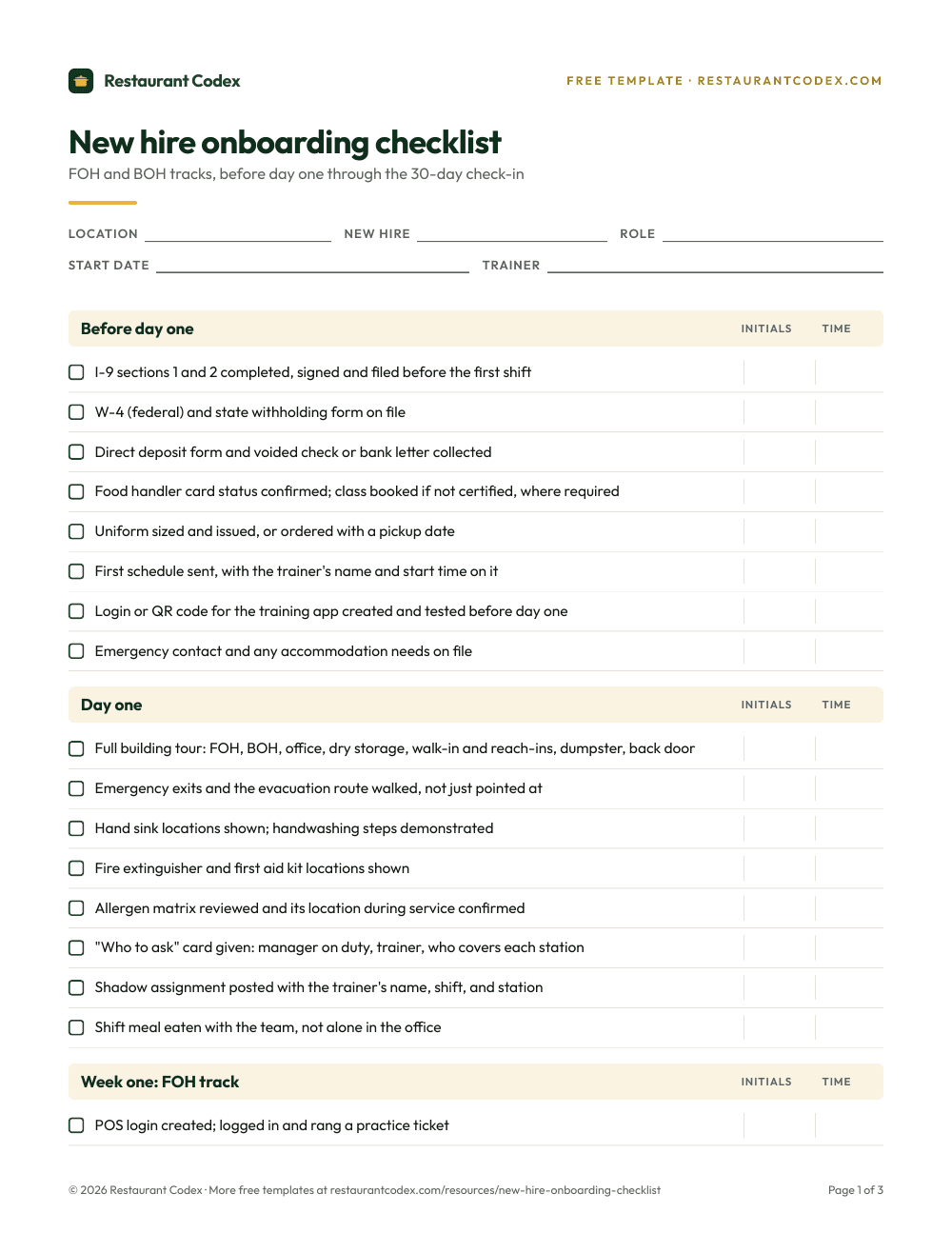
A restaurant onboarding checklist needs five blocks, and a checklist missing any one of them is really a paperwork form wearing a training hat: hiring paperwork and compliance, safety and harassment-prevention training, systems access, role-specific skill sign-offs, and a documented check-in.
The paperwork block covers I-9 and W-4 forms, payroll setup, a signed handbook acknowledgment, dress code and emergency contacts, done before day one so the first shift can be the tour and the shadow assignment instead of forty minutes in the back office. The safety block covers harassment-prevention and food-safety training with a passing score attached, not a video someone half-watches while folding napkins. ServSafe, run by the National Restaurant Association with its Manager credential accredited by ANAB-CFP, is the standard most operators default to for that piece, and it's worth building the same expectation into whatever LMS or training system tracks it.
Systems access is its own block because it gets skipped constantly: a POS login, the scheduling app, whatever the team uses to communicate, and a login to wherever the SOPs and recipe cards actually live. Skill sign-offs are role-specific by design. A server's checklist and a line cook's checklist should share almost nothing past the paperwork section, and each line needs the trainer's name attached to it, not a blanket "trained" checkbox that means nothing six weeks later. The final block is the check-in: can this person find a spec, a closing task or an equipment note without texting the manager. That's the real test of whether onboarding worked, and it's the one most checklists never ask.
What does turnover actually cost, in real numbers?
A single hourly departure costs a hospitality employer $5,864 on average, and can run as high as $14,019, once you count recruiting, interviewing, orientation and the productivity a team loses while a position sits open or a replacement is still learning (Cornell Center for Hospitality Research, Tracey and Hinkin). That figure comes from a study of a dozen hotels published in 2006, not restaurants specifically, and costs have moved since then, so treat it as a floor rather than a number tailored to your kitchen. SHRM's broader estimate lands in the same neighborhood: 50% to 200% of the departing employee's annual pay, once you add up the manager hours spent interviewing, training and covering the gap.
Most of that cost isn't the job posting. In the Cornell breakdown, lost productivity while a new hire ramps up ate the largest share of the total, more than recruiting and orientation combined. That's the part a real onboarding system actually shortens: a new hire with a named trainer, a clear ladder and fast answers reaches full productivity sooner, which is the biggest lever sitting inside that cost structure.
Run the math on your own numbers instead of borrowing someone else's. Take your average hourly wage, multiply by the hours a manager spends interviewing and training one new hire, add whatever shifts run short-staffed while the role sits open, and you have a figure specific to your restaurant. Most owners are surprised it's higher than what they'd have guessed sitting at the bar doing the math in their head.
The first 90 days: what a real timeline looks like
Retention isn't decided at the 90-day mark. It's decided in stages, and each stage needs a specific, checkable milestone instead of a manager's vague sense that things seem fine.
| Day | Milestone | Who signs off | What "done" looks like |
|---|---|---|---|
| 1 | Paperwork closed, tour done, trainer named | Manager | I-9, W-4 and handbook signed before the shift starts |
| 7 | Core systems and safety modules complete | Trainer | POS login works, safety score passed, section or station map known |
| 30 | First independent shift, first check-in | Trainer and manager | Solo shift completed, a short two-way conversation held |
| 60 | Full skill sign-off for the role | Trainer | Every line on the role checklist initialed, not blanket-checked |
| 90 | Retention decision documented | Manager | On track, needs more training, or not a fit, written down |
Only 54% of quick-service employees made it to day 90 in 2022, down from about 58% before the pandemic, based on surveys HourWork ran across more than 8,000 quick-service restaurants (Restaurant Dive, citing HourWork). Every stage in that table sits inside that window on purpose. Wait until day 90 to check in for the first time and you've already lost the chance to fix whatever's been wrong since day 10.
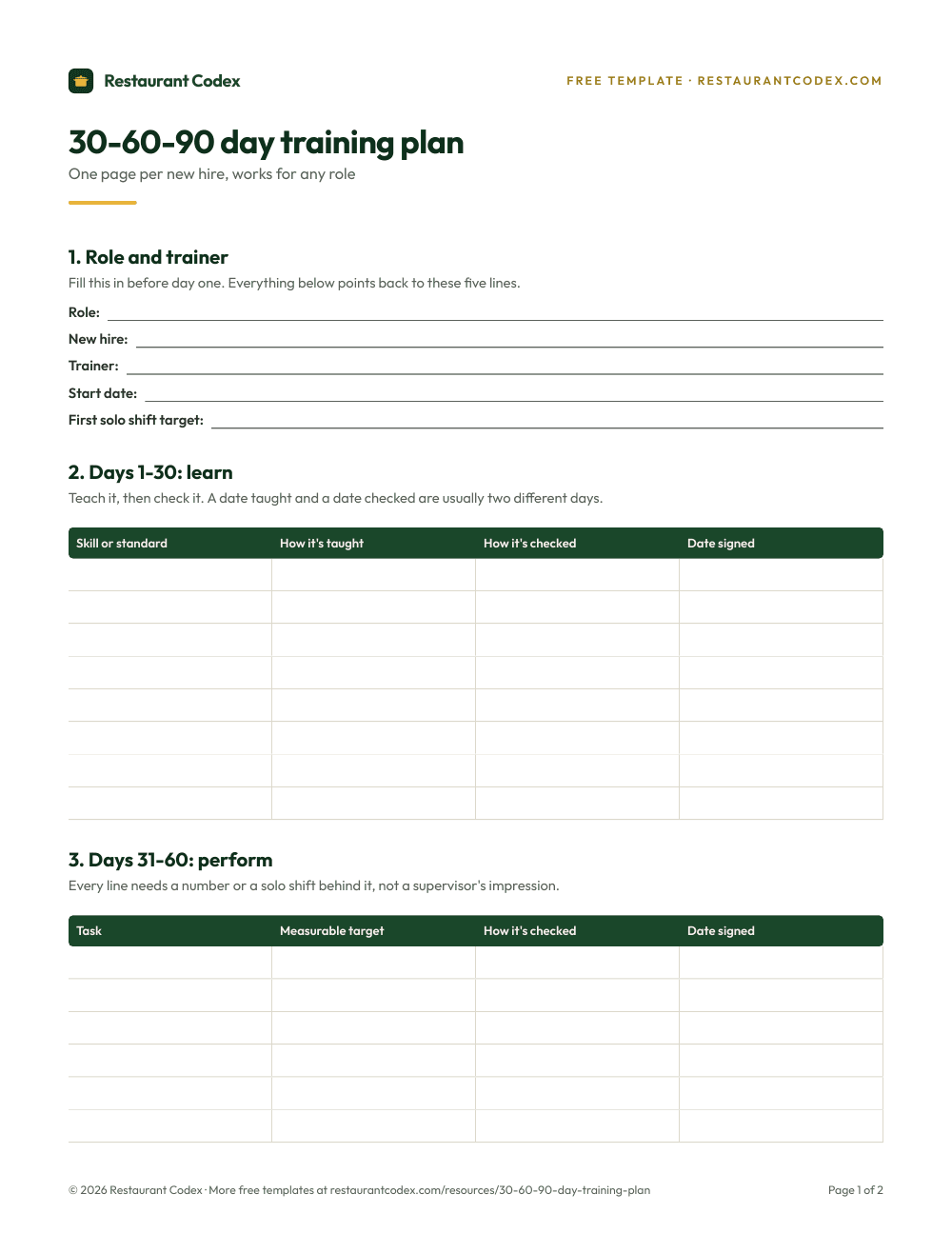
Running onboarding and retention across multiple locations
Across locations you run one onboarding checklist per role, identical at every store, with headquarters owning the compliance block and each GM owning the floor block. An operator with five stores can't run five different versions of "how we onboard a server" and still compare the results, and one with fifty certainly can't run fifty. So the split is the same everywhere: HQ owns the compliance block, the paperwork items, the safety-training pass rate, the deadlines, standardized so a district manager can audit any location's file the same way. The GM or trainer owns the floor block: who trains, how the shadow shift gets paired, what the first day actually feels like at that specific restaurant.
That split buys something a single-location owner doesn't need: a real comparison. Pull 90-day retention by store and the location where the manager treats the 30-day check-in as optional shows it in the number months before it would show up on the floor. A store running 70% 90-day retention against a portfolio average of 50% has a manager doing something worth copying to the other locations, not just a lucky quarter, and that's a line worth adding to a weekly operations review alongside labor and food cost.
One thing worth building into the standard, not left to each GM's judgment: materials in more than one language. More than a quarter of the restaurant workforce nationally is Hispanic, 28%, up from 22% in 2010 (National Restaurant Association). An onboarding checklist and handbook that only exist in English are a gap a lot of multi-unit groups don't notice until a location with a bilingual GM is quietly outperforming the rest of the portfolio.
Where onboarding and retention break down
Paperwork day gets mistaken for training. A new hire signs an I-9, watches an orientation video, and the whole checklist gets marked complete because the form is signed, not because anything was actually taught.
Shadowing happens with no sign-off attached. A new server follows someone for two shifts, which feels like training and checks nothing, so week three arrives and nobody can say with confidence what she actually knows how to do.
Trainers rotate. A new hire gets handed to whoever's free that shift, three different people give three different answers to the same question in one week, and nobody ends up accountable for whether the sign-offs on the sheet are real.
The 30-day conversation gets skipped for a busy week, then the 60-day one gets skipped too, and the first real signal that something's wrong is a two-week notice instead of a fixable complaint three weeks earlier.
Exit interviews become the only listening mechanism a restaurant has. By the time someone's walking out the door, you're getting the polite version of the truth, if you get any version at all. The check-ins that would have caught the problem happen after the resignation instead of before it, which is exactly backward.
How Restaurant Codex fits in
On paper, none of this needs software. It needs a trainer who actually initials the line when the skill happens, a checklist that gets checked instead of assumed, and a 30-day conversation that happens on day 30 and not day 90. Restaurant Codex keeps those same blocks digital: a trainer signs off from a phone as it happens, safety and certification status sit on the employee's profile instead of a sticky note by the office computer, and an owner watching ten stores sees every new hire's progress and every location's 90-day retention rate in one place instead of ten folders in ten back offices.
Restaurant Codex
The same checklist, on every phone, with photo proof
Restaurant Codex runs this template as a live task with timestamps, photos and one view across every location. Bring it to a 30-minute working session and we'll set it up on your real operation.
By the Restaurant Codex team
Written with operators who run multi-location restaurant groups. Reviewed against the FDA Food Code and the sources listed below.
Sources
- BLS, Job Openings and Labor Turnover Survey, Table 4, quits rate by industry
- FRED, Total Separations: Accommodation and Food Services (JTS7200TSR)
- Cornell Center for Hospitality Research, Tracey and Hinkin (2006), The Costs of Employee Turnover
- SHRM, The Myth of Replaceability: Preparing for the Loss of Key Employees
- O*NET OnLine, Cooks, Restaurant (35-2014.00), Job Zone
- Restaurant Dive, citing HourWork, most QSR employees worked 90 days before quitting in 2022
- National Restaurant Association, U.S. Restaurant Employee Demographics
- National Restaurant Association, ServSafe training and certification