How do you train a restaurant manager?
You train a restaurant manager by competency, not by job title: food safety and the law, the shift itself (opening, closing, and the walk-throughs in between), people (scheduling, coaching, discipline), money (the P&L lines a manager actually controls, cash, ordering), and guest recovery. Each one gets taught, then watched being done, then signed off, the same three-step discipline a kitchen uses to bring a new cook up to speed, aimed at a bigger job with more ways to go wrong quietly.
The job is worth that much structure on its own terms. Food service managers earned a median $69,390 a year in 2025, and the Bureau of Labor Statistics expects about 38,800 openings a year through 2035, a 6% growth rate it calls faster than average for all occupations. None of that shows up by accident. It shows up because someone built the manager the same deliberate way a kitchen builds a cook, one competency at a time, each one checked before it counts as done.
Order matters more than most training plans admit. Food safety goes first, not because it's the hardest, but because it's the fastest to verify: a thermometer reads 41°F or it doesn't. Opening and closing come next, because a manager who can't run the shift itself has nothing underneath the rest of the job. People and money come after that, once there's an actual shift to manage. Guest recovery sits last on purpose. It's the skill that gets tested in public, in front of someone who's already annoyed, and it goes better once the other four are solid.
A candidate promoted from the floor usually already knows the restaurant. What they haven't been taught is the manager's version of each skill: not how to run a table, but how to read a P&L line that moved because forty tables did something different this week; not how to follow a checklist, but how to write one someone else will actually follow. That gap is why training line staff and training a manager are related jobs, not the same one, even when it's the same person moving between them.
What should a restaurant manager actually know?
A restaurant manager should know enough, concretely, to run each of the five competencies without a phone call for most of what shows up in a normal week: the food-safety numbers that don't bend, the opening and closing sequence, a schedule that actually hits its labor target, the P&L lines a manager can move, and how to make a guest whole without asking permission first.
Food safety and the law come from a source that doesn't negotiate: cold holding at 41°F or below, hot holding at 135°F or above, straight from the FDA Food Code, plus whatever labor-law basics govern breaks, minor work hours, and scheduling notice in that state. A manager who knows the number but not the law still gets the restaurant fined.
The shift itself means running, not just attending, a pre-shift huddle and a documented handoff, the opening and closing sequence, and the walk-throughs in between. People means building a schedule against a labor target, having a real coaching conversation, and knowing when a problem needs documentation instead of a quiet word. Money means separating the P&L lines a manager can actually move, food cost, labor, waste, comps, from the ones they can't, rent, insurance, debt service, and ordering against a par sheet instead of a feeling. Guest recovery means resolving a complaint inside a written policy boundary, logging what was given and why, and not pulling in the owner for something the policy already covers.
Teaching and verifying aren't the same step, and treating them as one is where most manager training quietly fails. A manager who sat through a session on scheduling hasn't learned to schedule; a manager who built one that landed within target, unassisted, has.
| Competency | How to teach it | How to verify it |
|---|---|---|
| Food safety and the law | Walk the FDA Food Code's own numbers, then run the line check together with the trainee reading the thermometer | Trainee runs the full line check alone while a certified manager watches and signs; both temperatures correct, no prompting |
| Opening and closing the shift | Shadow a full open-to-close cycle, then run each checklist section with the outgoing manager narrating the reasoning behind each line | Trainee runs a full open or close alone; the handoff log is complete and the numbers on it match what actually happened |
| People: scheduling, coaching, discipline | Build the next two weeks' schedule against a labor target with a mentor reviewing it line by line; sit in on a coaching talk, then lead one | Trainee posts a schedule within target without a redo, and runs one coaching or write-up conversation a second manager reviews for tone and paperwork |
| Money: P&L lines, cash, ordering | Walk the P&L line by line, separating what a manager moves from what they don't; place one real order against a par sheet | Trainee explains, unprompted, why last week's food cost moved, and places an order that lands within the par sheet's tolerance |
| Guest recovery | Watch a manager resolve three real complaints, then resolve the next three with the manager present but silent | Trainee resolves a complaint alone, inside policy, without pulling in the owner, and logs what was given and why |
How long does restaurant manager training actually take?
Most owners see a manager ready for a full solo shift in 60 to 90 days, though the honest range is wider than that number suggests. O*NET places food service managers in Job Zone 1-2 and describes the on-the-job training window as running from a few days to a year, depending on the role and the operation, the same range it gives line cooks. That spread is exactly why a dated plan beats a vague one.
Each competency has its own realistic clock. Food safety and the law usually take one to two weeks to teach as a standard, plus however long it takes to schedule and pass a certified food protection manager exam, often inside the first month. Opening and closing typically need two to four weeks of shadowing a full cycle before someone runs one alone. People takes four to eight weeks, because a real schedule and a real coaching conversation only happen on their own calendar, not on a syllabus. Money takes four to six weeks to read a P&L competently and place an order that lands inside a par sheet's tolerance. Guest recovery keeps developing indefinitely, but a trainee should handle a first solo recovery within 30 to 45 days.
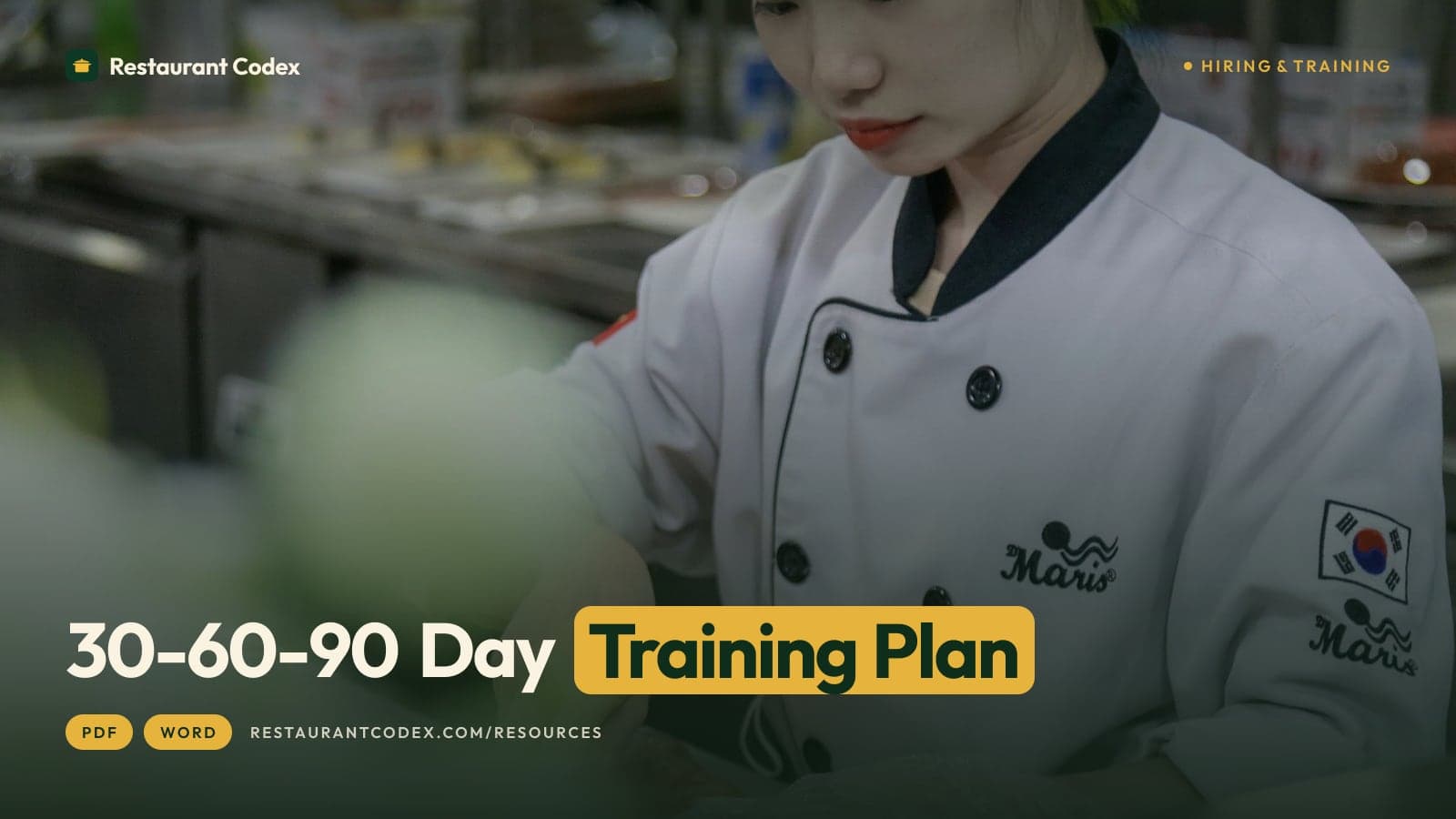
Add those windows up and 60 to 90 days is a reasonable floor for someone starting with no prior management background. A server or line lead who's already run parts of the shift informally often clears it faster. What shouldn't move is the order: nobody gets signed off on money or guest recovery before food safety and the shift itself are solid, no matter how fast the calendar is moving.
What does a restaurant manager's day actually look like?
A restaurant manager's day runs on three repeating walks and two blocks of work that only get done if they're scheduled on purpose: the numbers before doors, the walk-throughs during service, and the close. Here's what that looks like for someone covering a full day, open through close, which is still how a lot of single-location restaurants run even though not every manager works every hour of it personally.
| Time | What happens |
|---|---|
| 7:00-7:30am | Pulls yesterday's sales, today's forecast, labor scheduled, and top sellers off the POS; reads last night's handoff log |
| 7:30-8:30am | Opening walk: walk-in and reach-in temps, sanitizer, mise en place, restrooms, entrance |
| 8:30-11:00am | Prep oversight, vendor deliveries checked against invoices, a coaching conversation if one's on the calendar |
| 11:00am-2:00pm | Lunch service: a lap of the floor roughly every 20 minutes, ticket times, the 86 board, guest recovery as it comes up |
| 2:00-4:00pm | Admin block: next week's schedule, the P&L lines that moved, certification expiry checks, vendor calls |
| 4:00-4:30pm | Pre-shift huddle for dinner, standing, under 15 minutes |
| 4:30-9:00pm | Dinner service: mid-shift walks, comps and voids logged as they happen, guest recovery |
| 9:00-10:30pm | Close: cash counted with a second person present, equipment shutdown, cooling logged, handoff written before leaving |
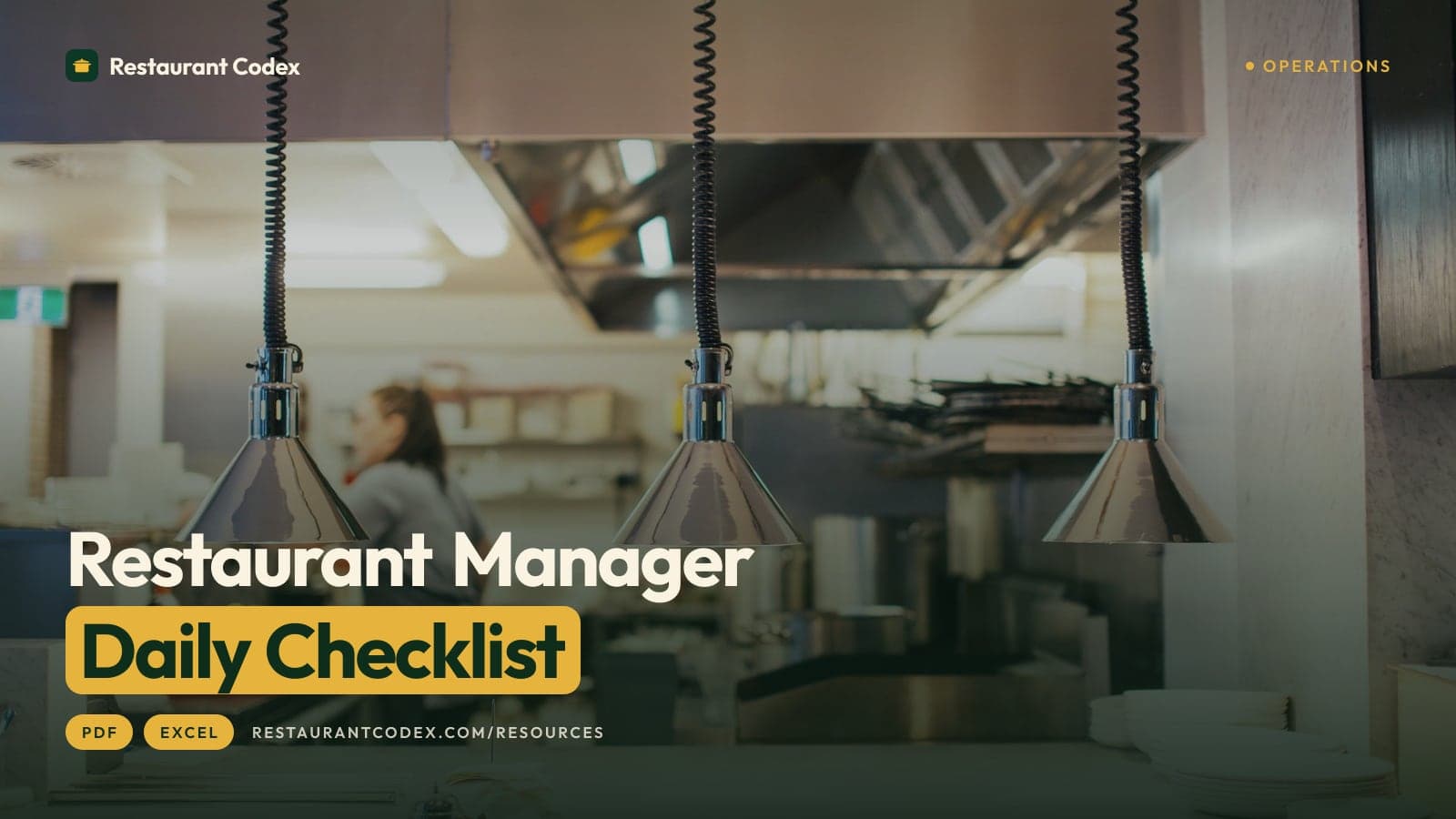
The admin block at 2pm is the one new managers cut first when the day runs long, and it's the one that costs the most when it goes missing for a week straight. A schedule built at 11:50pm from memory, after a double, isn't the same schedule a clear head builds at 2pm with the forecast in front of it.
Which restaurant manager certifications actually matter?
Two kinds of certification come up when owners search this, and they don't carry the same weight. A certified food protection manager credential, most often earned through ServSafe's Food Protection Manager Certification, is the one with legal teeth: many states require a food establishment to operate under the supervision of a certified food protection manager, built on the FDA Food Code's own requirement that the person in charge pass a test that's part of an accredited program. Illinois states this plainly on its own health department site: food establishments there must be under the supervision of a certified food protection manager in accordance with the state and adopted FDA Food Code. Check your own state and county before assuming one specific program is accepted locally. Accreditation by the ANSI National Accreditation Board under Conference for Food Protection standards, which is what ServSafe's Manager exam carries, is what most jurisdictions are actually asking for, not a brand name.
The second kind is a career credential, not a legal one. The Certified Restaurant Manager (CRM) designation from ServSuccess, the National Restaurant Association Educational Foundation's training arm, is voluntary everywhere. It asks for 2,000 hours of management experience, or 1,000 hours plus its own entry-level credential first, a valid ServSafe Food Protection Manager certificate, and a character reference, then tests financial management, purchasing and cost control, hiring and training, performance management, safety and regulations, and marketing. No health inspector asks for it. It's worth having for a manager who wants documented proof of range, not for a restaurant that only needs its shift legally covered.
The verdict: get the food-safety certification first, because it's often the law and it's always useful, and treat the broader management credential as optional, something to offer a manager who's already cleared the readiness sign-off below and wants the next thing to work toward.
How do you know a manager is ready to run a shift alone?
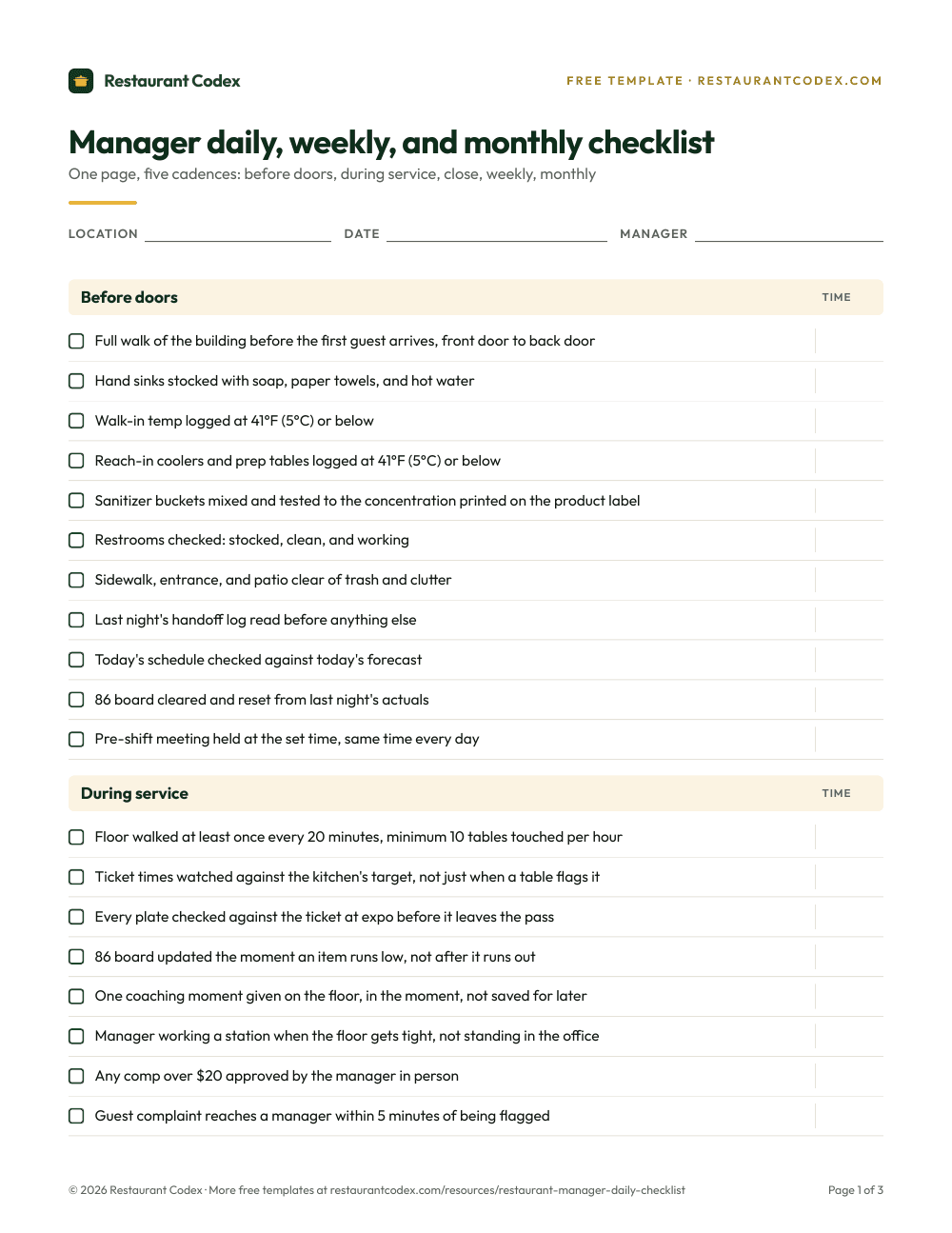
You know a manager is ready to run a shift alone when they've done each of the following by themselves, observed, not described back to you from memory: run a full pre-shift huddle standing, under 15 minutes, covering what's different, what can't break, who needs help, and what done looks like; completed a full line check and logged both temperatures correctly without being prompted; built and posted a week's schedule that landed inside the labor target on the first pass; made one comp or refund decision inside the written policy boundary and logged it without calling the owner; resolved a real guest complaint start to finish without pulling in anyone above them; and run a full close alone, including a two-person cash count they initiated themselves, a complete handoff log, and every line on the daily checklist marked with a time, not just a check.
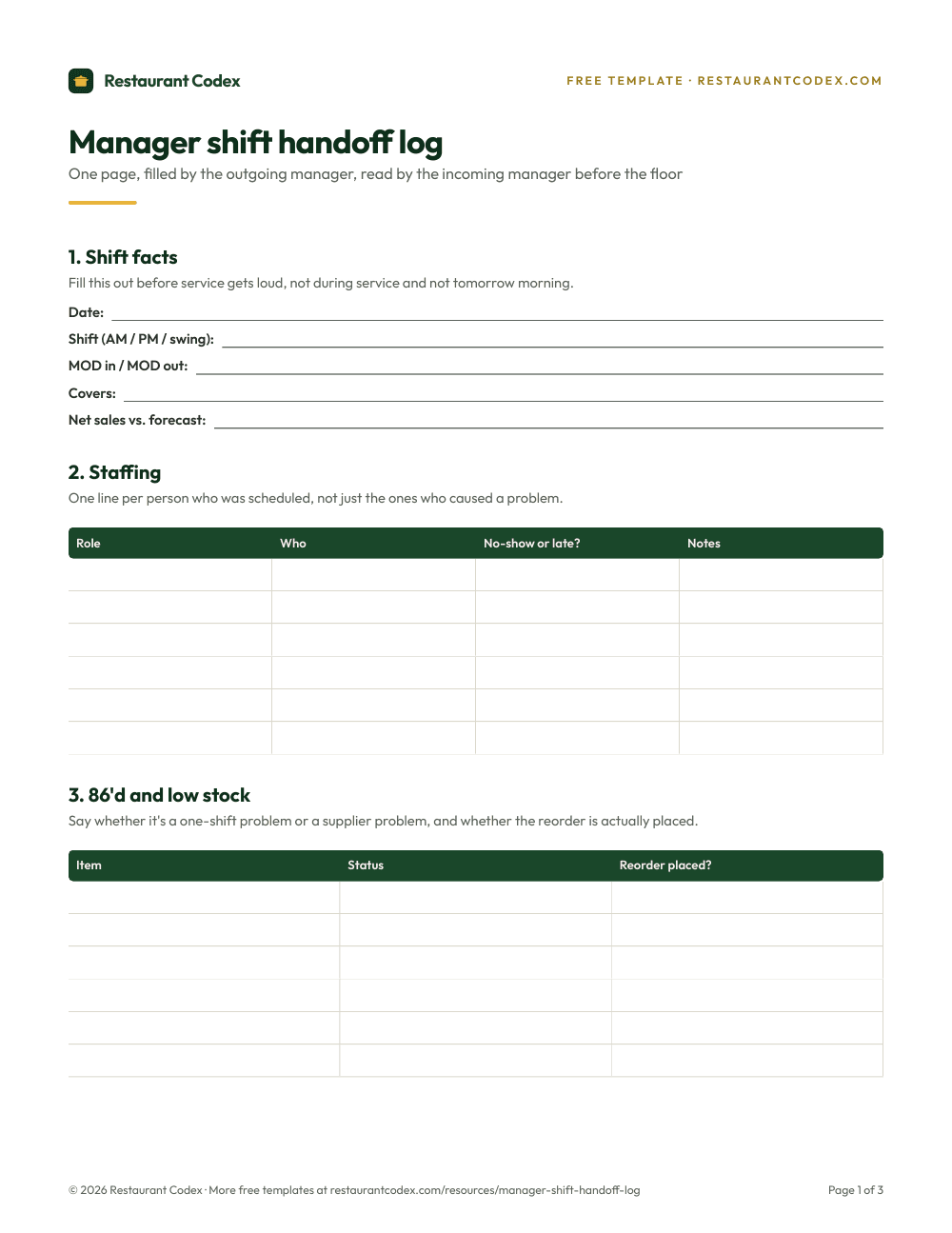
That list isn't about trusting the manager more. It's about replacing trust with proof that holds up when nobody's watching. At Avenida Café Bistro in El Salvador, opening and closing became easier to operate once there was real visibility into both, with less direct supervision needed day to day, and the owner reports saving about two hours every day as a result. That's what a readiness sign-off is actually for: not a gut call that someone seems ready, but a specific list of things they've already proven, with a date and a signature next to each one.
A 90-day manager training plan, worked through
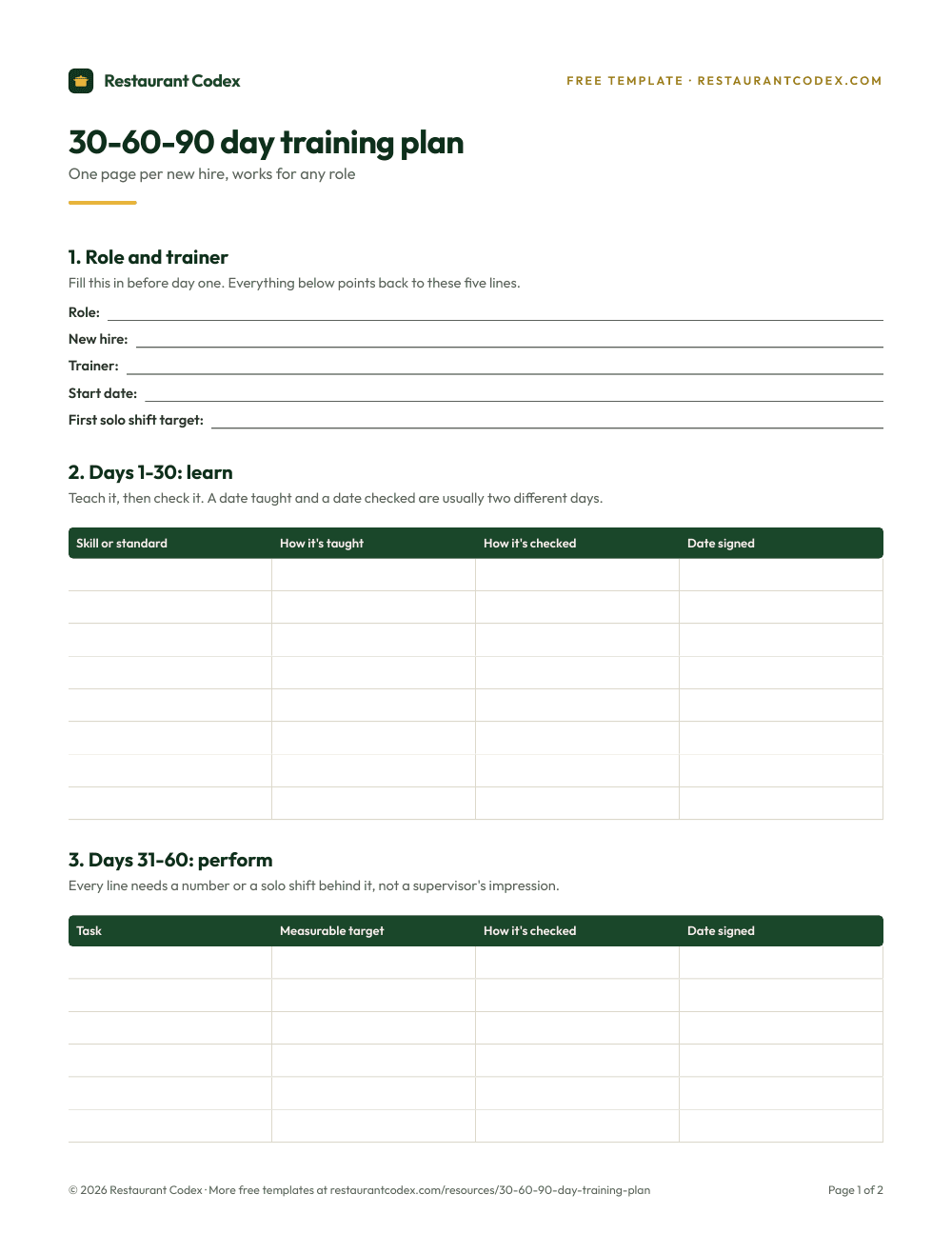
Take someone promoted from shift lead into a manager role at a single location, with no outside management background. The first 30 days aren't about running anything solo. They're about watching each competency done correctly, then doing it once with a senior manager narrating the reasoning out loud, food safety and the shift itself first, people and money once those two hold.
| Days | What happens | Who owns it |
|---|---|---|
| 1 to 30 | Each competency taught and demonstrated at least once, trainee shadowing and asking questions | Senior manager or owner, trainee observing and assisting |
| 31 to 60 | Trainee performs each competency alone while observed; a gap gets a specific fix and a retest, not an automatic pass | Trainee performs, senior manager signs off each one |
| 61 to 90 | Trainee clears the full readiness sign-off list and runs one complete shift alone, owner reachable but not in the building | Trainee runs the shift; owner reviews the log afterward |
Day 60 is the checkpoint that quietly gets skipped most often, because day 30 feels urgent and day 90 feels like the finish line. It's also the one most likely to catch a real problem, a schedule that's still missing target, a line check that's still being talked through instead of run solo, while there's still a month left to fix it before the trainee is standing a shift alone.
Where Restaurant Codex fits
Restaurant Codex keeps the training, the daily routine and the sign-off in one place instead of a binder, a spreadsheet and a manager's memory. In the LMS, a manager-in-training gets a path for the role on day one, tests drafted from your own manual, and a practical sign-off that a senior manager records at the station; readiness shows by location, role and path. In Operations, the opening, closing, temperature and cash-count lists the trainee has to run carry photo proof, so the readiness checklist can point at real shifts instead of a recollection. None of that replaces a senior manager standing next to a trainee during a real close. It means the proof that it happened doesn't live only in that manager's head.
Restaurant Codex
The same checklist, on every phone, with photo proof
Restaurant Codex runs this template as a live task with timestamps, photos and one view across every location. Bring it to a 30-minute working session and we'll show you how it would run across your locations.
By the Restaurant Codex team
Written with operators who run multi-location restaurant groups. Reviewed against the FDA Food Code and the sources listed below.
Sources
- BLS, Occupational Outlook Handbook, Food Service Managers (median pay, job outlook, projected openings)
- O*NET OnLine, Food Service Managers (11-9051.00), Job Zone and training time
- FDA Food Code 2026: cold holding, hot holding, and the certified person-in-charge requirement
- Illinois Department of Public Health, Certified Food Protection Manager (CFPM) requirement under the state and FDA Food Code
- ServSafe, ServSafe Food Protection Manager Certification (ANAB-CFP accredited)
- ServSuccess (National Restaurant Association Educational Foundation), Certified Restaurant Manager (CRM) credential requirements
- WhippleWood CPAs, Financial Benchmarks for Restaurants (food cost, labor cost, prime cost; National Restaurant Association and BLS 2026 data)