How many restaurants are there in Colombia?
Colombia has 155,488 restaurants and cafeterías with an active commercial registration renewed for 2025 or 2026, according to the commercial registry extract Confecámaras publishes on datos.gov.co, synced with the RUES (Colombia's single business and social registry) and updated October 2, 2026. The figure covers the four restaurant classes of the CIIU classification DANE uses: table service, self-service, cafeterías and other prepared-food outlets.
| CIIU class | Establishments | Share |
|---|---|---|
| 5611 Table-service restaurants | 87,016 | 56.0% |
| 5619 Other prepared-food outlets | 35,677 | 22.9% |
| 5613 Cafeterías | 27,170 | 17.5% |
| 5612 Self-service | 5,625 | 3.6% |
Two notes before going further. First, we only count registrations that are active and renewed for 2025 or 2026: Colombian merchants must renew within the first three months of every year (Commercial Code, article 33), and an active registration that hasn't been renewed in years is almost always a business that no longer exists. Second, the registry is the formal side of the market. Restaurants that never registered with a chamber of commerce don't show up, so the real number of places selling food is higher.
Where are Colombia's restaurants?
Bogotá holds 22.7% of the country's active restaurants: 35,261 in its chamber of commerce's jurisdiction, which covers the city and some neighboring municipalities. Next come the Medellín for Antioquia chamber (14,006), Cali (8,301), Bucaramanga (7,813) and Villavicencio (5,267).
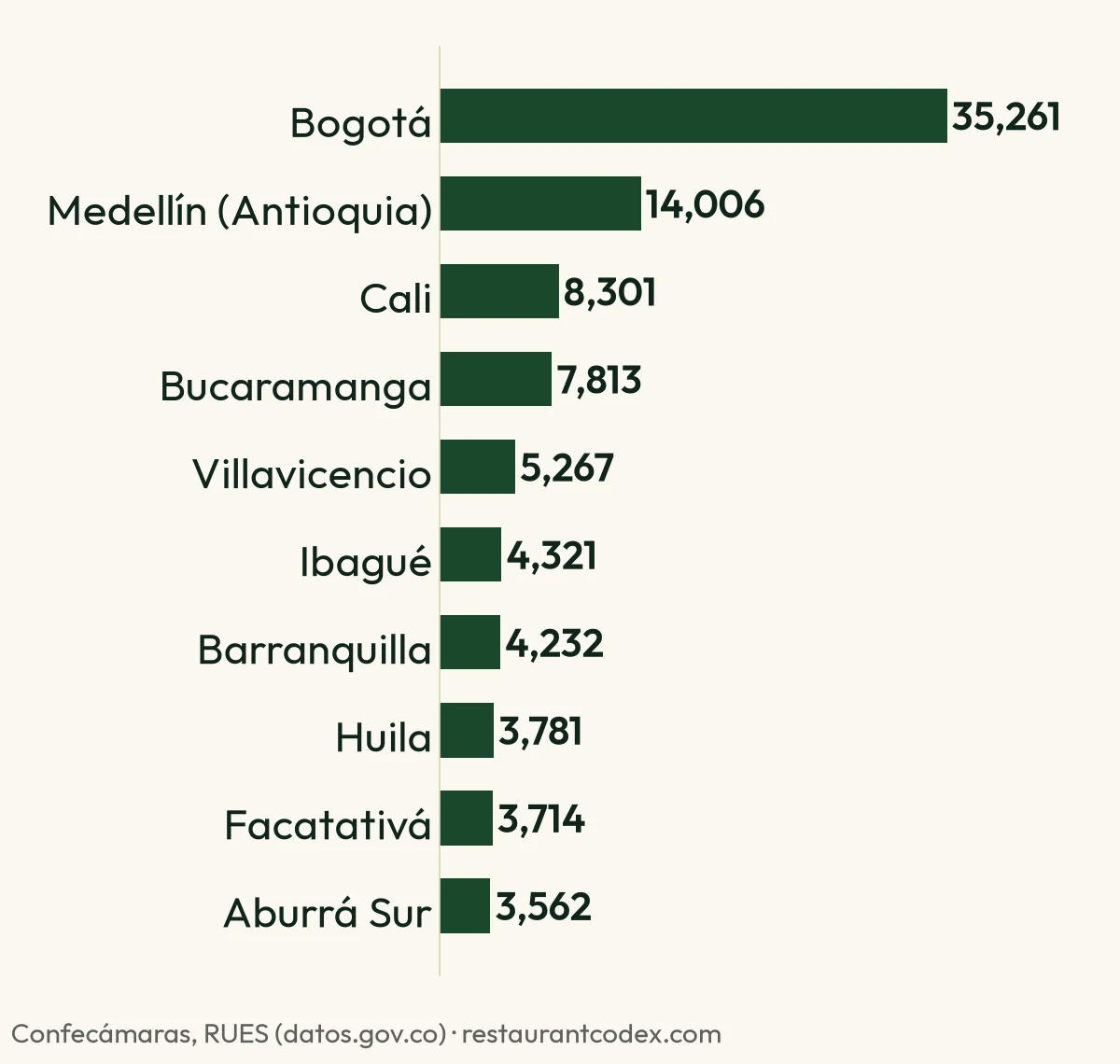
Then Ibagué (4,321), Barranquilla (4,232), Huila (3,781), Facatativá (3,714), Aburrá Sur (3,562), Cartagena (3,473) and Tunja (3,449). Figures are by chamber of commerce, not by municipality, because that's how the registry is organized: Aburrá Sur, for instance, covers the municipalities just south of Medellín. The full table for all 58 chambers is in the downloads at the end.
How many restaurants open and close in Colombia each year?
In 2025, 30,764 restaurants and cafeterías were registered in Colombia and 18,992 registrations were cancelled, a net gain of 11,772 establishments. It was the year with the most new registrations of the past decade.
| Year | Registered | Cancelled | Net |
|---|---|---|---|
| 2016 | 19,812 | 12,582 | 7,230 |
| 2017 | 23,899 | 16,610 | 7,289 |
| 2018 | 25,898 | 17,424 | 8,474 |
| 2019 | 26,160 | 20,416 | 5,744 |
| 2020 | 23,374 | 15,089 | 8,285 |
| 2021 | 28,088 | 14,764 | 13,324 |
| 2022 | 28,645 | 17,279 | 11,366 |
| 2023 | 26,857 | 17,602 | 9,255 |
| 2024 | 29,320 | 21,220 | 8,100 |
| 2025 | 30,764 | 18,992 | 11,772 |
What the table shows: 2020 slowed new registrations but didn't spike cancellations in the registry, which came in below 2019. The rebound arrived in 2021, with the largest net gain of the decade. And 2024 had the most cancellations of the period, 21,220. A cancellation isn't always a closure, since a registration is also cancelled when the owner or legal form changes, but it's the best public measure of exits there is.
How many restaurants survive in Colombia?
Of restaurants registered in 2021, only 30.6% still have an active registration renewed for 2025 or 2026. Of those registered in 2019, 25.6%. Three in four restaurants that opened six years ago are no longer in the registry as a going business.
| Year registered | Registered | Active and renewed in 2025-2026 | Share |
|---|---|---|---|
| 2019 | 26,160 | 6,688 | 25.6% |
| 2020 | 23,374 | 6,854 | 29.3% |
| 2021 | 28,088 | 8,590 | 30.6% |
| 2022 | 28,645 | 10,163 | 35.5% |
| 2023 | 26,857 | 11,859 | 44.2% |
The figure may run slightly low, because some businesses keep trading without renewing, but article 33 of the Commercial Code requires renewal every year, so the registry is a fair approximation. For anyone running a restaurant the reading is direct: the first three years are what separate the ones that stay.
Which kind of restaurant, and which city, lasts longer?
Pool the restaurants registered between 2020 and 2022 and 32.0% are still active and renewed. By type, self-service holds up a little better (38.4%), followed by cafeterías (33.7%), table service (32.3%) and other prepared-food outlets (29.3%). The gap between types is small; the gap between cities isn't.
| Chamber of commerce | Registered 2020-2022 | Active and renewed today |
|---|---|---|
| Bogotá | 11,471 | 49.2% |
| Medellín for Antioquia | 6,689 | 32.0% |
| Bucaramanga | 3,929 | 31.9% |
| Cali | 4,278 | 30.6% |
| Cartagena | 2,099 | 25.6% |
| Barranquilla | 3,268 | 22.2% |
In Bogotá, nearly half the restaurants that opened in those three years are still standing; in Barranquilla, just over one in five. Part of that distance may come from how consistently registrations are renewed in each city rather than how many places close, so read it as a signal rather than an exact closure rate. Still, the gap is too wide to be paperwork alone.
How many restaurant groups operate in Colombia?
4,694 owners hold between 2 and 15 registered restaurants, 13,448 establishments between them: 4,350 have 2 to 5 and 344 have 6 to 15. Above them, 86 owners hold 16 or more, and that's where the large chains sit. Unlike other registries, the count here is direct: the RUES links every establishment to its owner's ID number, so two locations with the same owner are recognized without guessing from names.
| Establishments per owner | Owners | Establishments |
|---|---|---|
| 1 | 137,087 | 137,087 |
| 2 to 5 | 4,350 | 10,514 |
| 6 to 15 | 344 | 2,934 |
| 16 to 50 | 62 | 1,691 |
| 51 or more | 24 | 3,140 |
Three things about those mid-sized groups. 82.4% operate within a single chamber of commerce's jurisdiction: they grow in their own city before leaving it. 58.7% are companies with a NIT (tax ID) and the rest are individuals with several locations in their own name. And they're based where the restaurants are: Bogotá (1,469 owners with 2 to 15 locations), Medellín for Antioquia (669), Cali (355), Barranquilla (254), Cartagena (203) and Bucaramanga (167).
A method note: we count by registered owner. A group that puts each location under a different company shows up as several owners, so the number of groups is, again, a floor.
What do the numbers mean for restaurant operators in Colombia?
The first reading is that running several locations is rare: of 141,867 registered restaurant owners, 4,780 have more than one, 3.4%. Whoever opens a second location joins a small group, usually with no nearby model to copy, and with everything that worked in one place (the owner at the register, the recipes in the cook's head, the WhatsApp group) about to fall short.
The second is survival. If three in four restaurants from 2019 are gone, what separates the ones that stay isn't only the food: it's keeping the standard when the owner isn't there and catching cost before it leaks. The guides on opening a second location and running a multi-location group start from there.
The third is geography. Bogotá, Medellín and Cali hold more than half of the country's mid-sized groups; that's where an operator with three or four locations competes for cooks, servers and managers with groups their size. To compare with Mexico, the same analysis on INEGI data is in Mexico's Restaurants in Numbers.
Method, sources and downloads
We used the "Establecimientos - Agencias - Sucursales" extract Confecámaras publishes on datos.gov.co with commercial registry data synced to the RUES, updated October 2, 2026. We took CIIU classes 5611, 5612, 5613 and 5619 by main activity. "Active" means an active registration renewed for 2025 or 2026. Registrations and cancellations by year come from the registration and cancellation dates of every record in those classes, whatever its current status. Owners are grouped by ID number, which we use only to count and never publish.
The tables carry the source's licence, CC BY-SA 4.0: credit Confecámaras (RUES) as the source and Restaurant Codex for the processing.
- Active restaurants by CIIU class
- Active restaurants by chamber of commerce
- Registrations and cancellations by year
- Survival by year of registration
- Survival of 2020-2022 registrations by type and by chamber
- Owners by number of establishments
- Owners with 2 to 15 locations by chamber
- Summary figures
The script that produces every number is published with the data.
Where Restaurant Codex fits
We published this because Restaurant Codex was built for restaurants that already run more than one location or are about to open the second: one place for each location's recipes, photo-proof checklists, training and inventory. Restaurants in Guatemala City, Mexico City, Monterrey, Cancún and Guayaquil, among others, run on Restaurant Codex; the customer list has the names. If your group shows up in these tables, the page on software for multiple locations shows what each part of the system handles.
Restaurant Codex
The same checklist, on every phone, with photo proof
Restaurant Codex runs this template as a live task with timestamps, photos and one view across every location. Bring it to a 30-minute working session and we'll show you how it would run across your locations.
By the Restaurant Codex team
Written with operators who run multi-location restaurant groups. Reviewed against the FDA Food Code and the sources listed below.
Sources
- Colombian Commercial Code, article 33 (annual renewal of the commercial registration), Secretaría del Senado
- Confecámaras, Establecimientos - Agencias - Sucursales (commercial registry synced to the RUES), datos.gov.co
- DANE, International Standard Industrial Classification Rev. 4 adapted for Colombia (CIIU Rev. 4 A.C.)