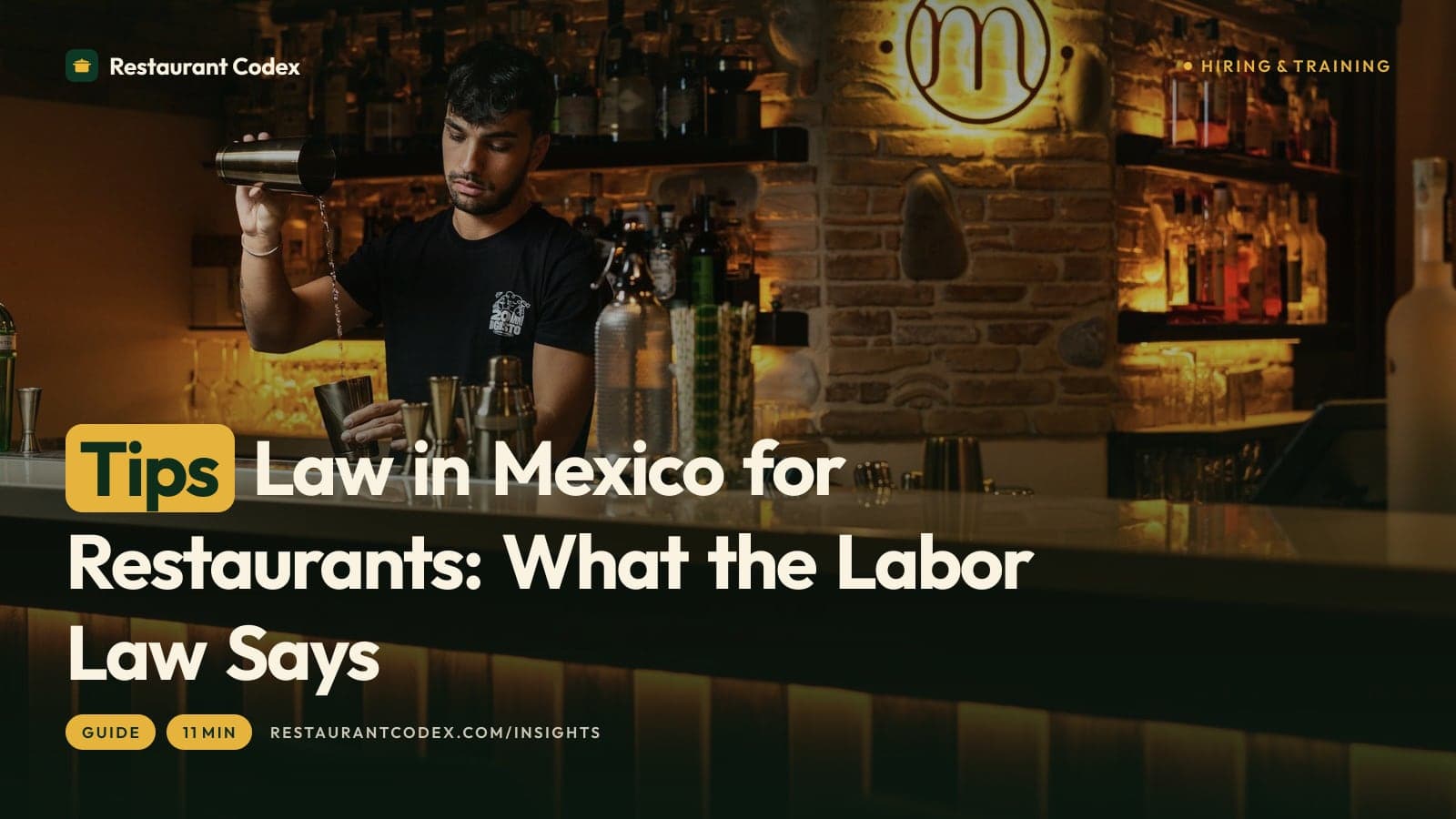
Are tips part of salary in Mexico?
Yes. Article 346 of the Ley Federal del Trabajo (LFT, the Federal Labor Law) says tips are part of the salary of workers in hotels, boarding houses, restaurants, fondas, cafes, bars and similar establishments, "on the terms of article 347". Article 344 sets who the chapter covers, and that is every worker in a restaurant, kitchen staff included.
The phrase "on the terms of article 347" is the one people skip. Article 347 says that if a percentage of the check is not set as the tip, the parties fix the increase to the base salary "for the payment of any indemnity or benefit that corresponds to the workers", and that salary must be remunerative, taking the size of the establishment into account. In plain words: the tip counts as salary when you calculate what a worker is owed if you let them go, and you must agree how much that increase is when the tip is not a fixed percentage.
That does not make the tip your payment. It is still the guest's money, handed to the worker. What the law does is treat it as part of the worker's income, with the income tax, social security and severance effects below.
If you come from a system with a tip credit, note that articles 344 to 350 contain nothing that lets an employer count tips toward the wage it owes. The tip sits on top of the wage and belongs to the staff.
Can a restaurant keep or pool tips in Mexico?
A restaurant cannot keep any share: the second paragraph of article 346 says employers cannot reserve or take part in tips, and article 350, section II, tells labor inspectors to verify that tips go entirely to the workers.
A common pool shared among workers can exist, as long as they agree to it and you retain nothing. The law does not ban collective splitting; it bans the employer's participation. The working rule for an owner: nothing from the tip pool goes into your till, not even temporarily.
Three things that sound reasonable and are not:
- Paying the restaurant's costs out of tips. Broken plates, cash shortages or the terminal fee do not come out of the pool. Article 110 of the LFT prohibits deductions from salary except in the cases it lists, and a tip is part of salary. That is a cautious reading, not a ruling a judge has issued on this exact point, so run it by your lawyer.
- Putting the owner or partners in the split. Article 346 closes that door. Whether a manager shares is a decision to make with a lawyer and write down, because managers often act as the employer's representative.
- Adding a fixed tip percentage to the bill. Two rules pull in different directions here. Article 347 mentions a percentage of the check, but PROFECO said on 2 January 2025, citing article 10 of the Federal Consumer Protection Law, that a tip is voluntary and cannot be included in the bill. For a normal restaurant, the safe route is that the guest decides. If you run banquets at a fixed price or have hotel contracts, ask a lawyer how to document a service charge, and do not call it a tip.
How do you split tips between floor and kitchen?
You split them however the employer and the workers agree in writing, because articles 344 to 350 contain no formula for splitting between areas. The only limit the law sets is that everything the guest left reaches the workers and you keep nothing.
The common schemes, with the trade-off in each:
| Scheme | How it works | When it fits | Where it breaks |
|---|---|---|---|
| Everyone keeps their own | The server keeps what the server receives | Short menus, few servers, no kitchen contact | The kitchen gets nothing and leaves first |
| Fixed percentage to the kitchen | For example, 30% of the weekly pool goes to the kitchen | Stable teams, easy to explain | Does not adjust for hours or shifts |
| Points by role and shift | Each role has points; the pool is split by total points | Mixed teams, several shifts | Needs shift records and a weekly review |
A worked example with made-up numbers, only to show the mechanics. Say a restaurant has a weekly pool of MXN 54,600 (cash and card together, nothing deducted) and these points per role: server 10, bartender 8, runner 7, line cook 6, kitchen helper 4, dishwasher 3. With 4 servers, 1 bartender, 2 runners, 3 line cooks, 2 kitchen helpers and 1 dishwasher, that is 91 points. Each point is worth 54,600 / 91 = MXN 600.
| Role | People | Points each | Each person gets | Subtotal |
|---|---|---|---|---|
| Server | 4 | 10 | MXN 6,000 | MXN 24,000 |
| Bartender | 1 | 8 | MXN 4,800 | MXN 4,800 |
| Runner | 2 | 7 | MXN 4,200 | MXN 8,400 |
| Line cook | 3 | 6 | MXN 3,600 | MXN 10,800 |
| Kitchen helper | 2 | 4 | MXN 2,400 | MXN 4,800 |
| Dishwasher | 1 | 3 | MXN 1,800 | MXN 1,800 |
| Total | 13 | 91 | MXN 54,600 |
The floor takes MXN 37,200 (68%) and the kitchen MXN 17,400 (32%). The points are an example, not law. Adjust for shifts or days worked, and record who was on.
A split that works is one anyone on the team can recalculate with a phone calculator. If the sheet needs the manager to explain it, it loses the trust the policy was meant to build.
How are tips taxed, and what about IMSS?
For the tax authority (SAT), a tip is income for the worker and you must count it when you calculate their income tax withholding. SAT criterion 35/ISR/N, in Annex 7 of the 2026 Miscellaneous Tax Resolution published in the DOF on 9 January 2026, says tips given to workers "must be considered by the employer to calculate and withhold" income tax, under article 96 of the income tax law, which applies the rate table to the worker's total income for the calendar month.
To do that you need to know what each person received. It is the most practical reason to keep the split in payroll and not in a notebook.
Criterion 30/IVA/N, in the same annex, says tips are not part of the VAT base, because the employer cannot keep any share of them.
For IMSS (the social security institute), the answer depends on who sets the tip. Article 27 of the Ley del Seguro Social (LSS) says the contribution base salary (SBC) is made up of "any other amount or benefit given to the worker for their work", and its list of exclusions, sections I to IX, does not mention tips.
| If the tip is... | Salary for severance (LFT) | IMSS SBC (LSS art. 27) | Income tax |
|---|---|---|---|
| A percentage or amount you set or hand over | Yes, art. 347 | Yes, it is an amount you give for the work | Added to their income, criterion 35/ISR/N |
| What the guest leaves directly and you do not determine | Yes, on the terms of art. 347 | Gray area, see below | Added to their income, criterion 35/ISR/N |
The gray area is this. The LSS says nothing specific about a tip the guest leaves directly. In practice, tax firms argue it does not enter the SBC because it comes from a third party and the employer does not know it, relying on IMSS Technical Council agreements and rulings of the Federal Administrative Justice Tribunal. That position is not in the text of the law. Ask your accountant for the legal basis in writing before you depend on it.
One contrast shows there is no express rule for restaurants: article 291-F of the LFT does exclude tips from the SBC of digital platform workers, explicitly. There is no equivalent text for restaurants.
And if the SBC changes, article 15, section I, of the LSS gives you five business days to report salary changes to IMSS.
What about tips paid by card?
A card tip is a tip like a cash tip: it belongs to the worker, it counts toward their income, and you cannot hold it back. The money lands in your bank account through the card processor, so you control the timing, and that is why the rule needs to be clear.
What to do in practice:
- Pay it with payroll or on the next fixed date. Article 101 of the LFT allows salary to be paid by bank deposit, debit card or transfer with the worker's consent, and says the cost of those payment methods is the employer's.
- Do not deduct the terminal fee from the worker's tip. The law does not say outright whether you can, and article 110 limits deductions from salary. The cautious route is to absorb the fee as a restaurant cost. If you want something else, have a lawyer approve it and have the workers sign.
- Let the guest decide. PROFECO says the tip is not included in the bill. If your terminal suggests percentages, the guest must be able to pick another amount or zero. The texts reviewed have no express rule on on-screen suggestions.
- Record who earned it. On a check with several tables or servers, the point-of-sale system should be able to attribute it; if it cannot, the split rule must say how it is handled.
What should a tip policy say?
A tip policy is a one- or two-page sheet, signed by each worker at hire, that says who takes part, how the pool is split, when it is paid and what is never deducted. Without one, the split depends on whoever is managing that night.
A base you can adapt with your lawyer:
- Principle. Everything the guest leaves as a tip, in cash or by card, belongs to the workers. The restaurant does not hold back or deduct anything from it.
- Who takes part. A list of roles (floor, bar, kitchen, dishwashing). The owner and partners do not take part. Write down what applies to the manager.
- How it is split. The scheme (points, percentage) and the value of each role. How absences, late arrivals and partial shifts are handled.
- When it is paid. A fixed date (weekly or with payroll) and the payment method. Card tips are paid the same way as cash tips.
- What is recorded. The cash-out total, the split sheet, who worked each shift. A copy for each worker.
- Taxes. A notice that the tip is added to their income for income tax withholding, and where they see it on their pay receipt.
- Changes. Any rule change is signed again with a start date. It never applies to tips already earned.
- Complaints. Who the worker tells if they think something is wrong, and how fast they get an answer.
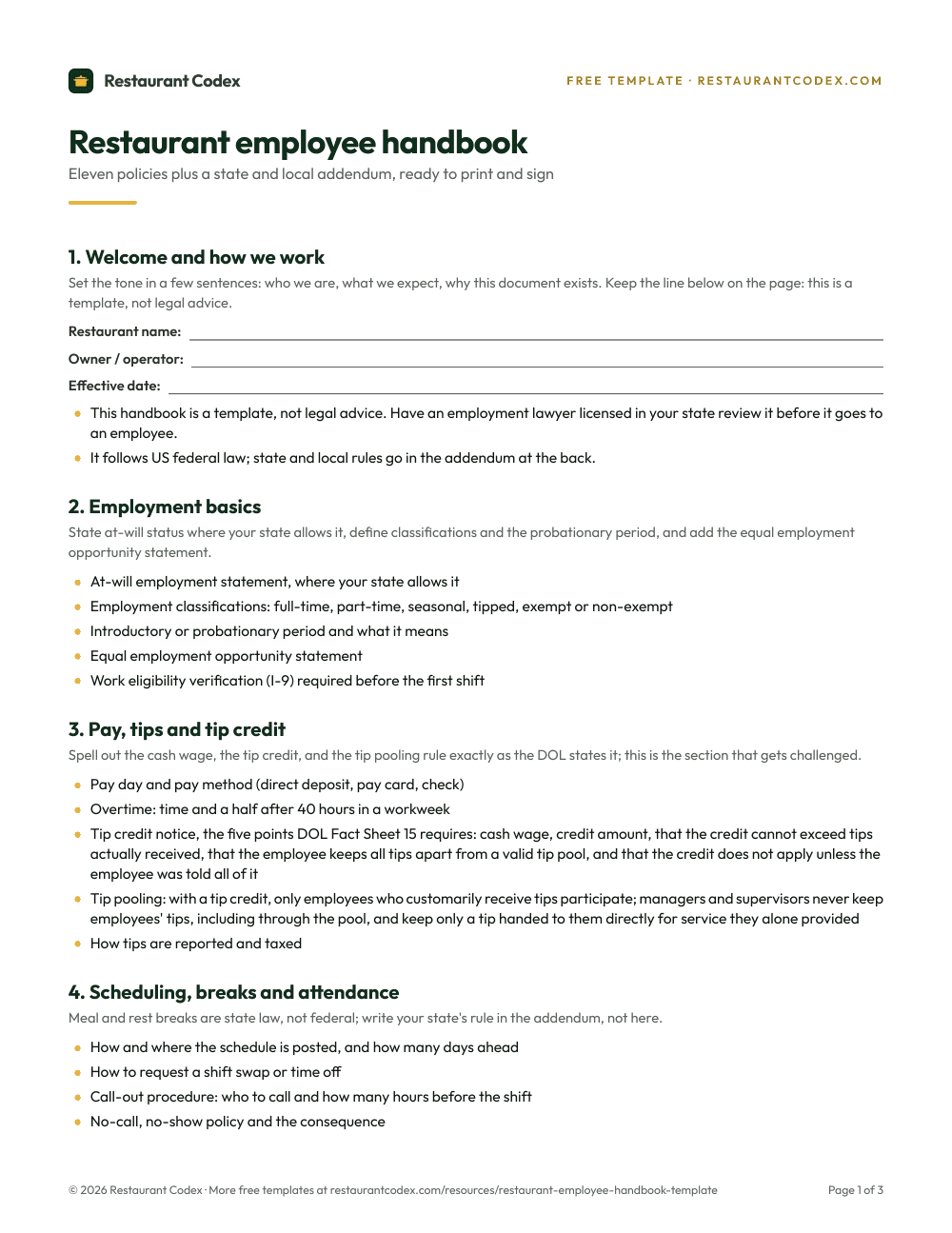
The policy belongs in the employee handbook, not floating in a chat. Explain it on day one; the onboarding process is where trust on this topic is won or lost. If you are a foreign operator, write it in Spanish, because that is the version your team will sign and the one a labor authority will read.
Did the tips law change in 2025 or 2026?
Not in the articles that matter. This guide was written on 24 October 2026 from the Chamber of Deputies text of the LFT (last reform DOF 15-01-2026) and the Diario Oficial indexes checked through 23 October 2026. The decrees amending the LFT in that period are the one of 1 May 2026 (working-hours reduction, amending articles 58, 59, 61, 66, 67, 68, 69, 71, 132 and 994) and the one of 14 May 2026 (performing artists). Neither touches articles 344 to 350.
What does affect you is working hours. The second transitory article of the 1 May decree lowers the ordinary working week in steps: 48 hours in 2026, 46 in 2027, 44 in 2028, 42 in 2029 and 40 in 2030. If your points scheme uses hours worked, review it each January.
Two things to confirm on your own: the IMSS basis for the tip a guest leaves directly, and any rule specific to your state. This guide covers the federal law and published criteria; it does not replace a lawyer.
Where Restaurant Codex fits
Restaurant Codex does not calculate tips or payroll, and it is not a point-of-sale or HR system: you still run the split in your payroll or spreadsheet, and the worker's signature stays on paper or in your personnel file.
What it does is put the policy where the team can find it. You can load it in the Knowledge Base as one more policy, shared with the roles that need it, and Codex Bot answers staff questions ("when is the card tip paid?") from what you wrote and shows the entry it used. If you want each role to read it on day one, you can link it to their training path. For the full picture, see what Restaurant Codex is.
Restaurant Codex
The same checklist, on every phone, with photo proof
Restaurant Codex runs this template as a live task with timestamps, photos and one view across every location. Bring it to a 30-minute working session and we'll show you how it would run across your locations.
By the Restaurant Codex team
Written with operators who run multi-location restaurant groups. Reviewed against the FDA Food Code and the sources listed below.
Sources
- Chamber of Deputies, Ley Federal del Trabajo (arts. 84, 89, 101, 110, 291-F, 344 to 350), text with last reform DOF 15-01-2026
- Chamber of Deputies, Ley del Seguro Social (arts. 15 and 27), text with last reform DOF 15-01-2026
- Diario Oficial de la Federación (9 January 2026), Annexes 3, 7, 10, 11, 12, 13, 14, 16 and 29 of the Resolución Miscelánea Fiscal para 2026 (criteria 35/ISR/N and 30/IVA/N)
- PROFECO, La propina ¿es obligatoria?; Profeco te responde (2 January 2025)
- Diario Oficial de la Federación (1 May 2026), decree amending the Ley Federal del Trabajo on reduction of the working day
- Diario Oficial de la Federación (14 May 2026), decree amending the Ley Federal del Trabajo and the Ley Federal del Derecho de Autor on performing artists