What are the major food allergens?
The United States recognizes nine major food allergens: milk, eggs, fish, crustacean shellfish, tree nuts, peanuts, wheat, soybeans and sesame. The Food Allergen Labeling and Consumer Protection Act of 2004 named the first eight, which FDA says accounted for 90 percent of food allergies and serious allergic reactions at the time. The FASTER Act, signed April 23, 2021 as Public Law 117-11, added sesame for food introduced into interstate commerce on or after January 1, 2023.
Those two laws govern labels on packaged food. FDA's page says the labeling law does not include "most foods sold at retail or food service establishments that are not pre-packaged with a label." A restaurant's duties come from elsewhere: the FDA Food Code, which FDA calls "neither federal law nor federal regulation" until a state, county or city adopts it, and from state law. In the 2022 Code, as FDA describes it, employee training must include food allergy awareness (sections 2-102.11 and 2-103.11), and where the Code is adopted, unpackaged food needs written notice to guests of the major allergens it contains (3-602.12). FDA's summary of changes for the 2026 Code amends 2-102.11 and 2-103.11 for food defense and managerial control, not allergens, and adds a Major Food Allergen Framework to its supporting documents.
Two limits matter before you build anything. FDA says it has not established a threshold level for any allergen, so there is no amount small enough to design around. And the nine are a legal list, not everything a guest can react to. A guest who says "I'm allergic to mustard" gets the same care as one who says "peanuts."
| Allergen | Where it hides on a line |
|---|---|
| Milk | Butter on a flattop or in a pan sauce, cream in soups, parmesan in dressings |
| Eggs | Aioli and mayonnaise, fresh pasta, tempura and breading, glazes |
| Fish | Anchovy in Caesar dressing, fish sauce, fish stock |
| Crustacean shellfish | Shrimp stock, shrimp in a shared fryer |
| Tree nuts | Almond flour, nut oils, pralines, nut garnishes |
| Peanuts | Peanut oil in a wok, satay sauce, crushed peanuts on top |
| Wheat | Flour in a roux, breading, beer batter, many soy sauces |
| Soybeans | Soy sauce, tofu, miso, soy lecithin in some dressings and chocolate |
| Sesame | Burger buns, tahini, sesame oil, seed garnish, some spice blends |
The right column is illustration, not a list to copy. The label on the product in your own walk-in is the authority.
How do you prevent allergen cross-contact?
You prevent cross-contact by treating allergen protein as something you remove, not something heat or sanitizer takes care of. FARE defines cross-contact as an allergen "accidentally transferred from one food to another," in amounts "so small that they usually can't be seen," and says "cooking does not reduce or eliminate the chances of a person with a food allergy having a reaction." Cross-contamination, the term kitchens already know, is about bacteria.
The best evidence is an FDA study of retail wiping and cleaning, summarized by Food Safety Magazine. Researchers soiled stainless steel, textured plastic and maple wood with peanut, milk and egg foods, then tested what was left. Dry wipes and cloths did not remove the allergens, and allergen on a dry wipe moved to the next surface. A terry cloth presoaked in water or sanitizer, several quat wipes, and the full wash, rinse, sanitize, air dry method did remove it. Scraping food off first helped, and textured plastic was the hardest surface to clear. The Massachusetts health department says sanitizing alone "does not fully eliminate" contamination by food allergens.
What that means on a line:
- Clean, don't wipe. Wash, rinse, sanitize and air dry anything an allergy order touches. A wiped board is not a cleaned board.
- Keep allergy-only tools. FARE suggests a cutting board, plates and utensils used only for allergy-free food, stored in a designated place. Textured plastic was the hardest surface in the FDA study, so choose smooth boards.
- Wash hands with soap. FARE cites a study in which soap removed food protein from hands and alcohol-based sanitizer did not.
- Do not share the flattop or the fryer. FARE's example is a flattop that cooked eggs and French toast at breakfast and still carries egg, milk and wheat proteins at lunch if nobody cleaned it. FARE tells guests that if a restaurant uses a shared grill or fryer for regular and allergen-free meals, "the restaurant does not understand food allergies."
- Hand it over, don't leave it on the pass. One person builds it, and it goes to the table separately, preferably carried by the chef or a manager, so it never sits beside a plate with the allergen on it.
Our view on the ticket: every allergy order should end in one of four outcomes, and the cook should be allowed to pick the last one.
| Situation | What the kitchen does |
|---|---|
| Recipe has no allergen and nothing shared touches it | Cook on a cleaned station with allergy-only tools, flag the ticket, hand-deliver |
| Recipe has no allergen, but it cooks on a shared flattop or in a shared fryer | Clean the surface fully or use a clean pan. If it needs the fryer, take that cooking method off the table |
| The allergen is an ingredient | Offer the swap written on the matrix. If none exists, say it can't be made safely |
| Anyone is unsure what is in an ingredient or sauce | Treat it as containing the allergen and don't serve it |
What doesn't work is the cook who "knows" a dish is fine, a towel instead of a wash, and a blanket line on the menu that says anything may contain anything. A disclaimer is not a control. The HACCP guide shows how to turn this into a written control point, with a limit and a record, if a dish needs one.
How do you train staff on allergies?
You train every role on the same three things, the nine allergens, the procedure when a guest says "allergy," and the emergency steps, then test each person on their own job. The Food Code asks the person in charge to ensure employees are trained in food safety, "including food allergy awareness," as it relates to their duties.
Massachusetts spells out the content, and it works as a template anywhere. Its health department deems a course approved if it is accredited by ANAB, approved through FARE's FAREcheck program, or is an interactive video with an exam that covers these areas:
- the nine allergens, in pictures and text;
- the symptoms and the risk, including death, and the difference between an intolerance and an allergy;
- a step-by-step procedure for service staff, kitchen staff and managers when a guest states an allergy, including what an employee does who doesn't know the answer;
- a consistent line of communication between guests, staff and chefs;
- methods to prevent cross-contact, including cleaning and separating tools and prep areas;
- emergency steps that start with "Call 911" and staying with the guest.
Then split it by job:
- Servers and hosts. Ask which allergen and how serious. Never answer from memory. Write the allergy on the ticket as its own line and tell the kitchen and a manager. A line that works: "Thanks for telling me. I'm going to check with the kitchen so I don't guess."
- Cooks. Read the matrix row before you cook. Clean the station and take allergy-only tools. Say no when you can't make it safe.
- Expo and runners. The allergy plate leaves the pass on its own, goes to the right guest by hand, and is named out loud.
- Managers. You own the answer when the matrix is unclear, and you run the emergency steps.
Run it as a ten-minute walk-through before service, with a real dish, until the order from the table to the pass is automatic. Our view: a test and a signature are not training. The check that counts is watching a cook handle a live allergy ticket at the station and signing off only when the steps happen in order. The staff training guide covers how to build that sign-off.
How do you document allergens on recipes?
You document allergens at the ingredient level on every recipe, then roll the recipes up into a matrix that service staff can read in seconds. A dish name tells you nothing. The allergen sits in the dressing, the marinade, the oil and the garnish.
Here is a hypothetical house chicken Caesar, checked ingredient by ingredient. The recipe is invented for the example.
| Component | What is in it | Allergens |
|---|---|---|
| Dressing | Egg yolk, anchovy fillets, parmesan | Eggs, fish, milk |
| Croutons | House bread baked with butter | Wheat, milk |
| Chicken | Marinated in soy sauce, which often contains wheat | Soybeans, wheat (confirm on the label) |
| Topping | Shaved parmesan | Milk |
| Flattop | Chicken is seared on the flattop that also cooks shrimp | Crustacean shellfish (cross-contact, not an ingredient) |
The matrix row reads: contains milk, eggs, fish, wheat and soybeans; cross-contact risk with crustacean shellfish; safe swap, none. A guest allergic to fish, egg or milk can't have the dressing, because the dressing is the dish. The honest answer is to offer a different dish, such as a green salad with oil and lemon, and the matrix should say so. A matrix that always finds a swap is a matrix nobody trusts.
The arithmetic explains why this needs discipline. A 40-dish menu against nine allergens is 360 cells, and every cell depends on ingredients that change when a supplier does. So:
- Read the label once per ingredient, and write what it says, not what you remember.
- Document batch recipes once. If the dressing is used in six dishes, the batch recipe carries the allergens and each dish points to it.
- Add the process, not just the ingredients. Which surface, fryer or pan the dish touches goes in the cross-contact column.
- Re-check on any change. New brand, new distributor, new menu item, same rule. Put a date and a name on the sheet.
- Specials get a row before service, not after the first question.
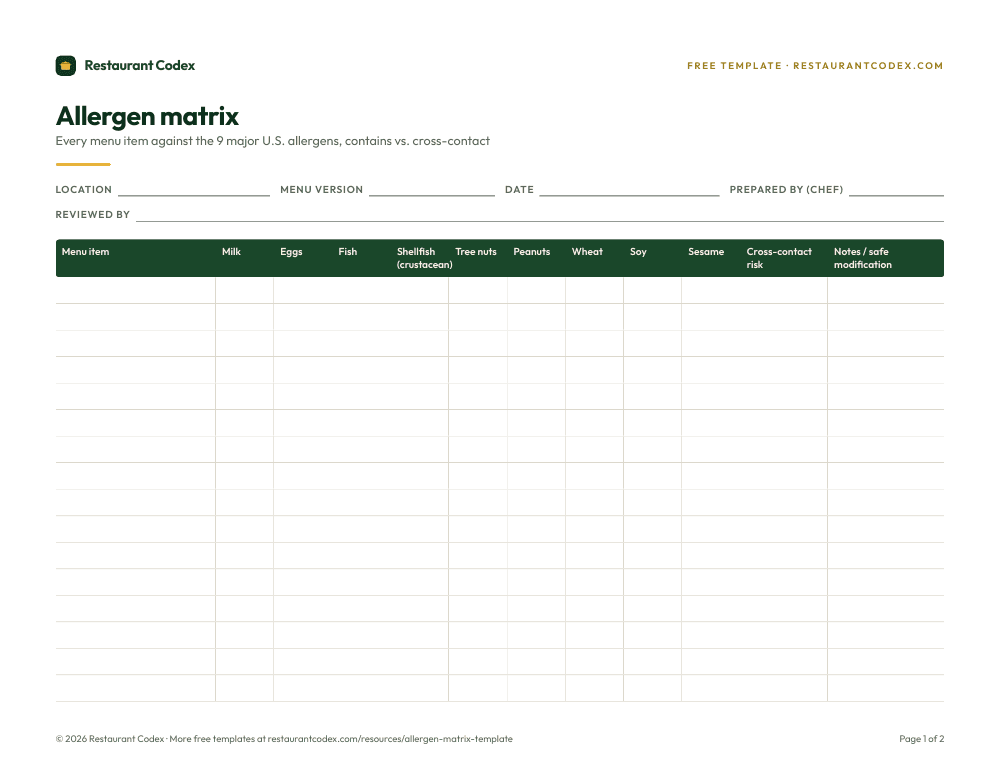
The template below puts each menu item against the nine allergens, marks ingredient against cross-contact, and has a column for the safe swap. The wider recipe system is in the recipe management guide.
What should you do if a guest has a reaction?
You call 911 for any severe reaction, help the guest get their own epinephrine if they carry it, and stay with them until help arrives. You are not there to diagnose. FARE describes the first symptoms as usually appearing "between a few minutes and two hours" after exposure, and says a reaction can be mild, severe or life-threatening.
FARE draws the line like this. Mild symptoms are an itchy or runny nose, an itchy mouth, a few hives, mild itch or mild nausea. Severe symptoms include shortness of breath, wheezing, a repetitive cough, a tight or hoarse throat, trouble swallowing, significant swelling of the tongue or lips, faintness, many hives and repetitive vomiting. FARE adds two rules that matter to a manager: "a reaction that involves any severe symptom is a severe reaction," and so are mild symptoms in more than one area of the body. Severe reactions "must be treated with epinephrine."
A card for the manager's office:
- Stop and ask. What did they eat, and do they carry epinephrine? If a guest has a severe symptom, move to step 2 without waiting to be sure.
- Call 911. FARE's wording is to tell the dispatcher that epinephrine was used for a suspected anaphylactic reaction to food, if it was, and to ask for an ambulance with epinephrine on board.
- Get the guest's own epinephrine into their hands and let them or a companion use it at the first sign of a severe reaction. FARE lists auto-injectors and a nasal spray.
- Stay with the guest until help arrives. The Massachusetts training content says the same.
- Do not offer an antihistamine in its place. FARE says one "cannot control a severe reaction or anaphylaxis."
- Expect the emergency room, even if the guest looks better. FARE says to go for further treatment even if the symptoms resolve.
Our view for afterwards: the same night, write down the table, the ticket, the dish, who cooked it, what the guest told the server, and what the matrix said. Then find out which step failed. If the matrix was wrong, fix it before the next service. If the matrix was right and the cook didn't use it, that's a training problem, not a paperwork problem. Talk to your insurer or a lawyer about anything beyond that.
How do you control allergens across several locations?
You control allergens across locations by making the matrix belong to the menu, not to the kitchen, and by making the allergy routine identical everywhere. Locations that each keep their own sheet tend to drift apart, and a guest who ate safely at one site assumes the next one is the same.
Rules differ by place, which is a second reason to centralize. A few examples as FARE and the statutes describe them:
| Where | What it asks |
|---|---|
| California (SB 68) | Commencing July 1, 2026, a food facility subject to the federal menu labeling provision, which the bill's digest describes as chains of 20 or more locations under the same name with substantially the same menu, must give written notice of the major allergens it knows or should know are in each menu item. It can be on the menu, or digital, such as a QR code, with an alternative such as a chart, grid or booklet for guests who can't use it |
| Massachusetts | A certified food protection manager with allergen training, an approved poster in the staff area, and menus that say: "Before placing your order, please inform your server if a person in your party has a food allergy." |
| Illinois | At least one manager on duty with training in nationally recognized allergen safety standards, available at all times the establishment is open (as listed by FARE) |
| Maryland | A food allergy awareness poster displayed in the staff area (as listed by FARE) |
| Michigan | Certified food safety managers in most restaurants take a course with an allergen component (as listed by FARE) |
FARE's page also lists Rhode Island and Virginia. The California law is about ingredients on the menu, not cross-contact, and its text says it does not alter any duty a facility has to reasonably ensure patrons' safety. A group with sites in several states is simplest to run to the strictest one everywhere.
What to centralize:
- One matrix per menu, one owner. Locations don't edit it. They ask for a change, and the owner checks the label and issues the new version.
- A substitution rule. If a site buys a different brand because the usual one is out, the allergen row is unverified until someone reads the new label. Until then the dish isn't offered to anyone who has declared an allergy.
- The same opening check. Allergy tools clean and present, matrix at the pass, poster where the law asks for it.
- The same training and sign-off for every cook and server, so a transfer between sites doesn't reset what they know.
The consistency guide covers the wider problem of keeping sites on one standard.
Where Restaurant Codex fits
Restaurant Codex keeps the documents and checks in one place; it doesn't make the safety decisions. In the Knowledge Base, plate recipes and batch recipes carry an allergens field next to photos, yield and shelf life, and PDFs and recipe photos import with their structure kept. Codex Bot answers a staff question from the group's own manual and recipes, shows the entry it used, and never changes a record, so a server at any site is reading the same row as the chef.
In Operations, the opening check for the allergy station can be a scheduled line check with photo proof the app requires, with a push when it's due or overdue and a manager alert when it's about an hour late. In Training, each role gets a learning path from day one, tests are graded on the server, and a manager gives a practical sign-off at the station. Owners compare locations side by side.
It doesn't read a supplier's label for you, and it doesn't decide whether a dish is safe for a given guest. Someone still has to check the label when a product changes and someone still has to say yes or no at the table.
Restaurant Codex
The same checklist, on every phone, with photo proof
Restaurant Codex runs this template as a live task with timestamps, photos and one view across every location. Bring it to a 30-minute working session and we'll show you how it would run across your locations.
By the Restaurant Codex team
Written with operators who run multi-location restaurant groups. Reviewed against the FDA Food Code and the sources listed below.
Sources
- FDA, Food Allergies (FALCPA, packaged foods, no threshold level set)
- FDA, The FASTER Act: Sesame Is the Ninth Major Food Allergen
- Public Law 117-11, Food Allergy Safety, Treatment, Education, and Research Act of 2021 (GovInfo)
- FDA, Addition to the 2022 Food Code: Sesame Added as a Major Food Allergen (Food Code 2-102.11, 2-103.11, 3-602.12)
- FDA, Summary of Changes in the 2026 FDA Food Code
- Massachusetts DPH, Retail Food Code Standards for Allergen Awareness (updated September 11, 2024)
- Food Safety Magazine, FDA Study: Allergen Removal and Transfer Using Wiping and Cleaning Methods in Retail Food Establishments (July 8, 2020)
- FARE, Avoiding Cross-Contact
- FARE, Recognizing and Treating Reaction Symptoms
- FARE, Food Allergies and Food Service Establishments (state laws)
- California Legislature, SB 68 (2025, Chapter 741), adds Health and Safety Code 114093.5