What Is Restaurant Recipe Management Software?
Restaurant recipe management software is the system that replaces a binder of recipe cards with searchable recipe data: ingredients in a fixed unit, a yield, an allergen tag, a plate photo, and a version number, so a change to one dish reaches every station using it the same day it happens.
The split that matters most is between batch and plate. A stock, a sauce base, or a pickled onion is a batch recipe, made in volume and drawn down over several services. A plate build references those batches by name and adds the final steps: portion, sear, sauce, garnish. Skip that split and a "recipe" turns into seven recipes stapled together, and a line cook has to read past the stock method just to find out how the dish gets plated.
Every field on a card exists because someone, somewhere, guessed wrong without it. Hold time and temperature aren't suggestions: the FDA Food Code sets hot holding at 135°F or above and cold holding at 41°F or below, and a recipe that just says "keep warm" asks a new cook to guess at a number a health inspector already has written down.
Permissions decide who can touch that number. Line cooks read and execute. Culinary leadership, usually the chef or a corporate chef in a larger group, owns changes, and finance may see cost fields without editing a plating photo. Skip this and you get "helpful" tweaks: a cook decides the sauce needs more butter, changes it, and never mentions it. Three weeks later the dish costs four points more than it's priced for and nobody can say why.
The payoff shows up the day a recipe actually changes. A vendor swaps a cheese, a chef adjusts a sauce, a dish gets pulled from one location's menu because a supplier fell through. Push that through a system and it reaches every station, at every location, the same day, with a short refresher in the LMS if the change needs one. Run it over a group chat instead, and half the team is still building the old version two weeks later, because the message scrolled past before the closing shift read it. See our guide to the restaurant knowledge base for how a recipe library fits next to equipment manuals and SOPs.
What Are Restaurant Recipe Library Best Practices?
A recipe library holds up when it enforces four rules every time, not most of the time: one unit system per ingredient category, allergen tags that live on the ingredient and flow into every recipe that uses it, a hard split between mise and plate, and a photo of every finished dish.
Units matter more than they look like they should. A recipe written with "a handful" instead of a weight can't produce a real cost per portion, the number food cost percentage runs on. Full-service restaurants typically run food cost between 28% and 35% of the menu price, averaging 32.4% nationally in 2026, according to National Restaurant Association data cited by WhippleWood CPAs. A library built on guessed quantities can't tell you which side of that range a dish actually sits on.
Naming discipline is a smaller problem that causes bigger ones. Name a dish the way the kitchen talks about it, but enforce one name per dish, matched to what's on the POS and the printed menu. "Grilled Salmon" on the menu and "Salmon Filet - Dinner" in the recipe file means a manager pulling a sales report can't find the card for a dish that just sold forty times, and the gap usually surfaces during a health inspection, never on a slow Tuesday when it would've been easy to fix.
Photos do work a written method can't. A plating description tells a new cook where the sauce goes; a photo shows it, and cooks match a picture faster than they parse a paragraph. Photograph the finish, but also the failure modes: a broken emulsion, the wrong cheese melt, the wrong glassware next to the right one. A library that only shows the correct result gives a cook nothing to compare against once something's already gone wrong on the pass.
Review runs on a calendar, not a complaint. Top sellers get a look every quarter whether or not anything's changed, because supplier substitutions creep in quietly. High-comp dishes get checked monthly until the comps stop, and anything touched by a promotion or a limited-time item gets reviewed the week after launch, while the kitchen still remembers what actually happened on the line.
How Should You Document a Restaurant Menu for Staff?
Restaurant menu documentation works when front of house and back of house each get a page built for what they're actually asked under pressure: servers need a one-sentence description, a pairing, pronunciation, and the top allergy questions for that dish, while cooks need the weighed build, hold times, and a batch link, not one page trying to do both.
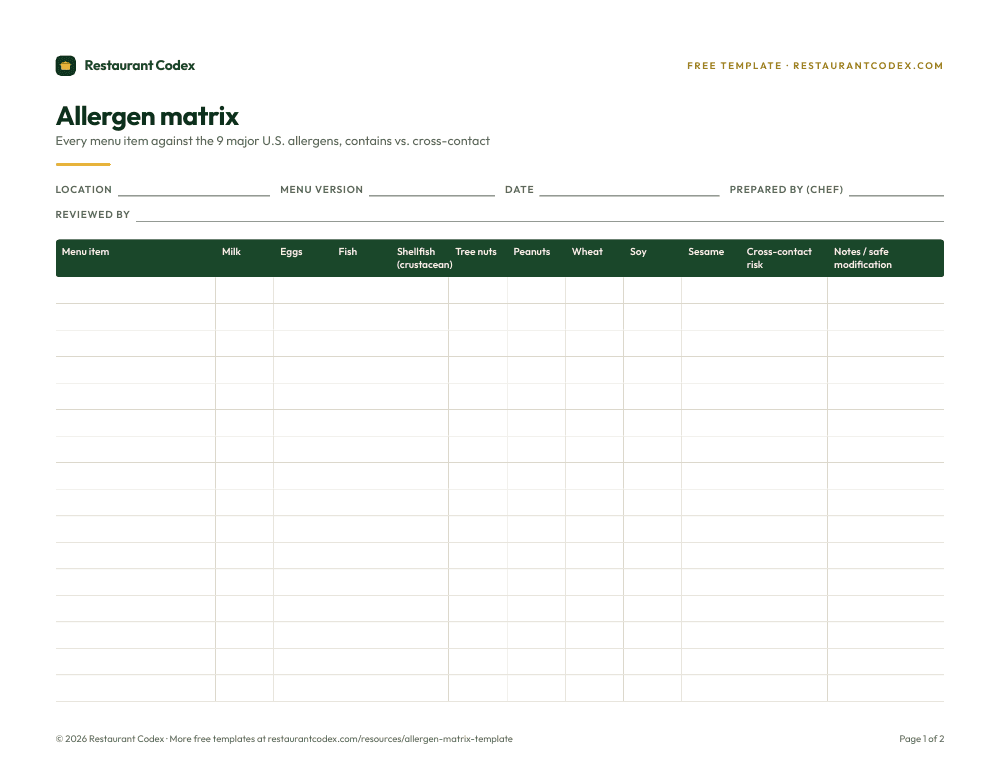
Almost every allergy question a server gets touches one of the nine major allergens the FDA tracks under FALCPA and the FASTER Act, the law that made sesame the ninth allergen effective January 1, 2023, so that's what the server page should be built around, not a general "ask the kitchen" note. The other line worth rehearsing is what to say when the kitchen 86s the dish mid-service. A server caught without an answer either oversells a dish that's gone or apologizes without offering what's actually available.
A cook needs the build: weights, method, finish cues, what plate it goes on, and the batch it draws from. A bartender needs the spec: pour amounts, ice, glassware, garnish, and which prep it depends on. Neither needs the guest-facing sentence, and a server doesn't need the batch yield. Putting both on one page produces a document that's three-quarters irrelevant to whoever's reading it in the moment.
The order of updates matters as much as the content. When culinary changes a build, the recipe spec updates first. The menu doc updates second, pulled from the new spec, not written from memory. The floor huddle gets the talking points third, at the next pre-shift. A short LMS refresher goes out fourth if the change is big enough that "you probably noticed" isn't good enough. Skip a step and half the floor is still selling a chicken thigh that got swapped to breast three days ago.
Stale documentation costs more trust than no documentation at all. A server who reads an old allergy note and gets it wrong in front of a guest with a real allergy doesn't get a second chance to be believed the next time they say "let me check."
How Do You Keep Allergen Information Accurate in Recipes?
Allergen accuracy starts at the ingredient, not the dish: tag milk, egg, wheat, soy, peanuts, tree nuts, fish, crustacean shellfish, and sesame, the nine major allergens the FDA recognizes since the FASTER Act added sesame effective January 1, 2023, on the ingredient record itself, so every recipe using that ingredient inherits the flag automatically. FARE, the Food Allergy Research & Education organization, publishes the same nine as the allergens a US kitchen has to plan around.
The harder problem is what happens after the tag exists. A supplier swaps a bread vendor or changes the oil a fry station uses, and none of that shows up as a change to your menu. It shows up as a change to an ingredient nobody re-checked. A system that ties tags to the ingredient can flag that swap and force a review before the new case gets used. A system that doesn't just serves the old, wrong answer with full confidence.
Cross-contact is the part a written tag can't capture: the fryer that does fries and breaded shrimp in the same oil, the pasta water a gluten-free order gets boiled in, the cutting board that had bread on it ten minutes ago. None of that appears in an ingredient list, so it has to be walked and written down station by station. Substitutions cause the same kind of harm. A cook swaps dairy for a guest's request, gets it right once, and never updates the build's metadata because it felt like a one-off. The next server who pulls up that dish still sees the old answer.
Servers need language, not just data: what's confirmed on the spec, what needs a manager to confirm first, and the honest limit, "we control the ingredients, we can't guarantee zero trace in a shared kitchen." A server who improvises past those three tiers, guessing to sound confident, is where liability actually starts.
Review has to be a trigger, not a habit. A menu change or a vendor substitution should trigger a short LMS refresher for anyone touching that dish, plus a task confirming the prep containers and station labels match what the spec now says.
A Worked Example: Standardizing a Dish That's Drifted
A braised short rib went on the menu two years ago, built by a sous chef who left eight months later. Ask three current line cooks how they make it and you'll get three different answers: one reduces the braising liquid until it coats a spoon, one reduces it by a fixed ratio, one skips reduction and thickens with a slurry because that's what the person who trained them did. The dish still sells. It just isn't the same dish depending on who's on the line.
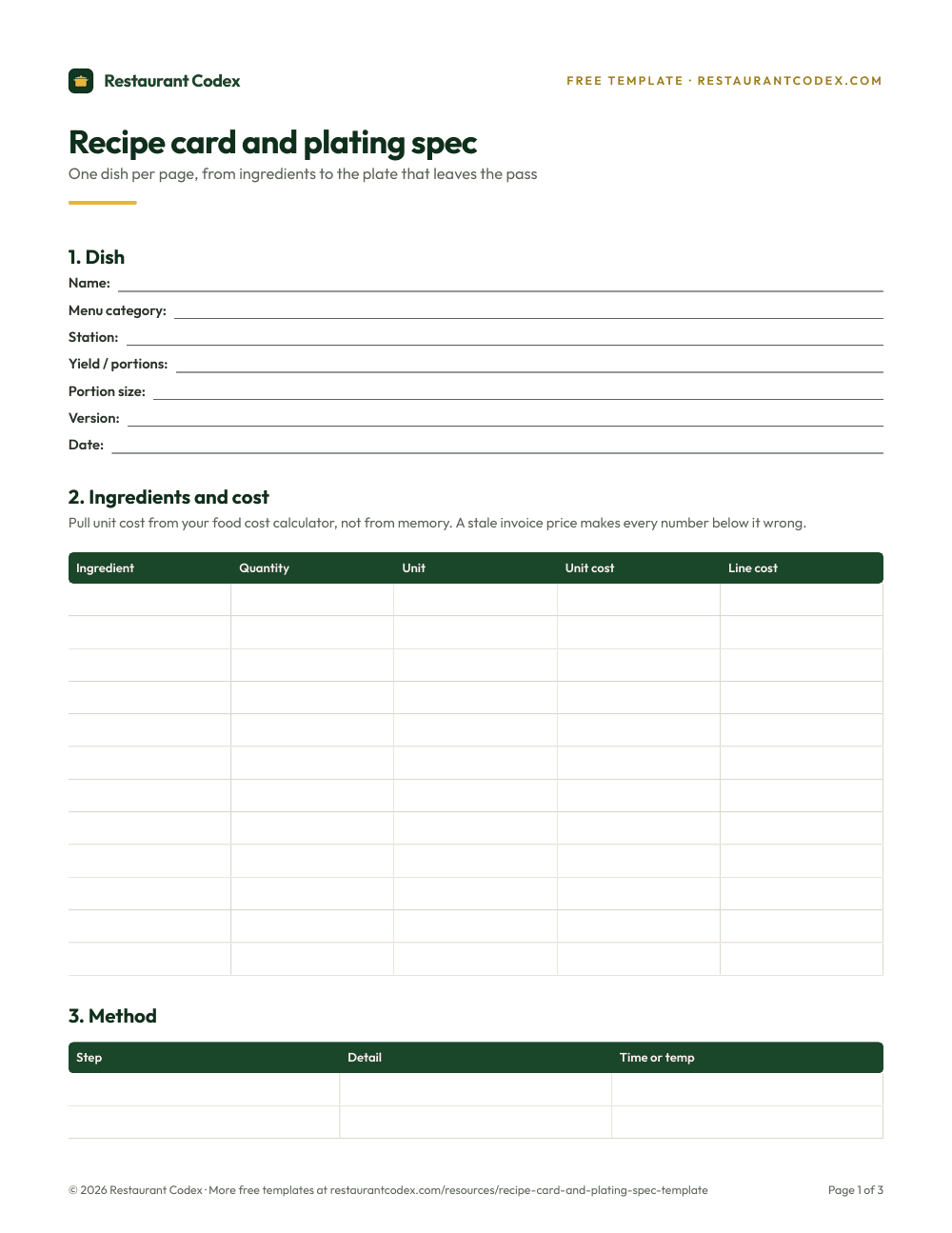
Standardizing it starts with a real batch cook, not a memory. Someone makes the dish exactly as it's supposed to be, weighing every ingredient as it goes in and timing every stage, then writes down what actually happened instead of what a two-year-old recipe says should have happened. That becomes the card.
| Ingredient | Qty used | Line cost |
|---|---|---|
| Beef short rib, bone-in | 14 oz raw, 9 oz yield after braise | $6.30 |
| Braising liquid (stock, wine, aromatics) | 6 oz reduced | $0.85 |
| Root vegetable garnish | 4 oz | $0.60 |
| Herb oil finish | 0.5 oz | $0.35 |
The short rib decides everything else. It goes in at 14 ounces raw and comes out at 9 ounces after a low braise renders fat and shrinks the muscle, a 64% yield. Skip that step and cost the dish off the raw weight, and the plate looks cheaper on paper than it actually is to make. Add the four lines and the dish costs $8.10 to plate. At a $28 menu price, food cost runs 28.9%, inside the 28% to 35% range full-service restaurants typically target and close to the 32.4% national average National Restaurant Association data puts on full-service in 2026, the same math a food cost calculator or the profit margin calculator runs for every dish on a menu.
The card settles the argument the three line cooks were having without anyone raising their voice. The braising liquid reduces to 6 ounces, not "until it coats a spoon." The yield is 64%, not "however much is left." Whoever trained the slurry version either matches the card next shift or makes the case for changing it, in writing, with a new version number, instead of quietly doing it their way because nobody checked.
Running a Recipe Library Across Multiple Locations
A single restaurant can run on one good chef's memory. A group running six locations, or sixty, can't, because that chef stands in exactly one kitchen at a time.
The card, not the chef, is what travels. HQ standardizes the recipe itself: weights, method, plating photo, hold times, and the allergen line, because health inspectors apply the same federal cold-holding and hot-holding standards, 41°F or below and 135°F or above, whether the kitchen's in Dallas or Denver. What each location gets to adapt is sourcing, within a limit that's written down, not assumed. If the Denver location can't get the flagship's fish supplier, the substitution goes back onto the card as a new, dated version, reviewed and signed off, not run quietly for three weeks before anyone at HQ notices the plate looks different.
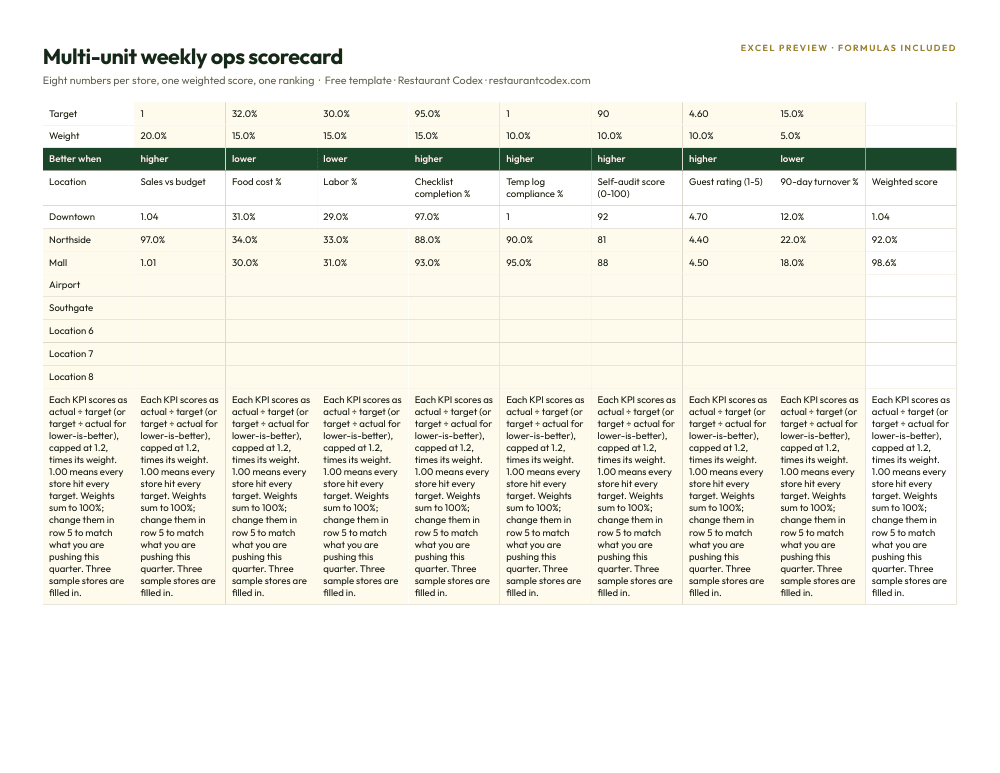
This is also how a group tells a location that's genuinely drifted from one that's just run by a careless cook. If the same card produces two versions of a dish at a six-point food cost gap between locations, that gap is data, not a mystery. A district chef with the card in hand can check a plate against it in the time it takes to plate one dish, instead of tasting something and guessing whether it's supposed to taste that way. Pull the numbers across locations monthly, and a training gap starts to look different from a sourcing problem, which matters because the fix for each one isn't the same conversation. See how to run a multi-location restaurant group for the fuller playbook.
Where Recipe Libraries Break Down
Five mistakes show up again and again in recipe libraries that stop working within a year.
No version numbers. A recipe with three "current" copies floating between a shared drive, a printed binder, and someone's phone isn't documented. It's guessed at from whichever copy is closest when a cook needs an answer.
Allergen tags that don't inherit. A pastry chef changes one dessert's sauce base and the change doesn't propagate to the other twelve dishes using the same sauce, so eleven allergen lines are now wrong and nobody knows until a guest asks the wrong server the right question.
FOH and BOH crammed onto one page. A document trying to give a server a sales pitch and a cook a weighed method at once ends up too long for either during a rush, so both stop opening it and go back to asking whoever's nearby.
Review that only happens after something goes wrong. A recipe checked for the first time in eight months because a guest complained has been drifting, unchecked, for eight months. By the time someone notices, the cost has usually moved too.
No owner for changes. If anyone on the line can "fix" a recipe because it felt off that night, the recipe isn't standardized, it's a suggestion. One person, usually the chef or a corporate culinary lead, owns the edit, the version bump, and the note explaining why.
Where Restaurant Codex Fits In
Restaurant Codex keeps recipes the way this guide describes: one card per dish inside the Knowledge Base, plate and batch builds kept separate, allergen tags that live on the ingredient and update every recipe that uses it, and a version history that shows who changed what and when instead of a debate about which printed copy is current. A spec change pushes a task to every station it touches and a short lesson to the LMS if the change needs one, and an owner running several locations can see food cost drift by store before it turns into a surprise on next month's P&L. None of that replaces a chef who knows the food. It means the next cook on that station is working from the same card the chef actually meant.
Restaurant Codex
The same checklist, on every phone, with photo proof
Restaurant Codex runs this template as a live task with timestamps, photos and one view across every location. Bring it to a 30-minute working session and we'll set it up on your real operation.
By the Restaurant Codex team
Written with operators who run multi-location restaurant groups. Reviewed against the FDA Food Code and the sources listed below.
Sources
- FDA, Food Allergies (9 major allergens under FALCPA and the FASTER Act, sesame added effective January 1, 2023)
- FDA Food Code 2022, § 3-501.16, Time/Temperature Control for Safety Food (hot and cold holding)
- WhippleWood CPAs, Financial Benchmarks for Restaurants, citing National Restaurant Association 2026 State of the Industry data
- FARE (Food Allergy Research & Education), Top 9 Food Allergens