What's the difference between a manual, an SOP, a checklist, and a handbook?
A restaurant operations manual holds four different tools that get treated as one: the manual's own policy pages, the SOP that states a single procedure's standard, the checklist that proves the standard got met today, and the employee handbook that carries the legal terms of employment. Most binders fail because all four get written, filed, and read as if they're the same kind of document.
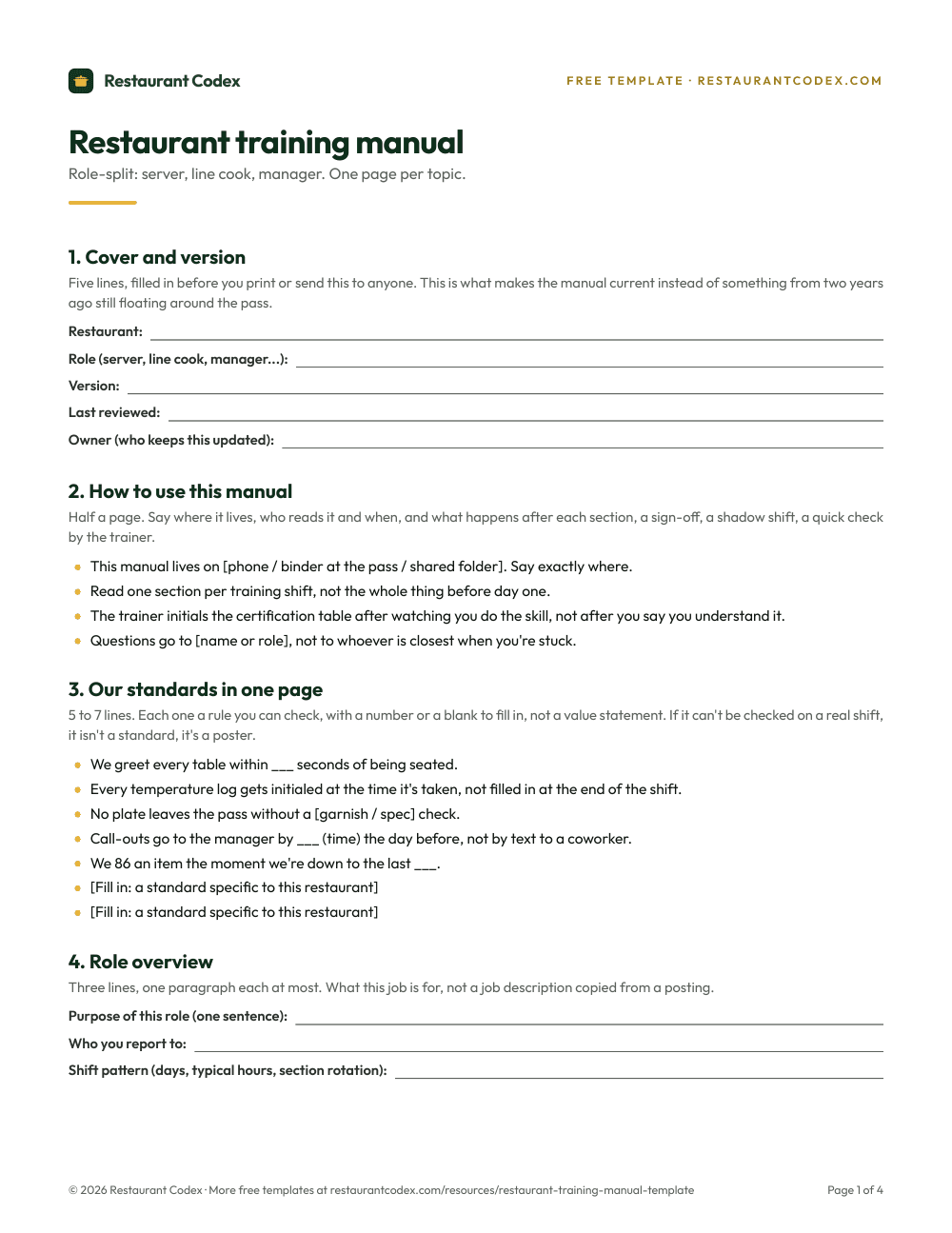
The manual itself is the table of contents and the policy layer: hours, roles, the chain of command, how a section gets updated and by whom. An SOP is one page for one procedure with a number in it. Cold holding at 41°F (5°C) or below is the kind of line an SOP states once and a manager checks someone against, not a sentence a policy page should be paraphrasing five different ways across five different sections (FDA Food Code 2022). A checklist doesn't state a standard at all. It proves, with a time and an initial, that someone did the thing the SOP already described. The handbook stands apart from all three because it isn't operational, it's contractual, built around pay, leave, discipline, and termination, and it's the one section a labor board or a court would read closely, not a health inspector.
Operators post the confusion online constantly, in close to these words: "Looking for resources for restaurant procedures (Manuals, PDFs etc), struggling on setting up proper procedures and SOPs." That single sentence folds four separate documents into one ask, and it's exactly why the binder that comes out the other end tries to be four things at once and ends up being none of them well.
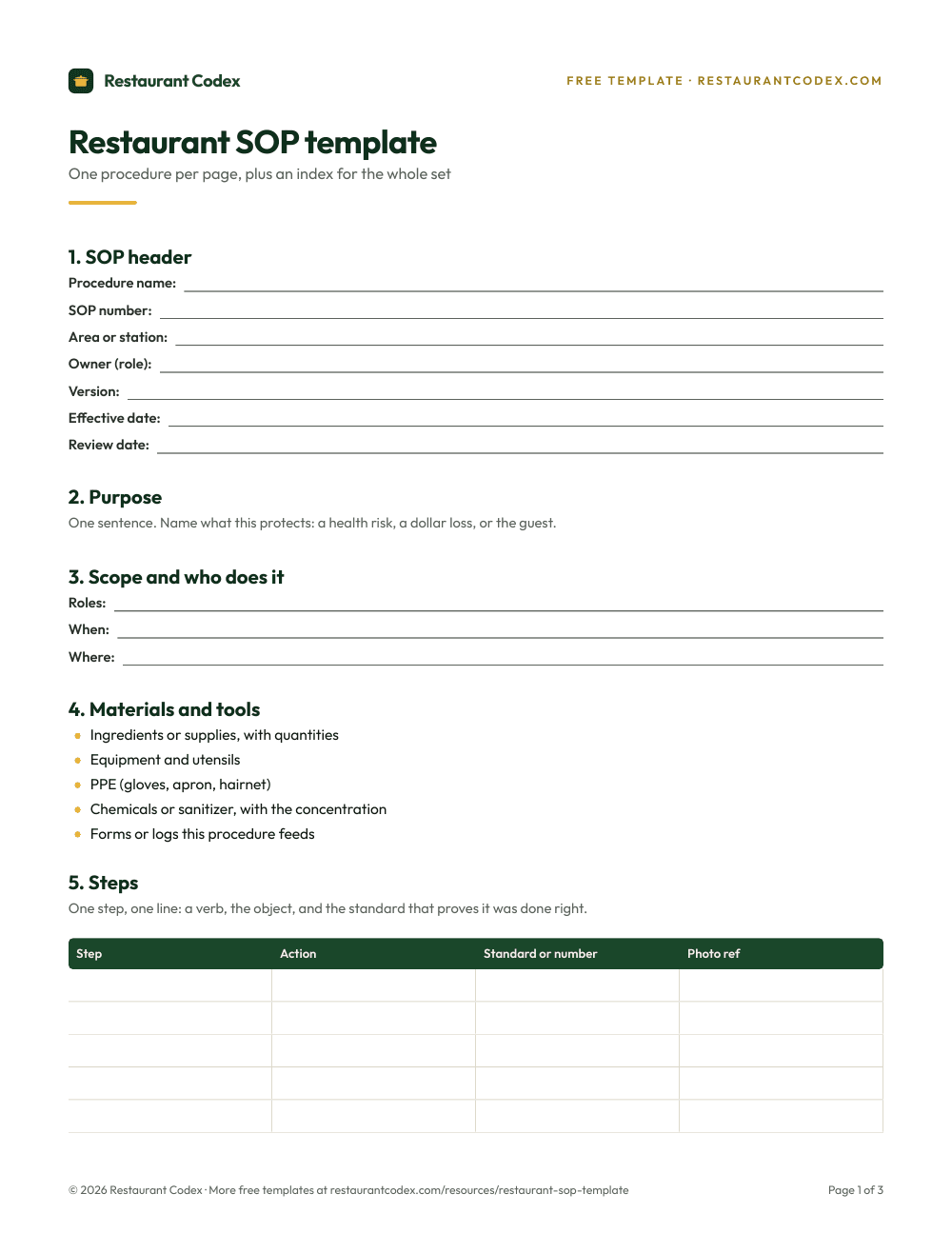
What goes in a restaurant operations manual?
A working restaurant operations manual has eight sections in this order: company basics, the daily shift rhythm, food safety and compliance, service and guest standards, cash and security, human resources policy, equipment and maintenance, and an emergency section, each one a folder that links out to its own SOPs and checklists instead of pasting them in whole.
- Company basics. Who owns what, the org chart, hours of operation, and how the manual itself gets updated.
- Daily rhythm. Opening and closing sequences, prep and par levels, the shift handoff format.
- Food safety and compliance. Temperature logs, the allergen matrix, the cleaning schedule, and the SOPs a health inspection actually checks against.
- Service and guest standards. Steps of service, the comp and refund policy, how a complaint gets handled and escalated.
- Cash and security. Till procedures, a two-person count rule where policy requires it, keys and alarm codes, basic loss prevention.
- Human resources policy. Attendance, dress code, conduct: the rules that live in the handbook and get referenced here, not rewritten twice.
- Equipment and maintenance. Startup and shutdown for major equipment, who to call, and what separates a service ticket from a manager decision.
- Emergency section. Fire, injury, power outage, severe weather: who calls whom, in what order.
Each section stays short on the page and heavy on links. A couple of paragraphs of policy up top, then pointers to the real SOPs and checklists doing the work, keeps the manual a table of contents instead of the forty-page document nobody scrolls through to find one number.
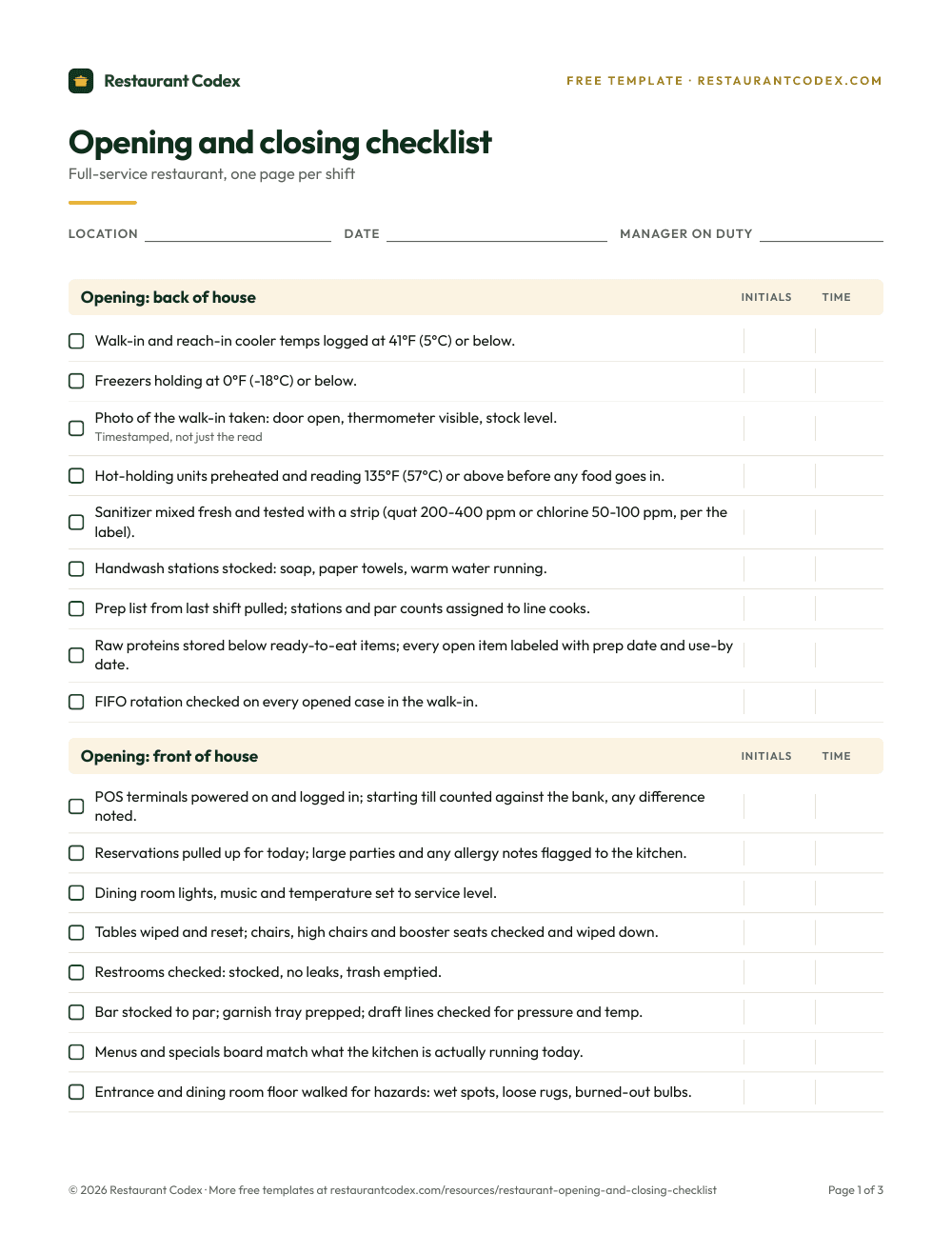
What do you write first if you have nothing?
The first section worth writing, starting from nothing, is the opening and closing checklist, because it already exists in someone's head this week and it's the fastest thing to get right, followed immediately by the food-safety SOPs a health inspector would actually check.
Shadow a real open and a real close before writing anything down. Watch what the person who's done it for two years actually does, not the version a manager assumes happens. That gap, between the assumed routine and the real one, is the first draft. From there, move to the procedures that carry the most risk: cooling, reheating, date marking, allergen handling, cash shorts. Service standards and equipment notes can wait a few weeks. The human resources section, and anything touching the handbook, should wait until last, both because it needs a different kind of review and because a restaurant with nothing written down needs its food-safety and daily-rhythm sections working before payroll policy becomes the priority.
This order isn't arbitrary. It follows what a health inspector checks first, what a new hire needs on day one, and what actually causes a restaurant to lose money or get fined when it's missing. Writing the handbook first and the cooling SOP last gets the risk order backward.
Who owns each section of the manual?
Every section of the manual needs one named owner who works closest to that part of the floor, not a title in the office, because a policy written by someone who's never run the station it describes reads like a rule from somewhere else to the people meant to follow it.
The kitchen manager or sous chef owns food safety, the daily kitchen rhythm, and equipment notes, since those are the sections where a vague line turns into a real problem fastest. The front-of-house manager owns service standards and guest recovery. Whoever handles the books owns cash and security. The owner or GM owns human resources policy, ideally with a lawyer's input on the handbook specifically, since that's the one section where a mistake carries legal weight rather than operational weight. Training deserves its own line even though it isn't a section of the manual itself: whoever owns a procedure should also sign off on the training material built from it, so the two never drift apart.
Requiring whoever owns the food-safety section to hold a ServSafe Manager credential, the ANAB-CFP-accredited certification the National Restaurant Association administers, is a cheap way to confirm that person understands the standard behind the number, not just the number itself.
When should you review or rewrite the manual?
A restaurant operations manual needs two kinds of review: a scheduled one, on the calendar every six months regardless of what changed, and a triggered one, the moment a law, a supplier, a menu item, or an incident changes something the manual currently states as fact.
The sesame allergen rule is the cleanest example of a trigger. On January 1, 2023, sesame became the ninth major food allergen recognized in the United States under the FASTER Act (FDA, FASTER Act). A manual's allergen section written the week before that date was wrong the week after it, and a scheduled review six months later would have left it wrong for half a year. The same logic applies to a new POS system, a change in state minimum wage, a lease that adds or drops a location, or a health inspection finding that flags a gap the manual didn't know it had.
A near miss deserves the same urgency as a written law changing. If a walk-in door was left cracked overnight and nobody caught it until morning, that's not a note for the next scheduled review, it's a rewrite of the closing checklist by the next shift.
Does Google Docs or OneNote work for a restaurant manual?
Google Docs and OneNote work fine for one restaurant with one person keeping it updated, and they start breaking down the moment a second location, a second editor, or real search across fifty pages becomes part of the job.
The failure pattern is consistent enough to name. Three files end up called some version of "FINAL," because nobody's sure which edit is current. Nobody owns a given page, so a change to the cold-holding number on one tab doesn't reach the copy still taped to the walk-in door. Search returns every file that mentions "cooler" instead of the one page that's current. There's no change log, so a manager can't tell what changed since the last time they read it, or who changed it. Operators run into this ceiling constantly and say so in plain terms: "Any tips on how to make an Operations Manual (SOP)... I'm using Google Docs," reads one post, and another: "Does anyone use software for SOP... We currently use onenote." Neither question is really about the software. It's about hitting the point where a document tool stops being enough for what's become an operational system.
None of that makes Google Docs or OneNote a bad starting point. A restaurant with one location and one careful owner can run on a shared doc for years without trouble. The honest line is where it stops: past a second location, a rotating set of editors, or a manual anyone actually needs to search under pressure, a document is still a document, and an operations system is something else.
Does the employee handbook need a lawyer?
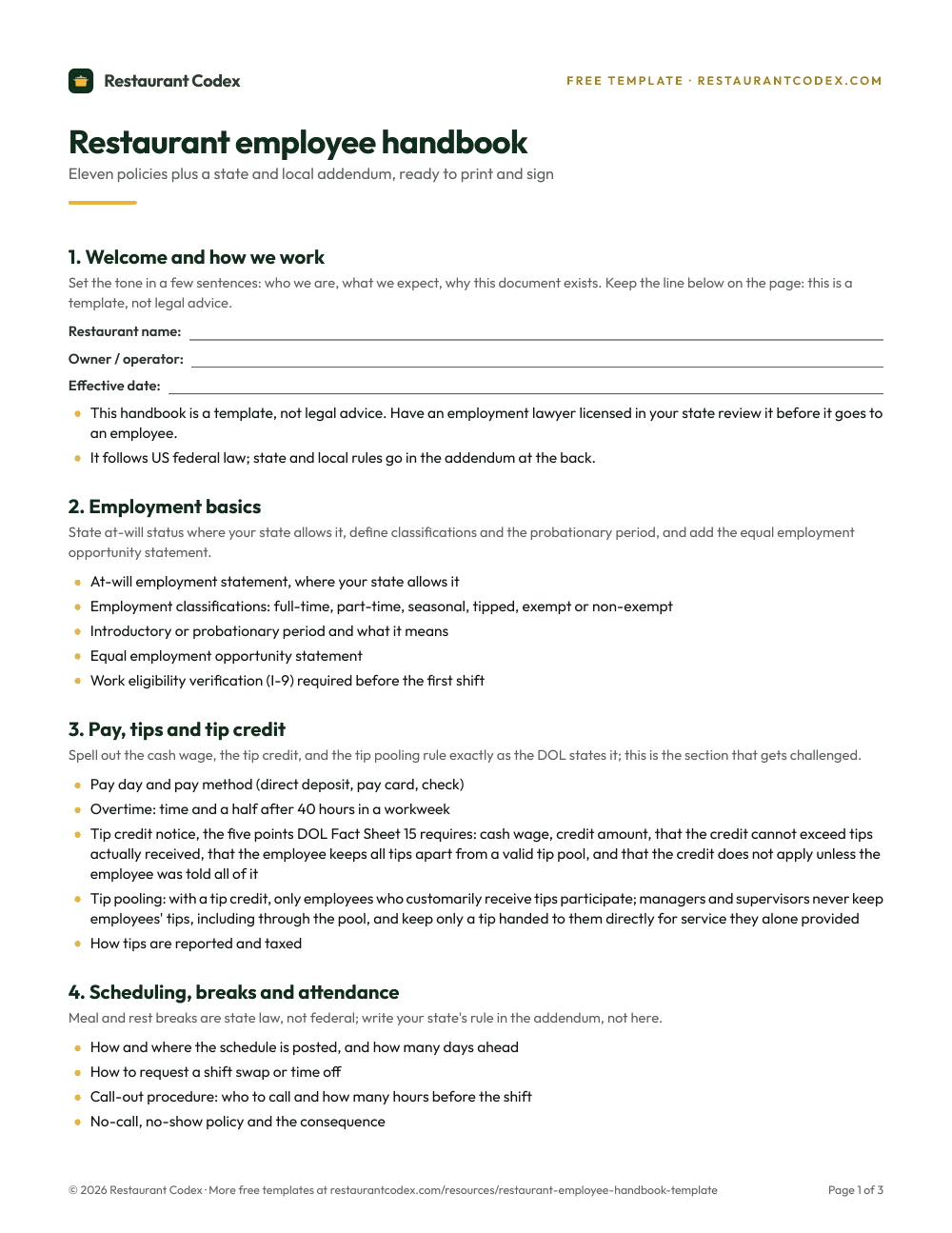
Yes, the employee handbook is the one section of the manual worth paying a lawyer to read, because it states policy on pay, leave, discipline, and termination, and those rules differ by state and city in ways a general guide can't state correctly for your address.
This question comes up constantly, in close to these words: "Employee Handbook, did you make your own or use a lawyer?" There's no universal right answer, because the honest answer depends on where the restaurant operates, and employment law is exactly the kind of thing this guide won't guess at. What's safe to say generally: draft the operational parts yourself, dress code, scheduling, how shift swaps work, the tone and culture sections, since those rarely carry legal weight. Reserve a lawyer's time for the parts that do: classification, leave policy, at-will language, discipline and termination procedure, and anything resembling an arbitration clause. A draft built from a solid template speeds up that review. It doesn't replace it.
A new owner starts from zero, worked through
Consider a situation that turns up on operator forums more often than you would expect, "Operational checklist help, my dad passed away and left me his restaurant," with nothing written down and a staff that had been running everything from memory for years.
Week one is the opening and closing checklist, built by shadowing whoever's actually been doing it, not by guessing. Weeks two through four cover the food-safety SOPs a health inspector would check first: cooling, reheating, date marking, allergens, handwashing. Month two adds service standards and cash procedures. The handbook comes last, and gets a lawyer's read before anyone signs one, because employment rules aren't something a grieving new owner should be guessing at from a blog post.
Speed matters here in a way it doesn't for a stable operation. Quits in accommodation and food services ran 3.5% in July 2026 (BLS JOLTS), and every one of those departures takes whatever that person knew with them. A restaurant that just changed hands is often down to two or three people who know how anything actually works, which means the six-month version of "get to it eventually" isn't a real option. The order above gets the highest-risk, most-forgettable knowledge onto paper first, while the people who know it are still around to check the draft.
How Restaurant Codex fits
We built the knowledge base, operations, and LMS pieces of Restaurant Codex so a manual's sections don't have to live as one document at all: SOPs live in the knowledge base with an owner and a version history, daily checklists run in operations against the same standard, and training in the LMS points back to the SOP it's built from. A change to a number updates everywhere it appears instead of on three tabs out of five. What it doesn't do is replace a lawyer for the handbook, or the work of watching a real open and close before writing either one down. Our guides on writing SOPs, the knowledge base itself, and staff training go deeper on each piece once the manual's shape is in place.
Restaurant Codex
The same checklist, on every phone, with photo proof
Restaurant Codex runs this template as a live task with timestamps, photos and one view across every location. Bring it to a 30-minute working session and we'll set it up on your real operation.
By the Restaurant Codex team
Written with operators who run multi-location restaurant groups. Reviewed against the FDA Food Code and the sources listed below.
Sources
- FDA Food Code 2022: cold holding, hot holding and two-stage cooling of TCS food
- FDA, FASTER Act: sesame as the 9th major food allergen (effective Jan. 1, 2023)
- U.S. Bureau of Labor Statistics, JOLTS, Table 4: quits rate by industry
- ServSafe Manager Certification, ANAB-CFP accredited, administered by the National Restaurant Association