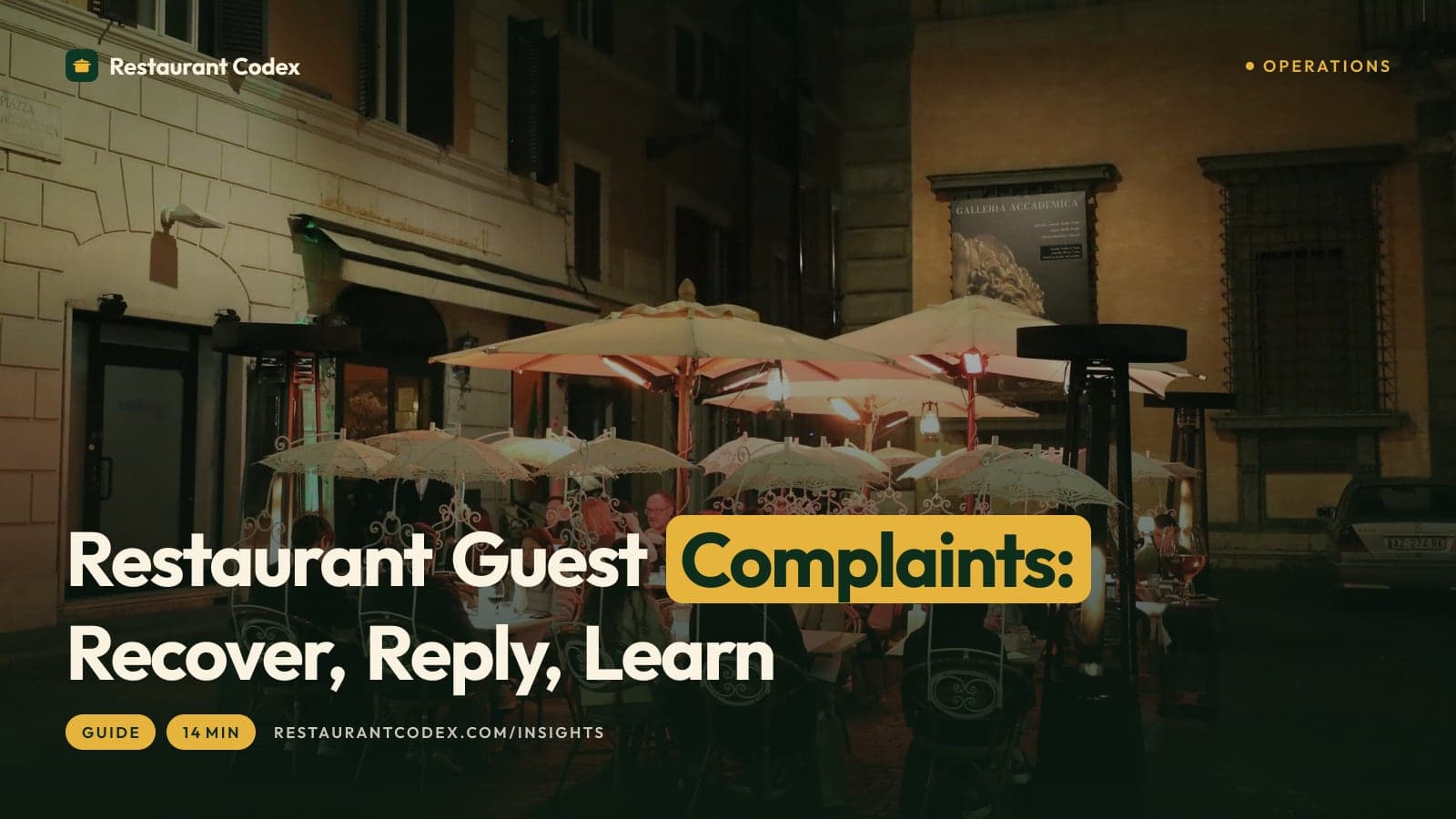
How do you handle a guest complaint?
You handle a guest complaint by getting to the table quickly, hearing all of it, fixing it inside a limit you wrote down before the shift, and logging it before you leave. In our experience the order matters more than the wording, and a plain apology in the first two minutes beats a polished one after a defensive start.
The sequence we teach managers:
- Go to the table yourself, as the manager, rather than leaving it to the server who made the mistake.
- Listen without interrupting. Then say back the problem in the guest's own words.
- Apologize for the specific thing that went wrong.
- Fix it now: remake it, replace it, adjust the bill, all inside your written limit.
- Check back before the guest leaves, and log it: date, table, dish, cause, what you gave and who decided.
What does not work is easy to spot on a busy night. Debating whether the guest is right. Walking back to the kitchen to find out who is to blame while the table waits. A fix that needs a call to the owner. Logging only the loud complaints, which tells you about the guests who shout and nothing about the ones who leave quietly and write a review.
Two kinds of complaint skip the normal sequence. An allergy mistake is a safety event first, and our allergen guide covers what to do when a guest has a reaction. A report of illness after a meal is a record-keeping event. Public Health - Seattle & King County tells food businesses to listen, document and report, and not to diagnose. Its checklist asks for the guest's name and phone number, the date and time of the meal, the foods eaten, the size of the party and how many people are ill, whether they dined in or took it away, whether the receipt is available, when symptoms began and any known food allergies. Staff who receive the complaint pass it to the person in charge, who notifies the health department. The same checklist then asks whether any employee was out sick in the three days before or after the food was prepared, and whether other guests complained in that window. Other health departments set their own rules, so ask yours.
Training a manager to run this sequence alone is a skill in itself: watch three real complaints, then do the next three with the trainer silent.
What do you say to an upset guest?
You say what went wrong in the guest's own words, apologize for that, say what you will do right now, and ask whether it works for them. The wording below is ours, not a script from any source. Change it until it sounds like you.
| Moment | Say | Avoid |
|---|---|---|
| Opening | "I'm the manager tonight. Tell me what happened." | "What seems to be the problem?" |
| After listening | "The pasta came out cold and you waited 40 minutes for it. I'm sorry. That's not how we want you to eat here." | "Sorry for any inconvenience." |
| The fix | "I'll have a fresh one made now and take it off your bill. Does that work for you?" | "That's all I can do," unless it is, and then state the limit plainly |
| The guest is wrong on a fact | "Thank you for telling me. Let me see what I can do." | "That's not what happened." |
| Leaving | "Thank you for telling me. I'm going to find out why it happened." | A coupon pushed across the table |
Not every complaint is fair. The words stay the same when the guest has a fact wrong: you can apologize for the experience without agreeing with every detail. What you cannot do is correct the guest in front of the table. If the record needs correcting, do it in the log.
Keep the apology off the team. "The kitchen is slammed" and "my server is new" are explanations, and the guest hears an excuse. Say what you will change instead.
How do you respond to negative online reviews?
You respond to a negative online review in public, soon, in a few calm sentences that thank the guest, name the specific problem, say what you did or will check, and offer a way to continue offline. You are writing for the reviewer and for every future guest who scrolls past it.
Ratings carry money, which is why this is worth a manager's time. Michael Luca of Harvard Business School combined Yelp reviews with revenue data from the Washington State Department of Revenue for all restaurants in Seattle from 2003 through 2009. He found that a one-star increase in Yelp rating led to a 5 to 9 percent increase in revenue, that the effect was driven by independent restaurants, and that ratings did not affect restaurants with a chain affiliation. That dataset is old and it is Yelp, so read it as direction, not forecast. Replies have their own evidence. Proserpio and Zervas found a 0.12-star increase in ratings and a 12 percent increase in review volume for hotels that responded, along with fewer but longer negative reviews. It is a hotel study, not a restaurant study.
The platforms set the rules for what you can write.
| Platform | What it says | What it means for your reply |
|---|---|---|
| You must verify your business to reply. The reviewer is notified when you reply and can still change the review afterward. You can flag a review you believe breaks Google's content policies | Write for the guest and for the next reader. Never offer anything in exchange for an edit or a removal | |
| Tripadvisor | Responses must be original, with no guest correspondence or snippets of the review. Non-commercial: gifts, services or money get a response removed. No threats, coercion or attempts to suppress a review, no accusations of review fraud, no guessing who the reviewer is, and no names, addresses or phone numbers | Keep the reply about the experience. Take the detail and any compensation offline |
| US federal rule | 16 CFR 465.7 bars an unfounded legal threat, a physical threat, intimidation or a knowingly false public accusation aimed at preventing or removing a review | Do not threaten a reviewer, however unfair the review is |
Tripadvisor's owner guide gives five tips for negative reviews: respond quickly, be courteous and professional, thank the reviewer, address the specific issue by saying what you have done to fix it, and highlight any positives the reviewer mentioned. It also warns that an aggressive or defensive reply turns off potential visitors, and that the same standard reply to every review can come across as repetitive and insincere.
A sample reply to a two-star review about cold pasta and a long wait. The cause in it is invented, so use only a cause you have confirmed:
It has no names, no argument and no offer in public. Keep the offer for the private conversation.
When should you comp a meal?
Comp a meal when the restaurant clearly caused the problem, size the comp to the problem, and set the limits before the shift so nobody is negotiating in front of the guest. These are starting limits. Set yours from your own check average.
| What went wrong | First move | Comp we would use | Who decides |
|---|---|---|---|
| Wrong dish or missed modifier | Remake it now | None if the remake is quick. The dish if the guest no longer wants it | Server or shift lead |
| Cold or overcooked food | Replace it now | The dish if the replacement is also late | Shift lead |
| A wait well past what the guest was told | Apologize and give a real update | A drink or a dessert | Shift lead |
| Foreign object in food | Remove the plate, apologize, replace it | The dish, and a look at the cause in the kitchen | Manager |
| Rude or careless service | The manager speaks to the guest | A gesture sized to the bill. Coach the team member in private afterward | Manager |
| Allergy mistake | Safety first | The meal, and a follow-up call from the manager | Manager, owner informed |
| Illness reported after the visit | Listen, document, report | Do not argue about cause and do not promise to pay costs. Ask your insurer or lawyer | Manager and owner |
The cost gap is larger than most teams assume. Take a dinner for four that comes to $112, where one $28 entree arrives cold. Assume a 30 percent food cost, which we are using for the illustration only. A prompt remake costs about $8.40 in ingredients (30 percent of $28) plus a few minutes of a cook's time. Comping the entree gives up $28. Comping the table gives up $112, more than 13 times the cost of the remake. And the frequency adds up: six comps a week at $22 each is $132 a week, or $6,864 a year at a single location.
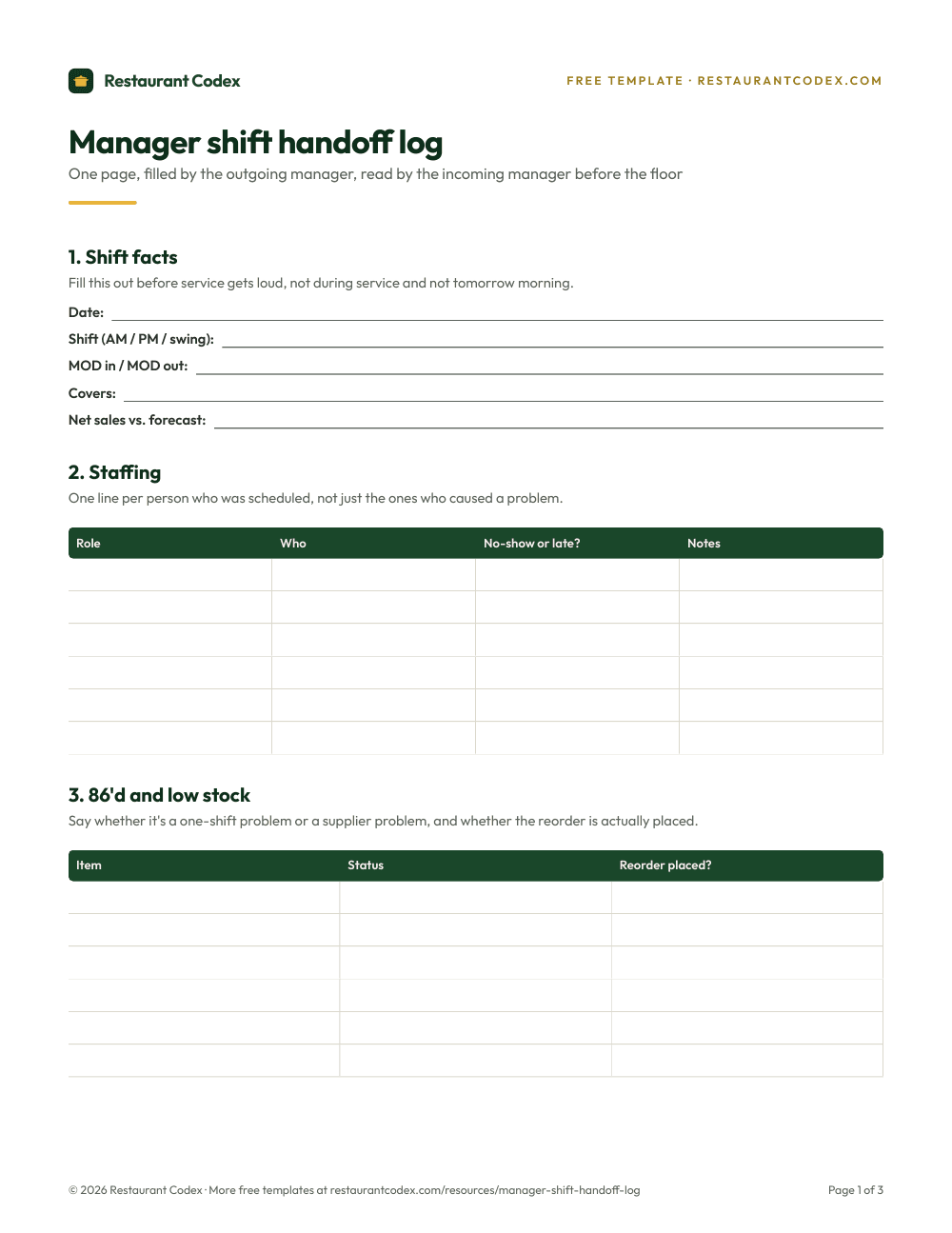
Log every comp: the dish, the amount, the reason and who approved it. The manager shift handoff log has a line for comps, which puts them in front of the next manager.
Do not tie a comp to a review. Google's policy does not allow a merchant to offer incentives, such as payment, discounts, or free goods or services, in exchange for posting a review or for revision or removal of a negative review. The FTC's rule adds that a business may not give compensation or incentives in exchange for, or conditioned expressly or by implication on, a review expressing a particular sentiment. So the comp settles the complaint, and the review is the guest's to keep, change or delete.
Our verdict: remake first, comp the dish when the remake is late or the guest is finished, and keep whole-table comps for safety failures and service that went badly wrong. If one dish is comped six times a week, stop treating it as a service problem. The recipe or the station is the problem.
How do you track complaints to find causes?
You track complaints by writing each one in the same log with a date, a location, the dish or area, a cause category and what you gave, then reading the counts by cause once a week. The log is a shared sheet. What matters is that every manager uses the same columns.
Seven cause categories cover most restaurants: food quality (temperature, taste, doneness), order accuracy, wait time, service, cleanliness, billing and price, and safety (allergy, illness, foreign object). Count each complaint once, under the cause you can confirm. Add online reviews to the same log, tagged by source, so the dining room and the screen are read together.
Here is a month at one location, with invented numbers:
| Cause | Complaints | Share of 38 |
|---|---|---|
| Cold food | 14 | 36.8% |
| Wrong dish | 9 | 23.7% |
| Wait time | 8 | 21.1% |
| Service | 4 | 10.5% |
| Billing | 3 | 7.9% |
Two causes make up 23 of the 38 complaints, 60.5 percent. That is where the first conversation goes. Then ask why until you reach something you can change. The Lean Enterprise Institute describes the 5 Whys as asking why repeatedly to get past the symptoms to the root cause, and notes that the specific number five is not the point. For cold food the chain might run: it sat at the pass, because nobody was told it was up, because the expo was also running drinks, because Friday dinner was scheduled one person short for its sales. The fix is a runner at the pass from 7 pm, not a lecture about urgency. The chain is invented to show the method.
If the dish is meant to be hot, the hot-holding standard also belongs in the review. Our food safety guide covers it.
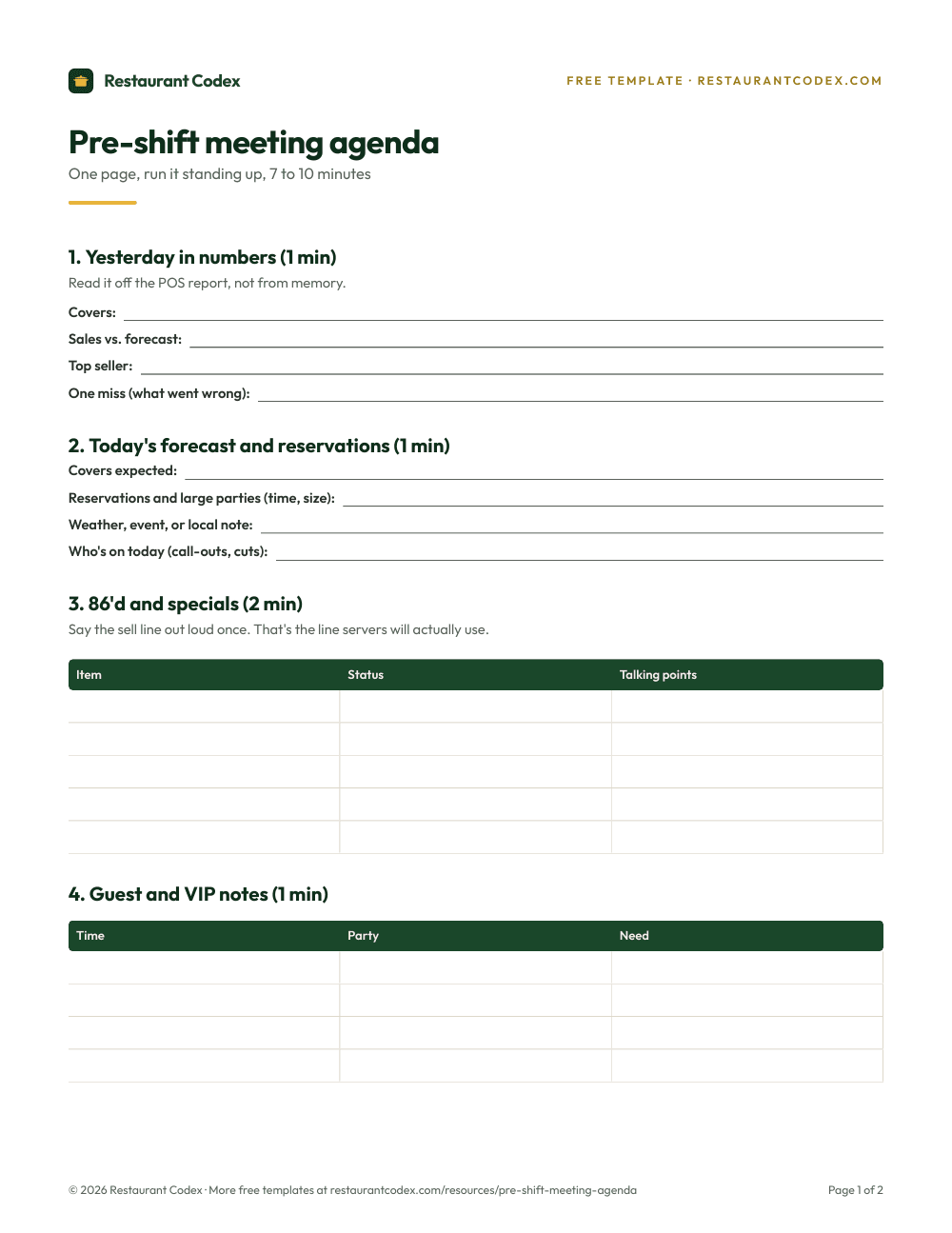
Close the loop on a schedule. Bring the top cause to the pre-shift meeting as the one standard of the week, and check the count again next week. The pre-shift meeting agenda has a slot for one standard, and our shift management guide covers how the huddle and the handoff fit together.
How do you manage complaints across several locations?
Across locations you use one log, one set of cause categories and one comp policy, and you compare complaints per 1,000 covers instead of raw counts. The comp limit can scale with each location's check average. The process should not change from one to the next.
An example with invented numbers for a month:
| Location | Covers | Complaints | Per 1,000 covers | Top cause |
|---|---|---|---|---|
| A | 9,000 | 27 | 3.0 | Cold food |
| B | 6,000 | 24 | 4.0 | Wait time |
| C | 4,000 | 8 | 2.0 | Wrong dish |
Location A has the most complaints, but B has the highest rate, and its cause is different. C looks best, but eight complaints is too few to rank anyone, so read the trend over eight to twelve weeks. A low count can also mean low logging. Check it against review ratings and ask the managers how a complaint gets into the log. This is one of the checks that makes consistency across locations measurable, and the same standard applies in each unit of a multi-location group.
The legal backdrop differs by country, and the group policy should say so.
| Country | What the source says | What to do |
|---|---|---|
| US | 16 CFR 465.4 and 465.7: no incentives conditioned on a particular review sentiment, and no unfounded legal threats or intimidation to prevent or remove a review | Never trade a comp for a review |
| Mexico | In Profeco's conciliation procedure, a conciliator mediates between the consumer and the provider. Profeco has no legal power to oblige the provider to meet everything the consumer claims | Keep the ticket and a note of what you offered. Answer a conciliation request in good faith |
| Colombia | Ley 1480 de 2011, article 3, gives consumers the right to claim directly from the provider. Under article 58, point 5, the claim can be written, by phone or verbal. For a verbal claim the provider must issue a written receipt with the date and subject, and answer within 15 business days with the evidence it relies on | Give a written receipt for a verbal claim and keep the 15-day clock. Ask a Colombian lawyer how this applies to a dining complaint |
Where Restaurant Codex fits
Restaurant Codex helps you write the standard down and check it, which is most of what a complaint log points to. The complaint log in this guide can be a shared sheet. Use what your managers will fill in.
In the Knowledge Base, the recovery steps, the comp limits and the review-reply rules can sit with the rest of the group's manual, and Codex Bot answers a manager's question from that manual and the group's recipes, shows the entry it used and never changes the records. When the log points to cold food or a wrong dish, the fix is usually a standard: plate and batch recipes with photos and allergens, and line checks and temperature logs in Operations, where the app enforces photo proof, pushes due and overdue items, and tells managers when a list is about an hour late. Owners can compare locations side by side.
Restaurant Codex
The same checklist, on every phone, with photo proof
Restaurant Codex runs this template as a live task with timestamps, photos and one view across every location. Bring it to a 30-minute working session and we'll show you how it would run across your locations.
By the Restaurant Codex team
Written with operators who run multi-location restaurant groups. Reviewed against the FDA Food Code and the sources listed below.
Sources
- Google Business Profile Help, Read and reply to reviews
- Google Maps, Prohibited and restricted content (contributed content policy)
- eCFR, 16 CFR Part 465, Rule on the Use of Consumer Reviews and Testimonials
- Tripadvisor, Management Responses Guidelines
- Tripadvisor Insights, Respond to Travelers: How to Add Management Responses
- Michael Luca, Reviews, Reputation, and Revenue: The Case of Yelp.com (Harvard Business School Working Paper 12-016)
- Proserpio and Zervas, Online Reputation Management: Estimating the Impact of Management Responses on Consumer Reviews (Marketing Science, 2017)
- Public Health - Seattle & King County, Guidance for Customer Food Safety Complaints
- Lean Enterprise Institute, 5 Whys
- Profeco, Cómo presentar mi queja como persona consumidora (procedimiento conciliatorio)
- Colombia, Ley 1480 de 2011, Estatuto del Consumidor (articles 3 and 58)