Can my restaurant be franchised?
Yes: Mexican law sets no minimum number of locations or years in operation to franchise; what has to exist is a trademark of yours, a written license to use it and knowledge you can pass on. We read articles 245 to 249 of the Federal Law for the Protection of Industrial Property (LFPPI, in Spanish) in full, and neither minimum appears. That's our reading of the text, so have a lawyer confirm it before you spend money.
Article 245 says a franchise exists when a trademark license granted in writing comes with technical knowledge or technical assistance, so that another person can produce, sell or provide services in a uniform way and under the operating, commercial and administrative methods of the mark's owner. If you only lend the brand and pass on nothing else, you have a trademark license, not a franchise.
The trademark is the first practical requirement. The owner of a registered or pending mark can license it by agreement (article 239), but if the registration isn't in force, IMPI refuses to record the license (article 257). According to IMPI, registering a mark online costs $2,695.18 MXN plus VAT per class, lasts 10 years and gets an answer in 4 to 6 months. Which classes to file a restaurant under is a question for your lawyer.
A practical test, ours and not the law's: could a cook who has never worked with you produce your dish using only your documents? If the answer depends on you being in the building, there's nothing to pass on yet.
DENUE, INEGI's directory of economic units, gives another clue. In our Mexico restaurant data guide, at least 875 groups with a company name run between 2 and 15 restaurants, and 73.3% of them do it in a single state. That's a floor, and DENUE doesn't separate owned from franchised units; what it suggests is that growing close to home is the norm. Franchising is how you leave that zone, and that's where you find out whether your operation holds without you.
What does Mexican law require to franchise?
Franchising is regulated by articles 245 to 249 of the LFPPI and its Regulation, and nearly everything the law makes you do happens before signing: give truthful information at least 30 days ahead and sign a written contract with minimum content. The Regulation is new: it was published in the Diario Oficial de la Federación (DOF) on April 28, 2026, took effect 60 business days later and repealed the 1994 one (transitory articles one and two). If a text you're reading cites the old one, check its date.
The information you hand over before signing
A franchisor must give the prospective franchisee, at least 30 days before the contract, information on the state of its company (article 245, second paragraph). The law doesn't name that document; in practice it's called the Circular de Oferta de Franquicia, or COF, as Gallastegui Franquicias explains. Article 124 of the Regulation sets 14 minimum points. On timing: the article says "thirty days beforehand" and nothing more, but article 21 of the same law says that only business days count in the deadlines it sets in days, and Gallastegui reads it as 30 business days. Whether that count applies to a deadline between private parties is a question for your lawyer; plan on 30 business days, about six weeks.
| What you hand over | Items of article 124 | Content |
|---|---|---|
| Who you are | I and III | Name, company name, address and nationality; age of the company and, if there is one, of the master franchisor |
| What you offer | II, IV, VII and X | Description of the franchise; intellectual property; territory; whether it comes from a master, development, multi-unit or similar agreement |
| What it costs | V and XII | Amounts and kinds of payments; general amounts and investment return times |
| What each party takes on | VI, VIII, IX and XI | Technical assistance and services you'll give; subfranchising; confidentiality; the franchisee's rights and obligations |
| Your record | XIII and XIV | Owned and franchised units; units opened, relocated, transferred and closed |
If the information isn't truthful, the franchisee can demand nullity of the contract plus damages for one year from signing; after that, only nullity (article 245). Closed units get disclosed too.
The contract and what the law protects
The contract must be in writing and contain at least ten points (article 246): geographic zone; location, minimum size and infrastructure investment; inventory, marketing, advertising and supply policies; reimbursements, financing and other payments; criteria for franchisee profit margins or commissions; technical and operational training and the method of technical assistance; criteria and procedures for supervision, evaluation and rating of performance; terms for subfranchising; grounds for termination; and the cases in which the contract is revised by agreement.
The law also limits what you can do. Your interference in the franchisee's organization is only to ensure compliance with administration and image standards, as the contract sets them (article 247). The franchisee keeps confidentiality during the contract and after it ends (article 248). Neither party can end it unilaterally unless the term is indefinite or there is just cause, and early termination follows the agreed grounds and procedures, with the agreed penalty or damages if they aren't respected (article 249). And the franchisee has no obligation to sell you its assets at the end or give you shares of its company, unless agreed otherwise (article 246).
IMPI and the restaurant itself
Either party can ask IMPI to record the license or franchise. The request carries the details of both parties and a signed copy of the agreement, which may leave out the clauses on royalties and other payments, confidential distribution and marketing information, and the technical annexes (article 21 of the Regulation). If something is missing, IMPI asks once and you have 2 months to fix it; otherwise the request is dismissed outright (article 23). IMPI resolves within 2 months at most (article 240), and the gob.mx procedure sheet IMPI-01-010 lists a fee of $384.77 MXN.
We couldn't find what happens to a franchise that isn't recorded: none of the articles we read says. Ask your lawyer. The restaurant itself must display the mark owner's name and address, the franchisee's, and that the mark is used under license (articles 242 of the LFPPI and 123 of the Regulation).
What goes in a franchise operations manual?
The manual is where you write the operating, commercial and administrative methods the law asks you to pass on, and it has to cover what the contract sets on supply, training and supervision. The law doesn't require a document by that name, but a franchise consists of passing on technical knowledge and methods (article 245), and the contract describes training, assistance and supervision (article 246, items III, VI and VII). The manual is where that becomes something another person can follow.
| What you document | What backs it |
|---|---|
| Concept, service and look of the restaurant | Quality, prestige and image (article 245); image standards (article 247) |
| Recipes, spec sheets and procedures by role | Producing or selling in a uniform way (article 245) |
| Opening, closing, cleaning and food safety | Same quality as the owner's (article 242) |
| Purchasing, approved suppliers, inventory and advertising | Inventory, marketing, advertising and supply policies (article 246, item III) |
| Training by role and how assistance is given | Item VI of article 246 |
| Supervision visits and rating | Item VII of article 246 |
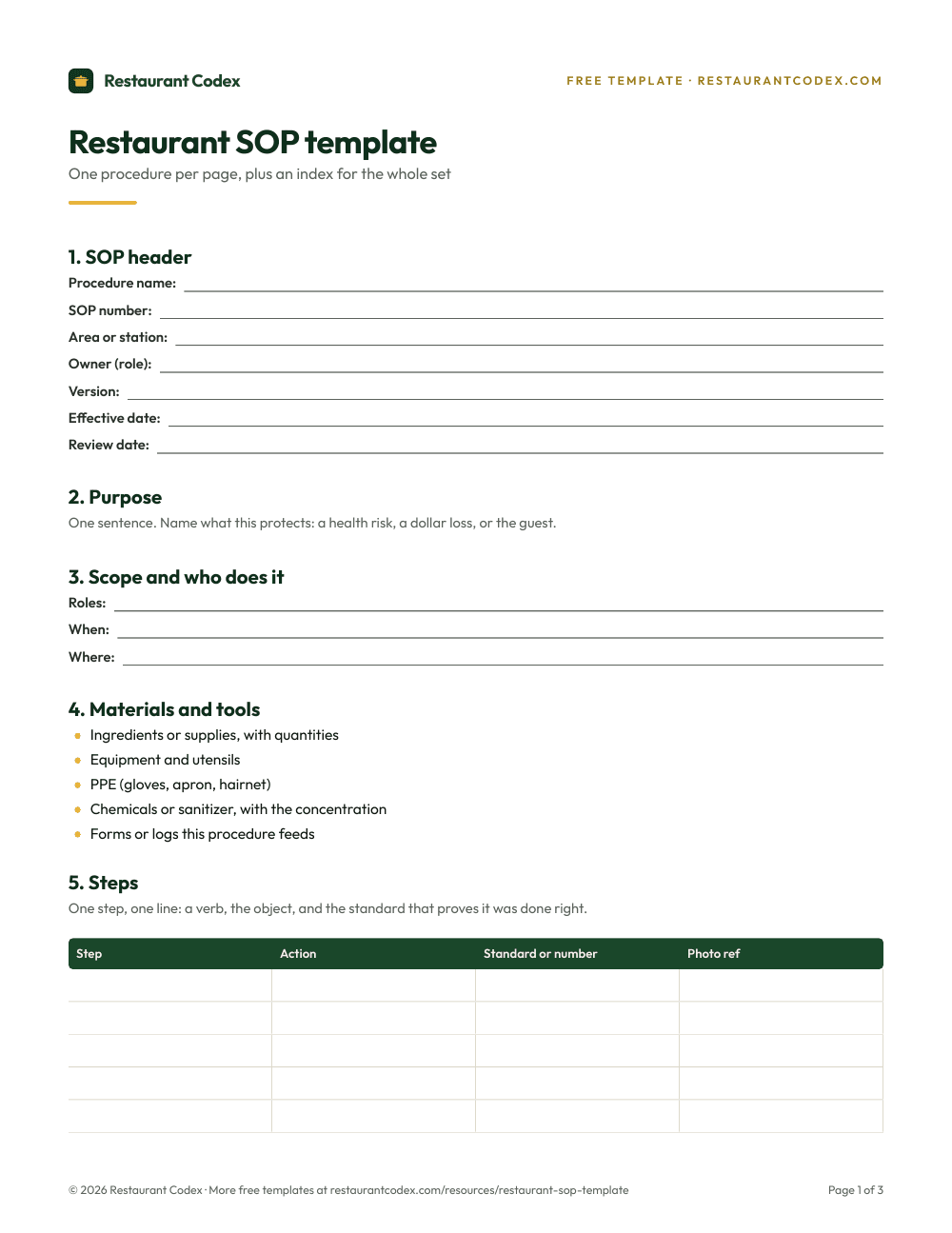
Our operations manual guide explains how to build one for your own locations. The franchise version differs in one way: it's read by someone who doesn't know you. Write each procedure the way the guide to writing SOPs describes: a purpose, numbered steps, who does it and how it's checked.
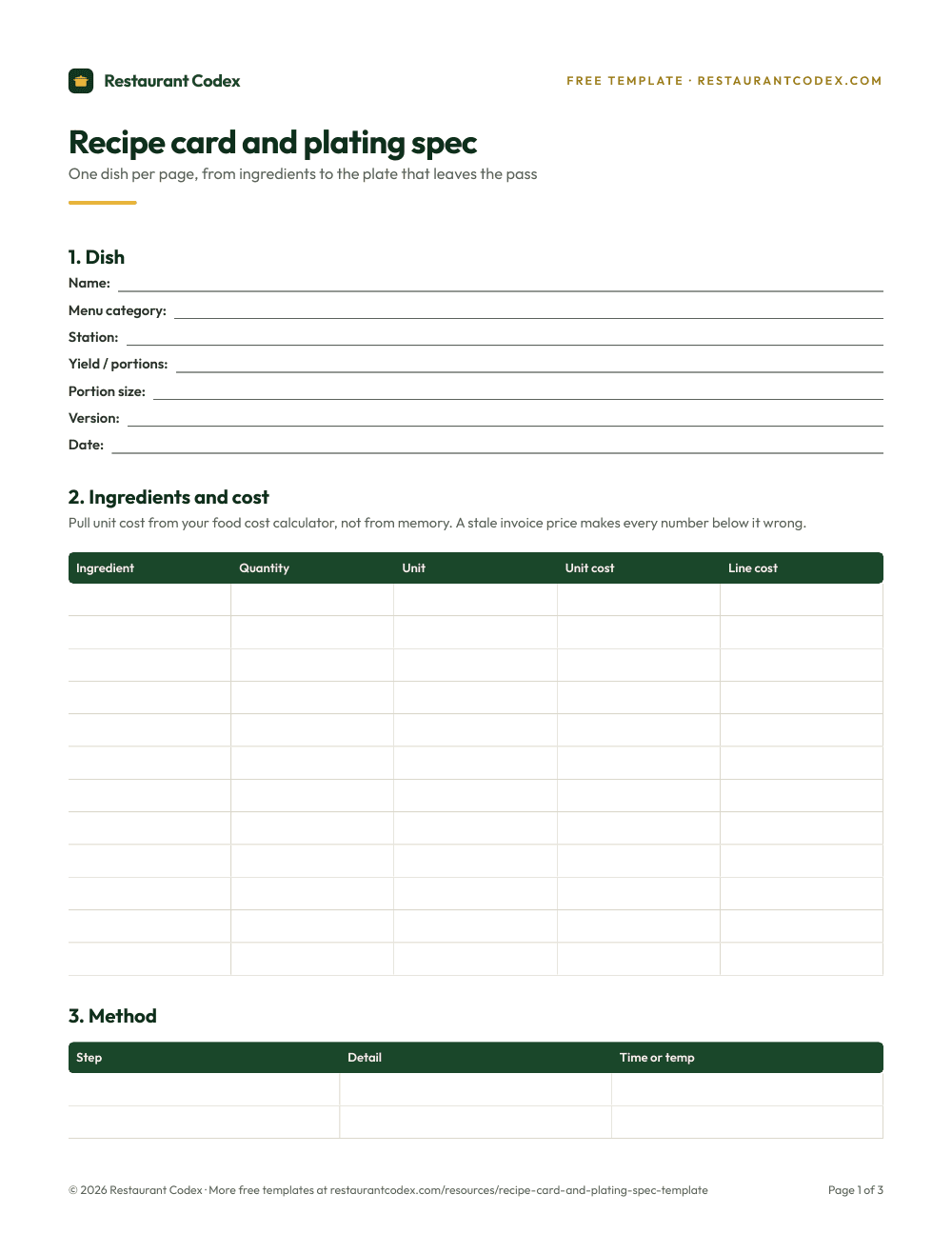
Recipes go on cards with weights, method and plating, because what the franchisee sells has to look like what you sell.
Mark which parts of the manual are confidential: the obligation in article 248 holds up better if you can say which document is which. As a reference for what brands promise, the Cuarto de Kilo listing in the AMF 2025 Directory (page 55) lists site selection, staff training, ongoing operating support, operating manuals and a supplier network with preferential prices. That's the brand describing itself.

How much does it cost to franchise a restaurant?
Of what we could verify, franchising costs $2,695.18 MXN plus VAT per class to register the trademark online and $384.77 MXN to record the license or franchise with IMPI; the other costs we couldn't confirm in a public source. That includes the fees of the lawyer who drafts the contract and the disclosure document, the work of writing the manual and the initial training. Get at least two written quotes that say what's included.
One cost you do know: your time. The contract obliges you to describe and deliver training and technical assistance, and to supervise (article 246, items VI and VII). That's payroll or your own hours from the first franchisee on.
To decide what to charge, look at what restaurant brands that already franchise report. These figures come from the AMF 2025 Directory (listings on pages 55, 59 and 79); each brand reports its own and we haven't audited them:
| Brand | Franchise fee | Royalties and advertising (monthly percentage) | Investment | Payback | Average margin |
|---|---|---|---|---|---|
| Cuarto de Kilo (34 units in Mexico and 1 in the US) | $499,000 MXN plus VAT | 5% royalties; 2% corporate advertising and 1% local | $3,990,000 MXN | 30 to 36 months | 15% |
| El Fogoncito (22 franchises) | $25,000 USD | 5% royalties; local advertising 2% and institutional 1.5% | $125,000 to $395,000 USD | 36 to 48 months | 17% |
| Santas Alitas (83 franchises) | $250,000, $290,000 or $350,000 MXN by model | 4% royalties; 2% advertising | $845,000, $1,380,000 or $2,100,000 MXN by model | 18 to 24 months | 18% |
The Santas Alitas models are Express, Mini and Restaurante-bar. Cuarto de Kilo specifies that its percentages are on net sales; the other two listings say only "monthly". None says whether the average margin is already after royalties, and that question decides whether your math closes. A hypothetical example: if your location leaves 12% profit before any royalty and you charge 5% royalties plus 3% advertising, the franchisee is left with 4 points before paying itself. Work out a location's break-even with the royalty inside the costs; our break-even guide gives the method.
Franchise or company-owned locations?
Franchising trades a location's whole margin for a royalty on its sales and hands the capital and the day-to-day operation to someone else; with company-owned locations you keep the margin, the risk and direct control.
| Company-owned | Franchise | |
|---|---|---|
| Capital to open | Yours | The franchisee's; the Santas Alitas and Cuarto de Kilo listings report $845,000 to $3,990,000 MXN |
| What you receive | The location's full profit | Initial fee and royalties; 4% to 5% monthly in the listings we reviewed |
| Control of operations | Direct, through your people | What the contract sets: supervision and administration and image standards (articles 246 and 247) |
| Exit | You sell or close when you decide | You can't end the contract without just cause or outside the agreed grounds (article 249) |
| What you must deliver | Nothing to a third party | Truthful information 30 days ahead, a written contract, training and technical assistance (articles 245 and 246) |
A franchise makes contractual what you settle by talking to your manager in a company-owned location: if the standard isn't written and measurable, there's no ground for termination you can cite. And, as our own criterion that doesn't come from the law, if you still can't say with numbers why your current locations perform the same, franchising multiplies the variation, not the business. Our guide to consistency across locations covers that point. You can also mix the two models, but article 124 of the Regulation makes you disclose how many units are owned and how many franchised.
How do franchisors keep standards across franchisees?
It's held by what the contract sets from the start: how you train, how you supervise and rate, and which purchases are mandatory, with the limit that you may only intervene to ensure administration and image standards as the contract provides (article 247).
Training and technical assistance come from article 246, item VI, and article 124, item VI of the Regulation makes you say in the disclosure document what kinds of assistance and services you'll give. Supervision is item VII: criteria, methods and procedures for supervision, information, evaluation and rating of performance and service quality, for both parties. In practice that's a visit calendar and a rating the franchisee knows in advance; a weekly scorecard per location is a place to start.
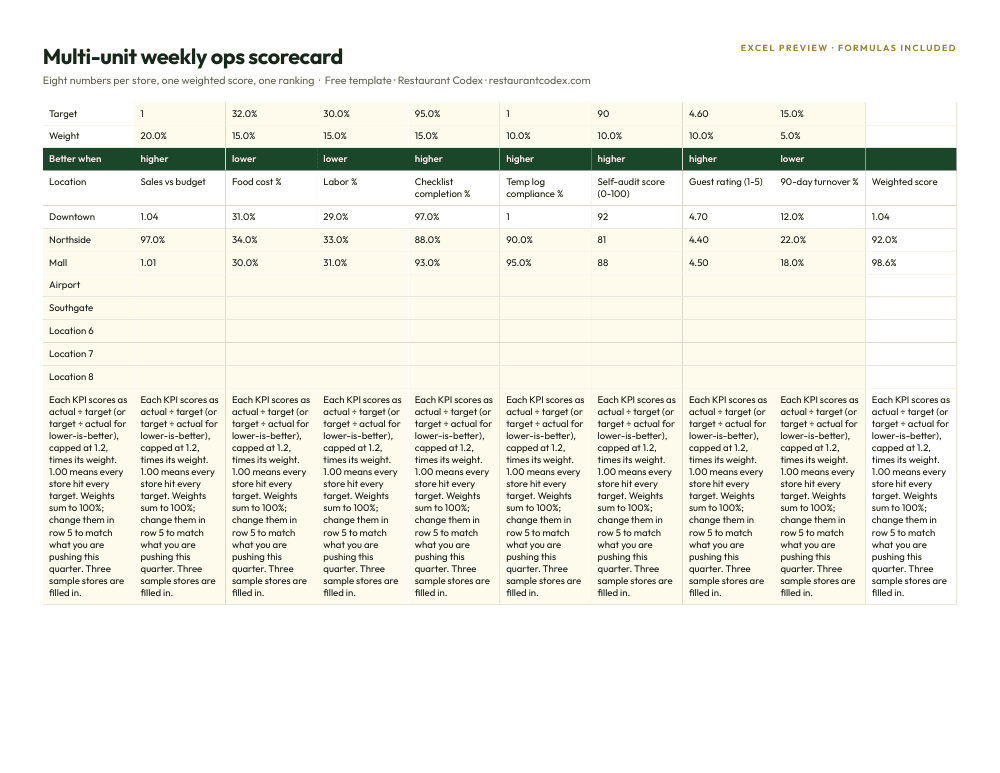
When something fails, what's written protects you. Since the contract ends only on the agreed grounds or for just cause (article 249), every standard you want to be able to enforce needs its measure and its consequence in the contract. Why standards loosen over time is covered in our guide on why standards slip.
The AMF also offers an AMF ISO/IEC 17067 certification, which according to its directory reviews nine aspects, among them legal solvency, financial control, administration and operation policies and marketing. The directory names four certified brands as examples (Tintorerías Max, Paquetellegue Express, Santas Alitas and Flexi), and Santas Alitas is the only restaurant. We didn't find the price of the certification in a public source.
Where Restaurant Codex fits
Restaurant Codex isn't franchise software: it doesn't handle contracts, disclosure documents or royalties, and it's built for groups with several locations. What it does is useful for writing a standard and checking it's met, location by location.
The Knowledge Base holds procedures, policies, the house manual and recipes, and Codex Bot answers staff from what you wrote. Operations schedules opening and closing lists, temperature logs and deep cleans at each location, with photo proof and alerts when something isn't done, and the owner compares every location in one view. Training and LMS gives each role a learning path from day one, with tests and a manager's practical sign-off. Tapiz Bistro & Bakery, in Mexico City, structured 220 recipes in two weeks so its team could work from the same standards. If you already run several locations, see the software for multi-location restaurants.
Restaurant Codex
The same checklist, on every phone, with photo proof
Restaurant Codex runs this template as a live task with timestamps, photos and one view across every location. Bring it to a 30-minute working session and we'll show you how it would run across your locations.
By the Restaurant Codex team
Written with operators who run multi-location restaurant groups. Reviewed against the FDA Food Code and the sources listed below.
Sources
- Cámara de Diputados, Ley Federal de Protección a la Propiedad Industrial (Federal Law for the Protection of Industrial Property), last reform DOF 03-04-2026 (articles 239, 240, 242, 245 to 249 and 257)
- Diario Oficial de la Federación, Reglamento de la Ley Federal de Protección a la Propiedad Industrial (Regulation of the LFPPI), 28-04-2026 (articles 21 to 23, 123 and 124)
- Gobierno de México (IMPI), procedure IMPI-01-010, request to record a license of use or franchise
- Gobierno de México (IMPI), Registro de marcas (trademark registration)
- Asociación Mexicana de Franquicias, Directorio Oficial 2025 (Cuarto de Kilo, El Fogoncito and Santas Alitas listings, and article on ISO/IEC 17067 certification)
- Gallastegui Franquicias, Entrega la COF, te lo agradecerás en el futuro (August 3, 2021)