What is a central kitchen?
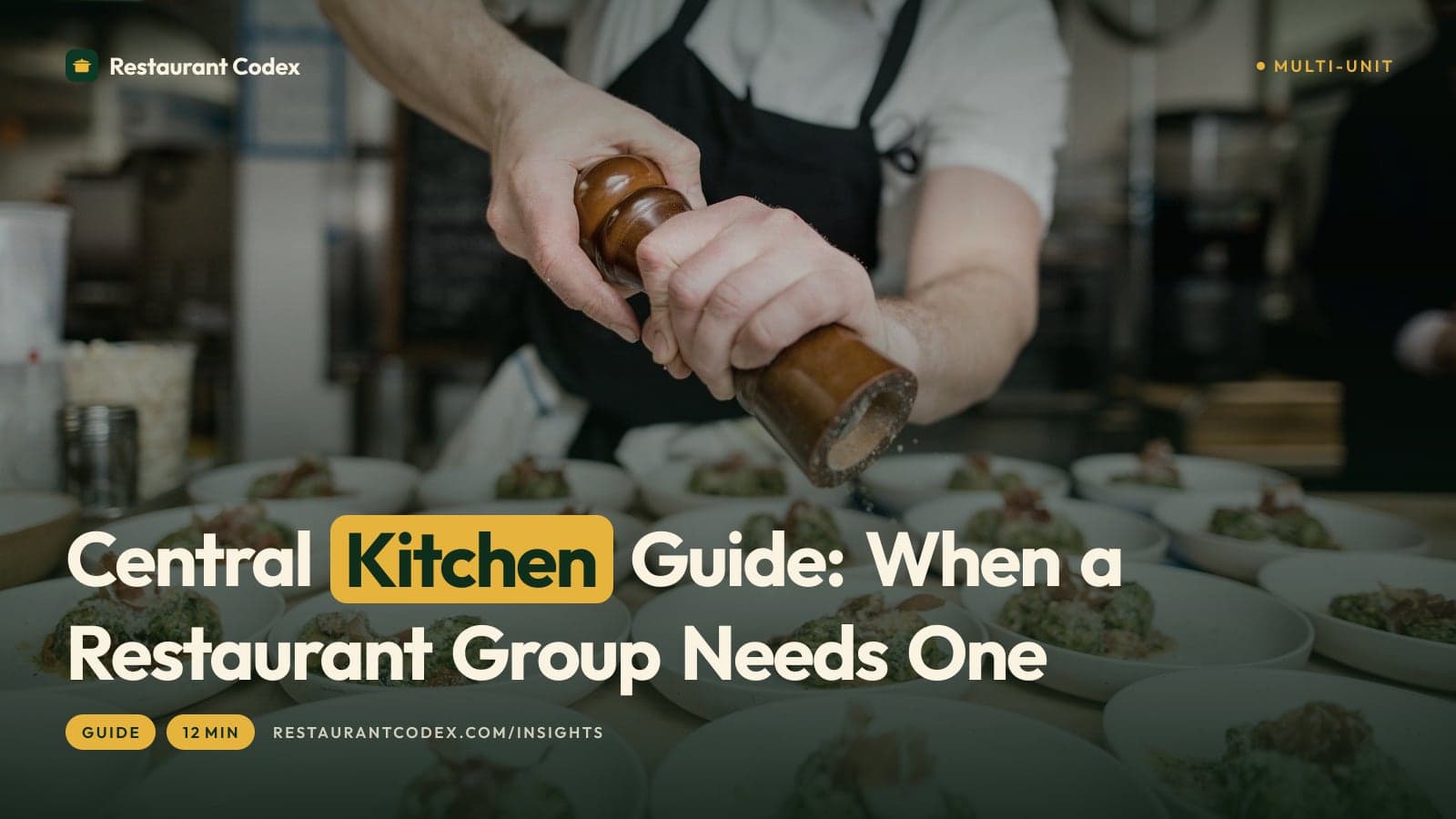
A central kitchen is a production kitchen, separate from your dining rooms, where one crew prepares food for several restaurants in the same group. The restaurants receive it as components or finished dishes and do the last step themselves: sear, reheat, plate, garnish, fry. Commissary is the US word for the same idea; in Mexico you'll hear cocina central.
What comes out of it varies. A prep-only kitchen washes, cuts, portions and marinates. A cook-chill kitchen cooks stocks, sauces, braises and doughs, chills them fast, and the sites reheat them. A finished-dish kitchen sends out food that only needs plating. Most groups start with the first or second and move a few items at a time.
It isn't a ghost kitchen (a kitchen that cooks only for delivery orders) and it isn't a purchasing warehouse, though many groups put dry storage in the same building. The test is simple: if a cook there is making food that another restaurant of yours will serve, it's a central kitchen.
The FDA Food Code treats this setup as part of the food business itself. Its definition of a food establishment includes "a central preparation facility that supplies a vending location or satellite feeding location." So the central kitchen gets the same food-safety rules as the restaurants it feeds, plus the extra ones that come with moving food between buildings.
When does a restaurant group need a commissary?
A group needs a commissary when the same prep is being repeated in several kitchens, quality differs from site to site because of it, and the sites are close enough to deliver to every day. One of those on its own isn't enough. All three together usually are.
Signs it's time:
- The same sauces, stocks or doughs are made at every site, and each site's version tastes a little different.
- Prep takes so many hours that you need cooks on early shifts at every location, and the kitchens are too small to hold the work.
- You plan to open more sites, and each new kitchen would otherwise need its own prep space and its own trained prep cook.
- The sites are within a short drive of one place, so food can arrive the same day it's made or the next morning.
Signs it isn't:
- Each concept has its own menu, so there's little overlap in what's prepared.
- The dishes depend on being cooked to order and don't hold well after chilling and reheating.
- You run two or three sites, and the fixed cost has too few places to spread across.
Distance matters in Mexico too. Our analysis of INEGI's DENUE directory (May 2026) found at least 875 company-named groups running 2 to 15 locations, and 73.3% of them operate in a single state (Mexico restaurant data 2026). Many groups already share a region, which is the first condition for a central kitchen. It doesn't tell you they have enough volume.
Academic work points the same way. A 2025 analytical study of chain restaurants by Yujia Zhang models a central kitchen as an investment in consistency across locations, and finds that whether it's viable depends significantly on its fixed investment cost relative to how sensitive guests are to inconsistency. If your guests would notice and care that the sauce differs between sites, the case is stronger. If they wouldn't, the rent has to be justified by cost alone.
What does a central kitchen cost and save?
A central kitchen swaps costs that repeat at every site for costs that exist once, so it saves money only when what each site saves, after delivery, adds up to more than the fixed cost of running it. We couldn't find a verifiable published benchmark for central-kitchen savings, so here is a hypothetical you can rebuild with your own figures. Every number below is invented to show the arithmetic.
Fixed costs per month for the central kitchen (hypothetical, in US dollars)
| Line | Amount |
|---|---|
| Rent | $4,500 |
| Utilities and equipment lease | $2,000 |
| Kitchen supervisor | $4,500 |
| Insurance, permits and cleaning | $1,000 |
| Total fixed | $12,000 |
What one site gains and spends per month (hypothetical)
| Line | Math | Amount |
|---|---|---|
| Prep labor moved off the site | 3 net hours a day x $18 loaded cost x 30 days | $1,620 |
| Food savings | 40% of $20,000 purchases moves through the central kitchen = $8,000; 6% better yield and buying = | $480 |
| Gain per site | $2,100 | |
| Delivery (van, driver time, fuel) | -$900 | |
| Net per site | $1,200 |
The "net hours" are the hours a site stops spending on those items, minus the hours the central crew spends making the same food. Break-even is the fixed cost divided by the net per site: $12,000 / $1,200 = 10 sites. At five sites the kitchen loses $6,000 a month (5 x $1,200 = $6,000, against $12,000 fixed). At 15 sites it earns $6,000 a month (15 x $1,200 = $18,000).
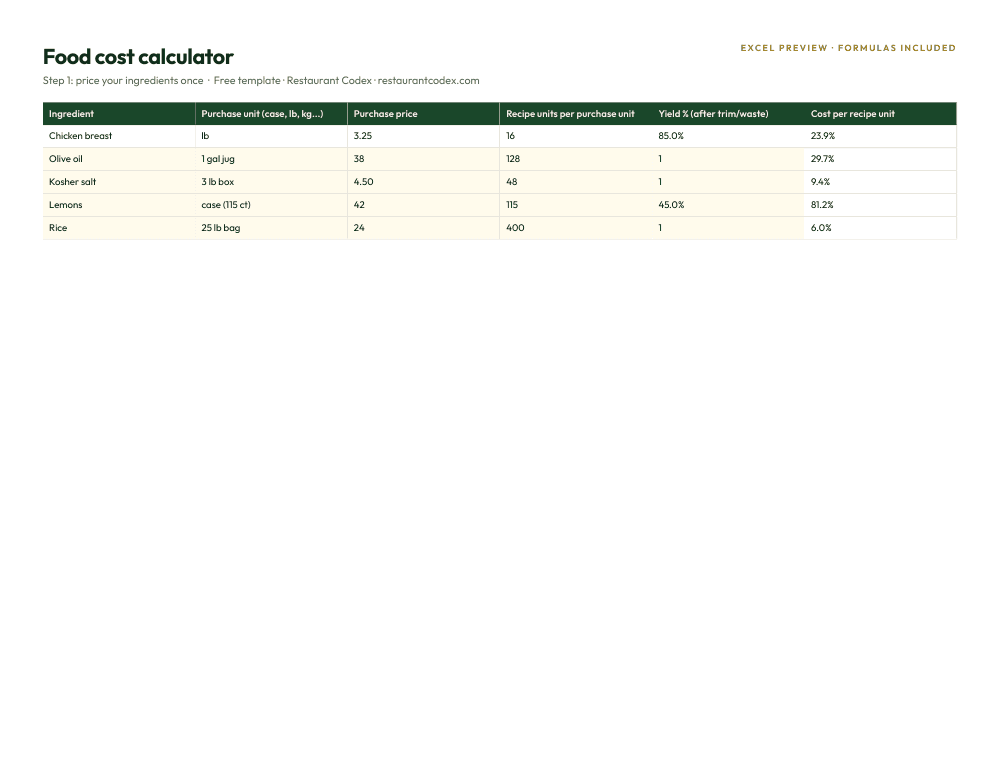
Change one assumption and the answer moves a lot: a cheaper rent, a driver you already pay, or twice as many items moving through the kitchen each shift the break-even by several sites. The model also leaves out costs you'll want in yours: the setup and equipment purchase, packaging and labels, extra receiving time at each site, product thrown out when you over-produce, and what you do on the day the central kitchen is down. Put the monthly numbers into the food cost calculator and track the result per location, so you can see whether the food cost line actually moved after the switch.
How do you keep food safe when it moves from a central kitchen to your restaurants?
You keep food safe in transit by controlling four things: how fast it cooled before it was packed, the temperature it leaves at, how long it spends in the van and in storage, and what each site checks when it arrives. The FDA Food Code (2022 edition) and Mexico's NOM-251 both cover these. The section numbers below are from the 2022 edition. FDA published a 2026 edition in September 2026 that keeps the same cooling times and holding temperatures.
Cooling before packing. Cooked food that needs temperature control must cool from 57°C (135°F) to 21°C (70°F) within 2 hours, and to 5°C (41°F) or less within a total of 6 hours (section 3-501.14). A central kitchen makes large batches, and a deep pot of stock doesn't meet those times by sitting in a walk-in, so plan for shallow pans, ice baths or a blast chiller.
Holding. Food that needs temperature control is held at 57°C (135°F) or above, or at 5°C (41°F) or less (section 3-501.16).
Receiving. Cold food arrives at 5°C (41°F) or below. Cooked food received hot arrives at 57°C (135°F) or above. Food shipped frozen is received frozen, and nothing may show signs of earlier temperature abuse (section 3-202.11). A site should treat a delivery from your own central kitchen exactly like one from a supplier.
Date marking. Ready-to-eat food made in-house and held more than 24 hours needs a clear date mark. It can be held at 5°C (41°F) or less for a maximum of 7 days, and the day of preparation counts as Day 1 (section 3-501.17). Label with the production date at the central kitchen. Every day in the walk-in and in the van is a day the site doesn't get.
Chilled vacuum-packed food. If the central kitchen cooks, vacuum-packs and chills food (cook-chill), section 3-502.12 has stricter rules. The operation must give the regulator a HACCP plan before it starts. The food must be prepared and consumed within the same business entity, cooled in the sealed bag, and kept at 5°C (41°F) or less for no more than 7 days (or cooled to 1°C (34°F) within 48 hours for longer holds, up to 30 days). Transport to a satellite location of the same business must use verifiable electronic monitoring of time and temperature. Check this with your regulator before you buy a vacuum packer.
Mexico, NOM-251-SSA1-2009. The norm's transport section (point 5.13) is short:
- Food must travel in conditions that avoid contamination (5.13.1) and be protected from pests and physical, chemical or biological contaminants (5.13.2).
- Food that needs refrigeration or freezing must travel at the temperatures the producer specifies (5.13.3).
- Vehicles must be clean (5.13.4).
Refrigeration equipment must hold a maximum of 7°C (5.5.2). Ready-to-serve food must be held hot above 60°C (140°F) and cold at 7°C (45°F) or less (7.3.3). The FDA's cold limit is 5°C (41°F), two degrees lower, and using one rule at 5°C everywhere is simpler to train and meets both. For the raw ingredients your central kitchen buys from suppliers, Table 1 under point 5.6.7 is stricter: refrigerated products are accepted at 4°C or less, and rejected above it, except live seafood, which can be accepted at 7°C.
NOM-251 doesn't name central kitchens. It has a chapter 6 for "fábricas" (food factories) and a chapter 7 for food service establishments, and the text doesn't say which one covers a restaurant group's central kitchen. That's for your local health authority to say. If it's chapter 6, you'd need written records in Spanish kept for at least one and a half times the product's shelf life (6.6.1), a lot code on prepackaged products (6.9.1), and identification on prepackaged products moved for distribution (6.9.2). The NOM-251 guide covers the rest of the norm.
In practice, a transport routine has five parts:
- A probe reading at packing, written on the dispatch sheet.
- Insulated boxes or a refrigerated vehicle, loaded so air can circulate, with raw and ready-to-eat food kept apart.
- A label on every container with the item, production date, use-by date, allergens and storage temperature.
- A receiving check at the site: probe a sample, check the label, refuse out-of-range product, and record it.
- A call to the central kitchen when a reading is out of range, the same day.
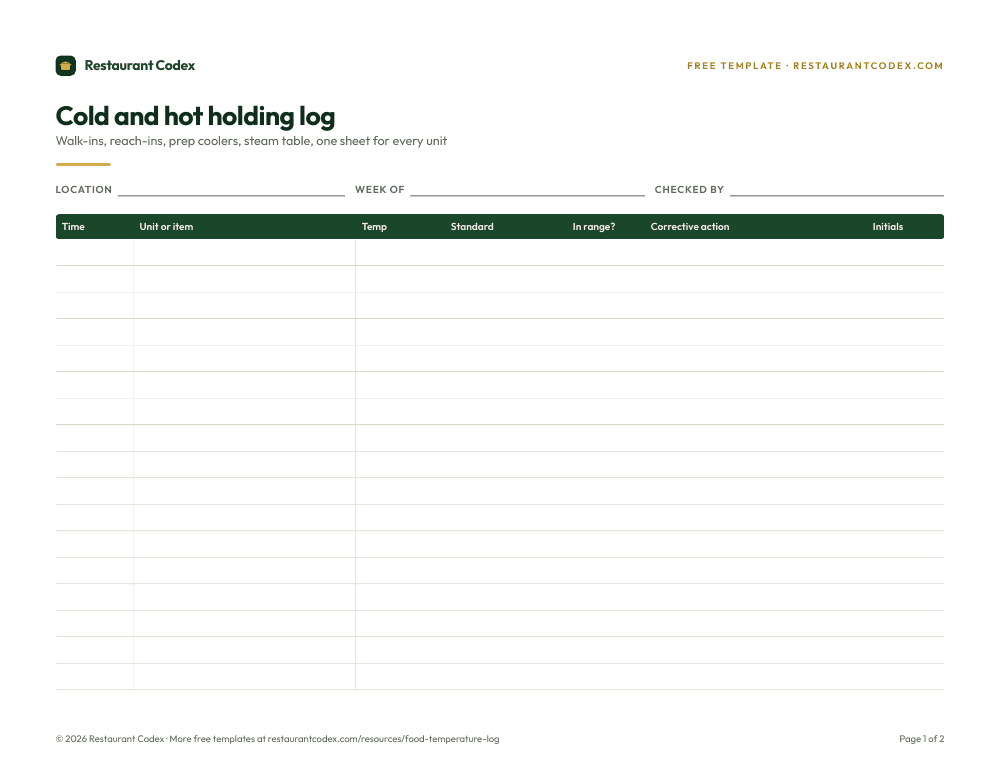
Use the food temperature log for the readings.
How do you write batch recipes and specs for a commissary?
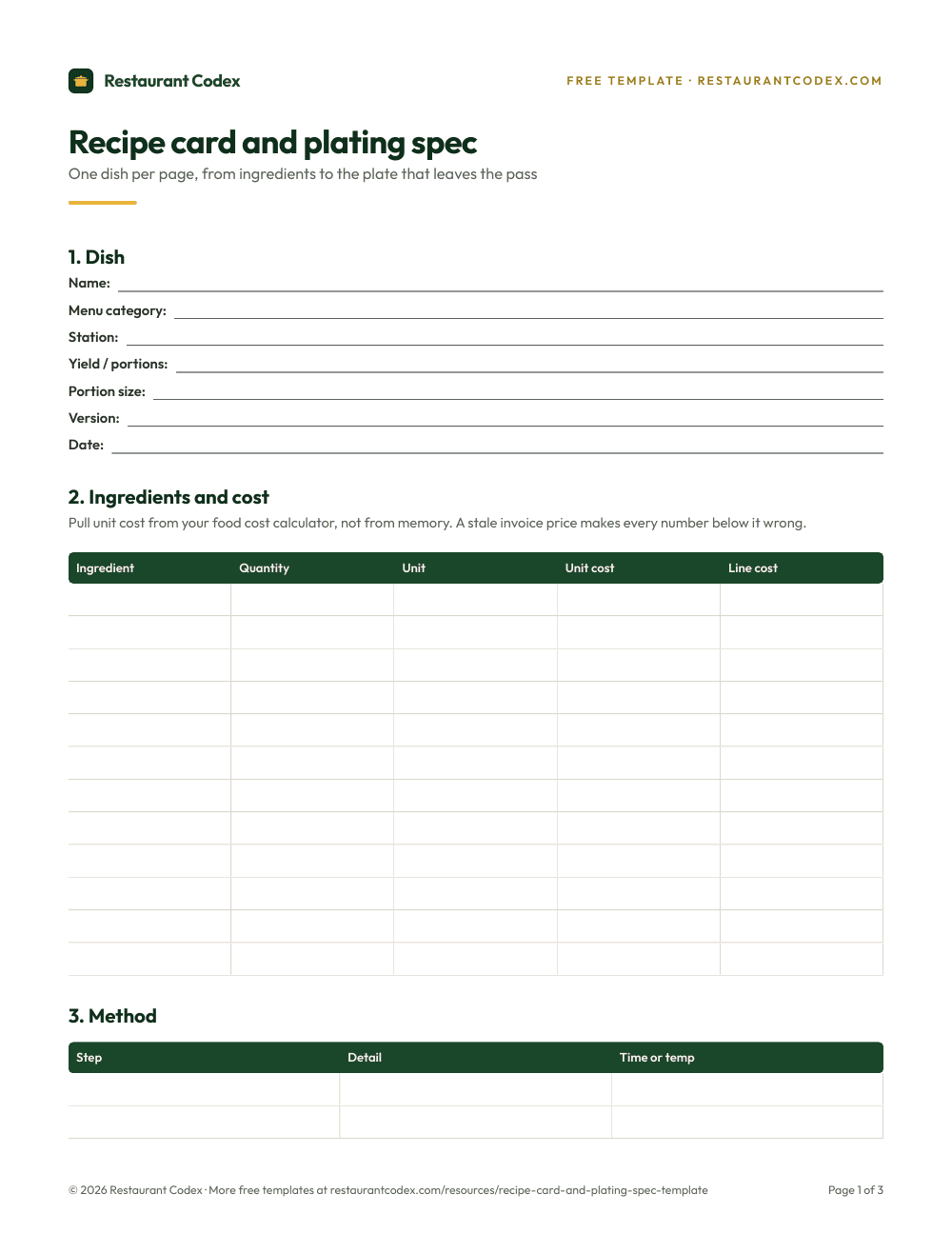
Batch recipes for a commissary are written in kilos or liters of finished yield with a shelf life, not in portions, and each site gets a separate finishing spec that turns the batch into a plate. Without both, the central kitchen makes consistent food that the sites then finish five different ways.
A batch recipe needs:
- Name, yield (weight or volume after cooking) and number of portions
- Ingredient weights and the method, with the cooking and cooling limits
- Container size, label wording and storage temperature
- Shelf life and the last day it can be served, counted from the day of production
- Allergens
- A photo of the product as it should arrive
A finishing spec for the site needs the reheating or finishing steps, the plate photo, the portion and the plate cost.
The cost carries through. Say a 20 kg tomato sauce batch costs $48.00 in ingredients and yields 18 kg after cooking. That's $2.67 a kilo, and a 120 g portion costs $0.32. Those are example numbers; the recipe costing guide shows how to cost with real yields. Keep one current copy of each recipe and retire the old one the day it changes. When it's in a shared recipe library, the central kitchen and the sites read the same page.
Is a central kitchen better than cooking at each location?
A central kitchen is better when consistency, kitchen space and prep labor are your main problems and the sites are close together; cooking at each location is better when freshness, menu flexibility and a small footprint matter more. Neither is right for every group.
| Central kitchen | Cooking at each location | |
|---|---|---|
| Consistency | One recipe, one crew, one set of measures | Depends on each site's cook |
| Prep labor | Moved to one crew on day shifts | Repeated at every site |
| Kitchen space | Smaller site kitchens, easier to open new ones | Each kitchen needs prep space |
| Food safety | One place to control, plus transport and storage to manage | Handling stays in the building where it's served |
| Flexibility | A menu change needs a production change | A site can adjust the same day |
| Capital | Lease, equipment, vehicle, packaging | Already in each kitchen |
| Risk | One kitchen down affects every site | One site's problem stays local |
| Freshness | Depends on delivery frequency | Made on the premises |
There's a middle option many groups take: send only the five or ten items that cost the most labor and travel well, such as stocks, sauces, doughs and braises, and keep everything else on site. Start with one item at one or two sites, check the food cost and the guest feedback for a month, and add from there. You can rent time in someone else's kitchen first before you commit to a lease.
Where Restaurant Codex fits
Restaurant Codex doesn't plan production or run deliveries, and it isn't a POS or accounting system. It holds the standard a central kitchen depends on and shows whether the sites follow it. In the Knowledge Base, batch recipes carry allergens, photos, yield and shelf life, written once and shared with the roles that need them. Tapiz Bistro & Bakery in Mexico City built 220 recipes in two weeks; see the customers.
Operations runs scheduled lists with photo proof, including the temperature logs and receiving checks above, and sends due-soon, overdue and still-not-done alerts. Owners compare every location side by side. Training paths and sign-offs tell you which cooks at each site have been signed off on the finishing specs. Inventory logs waste with a reason and shows food cost per location with a roll-up, so you can see whether the switch changed the number. Codex is priced per location and quoted on a call.
Restaurant Codex
The same checklist, on every phone, with photo proof
Restaurant Codex runs this template as a live task with timestamps, photos and one view across every location. Bring it to a 30-minute working session and we'll show you how it would run across your locations.
By the Restaurant Codex team
Written with operators who run multi-location restaurant groups. Reviewed against the FDA Food Code and the sources listed below.
Sources
- U.S. FDA, Food Code 2022 (full text; sections 3-202.11, 3-501.14, 3-501.16, 3-501.17, 3-502.12)
- Diario Oficial de la Federación, NOM-251-SSA1-2009, Prácticas de higiene para el proceso de alimentos, bebidas o suplementos alimenticios (1 March 2010)
- Yujia Zhang, Improving food quality consistency of chain restaurants with central kitchen, Modern Supply Chain Research and Applications 7(4), 2025
- INEGI, Directorio Estadístico Nacional de Unidades Económicas (DENUE), the data behind our Mexico restaurant analysis