How do you manage restaurant suppliers?
You manage suppliers by keeping a short list for each category, writing down what each one has agreed to, and scoring them on the same few measures every month. The list is simple: proteins, produce, dairy, dry goods, disposables, beverages and cleaning supplies, each with a primary supplier and a backup.
For each supplier, keep one page with:
- The price list and the date it was agreed
- Delivery days, and the cut-off time for orders
- Minimum order and any delivery charge
- Payment terms
- What happens when you reject a product: credit, replacement, or pickup
- A name and a phone number for the person who fixes things
Then score them. These are the measures that matter, with the number you track:
| Measure | How to calculate it | Why it matters |
|---|---|---|
| On-time delivery | Deliveries inside the agreed window, divided by all deliveries | Late trucks mean cooks improvising |
| Fill rate | Cases delivered divided by cases ordered | Shorts hide as stockouts |
| Invoice accuracy | Invoices with no errors divided by all invoices | Every error costs you time or money |
| Quality rejections | Cases rejected divided by cases delivered | Tells you if specs are being met |
| Price vs agreed list | Lines billed above the list divided by all lines | Catches creep |
As a made-up example, a supplier makes 20 deliveries in a month, 2 arrive late and 3 invoices have errors. That's 90% on time and 85% accurate. Neither is a crisis, but on the same scorecard the next supplier might show 100% and 95%, and you now have a reason to move volume.
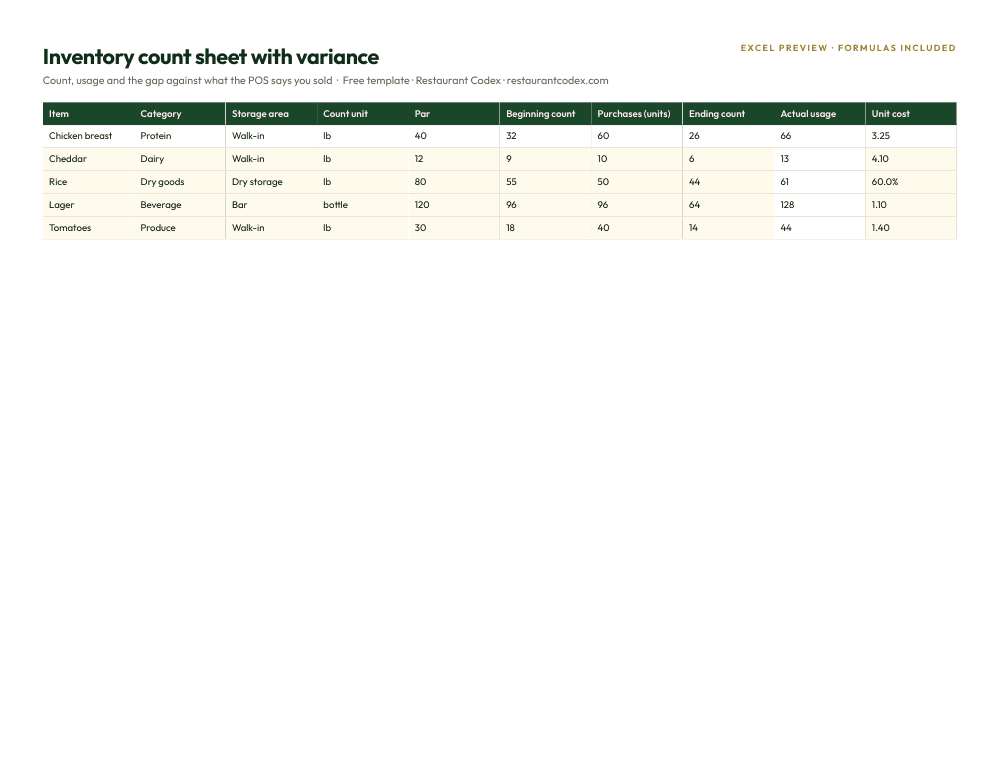
Who receives matters as much as who sells. Northern Arizona University's hospitality course notes say receiving practices "range from carefully checking each item delivered to allowing the supplier's truck driver to put the order away and the manager simply signing the invoice," and that only selected and trained employees should be permitted to receive. Put receiving on the training path for the people you trust with it. Our inventory guide covers the count that follows.
How do you set par levels and order quantities?
You set a par level by multiplying an item's average daily use by the days until the next delivery and adding a buffer, then you order the par minus what you counted, rounded to the pack size. Par is per item, per location and per delivery day, because a Friday order has to cover the weekend and a Wednesday order doesn't.
Here's a made-up example for chicken thighs at one site. The site uses 12 kg a day, deliveries come Monday, Wednesday and Friday, and the longest gap is Friday to Monday, three days.
| Step | Math | Result |
|---|---|---|
| Expected use until next delivery | 12 kg x 3 days | 36 kg |
| Buffer | Chosen from your count history | 4 kg |
| Par for the Friday order | 36 + 4 | 40 kg |
| Counted on Friday | 9 kg | |
| Need to order | 40 - 9 | 31 kg |
| Pack size | 10 kg cases | 3 cases = 30 kg |
Three cases leave 39 kg after delivery, which covers the 36 kg you expect to use and leaves a 3 kg buffer. Four cases would leave 49 kg and a 13 kg buffer you'd have to use before it spoils, so round to the case that covers expected use, not the one that makes the par.
Pick the buffer from history. Look at your last eight weeks of counts: if you ran short twice, raise it for that item; if the same item ends up in the waste log, lower it. Review pars monthly and after any change in menu or sales, because a par that was right in June is wrong in December. The prep list and par sheet sets par by station for prep, which is a different number from the purchasing par on your order.
How do you check supplier invoices?
You check an invoice in two steps: first the invoice against your order, then the delivered goods against the invoice. Northern Arizona University's course notes describe exactly this, and add that products invoiced by weight should be weighed on an accurate scale. The same notes say that as soon as the receiver signs the invoice, the merchandise is legally accepted and any problem becomes the restaurant's, so the check has to happen before the signature.
At the door, check:
- Count and weight. Does what's in the boxes match the invoice? Weigh anything sold by weight.
- Temperature. The FDA Food Code (2022 edition, section 3-202.11) says refrigerated food that needs temperature control is received at 5°C (41°F) or below. Probe a few items and write down the reading.
- Condition and spec. Right grade, right size, right date, no damage.
- Credit. Anything short, wrong or rejected goes on the invoice as a credit request, with the reason, before the driver leaves.
At the desk, check:
- Duplicates. Has this invoice number been entered before? Suppliers resend invoices, and paying twice is easy to do.
- Unit and pack size. A case of 10 and a case of 12 at the same price are different prices.
- Price against last price and the agreed list. This is where creep shows up.
- The math. Quantity times price equals the line total, and the lines add to the invoice total.
A made-up invoice shows what a price check catches:
| Item | Qty | Unit price | Line total | Last price | Change |
|---|---|---|---|---|---|
| Roma tomatoes, 25 lb case | 4 | $38.00 | $152.00 | $34.50 | +10.1% |
| Chicken thighs, 40 lb case | 3 | $71.20 | $213.60 | $71.20 | none |
| Heavy cream, quart | 12 | $4.15 | $49.80 | $4.15 | none |
| Invoice total | $415.40 |
The tomatoes cost $3.50 more per case than last time ($38.00 - $34.50), which is $14.00 on this delivery. One invoice, small number. Across four locations and every week, it's the difference between a supplier you trust and one you check.
How do you negotiate with food suppliers?
You negotiate by bringing numbers: what you buy by category, what you pay now, and what a second supplier quotes for the same spec. Most operators are already doing some version of this. In the National Restaurant Association's State of the Restaurant Industry 2026, full-service operators responding to higher food costs in 2025 reported that 63% shopped around for other suppliers and 55% negotiated with the ones they had.
Before you call, do three things:
- Pull twelve months of purchases by category and by location, and add them up. Your weight with a supplier is the group's total, not one site's.
- Write the spec for the top items: brand or grade, pack size, weight range. A quote means nothing unless it's for the same product.
- Get a competing quote on the items that make up most of your spend.
Then ask for things that aren't only a lower price:
- A price held for a set period, or notice before a change.
- Delivery days and windows that match your slow hours, so receiving isn't done in the rush.
- Credit terms for rejected and short items, in writing.
- Payment terms that fit your cash cycle.
- Substitution rules: what they send when an item is out, and whether you approve it first.
- A lower minimum order or no delivery charge if you consolidate sites onto one drop schedule.
Don't use a competing quote as a bluff. Use it as information, and be ready to move volume if the answer is no. Run this once or twice a year by category, not every week, and keep a record of what was agreed so you can check invoices against it.
Should you buy centrally or let each location buy locally?
Buy centrally what doesn't vary by location and where volume gets you a better price, and let each site buy locally what needs daily delivery or a local relationship. Most groups end up with a mix, with the central part being a price list and the local part being the order.
| Central purchasing | Local purchasing | |
|---|---|---|
| Price | One negotiated list on the group's volume | Each site pays what it can get |
| Consistency | Same product and spec everywhere | Varies by site |
| Control | One person watches prices and approves suppliers | Managers choose, so you review more |
| Freshness | Depends on the supplier's route | Easier to get daily delivery nearby |
| Speed | Slower to add a product or switch | A manager fixes a stockout today |
| Risk | One supplier failure hits every site | Failures stay local |
| Best for | Dry goods, disposables, most proteins, beverages | Produce, bread, specialty items |
A common setup is one central price list and approved-supplier list, with each site's manager placing the order against it. The owner sees every site's prices and purchases side by side, and a manager can still fix a missing item the same morning. If your sites are in one region, as many Mexican groups are (73.3% of the groups in our Mexico data analysis run in a single state), shared suppliers are easier to arrange than for sites in different cities.
How do you handle supplier price increases?
You handle a price increase in four steps: spot it on delivery day, ask why and for how long, compare it to the market and a second quote, then decide whether to absorb it, swap the item or change the menu. Speed matters, because every week you don't notice is a week of the higher cost in your food cost.
Know that prices don't move together. USDA's Economic Research Service, in its October 2026 Food Price Outlook, forecasts retail beef and veal prices up 8.7% for 2026, fresh vegetables up 5.8%, and eggs down 29.3%. These are retail consumer prices, not what you pay a distributor, so use them as a direction, not a quote. The point is that a supplier raising beef is probably following the market, and a supplier holding eggs flat while the market falls may owe you a conversation. Ask for relief when a category drops, the same way you'd ask for protection when it rises.
Work out what the increase does to a plate before you decide. Say the beef on a burger costs $4.00 and the burger sells for $16, so beef alone is 25% of the price. An 8.7% beef increase adds $0.35, taking the beef to $4.35 and its share of the price to 27.2%. To hold 25% you'd price the burger at $17.39, or find $0.35 elsewhere on the plate. Whether to pass it on is a menu decision; the menu engineering guide shows which dishes can take a price change and which should be reworked.
Four responses, in the order that costs least:
- Check the invoice is right. Some increases are errors.
- Ask for notice terms and a hold. A price held for a set number of weeks gives you time to adjust.
- Get a second quote and a sample of the alternative.
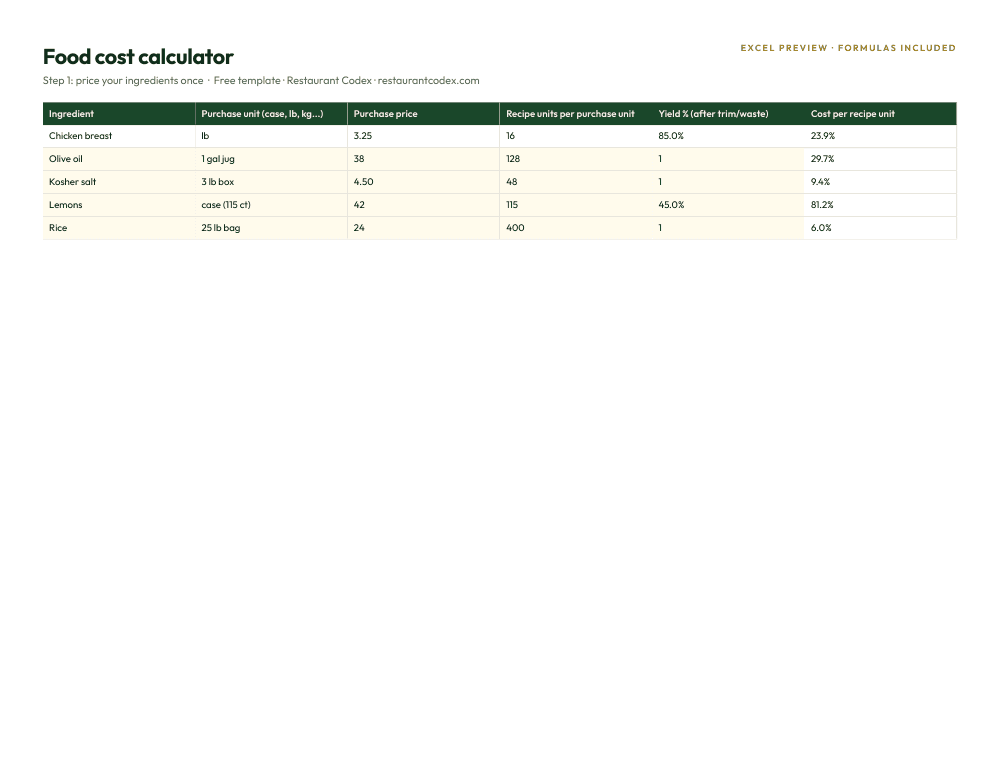
- Change the plate or the price. Substitute an ingredient, change the portion within your spec, or reprice. Re-cost the recipe with the food cost calculator first.
Where Restaurant Codex fits
Restaurant Codex doesn't pay suppliers or keep your books, and it isn't a POS or accounting system. Inventory is where purchasing gets checked: invoices are photographed and read line by line, price increases are flagged, and duplicate invoices are stopped. Counts are blind and done on the phone, with flags when stock doesn't add up. Waste is logged with a reason. The buying list is grouped by supplier and sent by email, WhatsApp or print. Food cost shows per location with a roll-up across the group, and no POS feed or recipe mapping is needed to start.
Codex Copilot can receive deliveries from invoice photos; risky changes ask for approval first, and every change can be undone. Quanto Basta in Mexico City holds 28% margins, consistently, with menu engineering and inventory; see the customers. Codex is priced per location and quoted on a call.
Restaurant Codex
The same checklist, on every phone, with photo proof
Restaurant Codex runs this template as a live task with timestamps, photos and one view across every location. Bring it to a 30-minute working session and we'll show you how it would run across your locations.
By the Restaurant Codex team
Written with operators who run multi-location restaurant groups. Reviewed against the FDA Food Code and the sources listed below.
Sources
- National Restaurant Association, State of the Restaurant Industry 2026 (full report)
- USDA Economic Research Service, Food Price Outlook, Summary Findings (October 2026 release)
- Northern Arizona University, HA442 Food Service Control, Receiving (course notes by Dr. Rande Wallace)
- U.S. FDA, Food Code 2022 (section 3-202.11, Temperature at receiving)