Who is Xenia built for?
Xenia is built for multi-unit operators who want one app for daily tasks, scored audits, maintenance and team communication across many sites. Its own AI information file puts the target at 10 or more locations and says single-location independents and operators with fewer than 5 locations are not who it is for. Franchisees with fewer than 10 locations inside a larger brand system are in scope. Xenia was founded in 2021, is based in Chicago, raised a $12M Series A, and says 500+ operators and 15,000+ locations use it. The restaurant customers it names include Slim Chickens, Newk's Eatery, Prince Street Pizza and Bacari Restaurants, next to retail brands such as Adidas and Van Leeuwen, convenience-store chains and hotels. It's a general frontline platform with a restaurant section, not a restaurant-only product.
Restaurant Codex is built for restaurant groups and priced per location, so a single-location owner gets the same product as a group. It runs the work on the shift (opening and closing lists with photo proof), the SOPs and recipes the team cooks from, training paths with a manager's sign-off, and inventory with food cost. Restaurant groups that run on Restaurant Codex include Mercado 24 in Guatemala City, where chef Pablo Díaz's kitchen is No. 42 on Latin America's 50 Best Restaurants 2025, Koli Cocina de Origen in Monterrey, which has held one MICHELIN Star since 2024, and Tapiz Bistro & Bakery in Mexico City. The awards belong to those restaurants, not to the software. See the customers page.
What does each platform actually do?
Xenia covers execution and upkeep: tasks, audits, work orders, sensors and communication. Restaurant Codex covers standards: checklists, SOPs and recipes, training, inventory and food cost. Row by row, with Xenia's side taken from its own site in October 2026:
| Xenia | Restaurant Codex | |
|---|---|---|
| Tasks and checklists | Recurring and one-off tasks by role, site or person, with photo verification; drag-and-drop builder with 14+ response types; multi-step approvals; works offline | Opening and closing lists, line checks, temperature logs, deep cleans and side work on schedule in each location's time zone; photo proof the app enforces |
| Audits and inspections | Scored audits with weighted points, section scores, grades, conditional questions; trends by location, district and region | Line checks and opening and closing lists with photo proof; no weighted audit scoring |
| Follow-up on failures | A failed audit item creates a task routed to the store team with photos and context | "Due soon" and "overdue" pushes to the assignee, then a "still not done" alert to managers about an hour late |
| Work orders and maintenance | Work orders, preventive maintenance calendars, asset register with QR codes, vendor assignment; add-ons on the pricing page | Not offered |
| Temperatures and food safety | Manual logs, Bluetooth probes, LoRaWAN sensors with out-of-range alerts (sensor add-on), HACCP and FSMA templates | Temperature logs and food-safety lists on schedule with photo proof; no sensors |
| SOPs and recipes | SOP builder, AI SOP writer, a searchable document library with view tracking; no recipe management on the pages we read | Knowledge Base: SOPs, policies, house manual and recipes with allergens, photos, yield and shelf life; Codex Bot answers staff from the group's own manual |
| Training | Embedded video, onboarding checklists, quizzes; not a full LMS by Xenia's own account, though Enterprise lists custom training and certification | A learning path per role on day one, tests AI can draft, a manager's practical sign-off at the station, certificates, readiness by location, role and path |
| Inventory and food cost | Par-level checks and low-stock alerts; not inventory management software by Xenia's own account | Invoices read line by line with price increases flagged, blind counts, waste with a reason, buying list by supplier, food cost per location |
| Communication | Team chats; announcements with acknowledgment tracking | Announcements sent through Copilot; no team chat listed |
| AI | Template Agent, Analytical Agent, AI Photo Rollouts, AI Summaries; some still in pilot | Codex Copilot answers and acts across modules and locations, with approvals and undo |
| Integrations | HRIS and payroll, BI tools, ticketing, SSO; public API on Enterprise | Copilot reaches accounting, POS, scheduling, HR, documents and email through MCP |
| Multi-location view | Regions, districts and sites with role-based access | Every location in one dashboard, side by side, with a live activity feed |
| Security | SOC 2 Type I certified; SAML single sign-on | SOC 2 aligned, on SOC 2 Type II certified hosts; roles Owner, Manager, Staff |
| Languages | English, Spanish, French, Arabic; operator supplies translated audit text | App in English, Spanish (Latin America), Portuguese (Latin America), chosen per person |
| How staff get in | Native iOS and Android apps, plus web | Installs from the browser; no app store, email or password; sign-in by a code sent by text |
| Pricing model | Basic, Pro, Enterprise; custom quotes, no list prices | Per location, quoted on a 30-minute call, no free tier |
Read the table by what's missing. A restaurant that runs only Xenia has scored audits, tasks, work orders and sensors, and keeps recipes, training and food cost somewhere else. A restaurant that runs only Restaurant Codex has the standards, the training and the inventory in one place, and no way to score a walk, open a repair ticket or read a freezer sensor.
Where Xenia is the better choice
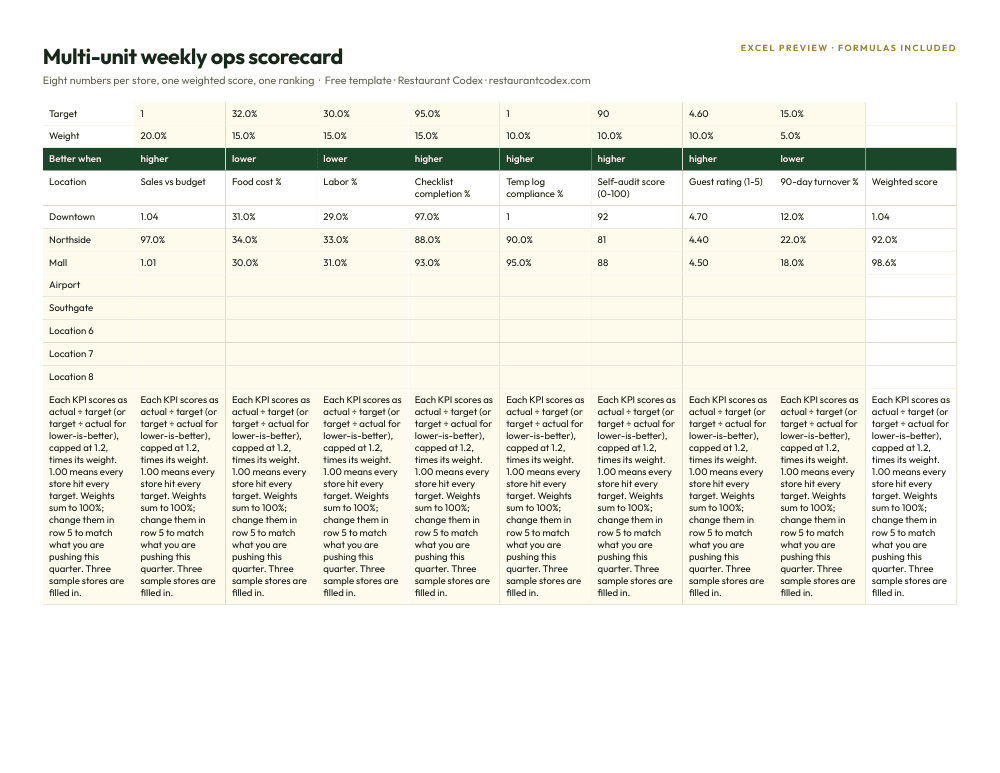
Xenia is the better choice when you score locations and fix equipment for a living. Its audits give each question points, weight critical areas more heavily, roll up section scores and can grade a site with letters or color ratings. A conditional audit hides the questions a site was never meant to have (Xenia's example is a fuel-only store that isn't marked down for missing food-service equipment). Restaurant Codex has nothing like that, so an area manager who walks stores each quarter and needs one comparable number per site should look at Xenia first. Codex describes a weekly walk-through that turns findings into tasks as something managers will be able to build with Copilot from November 2026, but that isn't a scored audit program.
It's the better choice for repairs. A store team can photograph a broken fryer, or scan the QR code on it, and open a work order that goes to a technician or an outside vendor. Xenia keeps an asset register, schedules preventive maintenance on a calendar, and can open a work order straight from a failed inspection. Restaurant Codex has no work orders and no asset tracking.
It's the better choice if you want sensors: LoRaWAN units for continuous freezer and refrigerator monitoring with out-of-range alerts, and Bluetooth probes that send readings into a checklist. Restaurant Codex logs temperatures by hand with a photo and a timestamp.
It's also the better choice when a security review decides the deal. Xenia says it is SOC 2 Type I certified and offers SAML single sign-on, HRIS sync and a public API on Enterprise. Restaurant Codex lists SOC 2 alignment and doesn't list single sign-on. Xenia says its mobile checklists and audits work offline and sync later; the Restaurant Codex site doesn't describe offline use, so if your walk-in has no signal, ask for the demo in that room.
Say a franchisee runs 30 sites and the brand grades them every quarter. The standards walk, the repair backlog and the freezer alarms all point at Xenia, and that group would be right to start there.
Where Restaurant Codex is the better choice
Restaurant Codex is the better choice when people don't know the standard, or food cost moves and nobody can say why. The Knowledge Base holds SOPs, policies and recipes written once and shared with the roles that need them, and Codex Bot answers a staff question from the group's own manual, shows the entry it used and never changes records. The Xenia pages we read describe SOPs as documents in a folder library and list no recipe management. See Knowledge Base.
It's the better choice for training that has to prove someone can do the job. A learning path per job role is in the staff app on day one, tests are graded on the server, and a manager signs off the practical skill at the station, so you can see who is cleared for what at each location. Xenia says it is not a full training or LMS platform. See Training and LMS.
It's the better choice for food cost. Invoices are photographed and read line by line, price increases are flagged, duplicates are stopped, counts are blind, waste carries a reason, and the buying list is grouped by supplier and sent by email, WhatsApp or print. Xenia says plainly that it isn't inventory management software. See Inventory.
And it's the better choice for a team that works in Spanish or Portuguese. The Restaurant Codex app runs in English, Spanish (Latin America) and Portuguese (Latin America), chosen per person. Xenia lists Spanish but not Portuguese, and for bilingual audits the operator types in the translated questions.
Say a five-location group scores its stores every quarter and still sees the same dish plated three ways. The score says the pass looked messy. It doesn't say which cooks were ever trained on the new plating, or whether the recipe on the line is the one the chef changed last month. That's a standards problem, and a better audit grade doesn't fix it.
What does each platform cost?
Xenia doesn't publish prices. As listed on Xenia's pricing page in October 2026, there are three plans and no numbers:
| Plan | Price listed | What it adds |
|---|---|---|
| Basic | "Custom pricing per location" | Task management and scheduling, checklists and audits, basic reporting, mobile app, 100+ templates |
| Pro | "Custom pricing per location" | AI co-pilots, custom dashboards, a training and documentation hub, communications tools, a dedicated account manager, integrations, location hierarchy |
| Enterprise | Talk to sales | Full implementation, a dedicated success manager, public API, HRIS and SSO, custom training and certification, priority support with an SLA |
The page says Xenia offers both per-user and per-site pricing. Its FAQ says the entry plan is a flat annual rate, Pro is per location per month and Enterprise is custom volume pricing, and it calls the entry plan Starter in places and Basic in others, so ask which one you're being quoted. Four add-ons are listed: sensors and continuous monitoring, facilities ticketing and work orders, asset management and QR codes, and food prep label printing. A pilot program is offered, and pilot pricing applies to the full rollout. The AI information file says there is no onboarding fee.
Restaurant Codex gives no number here either. It's paid, priced per location and quoted on a 30-minute call, with no free tier. Each location includes Operations, Knowledge Base, Training and LMS, Inventory and Codex Copilot, 5 manager and admin seats and 50 staff app seats, and rollout runs through the 8-Week Implementation Program with weekly one-on-one meetings.
Two questions settle most of it. If Xenia quotes per user, count every part-timer, because a restaurant's headcount is far larger than its manager count. And if the work orders and sensors you want are add-ons, get them in the same quote, then add what you'd still pay for recipes, training and food cost elsewhere before you compare totals.
What changes across several locations
Past a handful of locations, how each product shows you the group matters more than any single feature. Xenia models regions, districts and sites with role-based access, so a district manager sees only their stores, and audit scores trend by location, district, region or company. That structure earns its keep when there are regional directors between the owner and the store, which fits a vendor whose stated target is 10 or more locations.
A lot of groups sit below that line. In Mexico, our analysis of INEGI's DENUE (05/2026) found at least 875 company-named groups running 2 to 15 restaurants, and 741 of them have 2 to 5 locations; see Mexico's restaurants in numbers. A group that size rarely needs a district layer. It needs every location to start from the same plan and one screen that shows which stores are behind.
Restaurant Codex is built around that screen. Every location starts on the same plan, a GM at location twelve reads the same Knowledge Base as the GM at location one, and owners compare locations side by side with a live activity feed. Copilot lets an owner ask across the group in plain words and act in the same conversation. If you run a deep hierarchy, ask the Codex team to show how access is scoped by brand and location. See multi-location restaurant software.
How to decide
Start with what you lose the most time on. If your area managers spend the week walking stores, scoring them and chasing repairs, start with Xenia. If they spend it answering "how do we make this" and "was that person ever trained," and the food cost number surprises you every month, start with Restaurant Codex.
Then check the overlap. If Xenia is the choice, work out what you'd still need for recipes, training and inventory, so you don't buy a second system for the same checklist. If Restaurant Codex is the choice, decide what you'll do for scored audits and repairs, and read the guide to restaurant operations audits before you decide a spreadsheet is enough.
Last, ask each vendor for the same demo. For Xenia, watch a failed walk-in temperature check create a corrective task and see who's told when it isn't closed. For Restaurant Codex, watch a recipe change reach a line cook's phone and a new hire open their path on day one. A slide deck won't show you what the software does at 4 p.m. on a Friday. The guide to restaurant software layers shows where each product sits next to your POS and scheduling.
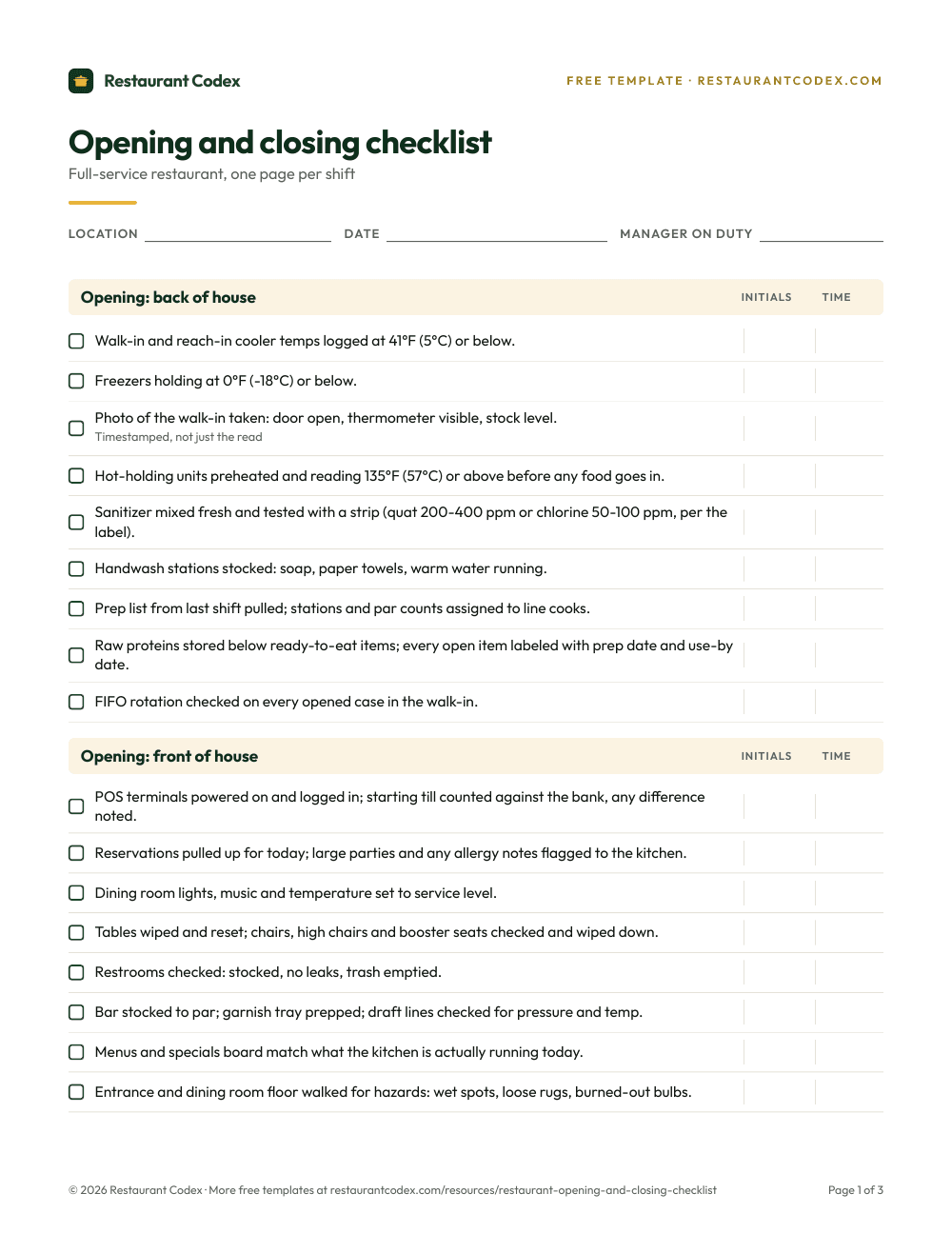
Restaurant Codex keeps checklists with photo proof, SOPs and recipes, training, inventory and food cost in one place, with one live view across every location. It does not score audits, run work orders or read freezer sensors.
Restaurant Codex
The same checklist, on every phone, with photo proof
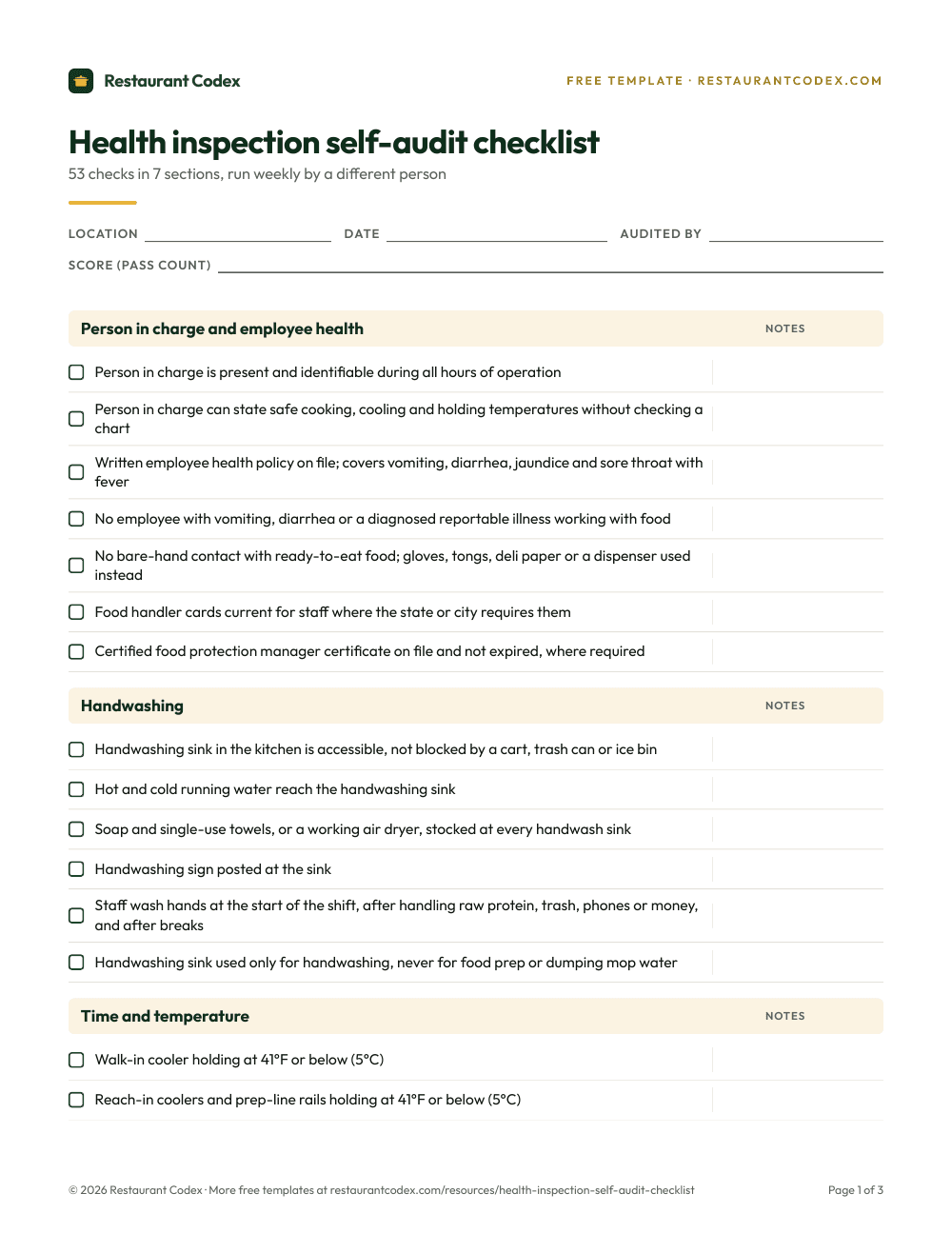
Restaurant Codex runs this template as a live task with timestamps, photos and one view across every location. Bring it to a 30-minute working session and we'll show you how it would run across your locations.
By the Restaurant Codex team
Written with operators who run multi-location restaurant groups. Reviewed against the FDA Food Code and the sources listed below.
Sources
- Xenia, Pricing
- Xenia, information file for AI assistants (llms.txt)
- Xenia, Restaurant Task Management Software
- Xenia, Checklists and SOPs
- Xenia, Inspections and Audits
- Xenia, Work Order Management
- Xenia, Temperature Monitoring
- Xenia, Inventory Management
- Xenia, Team Communication and Resources
- Xenia, Bilingual Conditional Audits