Who Operandio and Restaurant Codex Are Built For
Operandio is built for franchise and multi-unit network growth; Restaurant Codex is built for the daily grind of running the locations a 2-to-50-unit group already has.
Operandio's own homepage calls it "The Intelligent Franchise & Multi-Unit Operating System," designed to manage "every stage of your multi-unit network, from growth and location openings to onboarding, team training and operations execution." That phrase, growth and location openings, tells you who the product is aimed at: franchisors and multi-unit operators who are actively adding units, not just running the ones already on the map. Its published case studies fit that read. Bounce Inc runs 22 locations, Flagship Restaurant Group runs more than 50, and several franchise brands, Super Chix, Cold Rock Ice Creamery, Tex's Chicken & Burgers, LUCAS Restaurants, appear without a location count attached. No case study describes a 100-plus-unit enterprise chain.
Restaurant Codex sits in a similar size band, 2 to 50 locations, but the job is different. Onboarding happens directly with the operator rather than through a self-serve signup, and the system is built around a manager needing to know, from one screen, whether every location closed correctly last night, whether the walk-in temps got logged, and whether the new hire in the back actually passed the knife-skills quiz.
Put simply: if the next year is mostly about opening new franchised units, Operandio's positioning lines up with that job. If the next year is mostly about tightening what already exists across the locations you're running today, that's closer to what Restaurant Codex is built for.
Neither vendor treats a group under 2 locations as its target buyer. Both are built for the multi-unit case, where the real question isn't "does this software work" but "does it hold up the same way at location 6 as it does at location 1." Operandio's own case studies, franchise brands with no published unit count next to standalone operators like Bounce Inc and Flagship, suggest it flexes across both franchised and corporate-owned models. Restaurant Codex is built for the same range but stays inside operations: it isn't trying to also manage the legal and real-estate side of opening a new unit, just the checklists, training and food safety that start the day that unit opens.
What Operandio and Restaurant Codex Actually Do
Both cover checklists and training. Past that, the two products diverge more than a feature list at a glance would suggest.
| Area | Restaurant Codex | Operandio |
|---|---|---|
| Checklists and tasks | Photo proof and timestamps on every completed task | Task management and checklists, the product's core |
| Food safety and temps | Digital temp logs inside the same checklist system | Compliance automation, plus optional wireless IoT sensors from third-party manufacturers |
| SOPs and recipes | Knowledge base with an AI assistant that answers from the operator's own SOPs and recipes | Searchable knowledge and document management |
| Training | Training paths, quizzes and certifications tracked per employee | Mobile-first LMS with an AI course builder |
| Inventory and food cost | Inventory counts and food cost variance | "Parts Inventory Management" plus supplier management, aimed at equipment and parts |
| Scheduling | Not part of the platform | No distinct scheduling module found |
| POS | Not part of the platform | No POS integration found |
| Multi-location view | One live view across every location | "Network Dashboard" with role-based analytics |
| Languages | English and Spanish | Homepage claims "AI-powered multilingual support"; Spanish not named |
| How staff log in | QR code or phone number, no app-store download | Native mobile app and a shared-tablet app, offline-capable |
| Pricing model | Per-location subscription, quoted on a call | Priced by location and user count plus modules, quote-based, no free trial |
A few lines in that table need unpacking. Operandio's own temperature-monitoring page is explicit that the hardware isn't proprietary: it "supports a wide range of best-in-class sensors from various trusted manufacturers," which means shopping for and wiring in third-party devices rather than buying a single vendor's kit. Its inventory feature reads narrower than a food-cost tool, "Parts Inventory Management" plus supplier management sounds like equipment and parts tracking, not a food COGS workflow. Restaurant Codex's inventory side tracks counts and food cost variance directly, without a hardware purchase attached to it.
On training, a Capterra reviewer for Operandio flagged that "training courses only include simple multiple-choice questions" as a current limitation, alongside a separate note that "some areas are still being developed, like conditional logic and specific reporting features." Restaurant Codex tracks quizzes and certifications per employee as part of its training paths.
Picture two operators reading this table with different problems. One runs 12 taco locations today and is opening three more under a new franchisee this year; she needs franchisee onboarding, incident reporting and a way to track the parts inventory going into each new build-out, which points toward Operandio. Another runs the same 12 locations, isn't opening anything new this year, and is losing money to checklists that get signed off without being done and a food cost line that drifts a point or two every month without anyone catching it until the P&L lands; that's closer to what Restaurant Codex is built to fix. Same location count, different job.
Where Operandio Is the Better Choice
Operandio is the better choice for an operator whose next year is about opening units and whose platform has to cover more than the kitchen and the floor. Three real reasons.
First, its feature surface runs wider than day-to-day kitchen and floor operations. Asset tracking, incident reporting, supplier management for parts and equipment, and IoT sensor integration for temperature monitoring all live inside the same login. An operator who wants one system covering those functions in addition to checklists and training gets more of them bundled into Operandio than into Restaurant Codex.
Second, it's built specifically around franchise network growth. Location openings and franchisee onboarding are named, first-class parts of the product rather than something layered onto a general ops tool. A franchisor adding several units this year gets workflows built directly for that job, not adapted from a single-location checklist app.
Third, its review scores are strong. Capterra lists Operandio at 4.9 out of 5 across 22 reviews, and Software Advice shows the same 4.9/5 on what appears to be the same underlying dataset. Twenty-two reviews is a thin sample worth treating as indicative rather than conclusive, but reviewers consistently called it easy to use and praised how fast support responded, with one describing the "simplicity of creating checklists" as a standout.
None of that is a reason to dismiss it. A restaurant group that genuinely needs asset tracking, incident reporting and franchisee onboarding in one place is buying real functionality Restaurant Codex doesn't offer, and paying for a wider platform makes sense when you're actually using the width of it.
Where Restaurant Codex Is the Better Choice
Restaurant Codex is the better choice for a group whose daily problem is consistency across the locations it already runs, starting with where its SOPs and recipes live. Its knowledge base pairs SOPs and recipes with an AI assistant that answers questions from the operator's own content, not a generic search box scanning uploaded files. That matters most mid-rush, when a cook needs "how do we plate the new special" answered in seconds instead of a folder hunt.
Restaurant Codex also names Spanish as a supported language outright. Operandio's homepage claims "AI-powered multilingual support" without saying which languages that covers, so a bilingual crew can't confirm Spanish is actually in there without asking sales first.
Staff log in with a QR code or a phone number, no app-store download required. That matters in a business where hourly turnover means setting up a new employee's access happens most weeks. Operandio's native mobile and shared-tablet apps work fine, but they're still a download and an account setup per person, and a Capterra reviewer noted that "users are required to create their own profile" as a point of friction during rollout.
Restaurant Codex is also scoped to exactly what a 2-to-50-location group runs daily: checklists with photo proof and timestamps, food safety logs, an SOP and recipe knowledge base, training with quizzes and certifications, inventory and food cost variance, and one live view across every location. It isn't trying to also be an incident-reporting system or a parts supplier portal, which keeps the product focused on the loop most owners actually fight with every week.
What Operandio and Restaurant Codex Cost
Both are quote-based, and neither publishes a number you can put in a budget without a call. Operandio's pricing page states cost depends "on the number of business locations or users, as well as the modules you choose," gated behind a "Request pricing" form. Its FAQ confirms there's no free trial; new customers are offered a paid pilot instead, which means committing to a real, paid engagement before you get to try the product day-to-day rather than poking at a sandbox account for free. That's a reasonable model for a platform this configurable, module by module, location by location, but it changes the sales cycle: you're negotiating scope and modules before you've used any of them.
Restaurant Codex is quote-based too: a per-location subscription, priced on a 30-minute call rather than a public rate card, with onboarding done together with the operator rather than a self-checkout signup. Neither company publishes a number you can drop into a spreadsheet without talking to someone first, so budgeting for either one means getting an actual quote against your real location count before you compare, not estimating from a marketing page.
How to Decide in One Afternoon
Pull up both vendors' quote paths and answer one question before filling either one out: is the gap you're trying to close this year mostly about opening more locations, or mostly about running the locations you already have more consistently?
If you're actively opening franchised units and need incident reporting, parts and asset tracking, and franchisee onboarding workflows alongside checklists, request Operandio's pricing and ask specifically what the temperature-monitoring sensors cost as an add-on before you commit; that line item isn't on the pricing page. Ask, too, which modules are included at your location count and which are priced separately, since the site is explicit that modules affect the quote.
If your actual daily problem is that checklists get faked, SOPs live in a group chat nobody searches, and new hires can't get logged in without downloading yet another app, book Restaurant Codex's 30-minute call and ask for a quote against your real location count. Bring a specific failure from last month, a missed temp log, a closing checklist someone signed without doing, a new SOP that never made it past one location, and ask how the platform would have caught it. A vendor call answers that question faster than a feature list does.
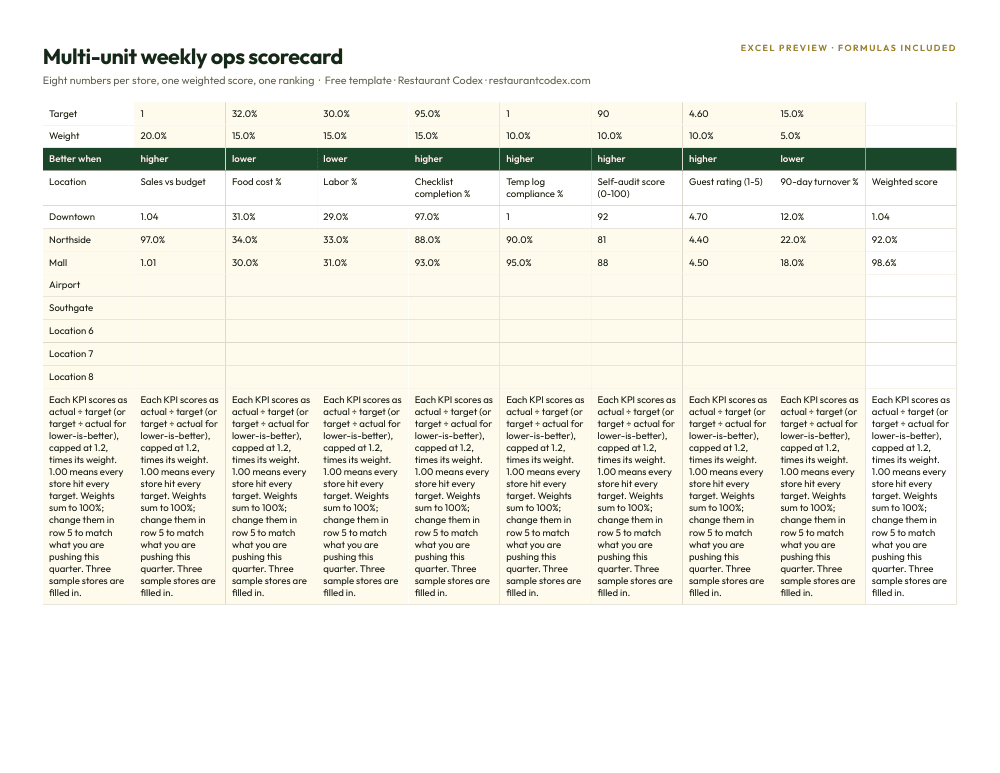
Either path, get both quotes for the same number of locations before signing anything; a quote scaled for 5 locations and one scaled for 20 aren't comparable, and neither company prices flat per group regardless of size. A multi-unit ops scorecard is a fast way to write down what "running consistently" means at your company before that call, so the conversation answers your questions instead of the vendor's slide deck.
Where Restaurant Codex Fits
Restaurant Codex runs the loop a 2-to-50-location group repeats every day: checklists that prove they happened with a photo and a timestamp, an SOP and recipe knowledge base an AI assistant can answer from directly, training paths with quizzes and certifications, food cost and inventory variance, and one live view across every store, in English and Spanish, with staff logging in by QR code or phone number instead of an app-store download.
Restaurant Codex
The same checklist, on every phone, with photo proof
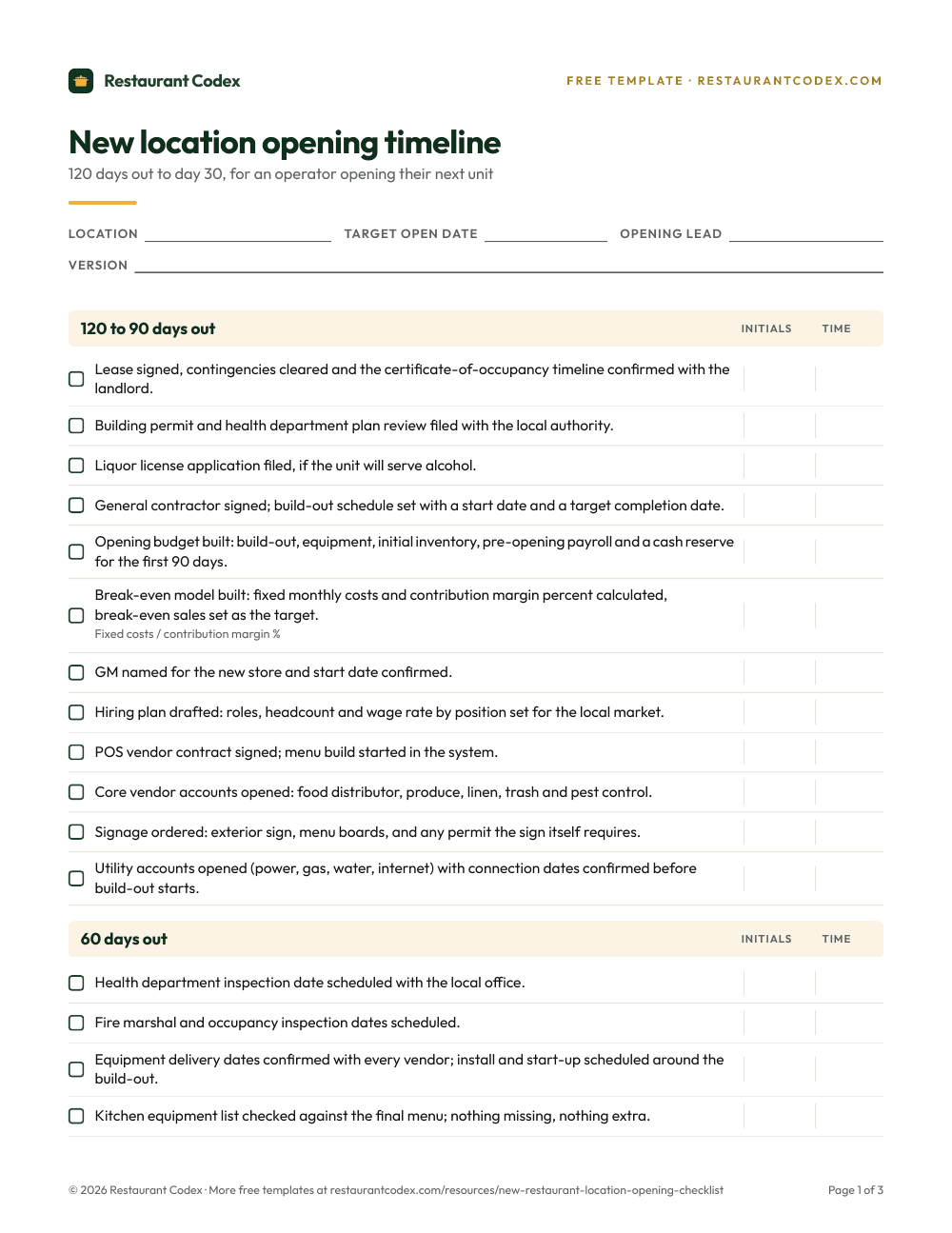
Restaurant Codex runs this template as a live task with timestamps, photos and one view across every location. Bring it to a 30-minute working session and we'll set it up on your real operation.
By the Restaurant Codex team
Written with operators who run multi-location restaurant groups. Reviewed against the FDA Food Code and the sources listed below.