Who is Jolt built for?
Jolt is built for food, retail and hospitality operators who want digital checklists and food-safety compliance on a phone or tablet, and it sells temperature-sensor hardware to automate the food-safety half. Its own tagline is "built for operators, by operators," and the product description centers on "team accountability, compliance with digital food safety, and enhanced employee performance" across food, retail and hospitality businesses. The reference customers it markets are large, recognizable chains: Chick-fil-A, Buffalo Wild Wings, Dairy Queen, Culver's, Jersey Mike's and Legoland. Capterra's reviewer base tells a wider story than the case studies do: 79% small business, 12% mid-size and 8% enterprise, concentrated in restaurants (29%) and food and beverage (22%). Read together, that's a tool with franchise-scale credibility that a large share of its actual buyers are smaller operators, not just the brands on the homepage.
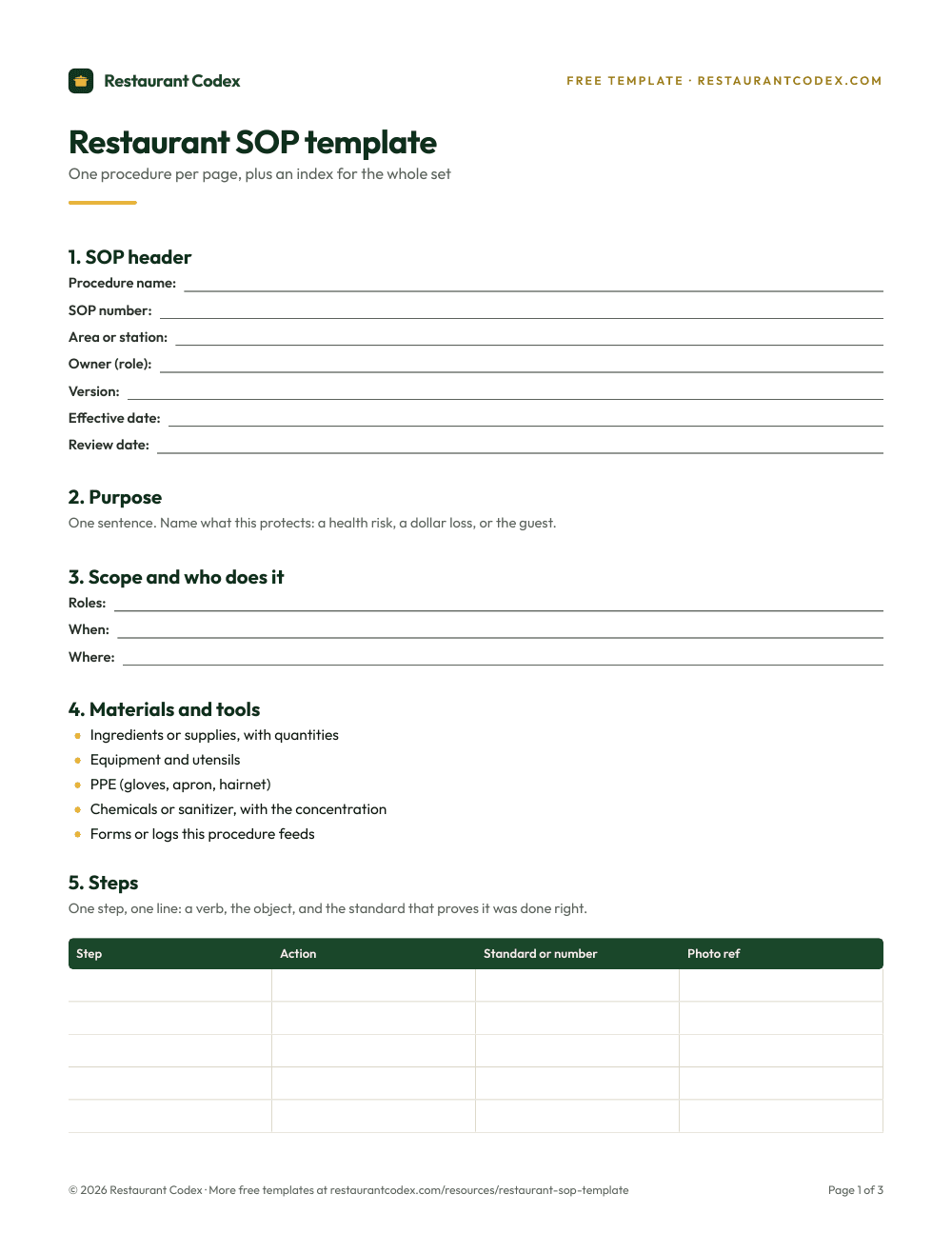
Restaurant Codex is built for the same size range Jolt's Capterra base mostly sits in, restaurant groups running 2 to 50 locations, but as a single system rather than a checklist-and-hardware bundle: one place for checklists, SOPs, training and food cost instead of a device fleet plus a separate app for everything training touches.
Picture a four-location taco group reading Jolt's homepage. The case studies say Chick-fil-A and Buffalo Wild Wings, brands with facilities teams and a hardware budget line most four-unit operators don't have. The Capterra numbers say something closer to that group's own reality: most buyers are small business, and the product works fine at that size too. Neither picture is wrong. It's just worth knowing which one you actually are before a sales call starts anchoring the conversation around enterprise features you won't touch.
What does each platform actually do?
Jolt covers checklists, temperature compliance and shift scheduling; Restaurant Codex covers checklists, SOPs and recipes, training, inventory and food cost. Row by row:
| Jolt | Restaurant Codex | |
|---|---|---|
| Checklists and tasks | Core product ("Operate"): digital checklists and task lists | Checklists with photo proof and a timestamp on every completed item |
| Food safety and temps | Core strength: wireless sensors, the SmartSense T1 device (temp, impact and light, cellular, GPS) and NIST-certified probes, sold separately as hardware | Temperature and food-safety checklists logged with photo proof and a timestamp; no proprietary sensor hardware |
| SOPs and recipes | SOPs and reference notes embedded inside checklist items, not a standalone knowledge base | A searchable SOP and recipe knowledge base with an AI assistant that answers from the operator's own content |
| Training | Light: videos and SOPs attached inside checklists, not a standalone LMS | Training paths, quizzes and certifications tracked per employee |
| Inventory and food cost | Not published as a Jolt feature | Inventory counts and food cost variance tracking |
| Scheduling | Drag-and-drop scheduling included | Not a core feature of the platform |
| POS | Not offered | Not offered |
| Multi-location view | Centralized multi-unit dashboard | One live view across every location |
| Languages | Not stated on Jolt's site | English and Spanish |
| How staff log in | Native app, iPad-oriented, with offline task storage | QR code or phone number, no app store install |
| Pricing model | Request-a-quote; Capterra lists a starting price around $89.99/month | Per-location subscription, quoted on a 30-minute call |
Read the table by what's missing, not just what's checked. Jolt has no published inventory or food cost feature and no standalone LMS, which means a Jolt shop is usually running a second and third product alongside it for those jobs. Restaurant Codex, on the other hand, doesn't do scheduling or POS integration, so a group that leans hard on drag-and-drop shift building or deep POS sync is comparing a narrower Codex feature set on those two rows specifically. Neither vendor does everything; the honest comparison is which gaps you'd actually have to fill.
Where Jolt is the better choice
Jolt is the better choice when purpose-built temperature hardware is the actual problem you're solving. Wireless sensors, NIST-certified probes and automatic logging remove manual temp checks entirely, which a software-only vendor simply doesn't sell, and that hardware sits inside SmartSense by Digi's broader IoT monitoring infrastructure, giving it a level of device engineering a checklist app built on a phone camera doesn't try to match.
It's also the better choice for an operator who wants a longer track record with recognizable reference customers. Jolt's marketed case studies run through national QSR and franchise names, Chick-fil-A, Buffalo Wild Wings, Dairy Queen among them, which matters to a buyer who wants proof the platform holds up at true franchise scale before signing.
And if checklists and temperature compliance are the whole job, not SOPs, not training, not food cost, Jolt's narrower focus means less system to configure. Capterra reviewers praise it as "straightforward and intuitive" with a checklist feature that "saved us from chaos," which is a fair description of what a single-purpose tool done well feels like.
313 reviews at 4.6 out of 5 is a real number, not a marketing line, and it's worth weighing against any newer vendor's smaller review base. A platform with that much usage history has already hit and fixed the obvious bugs a five-year-old product runs into, even if some, per the complaints below, are still open.
Where Restaurant Codex is the better choice
Restaurant Codex is the better choice for a group that wants one system instead of a checklist app plus a separate device fleet plus whatever else covers training, recipes and food cost. The SOP and recipe knowledge base ships with an AI assistant that answers from the operator's own content, so a new hire or a district manager gets a straight answer instead of a checklist item with a PDF attached to it. Training paths, quizzes and certifications live on the same employee record as the checklists, and inventory counts and food cost variance sit in the same view as everything else, not in a fourth tool.
It's also the better choice for a bilingual kitchen. Restaurant Codex runs in English and Spanish; nothing in Jolt's published material states a Spanish option. Staff join by QR code or a phone number, no app store account, no device provisioning, which matters more than it sounds like on a Friday when three new hires start at once. And Restaurant Codex is built specifically for the 2-to-50-location range, with per-location pricing quoted on a 30-minute call and onboarding done together with the operator rather than handed off to a self-serve setup wizard.
Capterra's complaint pattern is worth naming plainly, not as a dig: reviewers describe "frequent glitches and slowdowns" and an app that "can be quite unreliable... slow and sometimes freezes up." For a tool used mid-shift to log a walk-in temperature, that's the kind of friction that pushes staff back toward a paper clipboard.
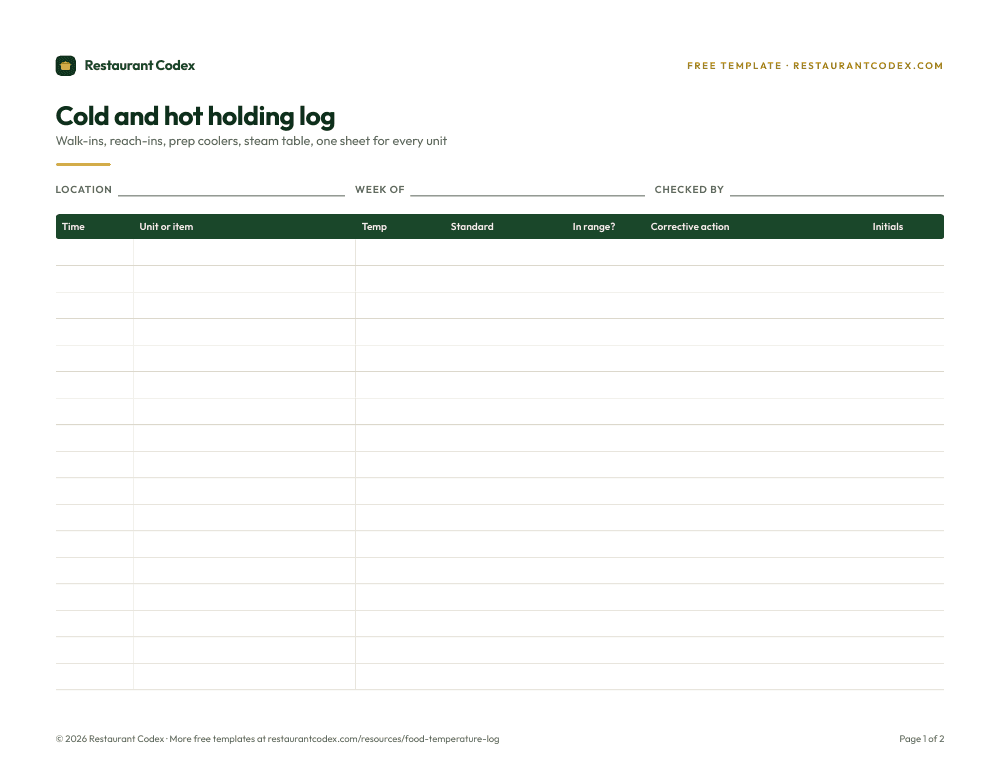
Picture an owner with seven locations checking in before lunch service. In a Jolt setup covering checklists and temps, food cost and training questions still route through separate tools or spreadsheets, so "how are we doing" means opening three things. In Restaurant Codex, that owner opens one live view and sees which stores are behind on closing checklists, which employees haven't finished a certification, and where food cost variance is drifting, all from the same screen, without calling a manager to ask.
What does each platform cost?
Both platforms are quote-based, and neither publishes a rate card. Jolt's pricing, about-us and request-a-demo pages now redirect to smartsense.co rather than showing numbers, and no public rate card exists on either site. Capterra lists a starting price around $89.99 a month with no free trial, but that's a third party's figure, not Jolt's own, and it almost certainly doesn't include the sensor hardware its food-safety features depend on.
Neither company publishes a minimum contract length, so ask directly rather than assuming month-to-month. And price out the hardware separately from the subscription for Jolt: a temperature-monitoring rollout across several locations means sensors, gateways and probes on top of whatever the software quote says, while a Restaurant Codex quote is the whole cost since there's no hardware line to add.
What changes across a 5-to-50-location group
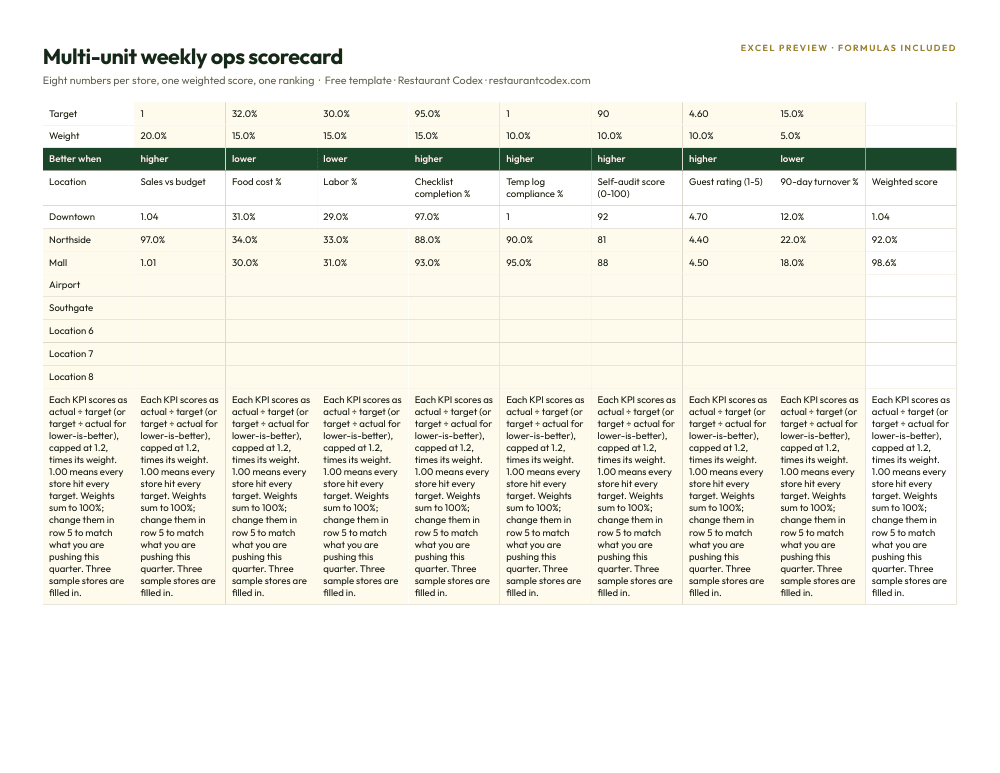
Past about five locations, the number of separate systems a district manager has to open every morning matters more than any single feature in the table. A single restaurant can run either platform and feel that less. Jolt's centralized dashboard rolls up checklist and temperature compliance across units, which is real and useful, but training, recipes and food cost still live somewhere else for every one of those locations, meaning a district manager checking five things ends up checking five things five times, once per system, not once per store.
Restaurant Codex was built around the opposite assumption: that the operator scaling from 5 to 50 locations needs one place to compare stores, not one dashboard per function. A GM at location 12 pulls the same SOP and recipe knowledge base a GM at location 1 uses, with the AI assistant answering from the group's own content instead of whatever that manager happens to remember. New hires across every location join the same way, QR code or phone number, so opening location 30 doesn't mean provisioning 30 new devices the way an iPad-oriented app might. None of that makes hardware-based temperature monitoring less valuable for a group serious about food safety. It just means a fast-growing group is choosing between one system with more device engineering behind its safety features, and one system with fewer tools to keep synchronized as the location count climbs.
How to decide in one afternoon
Book both calls the same week and ask each vendor the same five questions. First, what does this actually cost per location, all in, including any hardware Jolt would want you to buy on top of the subscription. Second, where do SOPs, recipes and training live, one searchable system or a folder of PDFs attached to checklist items. Third, does the platform run in Spanish if any part of your kitchen team needs it. Fourth, what happens when a location gets added or dropped, one call to reprice or a new negotiation. Fifth, ask each rep to demo the exact moment a manager gets flagged for a missed temperature check, not the slide about it, the actual screen, since that's the workflow that either becomes a five-second habit or a task staff learn to route around.
If the honest answer is that temperature-sensor hardware and a franchise-proven track record matter more than anything else, Jolt is a reasonable call to make first. If the honest answer is that you're juggling four tools for checklists, training, recipes and food cost and want one system a 30-minute call can actually configure, Restaurant Codex is worth the same afternoon.
Restaurant Codex keeps checklists, SOPs, training, inventory and food cost in one place: checklists with photo proof and a timestamp, an SOP and recipe knowledge base an AI assistant can answer questions from, training paths with quizzes and certifications, and one live view across every location, in English and Spanish, staff joining by QR code or phone number instead of an app store.
Restaurant Codex
The same checklist, on every phone, with photo proof
Restaurant Codex runs this template as a live task with timestamps, photos and one view across every location. Bring it to a 30-minute working session and we'll set it up on your real operation.
By the Restaurant Codex team
Written with operators who run multi-location restaurant groups. Reviewed against the FDA Food Code and the sources listed below.