What Is a Restaurant Operations Audit?
A restaurant operations audit is a scheduled, scored walk of a location against a written standard, covering food safety, cleanliness, recipe and portion adherence, service, cash handling, people and training records, maintenance, and brand standards. It's one of four audits a restaurant can face. A financial audit checks the books. A compliance audit checks one law against one business, usually run by a regulator. A brand audit checks a location against what the sign out front promises a guest. The operations audit, the one this guide covers, borrows pieces of the other three and runs on its own calendar, usually monthly or quarterly, done by an owner at one location or by an area manager across several.
A self-audit is not a health inspection, and the difference matters more than it sounds like it should. In the U.S., the FDA Food Code is a model, not a law; the agency that actually walks into a kitchen and writes a citation is the local or state health department, which adopts its own edition of the code on its own timeline and enforces it its own way. The FDA doesn't send an inspector. Running a self-audit well means grading yourself against roughly the standard your local department already uses, so a finding on your own sheet is one you fixed before anyone with a badge saw it.
That's the real reason this is worth building past a single location. One owner can hold one store's standard in their head and catch most drift by feel. Past two or three, feel stops being a method, and the audit becomes the thing doing the watching instead.
What Does a Restaurant Audit Actually Check?
A restaurant audit checks eight areas: food safety, cash and comps, recipe and portion adherence, cleanliness, service, people and training records, maintenance, and brand standards. Each one gets a weight based on how much damage a miss does, and each one gets checked against something you can see, not something you're told.
| Area | What to check | Evidence to see | Weight |
|---|---|---|---|
| Food safety | Cold and hot holding, date marks, handwashing, cross-contamination | Temp log with a timestamp, a photo of the actual reading, dated containers, a stocked hand sink | 20% |
| Cash and comps | Drawer count, comp and void log, discount pattern | A two-person count signed by both people, a comp log with a reason and a manager's initials, a void report pulled from the POS | 15% |
| Recipe and portion adherence | Plate against spec, scale weights, the allergy answer | A plated dish photographed next to the spec sheet, a scale reading on a sampled portion, a recorded answer to an allergy question | 15% |
| Cleanliness | Floors, hoods, walk-in organization, restrooms | Time-stamped photos of the hood filter and the grease trap, a restroom log signed through the shift | 10% |
| Service | Ticket times, table touches, the greeting | A POS ticket-time report, one table timed from seated to check | 10% |
| People and training records | Certifications current, onboarding complete, schedule matches the roles posted | A food handler or ServSafe card with its expiry date, a signed onboarding checklist, the schedule as the system shows it | 10% |
| Maintenance | Equipment log, open repair tickets, preventive schedule | A dated repair ticket, a maintenance log entry, a photo of the equipment in question | 10% |
| Brand standards | Signage, uniforms, plating presentation, music and lighting | A photo walk against the brand standards file | 10% |
The evidence column is the one most self-audits skip, and it's the one that actually makes a score mean something. Asking a manager whether the walk-in held overnight gets you an answer. Pulling up last night's actual temp log gets you a fact. Under the FDA Food Code's 2026 edition, published in September 2026, cold holding has to read 41°F (5°C) or below and hot holding 135°F (57°C) or above; that line on the sheet doesn't get a verbal pass, it gets a photo of the number. Build the whole audit around evidence you can see rather than an answer you're given, and the score stops drifting the way a self-graded exam always drifts.
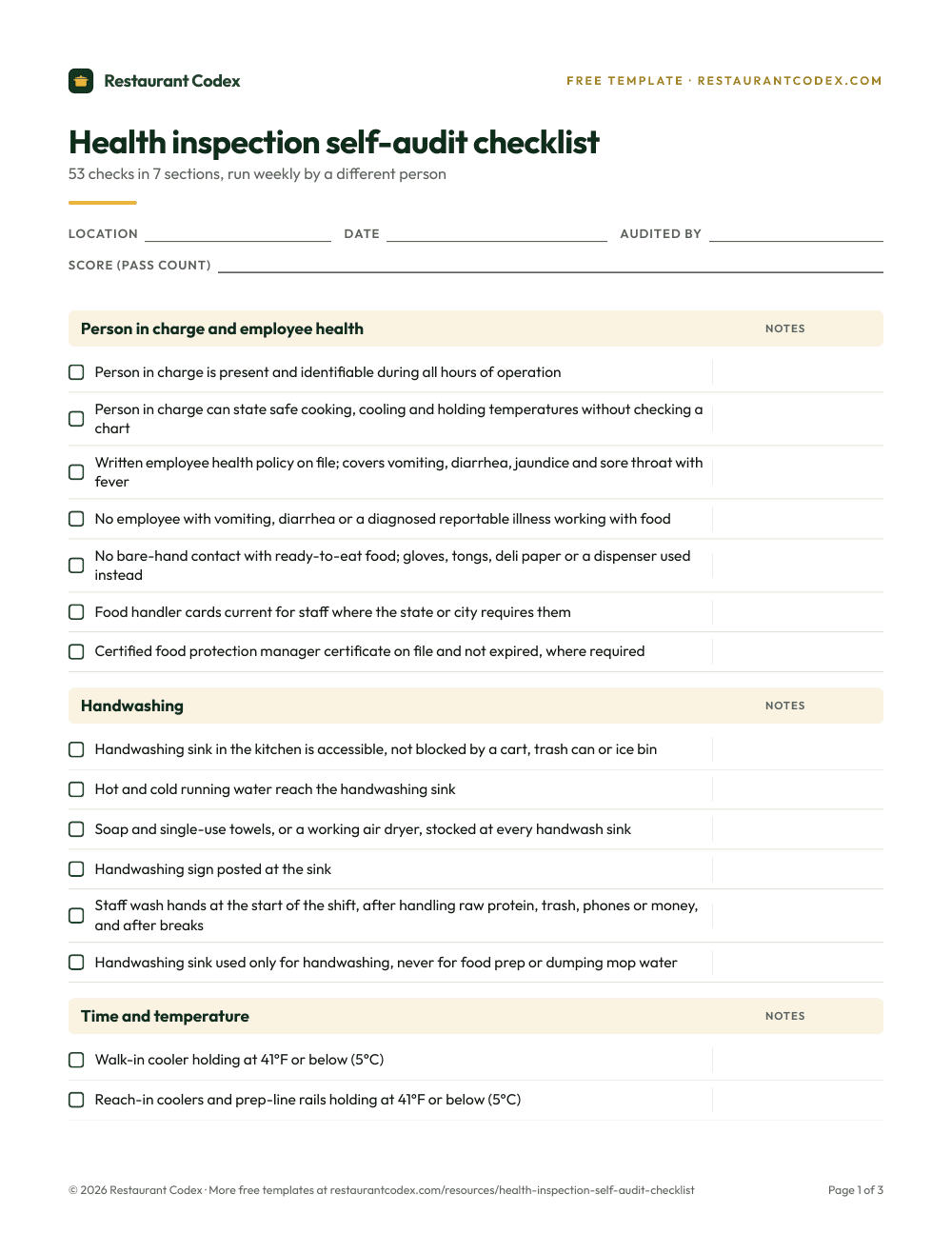
The health inspection self-audit checklist above walks the food-safety line in more detail, 53 points built on the same code. This audit's food-safety row is a summary of that sheet for the purpose of a single store visit, not a replacement for running it on its own weekly schedule.
How Often Should You Audit Each Location?
How often depends on risk, not a fixed number every location gets by default. A location with a recent violation, a GM who's been there under 90 days, or a score under 80 last cycle gets visited every two to four weeks, unannounced, until two cycles in a row come back clean. A location running two clean cycles with a tenured GM moves to monthly, mixing announced and unannounced so the GM doesn't learn to perform for one specific day. A location clearing 95 or above for two straight quarters, with the same GM the whole time, can move to quarterly, mostly announced, since the point of an audit at that stage is confirming the standard still holds, not catching someone off guard.
| Risk tier | Example | Announced or unannounced | Cadence |
|---|---|---|---|
| High | Recent violation, new GM, score under 80 | Unannounced | Every 2 to 4 weeks |
| Standard | Two clean cycles, tenured GM | Mixed | Monthly |
| Low | 95 or above for two straight quarters | Mostly announced | Quarterly |
Announced visits aren't a lesser version of the real thing. A GM who knows the date can show you what a location looks like on its best day, which tells you something too, mainly whether the standard is even achievable with the staff and equipment on hand. Unannounced visits tell you what an ordinary Tuesday looks like. A group running only announced visits is grading a performance. A group running only unannounced visits never finds out its own ceiling. Use both, and let the risk tier decide the mix instead of a preference for one over the other.
How Do You Score a Restaurant Store Visit?
You score a store visit by grading each of the eight areas as a percentage of its evidence confirmed, multiplying by that area's weight, and adding the eight results into one number out of 100. An area that's 90% confirmed at a 20% weight contributes 18 points; the same 90% at a 10% weight contributes 9. Miss something in a heavily weighted area and the total drops faster than missing the same share of a lightly weighted one, which is the entire reason the weights exist instead of averaging all eight equally.
Say an area manager audits a hypothetical location, call it Riverside, and comes back with this.
| Area | Weight | Score | Weighted points |
|---|---|---|---|
| Food safety | 20% | 90% | 18.0 |
| Cash and comps | 15% | 100% | 15.0 |
| Recipe and portion adherence | 15% | 80% | 12.0 |
| Cleanliness | 10% | 85% | 8.5 |
| Service | 10% | 90% | 9.0 |
| People and training records | 10% | 70% | 7.0 |
| Maintenance | 10% | 90% | 9.0 |
| Brand standards | 10% | 100% | 10.0 |
| Total | 100% | 88.5 |
Riverside lands at 88.5. Set the pass line at 90 and above with nothing owed beyond the normal schedule, 80 to 89 as conditional with one follow-up item assigned inside 30 days, and under 80 as a move to the high-risk tier with an unannounced revisit inside two weeks. Riverside's 88.5 is conditional, and the number alone tells you exactly where to look: people and training records scored 70%, the lowest of the eight and the one dragging the total down from a clean pass.
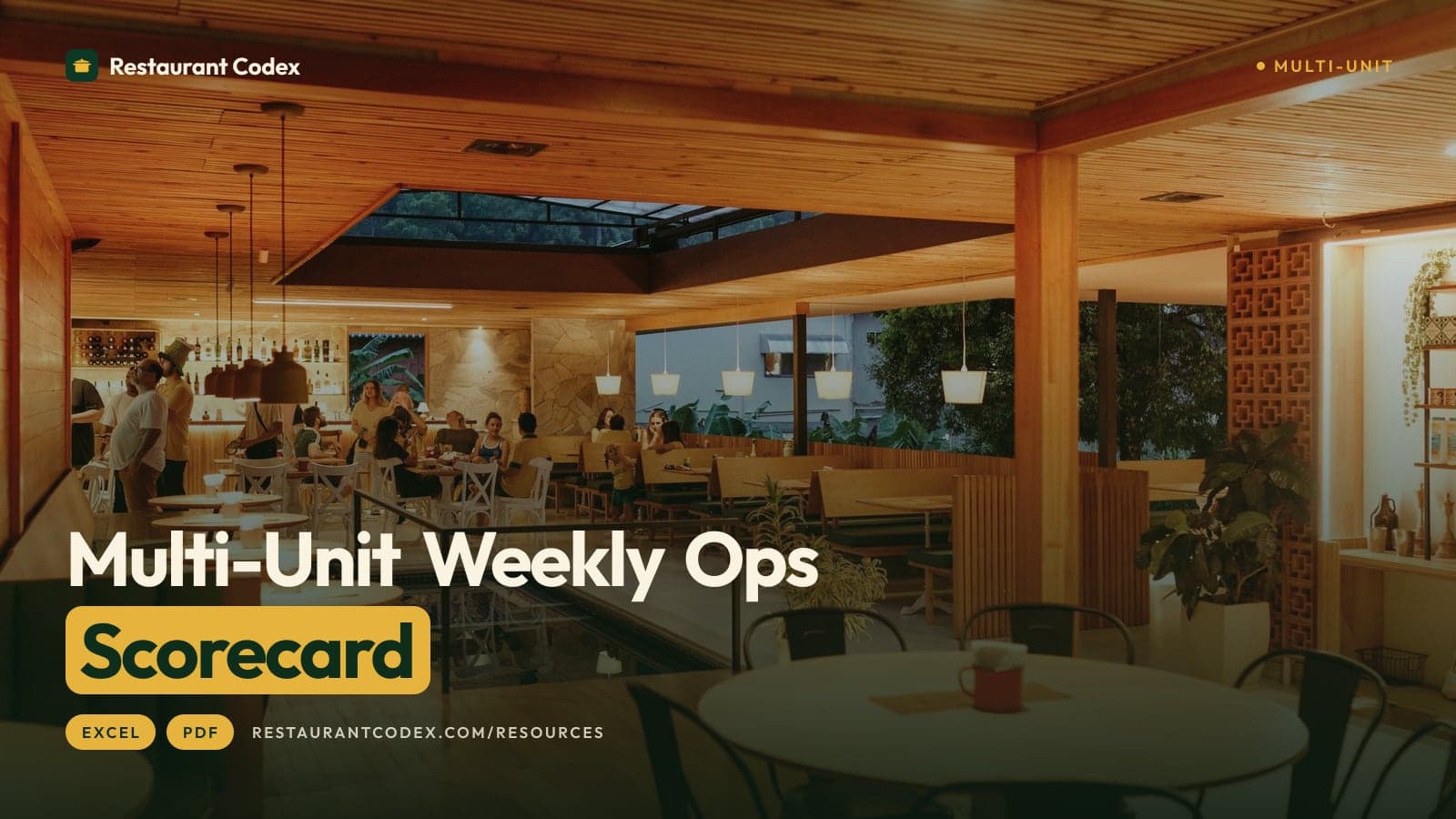
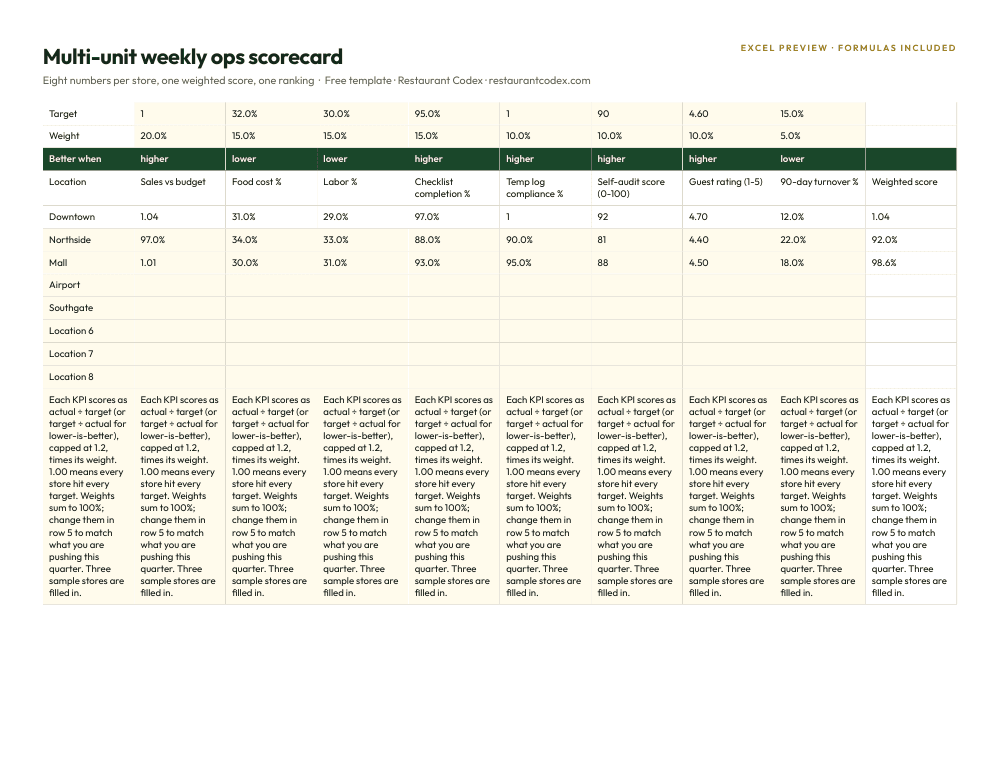
A score like this pairs with the group-wide weekly ops scorecard, which tracks a different set of numbers, sales, food cost, labor, week to week between visits. The scorecard says which location needs the next visit. This score is what that visit produces once it happens.
What Do You Do With the Findings?
What you do with a finding is separate the red number from its cause, because a score describes a symptom and the actual problem usually sits somewhere underneath it. At Riverside, two food handler cards had expired and one new hire's onboarding checklist was never signed, which is what produced that 70%. Marking the row red and moving on tells the next audit to expect the same 70% again. Asking why gets somewhere different: nobody owns tracking card expiry dates, so renewal only happens when someone remembers, which is a system gap, not a training gap, and it will keep producing the same red number at every location until someone fixes it once, centrally, instead of store by store.
Every finding becomes a task with an owner, a date, and a proof requirement, not a note in a binder that gets reread at the next visit. Riverside's write-up reads something like this: the GM renews both expired cards by November 15 and uploads a photo of the new cards; the ops lead adds a 60-day expiry alert wherever training records live, so the next card doesn't lapse silently. One task per finding, not three or four at once, because a GM handed five fixes finishes none of them, and a GM handed one finishes it by the date on the sheet.
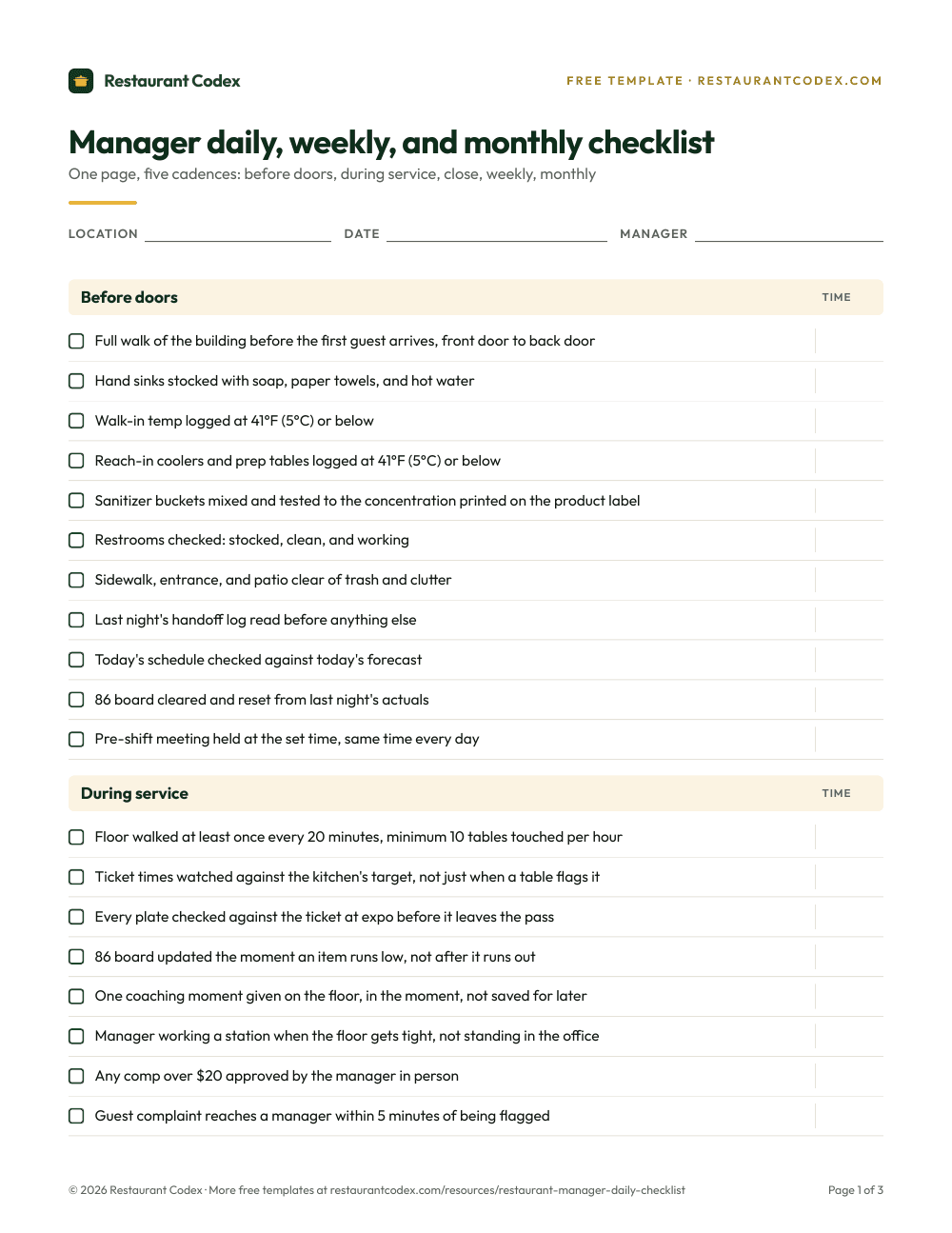
The daily checklist carries the evidence between visits, the temp log, the cash count, the training record, so the next audit isn't the first time anyone's looked. That's the difference between an audit that catches drift once a quarter and one that catches it the week it starts.
How Do Area Managers Supervise Multiple Locations?
Area managers supervise multiple locations by splitting the job into two halves: the scheduled visit, which produces the score, and everything that happens between visits, which the proof loop and the scorecard carry instead of a phone call. A supervisor running six locations can't stand in six rooms at once, and trying to anyway is how a good area manager burns out inside a year. What actually scales is reading the same evidence a GM already generates running their own daily checklist, and showing up in person only when a number or a gap in that evidence says to.
Avenida Café Bistro in El Salvador, run by Salomon, saved two hours every day once opening and closing became easier to operate, with visibility and less direct supervision instead of someone standing over the shift. That's one location and one owner, but it's the same math an area manager is running at scale: the two hours an owner gets back by trusting evidence over presence are the hours a supervisor is trying to buy back across every location on their list, multiplied by however many they carry.
None of this replaces restaurant consistency across locations, the written standard that says what "right" looks like before anyone walks in to check it, or the broader job of running a multi-location group. The audit is the verification step. Both of those guides cover what gets verified and the rest of the job built around it.
Where Restaurant Codex Fits
In Restaurant Codex, the audit can run as a scheduled checklist in Operations: each line can require a photo, so the evidence column fills itself, and the owner sees every location's results side by side. A finding becomes a task with an owner, a due date and a required photo before it closes, so the follow-up doesn't depend on anyone rereading a binder. The weights and the pass bands above stay in your own scorecard; Codex holds the evidence and the follow-up, not the formula. The same daily lists that run opening and closing are what the next visit reads first, so the walk starts already knowing where to look. None of this replaces an area manager on the floor.
Restaurant Codex
The same checklist, on every phone, with photo proof
Restaurant Codex runs this template as a live task with timestamps, photos and one view across every location. Bring it to a 30-minute working session and we'll show you how it would run across your locations.
By the Restaurant Codex team
Written with operators who run multi-location restaurant groups. Reviewed against the FDA Food Code and the sources listed below.
Sources
- National Restaurant Association, State of the Restaurant Industry 2026 press release: 42% of operators were not profitable last year
- FDA Food Code, 2026 edition: cold holding and hot holding temperatures for TCS food
- FDA, FASTER Act: Sesame as the 9th Major Food Allergen
- BLS, Job Openings and Labor Turnover Survey, Table 4, separations rate by industry
- FRED (Federal Reserve Bank of St. Louis), Total Separations: Accommodation and Food Services (JTS7200TSR)
- National Restaurant Association 2026 data via WhippleWood, Financial Benchmarks for Restaurants