Who Trainual and Restaurant Codex Are Built For
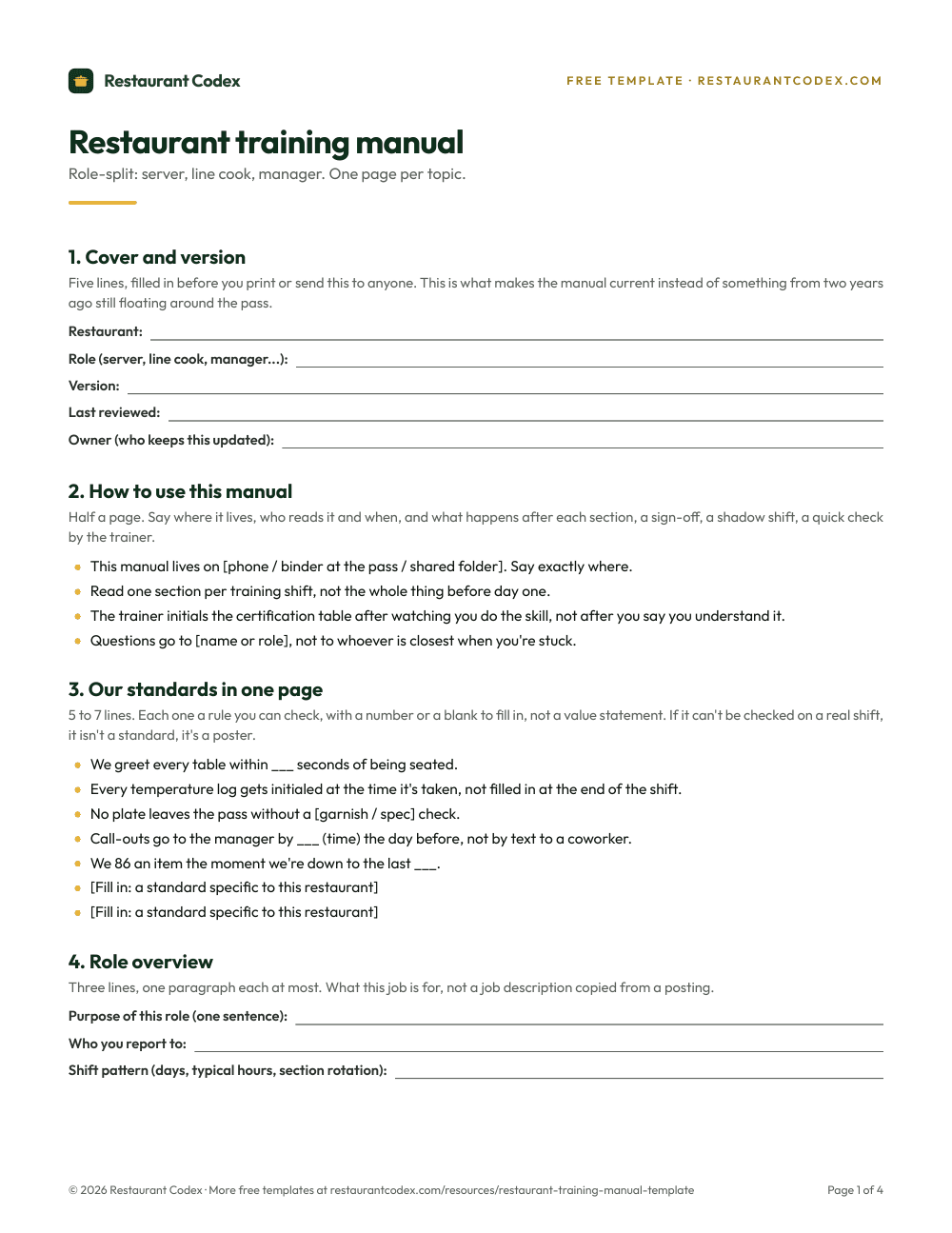
Trainual is built for any company that needs to document how it runs and train people against that documentation, restaurants included, but restaurants aren't the point. Restaurant Codex is built only for restaurants: the checklists, temperature logs, recipe specs and shift tasks a kitchen and floor run every day, in one system across a group of locations.
Trainual's own FAQ describes its fit as companies with 25 to 1,000 employees, and its homepage claims more than 8,000 teams use it. The industries it names span HVAC, construction, medical and dental practices, law firms, schools, real estate, automotive shops and SaaS companies. No restaurant industry page and no restaurant case study turns up on its site. That's not a gap in the product, it's a different product: a documentation and training layer meant to sit underneath a whole company, department by department, whatever that company happens to sell.
Restaurant Codex narrows the other direction. It's built for restaurant groups running 2 to 50 locations, where the daily unit of work is a shift, not a department, and the record that matters is whether the walk-in got checked at 7 AM, not whether the org chart is current. If a restaurant is one line of business inside a bigger, more varied company, or the crew includes people who never set foot in a kitchen, Trainual's breadth is the better starting point. If everything you run is a restaurant kitchen and floor, Codex is built closer to how that day actually happens.
Picture two owners reading the same homepage. One runs a facilities company with an HVAC division, a construction division and a small chain of restaurants under the same holding company; she needs training and process docs that read the same way across all three, and Trainual's whole-company framing fits that job directly. The other runs four taco shops and nothing else; his problem is a walk-in that didn't get checked last Tuesday and a prep list three different cooks fill out three different ways, and that's a narrower, more specific problem than a general documentation platform is built to solve first.
What Trainual and Restaurant Codex Actually Do
Both cover SOPs and training. Past that, the two products diverge sharply, and the gaps matter as much as what's included.
| Trainual | Restaurant Codex | |
|---|---|---|
| Checklists and tasks | Process and SOP templates, not shift-level task lists | Checklists with photo proof and a timestamp on every completed item |
| Food safety and temps | No food-safety or temperature-logging feature found | Same checklist system, photo proof and a timestamp |
| SOPs and recipes | SOP and process documentation with video and step docs, plus AI Q&A search over that content | SOP and recipe knowledge base with an AI assistant that answers from the operator's own content |
| Training | Onboarding paths, role-based training, a course library, testing and tracking | Training paths, quizzes and certifications |
| Inventory and food cost | Not found | Inventory counts and food cost variance tracking |
| Scheduling | Not found | Not a core feature of the platform |
| POS | No POS integration found; integrations are HRIS/payroll, file storage and SSO | Not offered |
| Multi-location view | A "multi-location teams" page exists; no compliance dashboard found | One live view across every location |
| Languages | Not stated on the site or help center | English and Spanish |
| How staff log in | Native iOS and Android app, downloaded from an app store | QR code or phone number, no app-store download |
| Pricing model | Per seat, quote-based tiers | Per-location subscription, quoted on a call |
Trainual's real strength sits in that SOPs and recipes row. Video-backed process docs with an AI search layer over them is a genuinely useful way to answer "how do we do this" without a folder hunt through a shared drive, and its integrations page shows real connections to HRIS and payroll tools, ADP and Paycom among them, that a restaurant-only platform doesn't build toward. What doesn't show up on any Trainual page checked is a food-safety or temperature-logging feature, an inventory module, a scheduling tool or a POS integration. None of that is an oversight. It's outside what a general business documentation platform is trying to be, in the same way Restaurant Codex isn't trying to replace a company's org chart or its payroll system.
Where Trainual Is the Better Choice
Trainual is the better choice when the thing you need documented is a whole company, not a shift. Three real reasons.
First, the operation isn't only restaurants. A hospitality group running retail, real estate or corporate functions alongside its restaurants needs training and process docs that work the same way for every department, not a tool built around the assumption that everyone's running a shift. Trainual's course library and role-based training apply the same way to an accounting team as to a restaurant crew.
Second, the documentation need runs broader than a restaurant's daily tasks. Trainual's help center and integrations page point to org-level functions, general process documentation, onboarding that spans departments, connections to file storage and single sign-on, that a restaurant-vertical tool doesn't try to cover, because most of it has nothing to do with a shift.
Third, payroll and HR systems are already in place and matter more day to day than food-safety tracking. Trainual's integrations page lists connections to HRIS and payroll platforms including ADP and Paycom. A platform built specifically for restaurant operations isn't trying to match that HR integration depth, because it's solving a different problem: the shift, not the personnel file.
Trainual's review record backs up the ease-of-use pitch. Capterra shows it at 4.8 out of 5 across 509 reviews, with reviewers repeatedly calling it "easy to use" and "user-friendly," and crediting it with "faster onboarding" and "excellent customer support." The complaints cluster somewhere specific: "video uploading challenges," "mobile navigation issues," and more than one reviewer flagging "limited AI capabilities" against what they expected. None of that is damning for a documentation and training platform doing documentation and training well. It's worth asking about those specific friction points on the demo before committing a year of seats to it.
Where Restaurant Codex Is the Better Choice
Restaurant Codex is the better choice when everything you run is a kitchen and a floor, starting with food safety. Temperature checks, prep logs and cleaning schedules run through the same checklist system as everything else, with photo proof and a timestamp on each one, which matters the moment a health inspector asks for records instead of a promise. Trainual has no equivalent feature on any page checked.
Pricing scales with locations, not with hiring. A per-seat tool gets more expensive every time a restaurant staffs up for a busy season or a new opening; a per-location subscription doesn't move until the location count does, which is the number that actually tracks how a restaurant group grows. Take a four-location group with roughly 90 staff across cooks, servers and shift leads: a per-seat platform prices against all 90, plus whoever gets hired at the next wave. A per-location platform prices against 4, plus whoever the fifth location adds. Only one of those shapes tracks the metric an owner is actually trying to grow.
Staff don't need an app-store account to get started. Joining by QR code or a phone number matters more than it sounds like it should for a workforce with high turnover, where half the crew doesn't want a work app taking up phone storage next to their own. Trainual's staff-facing app is a native iOS and Android download, a real feature but one more step for every new hire.
Spanish is built in, not a gap to check for on a sales call. English and Spanish both run natively in Restaurant Codex, which matters directly in a kitchen where part of the crew works in Spanish. Nothing on Trainual's site or help center states a Spanish option either way.
One location doesn't mean one system. A group running 2 to 50 locations gets a single live view of every location's checklists, training and food cost variance, instead of piecing that picture together store by store, and onboarding happens directly with the operator rather than through a separate paid implementation track billed apart from the subscription.
What Trainual and Restaurant Codex Cost
Neither vendor publishes a price, and they count different things. Trainual publishes four tier names, Core, Pro, Premium and Enterprise, with no dollar figures on any of them; every tier sits behind a "Get a demo" request. Pricing is per seat, so the bill moves with headcount, not with how many restaurants a group runs. New customers also pay a one-time $1,000 implementation fee, which buys dedicated support over 4 to 6 weeks, content migration and account structuring included, with a faster 10-business-day track available for the same fee. Minimum contract length isn't published; a subscription runs to the end of the current billing cycle on cancellation, or can be paused for up to 3 months.
Restaurant Codex runs a per-location subscription, quoted on a 30-minute call rather than published as a rate card, because the honest price depends on how many locations there are and what each one needs. Onboarding happens together with the operator rather than through a separate paid implementation track.
How to Decide in One Afternoon
Book both: a Trainual demo and a 30-minute call with Restaurant Codex. Bring the same four questions to each one. Does it log a food temperature with a photo and a timestamp, or does that stay on paper? Does the price change when the team hires ten more people, or only when a location opens or closes? Does staff need to download and log into an app-store app, or can they join with a QR code or a phone number? Is the platform available in Spanish for a crew that needs it?
Whichever way it goes, the honest test isn't which platform lists more features on its homepage. It's which one matches the unit you're actually trying to run consistently, a company with departments, or a restaurant with shifts.
Where Restaurant Codex Fits
Restaurant Codex isn't trying to replace Trainual's org charts or cross-department documentation. It's built for the operations layer under a restaurant group specifically: checklists in the Knowledge Base and Operations that carry photo proof and a timestamp, training paths that end in a quiz and a certification, inventory and food cost variance in the same view, and one live look across every location's checklists and training, in English and Spanish. An owner adds a location the way they'd add a location, not the way they'd add a department.
Restaurant Codex
The same checklist, on every phone, with photo proof
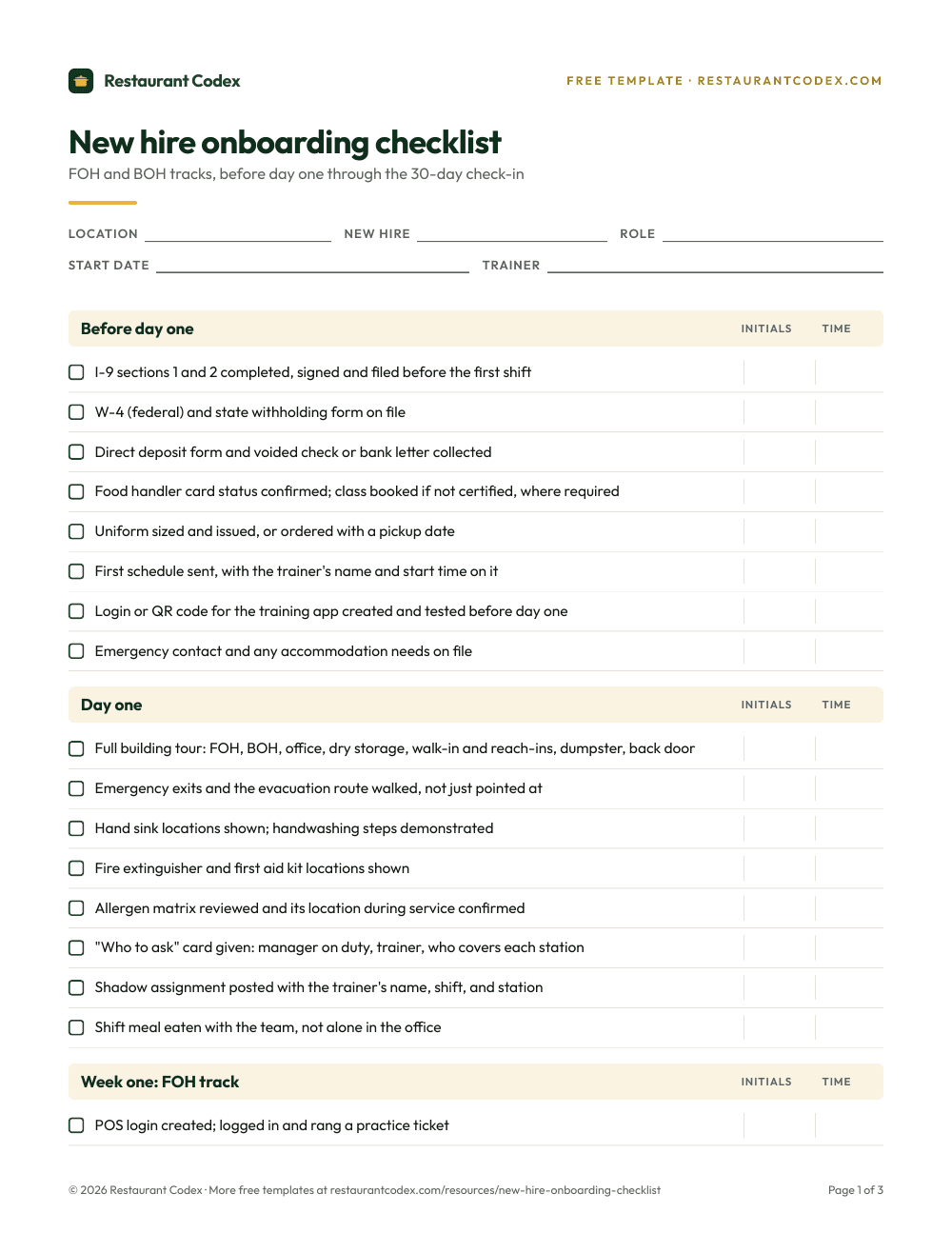
Restaurant Codex runs this template as a live task with timestamps, photos and one view across every location. Bring it to a 30-minute working session and we'll set it up on your real operation.
By the Restaurant Codex team
Written with operators who run multi-location restaurant groups. Reviewed against the FDA Food Code and the sources listed below.