Who is SafetyCulture built for?
SafetyCulture is built for any organization that inspects things. Its home page names hospitality, construction, manufacturing and retail. The company started as SafetyDocs in 2004, introduced the iAuditor app in 2012 and, in August 2026, renamed itself Mitti. The old safetyculture.com address now redirects to mitti.com. Its about page claims 80,000 organizations and more than 2 million users, with customers in 190 countries, and its timeline names offices in Sydney, Kansas City, Manchester and Manila. A restaurant page sits under its hospitality section and names Snooze Eatery and THISBOWL, and the hospitality page names Sodexo and SSP. It's a general operations platform with a restaurant section, not a restaurant-only product.
Restaurant Codex is built for restaurant groups and priced per location, so a single-location owner gets the same product as a group. It runs the work on the shift (opening and closing lists with photo proof), the SOPs and recipes the team cooks from, training paths with a manager's sign-off, and inventory with food cost. Restaurant groups that run on Restaurant Codex include Mercado 24 in Guatemala City, where chef Pablo Díaz's kitchen is No. 42 on Latin America's 50 Best Restaurants 2025, Koli Cocina de Origen in Monterrey, which has held one MICHELIN Star since 2024, and Tapiz Bistro & Bakery in Mexico City. The awards belong to those restaurants, not to the software. See the customers page.
What does each platform actually do?
SafetyCulture covers inspections, training, issues, sensors, assets and documents for many industries. Restaurant Codex covers standards for restaurants: checklists, SOPs and recipes, training, inventory and food cost. Row by row, with SafetyCulture's side taken from Mitti's own site and help center in October 2026:
| SafetyCulture (Mitti) | Restaurant Codex | |
|---|---|---|
| Checklists and inspections | Drag-and-drop template editor; library of 9,000+ templates; AI turns a photo or PDF into a checklist; date, time, GPS and user on every record | Opening and closing lists, line checks, temperature logs, deep cleans and side work on schedule in each location's time zone; photo proof the app enforces |
| Scored audits | Weight per question for multiple choice, checkbox and slider answers, on any plan | No weighted scoring |
| Follow-up on failures | A failed check becomes an Action with photo proof; issue reporting; task chats; agents that chase overdue actions (early access) | "Due soon" and "overdue" pushes to the assignee, then a "still not done" alert to managers about an hour late; no issue-reporting module listed |
| Temperatures and food safety | Kitchen inspection checklists; LoRaWAN sensors for temperature, humidity and door open/close, sold as hardware; alerts that can escalate if nobody responds | Temperature logs and food-safety lists on schedule with photo proof; no sensors |
| Assets and maintenance | Asset tracking and preventive maintenance | Not offered |
| Documents and SOPs | Documents with owners, expiry dates, tracked versions, digital signatures and a record of who acknowledged a file; AI Assistant answers from the files | Knowledge Base: SOPs, policies, house manual and recipes; Codex Bot answers staff from the group's own manual; no version history listed |
| Recipes | No recipe product listed | Plate and batch recipes with allergens, photos, yield and shelf life |
| Training | Basic on every plan; Premium adds recurring courses and a training matrix; 1,000+ free courses; AI builds a course from a file or prompt; narration and translation into 100+ languages; in-person assessments; credentials with expiry tracking | A learning path per role on day one, AI-drafted tests graded on the server, a manager's practical sign-off at the station, certificates, readiness by location, role and path |
| Inventory and food cost | Sensors on storage areas and a record of ingredient use, per its restaurant page; no invoice-to-food-cost product listed | Invoices read line by line with price increases flagged, blind counts, waste with a reason, buying list by supplier, food cost per location |
| Communication | Heads Up broadcasts to every site or a chosen group, showing who received a message | Copilot can send announcements; no team chat listed |
| AI | AI Assistant with monthly credits per seat | Codex Copilot answers and acts across modules and locations, with approvals and undo; Codex Bot for staff |
| Offline | Mobile app works offline for inspections, issues, actions, documents and training | Not described on the Restaurant Codex site |
| Security | ISO 27001:2022 and SOC 2 Type II; SSO on Premium, SCIM on Enterprise | SOC 2 aligned, on SOC 2 Type II certified hosts; roles Owner, Manager, Staff |
| Languages | App in 9 web and 16 mobile languages including Spanish (Mexico); templates in several languages only by uploading translations | App in English, Spanish (Latin America), Portuguese (Latin America), chosen per person |
| Pricing model | Free, Premium per seat, Enterprise custom; location-based pricing on request | Per location, quoted on a 30-minute call, no free tier |
Read the table by what's missing. A restaurant that runs only SafetyCulture has scored audits, sensors, asset upkeep and document control, and keeps recipes and food cost somewhere else. A restaurant that runs only Restaurant Codex has the standards, the training and the inventory in one place, and no way to weight a score, tag a freezer or open a maintenance schedule.
Where SafetyCulture is the better choice
SafetyCulture is the better choice when inspections are the core job. Each question can carry its own weight, so a missing handwash station can count for more than a dusty shelf, and scoring is available on every plan, including Free. Mitti says its library holds more than 9,000 customizable templates, and its AI Assistant can turn a photo or a PDF of your paper checklist into a digital one. Restaurant Codex has no weighted scoring.
It's the better choice if you want sensors and equipment upkeep in the same app as the checklists. Mitti sells LoRaWAN sensors for temperature, humidity and door open/close, and an alert can escalate automatically if nobody responds or raise an action with an owner and a due date. Asset tracking comes with preventive maintenance. Restaurant Codex logs temperatures by hand, with a photo and a timestamp, and has no asset module.
It's the better choice for document control. Documents lets you assign a named owner and an expiry date to each file, with reminders, tracks every version and access change, keeps digital signatures and shows who has acknowledged a file through a course or a signed Heads Up. The Restaurant Codex Knowledge Base shares SOPs and recipes with the right roles, but it doesn't list version history.
It's the better choice for training breadth. Basic training is on every plan, the library has 1,000+ free courses, AI turns a PDF, PowerPoint or Word file into a course, and any course can be narrated and translated into 100+ languages. Credentials carry expiry tracking, and the app also supports in-person assessments. Mitti's own FAQ is candid about the edge: it isn't meant to be a general corporate LMS, and SCORM files import as lesson slides rather than running natively.
It's also the better choice when a security review decides the deal, because Mitti lists ISO 27001:2022 and SOC 2 Type II, and the mobile app keeps working offline for inspections, issues, actions, documents and training. It also has a free plan, so a single kitchen can try it without paying.
Say a group wants freezer sensors, scored kitchen inspections and equipment upkeep in one tool. SafetyCulture lists all three. Restaurant Codex lists none of them.
Where Restaurant Codex is the better choice
Restaurant Codex is the better choice when the problem is that people don't know the standard, or food cost moves and nobody can say why. The Knowledge Base holds plate and batch recipes with allergens, photos, yield and shelf life, written once and shared with the roles that need them, and Codex Bot answers a staff question from the group's own manual and shows the entry it used. In SafetyCulture a recipe would live in Documents as a file, and no recipe product is listed on the pages we read. See Knowledge Base.
It's the better choice for food cost. Invoices are photographed and read line by line, price increases are flagged, duplicates are stopped, counts are blind, waste carries a reason and the buying list goes out by supplier through email, WhatsApp or print. SafetyCulture's restaurant page treats inventory as monitoring and a record of use. See Inventory.
It's the better choice for training tied to your own recipes. SafetyCulture can add an SOP to a course, and it also has in-person assessments, so the gap is narrower than it looks. What Restaurant Codex adds is that the learning path for a job role links the group's own manual entries and recipes, AI can draft tests from the manual for a manager to edit, and the manager signs off the skill at the station. See Training and LMS.
And it's the better choice when the price shouldn't grow with every part-timer. Each location includes 5 manager and admin seats and 50 staff seats. SafetyCulture's seat model is covered below, and a line cook who starts a daily opening list is the case to check.
Say a group changes a signature dish. The new recipe card, with its allergens, yield and shelf life, is written once in the Knowledge Base and shared with the roles that cook it, the line cook's path links to it, and a manager signs off the skill at the station. You can assemble a version of that in SafetyCulture from a file, a course and an assessment, but no recipe product is listed, and the pieces are yours to connect.
What does each platform cost?
SafetyCulture publishes its prices. As listed on Mitti's pricing page in October 2026, excluding taxes:
| Plan | Price listed | What it includes |
|---|---|---|
| Free | $0, up to 10 seats | 5 active inspection templates; basic analytics, training, tasks and issue reporting; up to 300 AI credits per seat per month |
| Premium | $24 per seat per month billed annually, $29 billed monthly | Unlimited templates, including multi-language; advanced analytics and training; permissions; integrations; SSO; automated maintenance; AI credits from 500 per seat |
| Enterprise | Custom | SCIM provisioning, enforced login controls, 24/7 priority support, integrations builder, sandbox; AI credits from 800 per seat |
Three details matter for a restaurant. First, seat types. Mitti's help center lists Full, Lite and Guest seats. A Lite seat can start 1 inspection a month (12 a year on annual billing), a Guest seat 3 for the life of the seat, and only a Full seat starts unlimited inspections. Ask how a daily opening list assigned to a line cook counts against the cap. Second, AI credits beyond the monthly allowance cost $0.01 each. Third, outside Australia and New Zealand, Mitti bills in U.S. dollars. Mitti also offers location-based pricing: one fixed price per site, everyone working there included. It isn't listed, so you get it by asking for a quote.
Say a four-location group has 8 managers and 40 line staff who all need to start daily checklists. If everyone needs a Full seat, that is 48 seats at $24, or $1,152 a month ($13,824 a year billed annually), before taxes, sensors and extra AI credits. Guest seats are free and the Lite price isn't on the pricing page, but their inspection caps make them a poor fit for daily lists. That is the case location-based pricing is for.
Restaurant Codex shows no number either. It's paid, priced per location and quoted on a 30-minute call, with no free tier. Each location includes Operations, Knowledge Base, Training and LMS, Inventory and Codex Copilot, 5 manager and admin seats and 50 staff app seats, and rollout runs through the 8-Week Implementation Program with weekly one-on-one meetings.
What changes across several locations
Past a few locations, how each product shows you the group matters more than any single feature. Mitti's hospitality page says head office can build custom dashboards in Analytics to see performance across every site, assign training by role or site, and let Agents (early access) chase overdue actions and send a morning briefing, with nothing moving without sign-off. That suits a company with regional managers who audit sites and want one place to see the results.
Restaurant Codex is built around a simpler picture. Every location starts on the same plan, the Knowledge Base is written once and shared with the roles or teams that need it, and owners compare locations side by side with a live activity feed. Copilot lets an owner ask across the group in plain words and act in the same conversation. If you run a deep hierarchy, ask the Codex team to show how access is scoped by brand and location. See multi-location restaurant software.
If the choice is really about audits and repairs, our comparison with Xenia covers a similar trade-off.
How to decide
Start with what you lose the most time on. If your area managers spend the week inspecting, scoring and chasing equipment, SafetyCulture is the stronger fit. If they spend it answering "how do we make this" and "was that person ever trained," and the food cost number surprises you every month, start with Restaurant Codex.
Then check the seats. For SafetyCulture, count every person who will start a checklist each day, and ask what the quote looks like per seat and per location. For Restaurant Codex, ask what you'd do for scored audits and equipment upkeep, and read our guide to restaurant operations audits to see how a weighted score works.
Last, ask each vendor for the same demo. For SafetyCulture, watch a failed walk-in temperature turn into an action with an owner, and see which seat type a line cook needs. For Restaurant Codex, watch a recipe change reach a line cook's phone and a new hire open their path on day one. Our guide to the software restaurants use covers the POS and scheduling tools that sit next to either product.
Restaurant Codex keeps checklists with photo proof, SOPs and recipes, training, inventory and food cost in one place, with one live view across every location. It does not score audits, run asset maintenance or read freezer sensors.
Restaurant Codex
The same checklist, on every phone, with photo proof
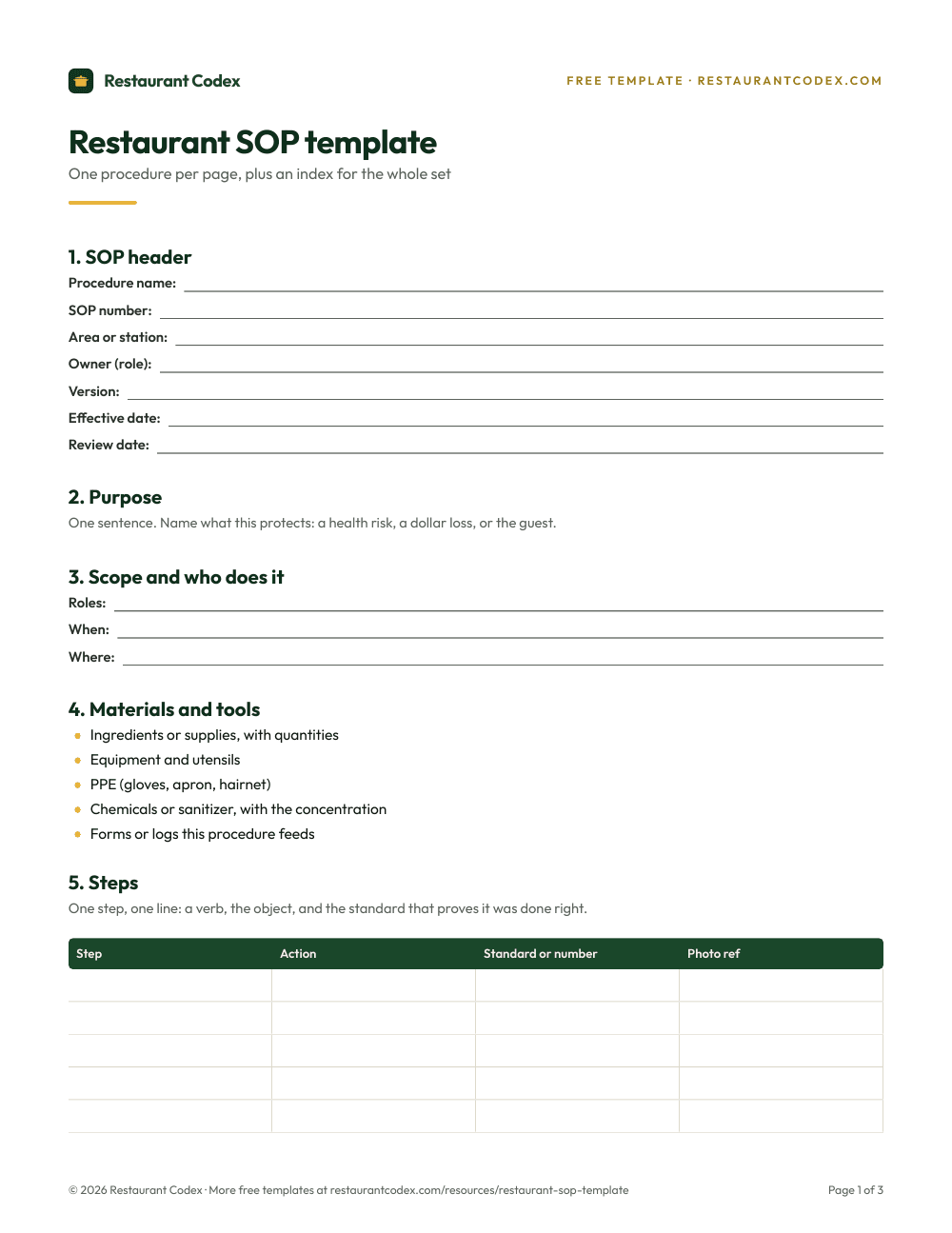
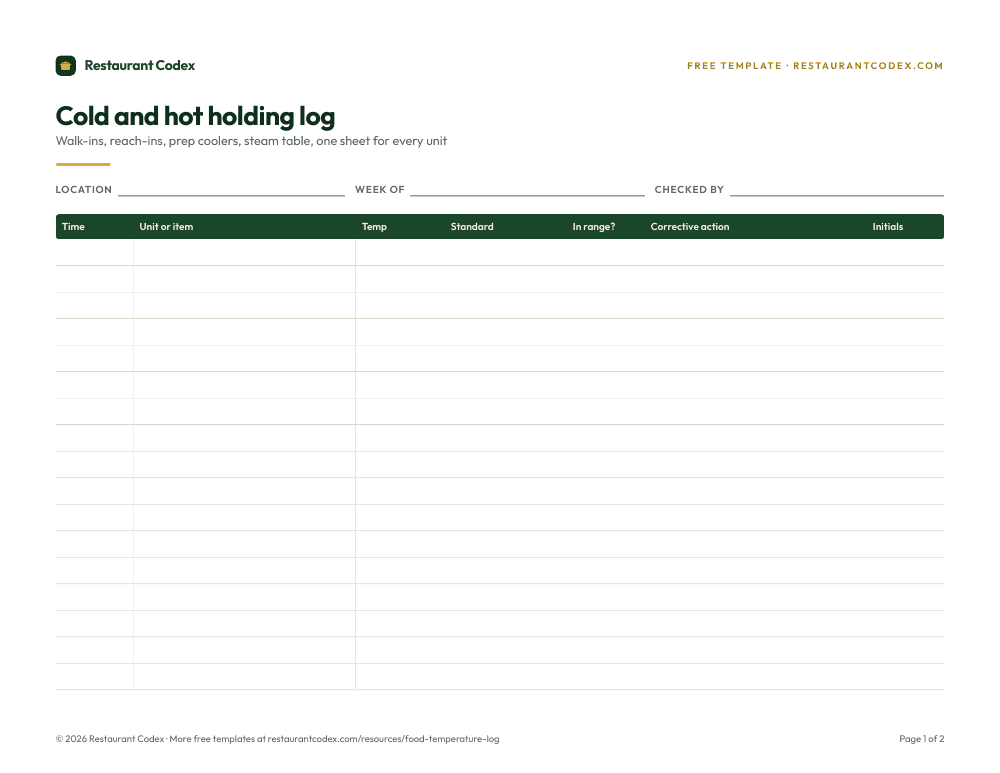
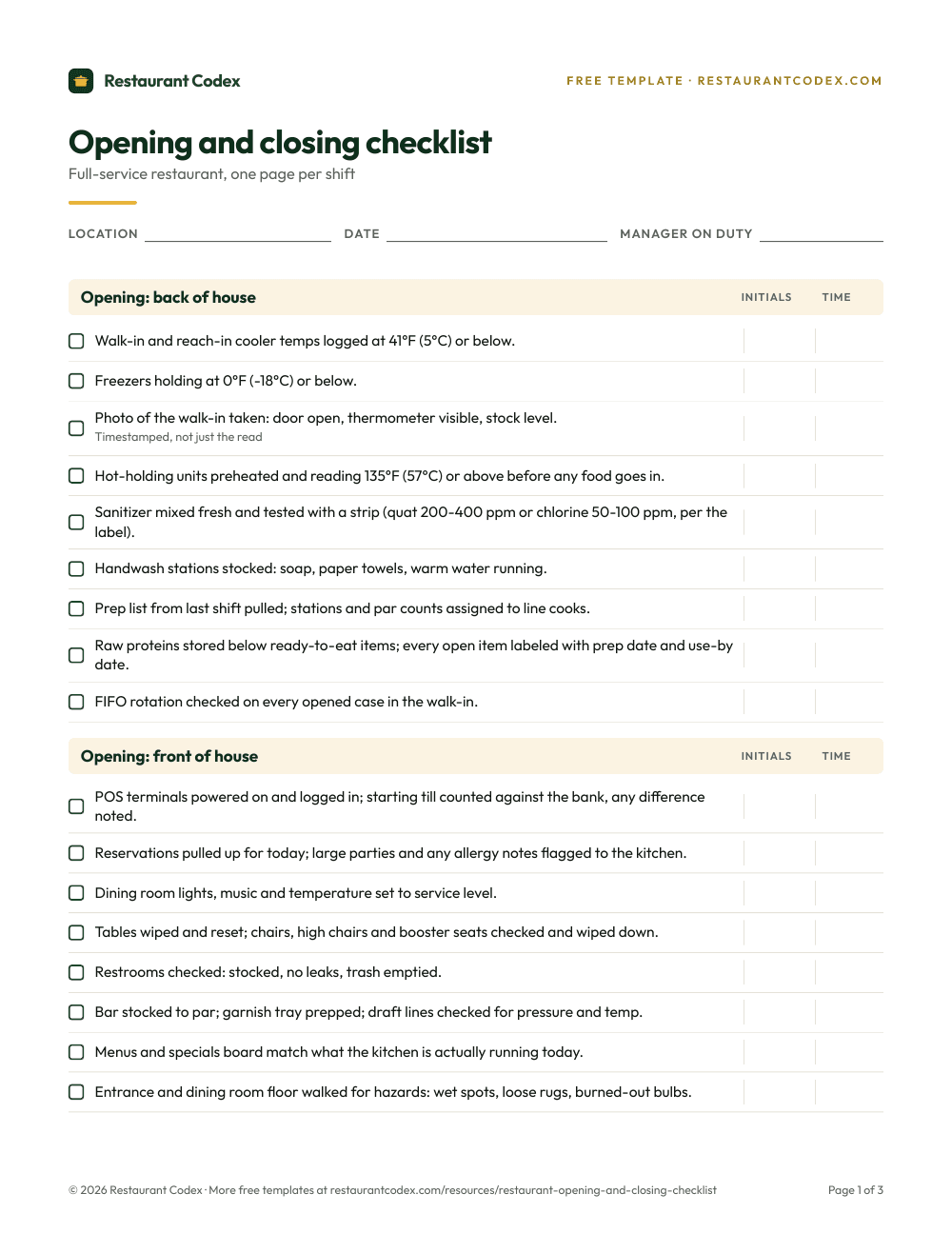
Restaurant Codex runs this template as a live task with timestamps, photos and one view across every location. Bring it to a 30-minute working session and we'll show you how it would run across your locations.
By the Restaurant Codex team
Written with operators who run multi-location restaurant groups. Reviewed against the FDA Food Code and the sources listed below.
Sources
- Mitti (by SafetyCulture), Pricing
- Mitti developer changelog, SafetyCulture is now Mitti
- Mitti (by SafetyCulture), About
- Mitti (by SafetyCulture), Restaurant Management
- Mitti (by SafetyCulture), Hospitality
- Mitti (by SafetyCulture), Inspections and Reports
- Mitti (by SafetyCulture), Training
- Mitti (by SafetyCulture), Documents
- Mitti (by SafetyCulture), Sensors and IoT
- Mitti (by SafetyCulture), Security
- Mitti Help Center, What are seat types in Mitti?
- Mitti Help Center, Set up scoring for questions
- Mitti Help Center, Change the language setting for my organization
- Mitti Help Center, Manage multi-language templates
- Mitti Help Center, Supported offline features and best practices