How do you train a new line cook?
You train a new line cook by teaching one task at a time in four steps: prepare them, show the task, have them do it while you correct, then check back after you step away. That is the Training Within Industry method, which the Lean Enterprise Institute says was developed during World War II so U.S. companies could train large numbers of new workers. Its four steps are prepare the worker, present the job, try out the job and follow up. The trainee sees the job, hears it described, tries it hands-on right away, describes it back and is supported until fully competent.
The trainer works from a job breakdown sheet with three columns: important steps, key points and reasons why. The same source says the information is shared with the worker a little at a time, at a pace that suits the person. That is the part kitchens usually skip. A cook who is only told the steps copies the motions. A cook who is told the key point and the reason can fix the dish when the pan is hotter than usual.
Here is the format for one task, sautéing a chicken breast. The content is our illustration of the format, not a standard recipe.
| Important step | Key point | Reason |
|---|---|---|
| Season and place in the hot pan | Pat the surface dry first | Moisture on the surface steams the chicken instead of browning it |
| Turn it once | Leave it until it releases from the pan | Moving it early tears the crust |
| Check the temperature | Probe the thickest part and read the number | Poultry is cooked to 165°F (74°C) per the USDA FSIS chart, so the number decides, not the color |
| Rest and plate | Plate against the photo on the card | The guest gets the same dish from every cook |
BLS describes the same order at the level of the whole job: trainees generally first learn kitchen basics and workplace safety, and then learn how to handle and cook food. So the first shift is not a station. It is where the knives, towels, sanitizer, thermometers and the walk-in live, and what the cook does when they cut themselves or cannot find something.
What does not work is the long trail. The cook follows someone busier for a week, nods, and then finds their name alone on the schedule. Nobody decided that was the moment. Under the four-step method the cook tries a real task on the first or second shift, with the trainer next to them.
Pick the trainer on purpose. The Lean Enterprise Institute says Job Instruction was built to teach supervisors and experienced workers how to teach. In a kitchen that means a cook who is signed off on the station and is not also holding the rush. Our staff training guide covers the wider training system around it.
What does a line cook need to know?
A line cook needs to know the temperatures, the station, the recipes, the cleaning routine and how to back up the cook next to them. ONET ranks the core tasks of a restaurant cook by importance, which gives a fair order to teach in. The scores below are from ONET's details page, out of 100.
| Core task, as O*NET words it | Score | What you teach |
|---|---|---|
| Ensure food is stored and cooked at correct temperature by regulating temperature of ovens, broilers, grills, and roasters | 94 | The station's equipment, the probe thermometer, cold holding at 41°F (5°C) or below, hot holding at 135°F (57°C) or above |
| Inspect and clean food preparation areas, such as equipment, work surfaces, and serving areas, to ensure safe and sanitary food-handling practices | 93 | Cleaning as you go, sanitizer, the end-of-shift breakdown |
| Portion, arrange, and garnish food, and serve food to waiters or patrons | 92 | Portion weights and the plating spec |
| Ensure freshness of food and ingredients by checking for quality, keeping track of old and new items, and rotating stock | 91 | Date labels, first in first out, how to read shelf life |
| Season and cook food according to recipes or personal judgment and experience | 91 | The recipe card |
| Weigh, measure, and mix ingredients according to recipes or personal judgment, using various kitchen utensils and equipment | 87 | Scales, scoops, measured portions |
| Substitute for or assist other cooks during emergencies or rush periods | 83 | A second station |
Read the fifth row closely. O*NET words the task as "recipes or personal judgment and experience". In many kitchens the judgment is what runs the line, and it is the reason two cooks plate the same dish differently. Teaching to a written spec is how you take that out, and the section on recipes below covers it.
The temperatures in the first row are the FDA Food Code numbers also used in our food safety compliance guide. A cook who knows 41°F and 135°F and checks them with a probe has the base of the job. Allergens are part of it too: a cook who cannot read a matrix row and clean a station before an allergy ticket should not be on the line alone. The allergen management guide covers that routine.
On the legal side, the Massachusetts allergen guidance, citing the Food Code's person-in-charge section (2-103.11), says the person in charge must ensure all employees are properly trained in food safety, including food allergy awareness, as it relates to their assigned duties. Local rules on top of that vary.
| Where | What it asks |
|---|---|
| California | For covered food handlers, a food handler card within 30 days after the date of hire, valid for three years. Since SB 476 (Chapter 610 of 2023) the employer pays the cost and counts the training time as hours worked, may not make an existing card a condition of hire, and must keep records that each food handler holds a valid card |
| Mexico | NOM-251, point 5.14.1: all staff in production areas are trained in good hygiene practices at least once a year. Its list of topics in 5.14.2 does not include allergens, so add them |
| Colombia | Resolution 2674 of 2013, article 12: a continuous training plan from the moment of hire, of at least 10 hours a year. Article 36 adds that handlers at restaurants must be trained in hygienic food handling |
| Elsewhere in the U.S. | BLS notes that many states do not require certification for cooks and some states and localities require a food handler's certification. Ask your local licensing board |
How do you handle station training and cross-training?
You teach the home station until a manager signs it off, then add exactly one second station. The reason is capacity: a cook who has not yet run one station alone does not have room to learn another, and both stay half-learned. A cook who holds a home station cleanly is ready for a neighbor station.
The order of the second station should follow the real call-outs. Pick the station you would actually move this person to on a night someone is out, which is the O*NET task of substituting for or assisting other cooks, scored 83. A kitchen where every cook has three half-known stations looks flexible on the schedule and falls apart on a Friday.
Use five levels, written on one sheet:
- 0: not trained on this station.
- 1: learning, with a trainer next to them.
- 2: working alone with spot checks.
- 3: signed off by a manager after watching a full service.
- 4: can teach it.
The rule is simple. Nobody works a station alone at a level below 3. Here is a worked example, with invented cooks and levels, for a four-station line:
| Cook | Grill | Sauté | Fry | Cold |
|---|---|---|---|---|
| A | 3 | 3 | 0 | 2 |
| B | 4 | 2 | 0 | 3 |
| C | 1 | 3 | 3 | 0 |
| D | 0 | 0 | 2 | 3 |
Read down the Fry column. Only C is at level 3. If C calls out on a Friday, fry has nobody who is signed off, and the manager is choosing between D at level 2 and a guess. The fix is the next training slot: A or B gets fry before anyone gets a third station. A matrix like this is a plain sheet, a few minutes to update after each sign-off, and it turns "who can cover" from memory into a list. Read across too: D is at level 3 on one station only, and that is where D should stay until fry is signed.
How do you teach recipes and plating to spec?
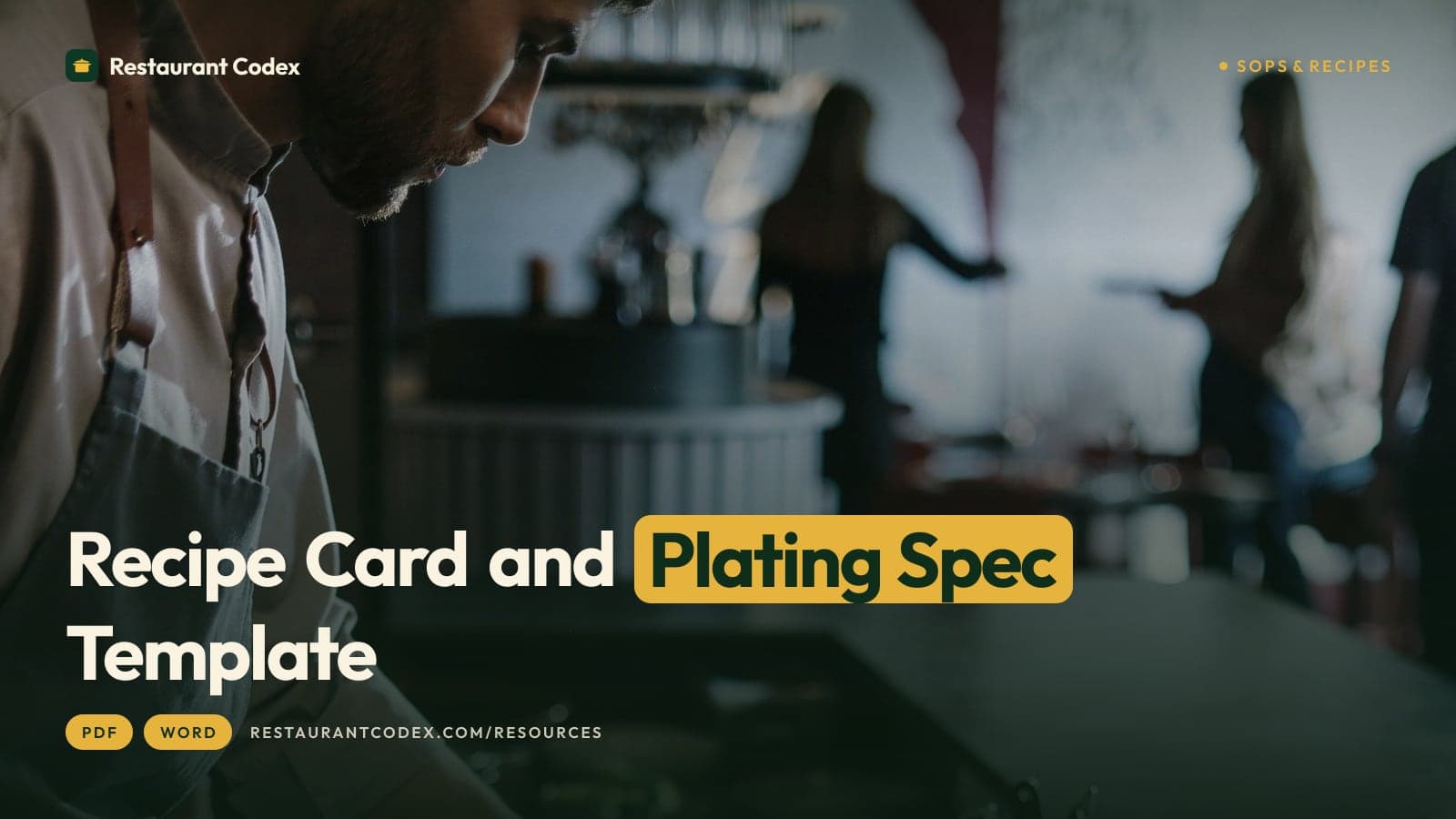
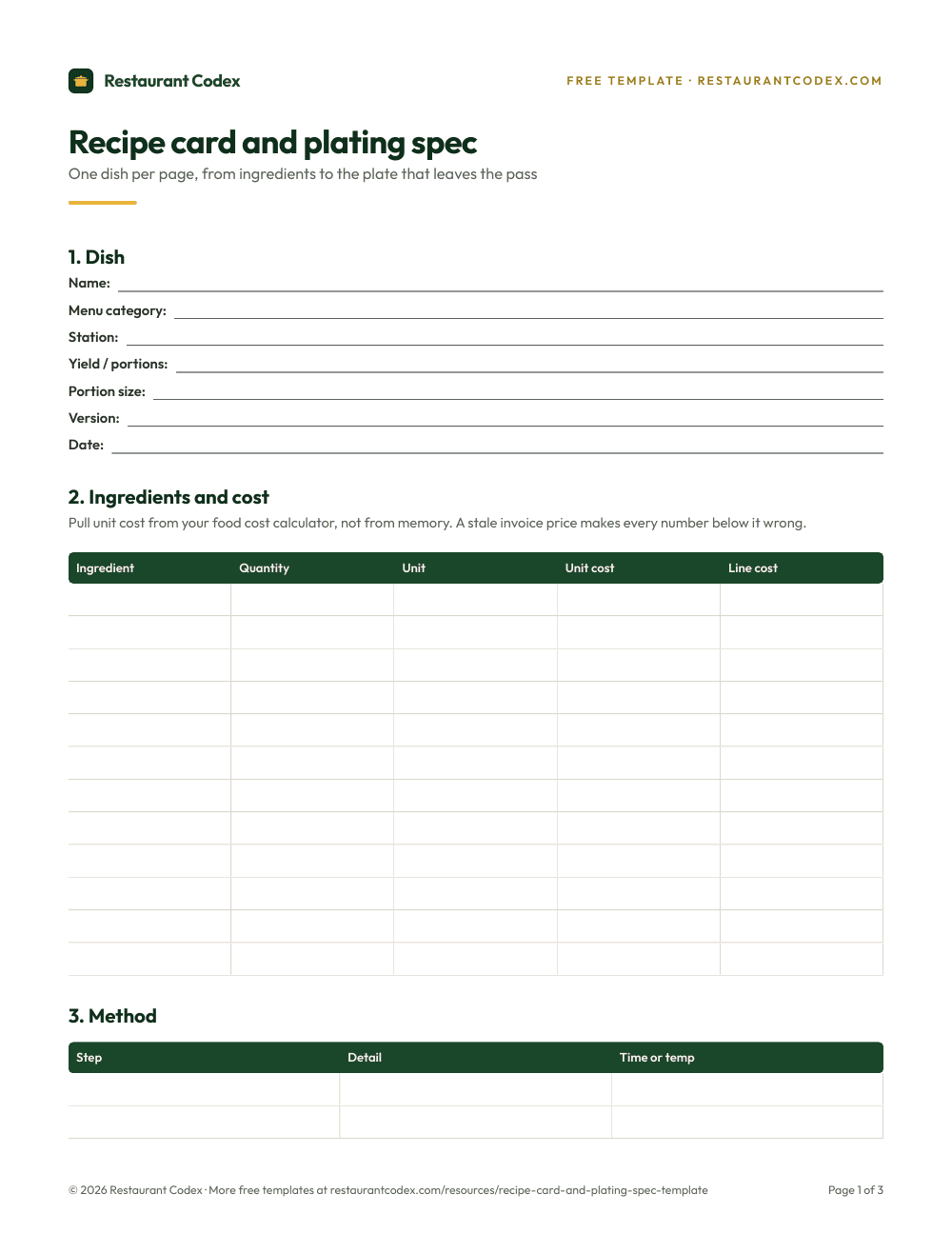
You teach recipes and plating by making the cook work from a written card with weights, method, hold times, allergens and a photo of the finished plate, and by comparing every plate to the photo at the pass. The card is what lets the dish come out the same from every cook. Our recipe card and plating spec template is one page per dish for this.
Teach each dish in four passes, which is the four-step method applied to a recipe:
- The trainer cooks the dish from the card, not from memory, and says the key points out loud.
- The cook cooks it while the trainer reads the card.
- The cook cooks it alone, and the trainer compares the plate to the photo and corrects on the spot.
- The cook cooks it again on a second shift before the dish counts as taught.
A written plating spec tells a cook where the sauce goes. A photo shows it. Take the photo at the pass, with the real plate and the real light, not a menu shot.
Pace is the part kitchens get wrong. As an illustration with our own numbers: a sauté station with 12 dishes and 4 batch sauces is 16 items. At two new items per shift, with the earlier ones repeated, that is about eight shifts to teach the station, and the cook is not fast yet. Teaching all 16 in one night teaches none of them. Set the pace per kitchen, and write down which items have been taught and which have passed the photo check.
Tapiz Bistro & Bakery in Mexico City, run by Alejandro Cebeira, has a useful data point here. Restaurant Codex's customer record lists 220 recipes in two weeks, with the operating knowledge structured so the team could work from the same standards. Getting recipes out of heads and onto cards is the step that comes before any trainee can be taught to a spec.
What does not work: teaching from the chef's memory, a photo that is not of the real plate, and changing a dish by telling the line without changing the card. The next cook is then trained to the old version. Our recipe management guide covers how to keep the cards and the kitchen in step.
How long does it take to train a line cook?
There is no single number. O*NET places restaurant cooks in a job zone where on-the-job training ranges from a few days to one year, and BLS says the length of training varies by type of cook and that apprenticeships run about a year. So the useful question is how long your station takes, and the answer is a set of dates, written on day one.
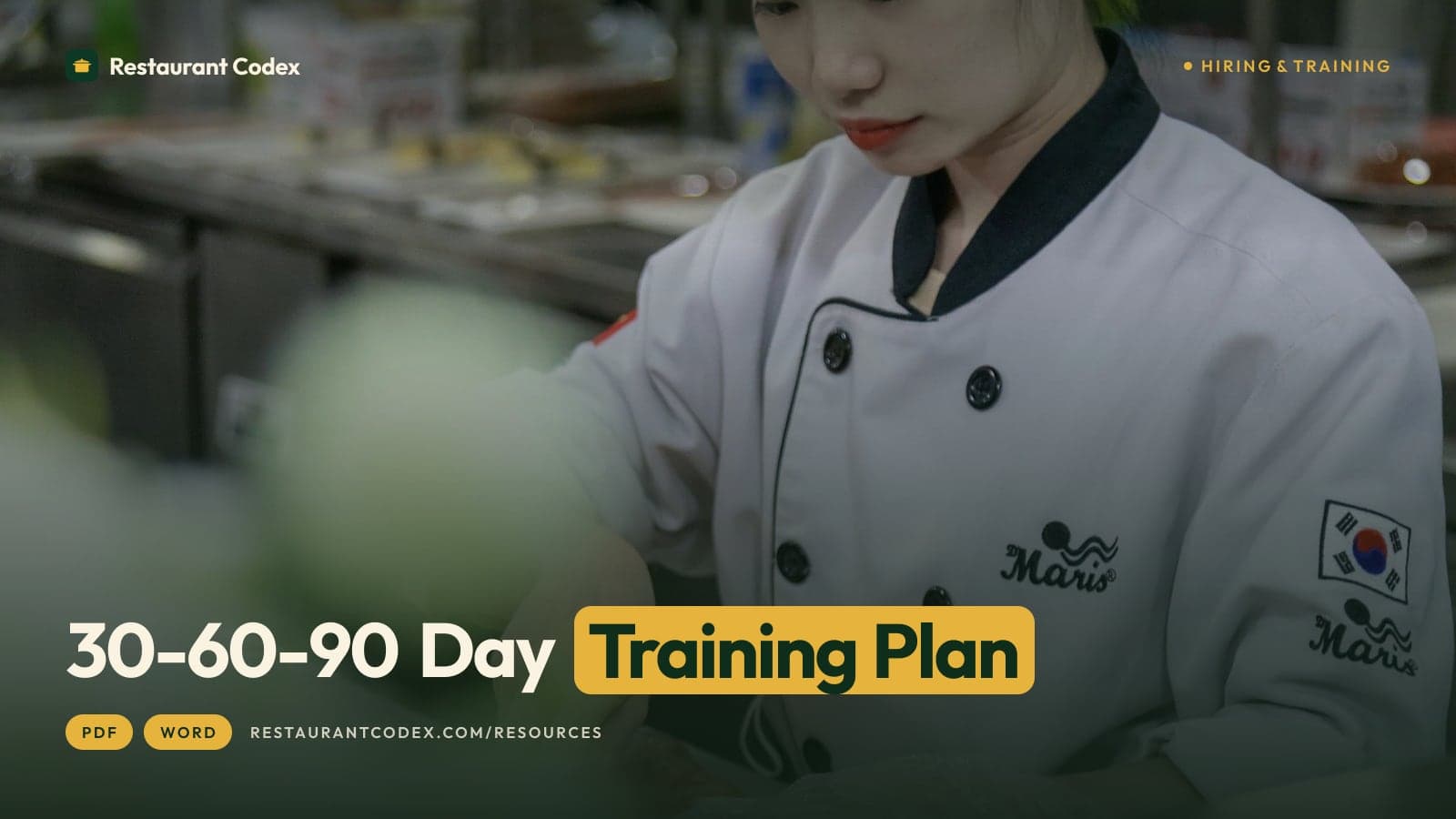
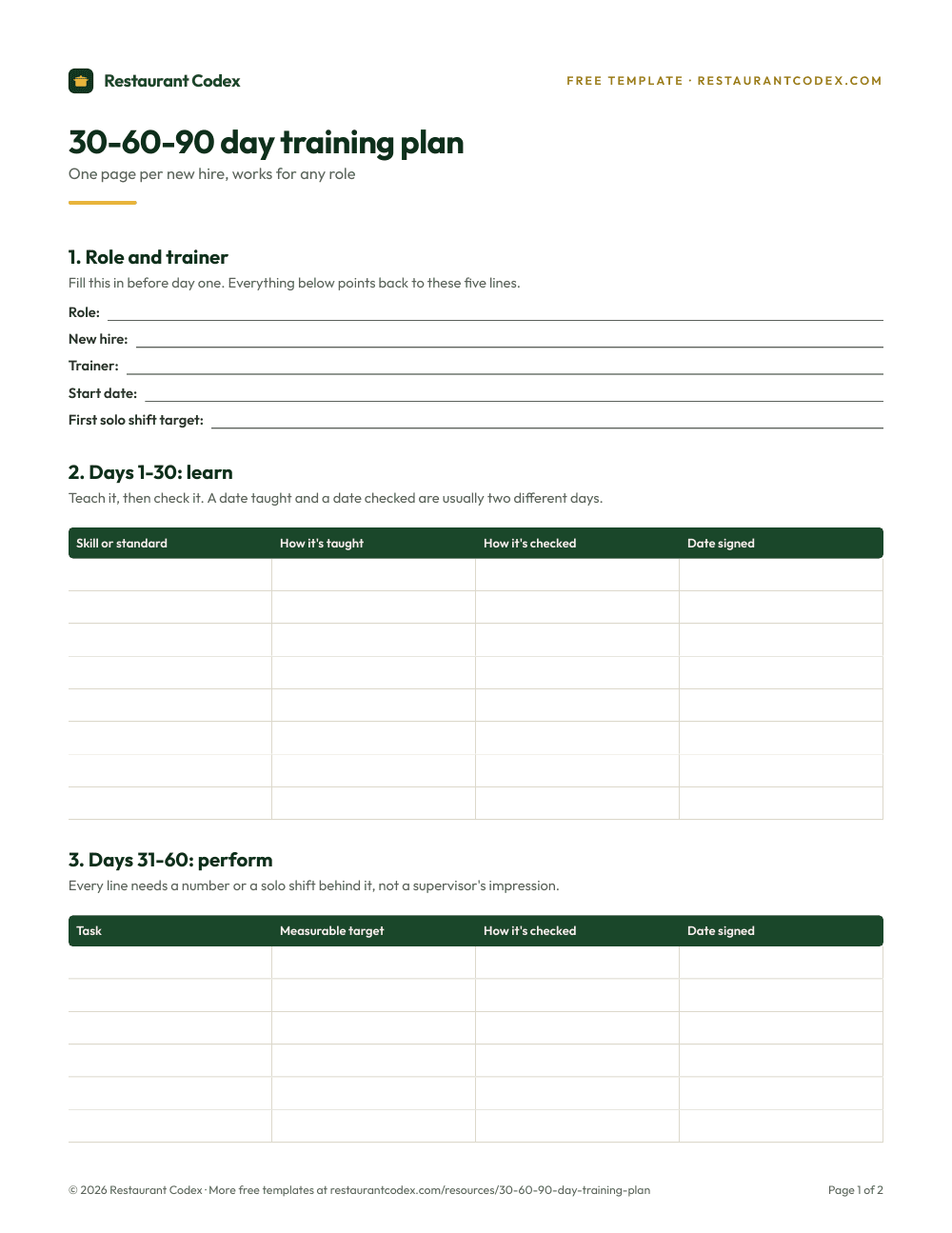
We use a 30-60-90 plan, the same one as our 30-60-90 training plan template:
| When | Goal | The check |
|---|---|---|
| Days 1 to 30 | Learn: kitchen basics and safety first, then the home station's recipes taught to spec | A practical walkthrough where the cook does the task while the trainer watches and initials it |
| Days 31 to 60 | Perform: runs the home station through a full service without the trainer finishing plates | Ticket times and plate-to-photo checks at the pass |
| Days 61 to 90 | Own: signed off on the home station, one second station started, and teaches one task to a newer cook | The manager's sign-off |
Write the date of the first solo shift on the sheet before day one. Without a date, "we'll see how it goes" becomes the plan, and the cook ends up alone on the schedule because it was the next open slot.
The sign-off sets the real speed, not the calendar. A cook with five years on a line may clear day 30 in a week. A cook new to the trade may need the 60-day mark extended. If a check is missed, write what changes in the next 30 days rather than letting the plan lapse. Our onboarding and turnover guide covers the first 90 days for the whole team.
How do you sign off a cook as ready?
A manager signs a cook off by watching them run the station through a full service and checking what they see against a written list. A quiz is not a sign-off. "Can recite the allergen list" and "handled a real allergy ticket correctly without being prompted" are different claims, and only the second one earns a signature.
Our sign-off list for one station:
- Mise en place is done to the card before service starts.
- Every dish in the service is plated to the photo.
- Probe temperatures are taken and logged where the station needs them.
- An allergy ticket is handled the whole way: the matrix row read, the station cleaned, separate tools used.
- The station is kept clean during service and broken down to the cleaning list afterward.
- The cook asks for help before the tickets stack.
Record the station, the date, the service watched, the manager's name and the cook's name. Keep it where the next manager can find it. California makes a version of this a legal duty for food handler cards: a covered facility must keep records that each food handler holds a valid card and provide them to the local enforcement officer on request.
What does not work: a sign-off by the trainer who needs the cook on the line, a single signature on day 90 for everything, and a pass based on how the night felt. If you cannot name the service the manager watched, the sign-off did not happen.
Where Restaurant Codex fits
Restaurant Codex keeps the cards, the training path and the sign-off in one place. It does not teach anyone to cook; the trainer does. In the Knowledge Base, plate recipes and batch recipes carry allergens, photos, yield and shelf life, and PDFs and recipe photos import with their structure kept. Codex Bot answers a cook's question from the group's own manual and recipes, shows the entry it used and never changes records.
In Training and LMS, every job role gets a learning path in the staff app on day one, with short videos, PDFs, linked manual entries and recipes. Tests can be drafted by AI from the manual and edited by a manager, and are graded on the server. A manager gives the practical sign-off at the station, and certificates and readiness by location, role and path show who is cleared where. In Operations, line checks and temperature logs can require photo proof that the app enforces. The app is available in English, Spanish (Latin America) and Portuguese (Latin America).
Restaurant Codex
The same checklist, on every phone, with photo proof
Restaurant Codex runs this template as a live task with timestamps, photos and one view across every location. Bring it to a 30-minute working session and we'll show you how it would run across your locations.
By the Restaurant Codex team
Written with operators who run multi-location restaurant groups. Reviewed against the FDA Food Code and the sources listed below.
Sources
- BLS, Occupational Outlook Handbook, Cooks (How to Become a Cook)
- O*NET OnLine, Cooks, Restaurant (35-2014.00), Job Zone and Training
- O*NET OnLine, Cooks, Restaurant (35-2014.00), Details: tasks and importance scores
- Lean Enterprise Institute, Training Within Industry (TWI)
- USDA FSIS, Safe Minimum Internal Temperature Chart
- FDA Food Code 2026 (cold holding, hot holding, two-stage cooling, reheating to 165°F)
- Massachusetts DPH, Retail Food Code Standards for Allergen Awareness (updated September 11, 2024)
- California Legislature, SB 476 (2023, Chapter 610), amends Health and Safety Code 113948
- Diario Oficial de la Federación, NOM-251-SSA1-2009, Prácticas de higiene para el proceso de alimentos, bebidas o suplementos alimenticios (March 1, 2010)
- Ministerio de Salud y Protección Social de Colombia, Resolución 2674 de 2013