What is a restaurant mystery shopper?
A restaurant mystery shopper is a trained or briefed guest who visits like any other customer, orders and pays, and then reports on the visit against a written standard. The Mystery Shopping Providers Association (MSPA) defines mystery shopping as using people who act as potential or actual customers to experience and measure a service process, then report back "in a detailed and objective way." In a 1998 paper in Managing Service Quality, Alan Wilson describes it as a form of participant observation, and as a technique service organisations use to measure performance against pre-set quality standards.
The word "standard" matters. A shopper has nothing to measure against unless you've written down what a good visit looks like: greeted within a set time, a drink suggested, hot food served hot, the table checked after the food lands. If those standards don't exist yet, write them first; our guide to writing SOPs that get followed is the place to start.
There are three ways to run a program:
- An agency. It recruits and briefs the shopper, designs the scenario, collects the report and often reimburses the meal.
- A freelance or panel shopper you brief yourself. You skip the agency fee, but you build the form and check the reports yourself.
- A person from inside your group that the team at that location doesn't know. It costs the meal and some time, and it only works while the shopper stays unknown.
Two limits are worth knowing before you start. The MSPA describes mystery shopping as "above all a tool to assess the quality of service, organisation and management, rather than a market research technique," and says it has no universal minimum sample size that is representative of the whole. So a score built from three shops is an observation, not a statistic. And the MSPA says shoppers should fit the profile of the guests you normally get and shouldn't seem over-rehearsed, or staff may guess they aren't real customers.
What does a mystery shopper check?
A mystery shopper checks the parts of a visit a guest can see, hear and time. Coyle Hospitality, a restaurant mystery shopping provider, lists the areas its programs can evaluate: reservation and booking, greeting and seating, host performance, server engagement and menu knowledge, order accuracy, food and beverage presentation, timing and pacing, suggestive selling, table maintenance, manager presence, problem resolution, check presentation and payment, guest departure, brand standard compliance and overall satisfaction. It also sells narrower products, including focused shops built around 20 to 30 priority items and cash integrity shops.
Research points the same way. Bichler, Pikkemaat and Peters used an e-mystery guest approach, with 66 mystery guests making 247 visits, to test how reliability, attentiveness, responsiveness, atmosphere and food quality relate to revisit intention. In their 2021 study, food quality had the largest direct effect on revisit intention (β = 0.504), with attentiveness next (β = 0.213). That is one study, not a law, but it supports giving the plate and the attention at the table real weight on your form.
What a shopper can't see matters as much:
| A shopper can see | Only a walk-through finds |
|---|---|
| Greeting, seating and wait times | Walk-in and reach-in temperatures |
| Whether a server answers a menu question correctly | Whether the recipe file is followed on the line |
| Order accuracy and time to the table | Receiving, storage and labeling |
| Plate presentation and temperature as served | Cleaning logs and training records |
| Table and restroom condition at that moment | Maintenance and equipment |
| Whether the bill and the receipt are right | Voids, comps and drawer counts (a shop only sees the guest end) |
The right column is the job of an operations audit. The cash line is covered in our guide to theft and cash control.
How much does mystery shopping cost?
Published restaurant prices run from $35 to $120 per shop, plus the meal. T-ROC's 2026 pricing guide puts a standard restaurant or quick-service shop with a meal evaluation at $75 to $120 per shop, plus meal reimbursement, and a regional pilot of 200 to 500 shops at $25,000 to $75,000 a year. Coyle Hospitality lists its full restaurant and bar evaluation from $75 USD per audit, focused evaluations and fast casual shops from $35, and cash integrity shops from $95.
These are two providers' own price pages, in US dollars, not a survey, and "starting at" is a floor. T-ROC says price moves with shop complexity, photo and audio documentation, shopper certification, reporting depth and turnaround speed, and that per-shop prices fall with scale and longer commitments.
Here's a made-up example for a group of eight locations, shopping each one four times a year:
| Item | Math | Result |
|---|---|---|
| Shops per year | 8 locations x 4 | 32 |
| Provider fee at $75 to $120 | 32 x $75, 32 x $120 | $2,400 to $3,840 |
| Meals, assuming $40 each | 32 x $40 | $1,280 |
| Total per year | $3,680 to $5,120 | |
| Per location | Total divided by 8 | $460 to $640 |
The meal figure is our assumption; use your own average check. A 200-shop regional pilot is built for a much larger footprint than this, so ask each provider for a per-shop quote at your volume. Running it in-house costs the same meals and some manager time, but you give up the anonymity and the consistency a provider's panel gives you.
How do you build a mystery shopper form?
You build the form around the visit in order, from arrival to exit, and ask questions a stranger can answer with a fact. The MSPA guidelines say the questionnaire should focus on objective questions, with the majority gathering factual information, and that the aim is to document what happened at the point of contact, not how the shopper feels. A few subjective ratings, such as overall satisfaction, can help interpret the results, but they should be clearly defined and kept few.
The guidelines also ask that the scenario be relevant, credible, ethical, practical, safe for the shopper and objective. In practice that means a simple visit, with one or two planned moments, and a shopper who doesn't sound rehearsed. Coyle's focused shops measure 20 to 30 items, which is a useful ceiling: past that, the shopper is filling in a form instead of eating dinner.
A made-up starting form, to be tuned to your own standards:
| Moment | Question | Answer |
|---|---|---|
| Arrival | Minutes from walking in to being greeted | Number |
| Arrival | Minutes from greeting to being seated | Number |
| Order | Shopper asked what's in a named dish; the answer matched your recipe file | Yes or no, plus the question |
| Order | A drink or a dessert was suggested | Yes or no |
| Food | Minutes from order to first plate | Number |
| Food | Everything ordered arrived, and was correct | Yes or no, plus what was wrong |
| Food | Hot food arrived hot and cold food arrived cold | Yes or no, plus the dish |
| Food | The plate matched the photo in your spec | Yes or no, plus a photo |
| Service | Someone checked the table after the food arrived | Yes or no |
| Planned moment | Shopper asked for one small missing item; minutes until it arrived | Number |
| Payment | The bill was correct, and a receipt was given | Yes or no for each, plus a photo of the receipt |
| Restroom | Clean and stocked at the time of the visit | Yes or no |
| Exit | Thanked on leaving | Yes or no |
| Overall | Impression of the visit, where 1 is "wouldn't come back" and 5 is "would recommend" | 1 to 5, plus one sentence |
Only the last row is a feeling, and it's defined. Have the shopper fill it in the same day, while the visit is fresh, and keep the answers as numbers and yes or no wherever you can so reports from different shoppers can be added up. We'd leave audio recording out and check local rules before any recording at all.
How is a mystery shopper different from an operations audit?
A mystery shopper sees the visit from the guest's seat and can't go behind the counter, while an operations audit is a walk of the whole location by someone who can open the cooler, the records and the cash. They answer different questions.
| Mystery shopper | Operations audit | |
|---|---|---|
| Who | A stranger posing as a guest | An owner or area manager |
| Sees | What a guest sees, hears and times | Kitchen, storage, records, cash, maintenance |
| Announced? | No, by design | Either, depending on the goal |
| Best at | Service, speed, accuracy, how the standard feels | Food safety, process, evidence, people records |
| Weak at | Anything behind the counter; small samples | Telling you how a guest experiences the visit |
| Risk | Reading a shopper's mood as a fact | Staff who tidy up for a visit they know about |
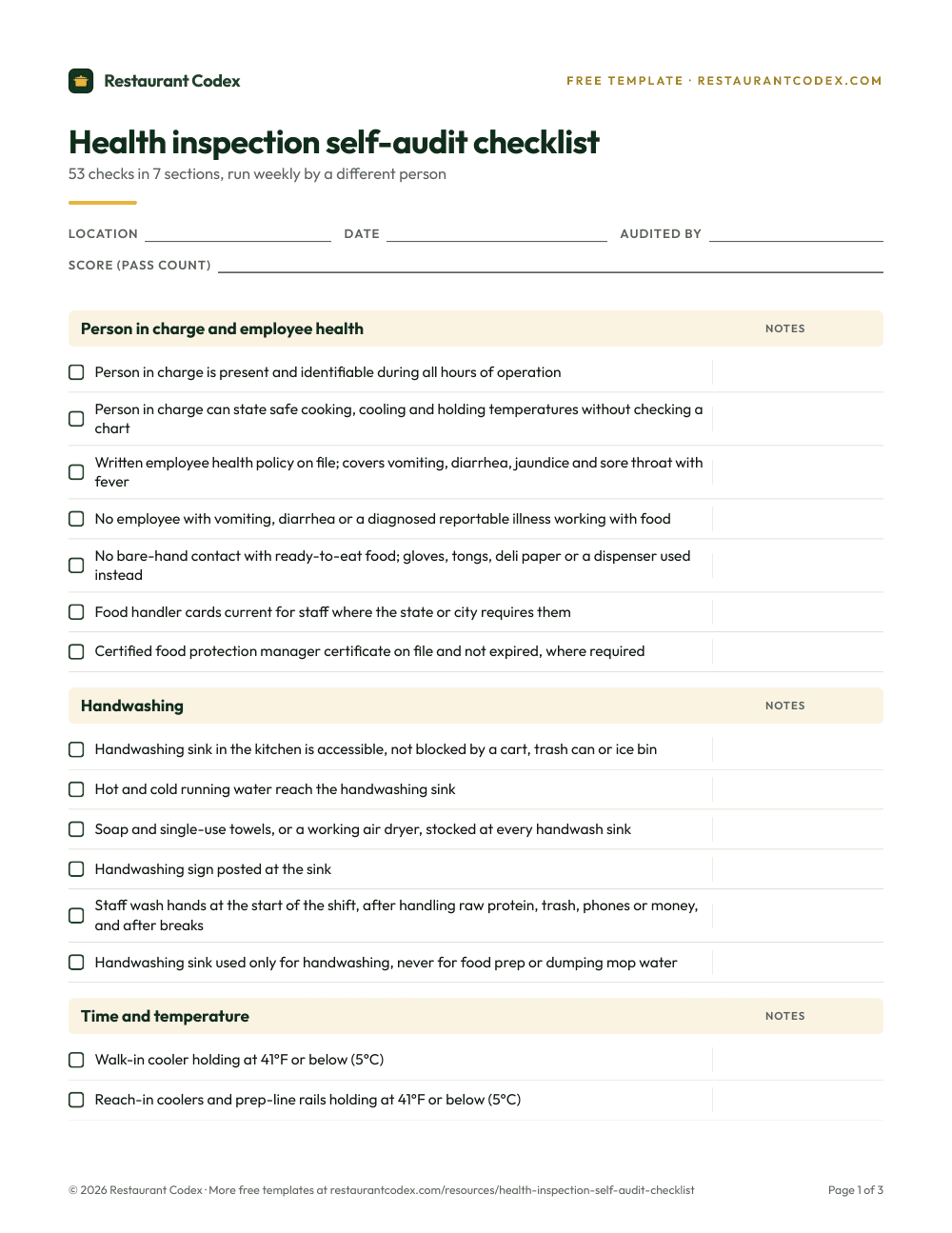
Use both. The shopper tells you what the guest got; the audit tells you why. Our operations audit guide covers the walk, the scoring and the follow-up, and the health inspection self-audit checklist is the food safety side.
Don't treat a shop score as the guest's voice, either. In a 2019 study using large-scale data from three service retail chains, Blessing and Natter found no substantial correlation between mystery shopper assessments and customer evaluations or sales, and concluded that shoppers "are not good proxies for real customers." The same study confirmed that customer satisfaction measures do relate to sales. It covered retail, not restaurants, but the lesson carries: set the shop score next to your reviews and complaints, and read the guest complaints guide for how to track those back to causes.
What do you do with mystery shopper results?
You read the report within days, look for the same miss across several shops, and turn each pattern into a fix with an owner and a re-check. Three habits keep that honest.
Check the report against facts. The receipt, the timestamps and the photos either support a line or they don't. Anything resting on the shopper's impression gets less weight.
Look for patterns before individuals. Here's a made-up result from 32 shops across eight locations, showing how often each moment met the standard:
| Moment | Standard met, out of 32 shops | Share |
|---|---|---|
| Greeted within the set time | 29 | 91% |
| Server answered a dish question correctly | 17 | 53% |
| A drink or dessert was suggested | 12 | 38% |
| Table checked after the food arrived | 11 | 34% |
| Bill correct | 32 | 100% |
A miss that shows up at every location, like the dish questions and the table checks here, is usually a standard nobody taught, so the fix is a shared one: update the recipe or SOP, retrain, and re-shop that moment. A miss concentrated in one location is a management conversation at that site. With four shops per location, use the table to decide where to look, not to rank the sites.
Use it to develop people, not to punish them. The MSPA guidelines say all staff must be told the organisation is mystery shopped, that bonuses tied to the program must be made clear, and that disciplinary action should not be taken solely on the basis of shop results. They say the aim is to raise service levels and develop staff through training and motivation. Share the pattern with the team, and start with retraining.
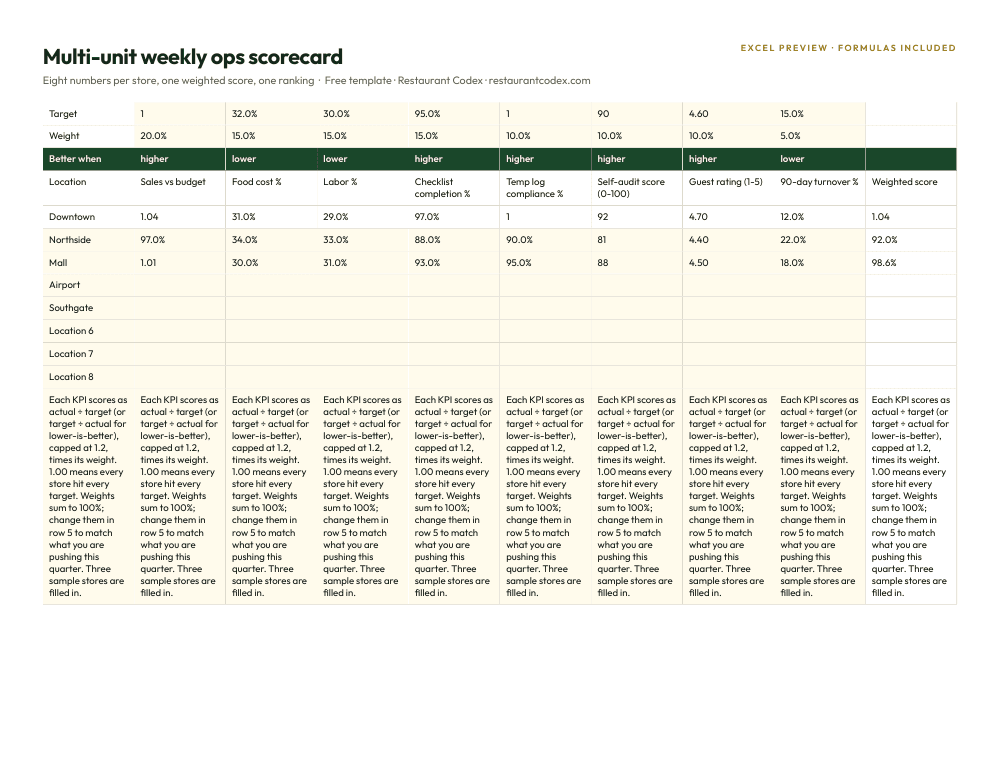
Then close the loop. Give every finding an owner and a date, and shop the same moment again within the quarter to see if it moved. The multi-unit weekly ops scorecard is a place to keep the shop results next to your other numbers by location.
Where Restaurant Codex fits
Restaurant Codex doesn't recruit shoppers, send them out or score their reports, and it isn't a survey or reviews tool. It holds the standard a shopper is measured against and the follow-up after a miss. In the Knowledge Base, SOPs and plate and batch recipes carry photos, allergens, yield and shelf life, so the spec the shopper checks against is the same page the cook uses. When a report shows a gap, Training assigns the path and records the manager's sign-off, and a list in Operations can check the same item every shift with photo proof, with due-soon, overdue and still-not-done alerts so it doesn't wait for the next visit. As an owner you see every location side by side, which is where a pattern across sites shows up first. Codex is priced per location and quoted on a call.
Restaurant Codex
The same checklist, on every phone, with photo proof
Restaurant Codex runs this template as a live task with timestamps, photos and one view across every location. Bring it to a 30-minute working session and we'll show you how it would run across your locations.
By the Restaurant Codex team
Written with operators who run multi-location restaurant groups. Reviewed against the FDA Food Code and the sources listed below.
Sources
- T-ROC, How Much Does Mystery Shopping Cost? 2026 Pricing Guide
- Coyle Hospitality Group, Restaurant Mystery Shopping & Secret Shopping
- Mystery Shopping Providers Association, Guidelines for Mystery Shopping (Global, updated August 2011)
- Alan Wilson, The role of mystery shopping in the measurement of service performance, Managing Service Quality 8(6), 1998
- Bichler, Pikkemaat and Peters, Exploring the role of service quality, atmosphere and food for revisits in restaurants by using a e-mystery guest approach, Journal of Hospitality and Tourism Insights 4(3), 2021
- Blessing and Natter, Do Mystery Shoppers Really Predict Customer Satisfaction and Sales Performance? Journal of Retailing 95(3), 2019