Who is MarketMan built for?
MarketMan is built for operators whose main pain is what comes in the back door and what it costs. Its pages describe one area in depth: counts, transfers, waste, purchase orders, invoice capture, recipe costing and the reports that compare what you should have used with what you did. It says restaurants of every type use it, including quick-service, full-service, cafes, bars and ghost kitchens, and that it is "designed to perform for single-location operators and large multi-unit chains alike." The company is part of Meal Ticket, a foodservice software group, and says more than 15,000 restaurants use it.
Restaurant Codex is built for the operation around the inventory. It runs opening and closing lists with photo proof, the SOPs and recipes the team works from, training paths and sign-offs, and an inventory module with food cost per location. It's priced per location, and inventory is one of its five modules, not the whole product.
Restaurant groups that run on Restaurant Codex include Mercado 24 in Guatemala City, where chef Pablo Díaz's kitchen is No. 42 on Latin America's 50 Best Restaurants 2025, Koli Cocina de Origen in Monterrey, which has held one MICHELIN Star since 2024, and Tapiz Bistro & Bakery in Mexico City. The awards belong to those restaurants, not to the software. See the customers page.
What does each platform actually do?
MarketMan goes deep on inventory and purchasing. Restaurant Codex goes wide across the operation and covers inventory in less depth. Row by row, with MarketMan's side taken from its own pages in October 2026:
| MarketMan | Restaurant Codex | |
|---|---|---|
| Counts | Counts and transfers on web and mobile (iOS and Android), daily, weekly or custom schedules, partial counts | Blind counts on the phone, with flags when stock doesn't add up |
| Invoices | Snap a photo or upload an invoice; OCR scans update items and quantities received; unlimited scans from Growth | Invoices photographed and read line by line, price increases flagged, duplicates stopped |
| Price tracking | Price tracking and alerts across vendors; credit memos for discrepancies | Price increases flagged on each invoice |
| Ordering | Purchase orders from par levels, "fill to par", Order By Recipe and Smart Ordering from Growth; PO approvals on web and mobile; vendor EDI (US, CA and UK only) | A buying list grouped by supplier, sent by email, WhatsApp or print; no EDI described |
| Waste | Waste tracking and variance reports | Waste logged with a reason |
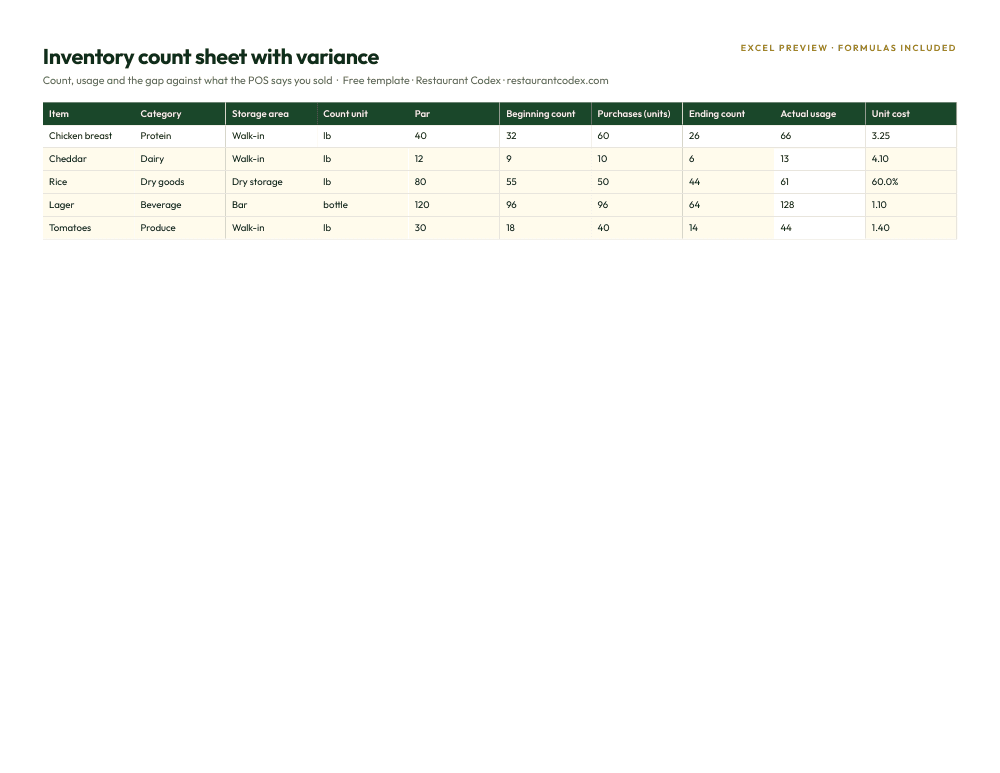
| Food cost | Real-time recipe costing, menu profitability, actual vs. theoretical against POS sell-through | Food cost per location with an all-locations roll-up; no POS feed or recipe mapping needed to start |
| Integrations | POS (Square, Toast, Lightspeed, Clover), accounting (QuickBooks, Xero), distributors; API by add-on or in Enterprise | Codex Copilot reaches accounting, POS, scheduling, HR, documents and email through MCP |
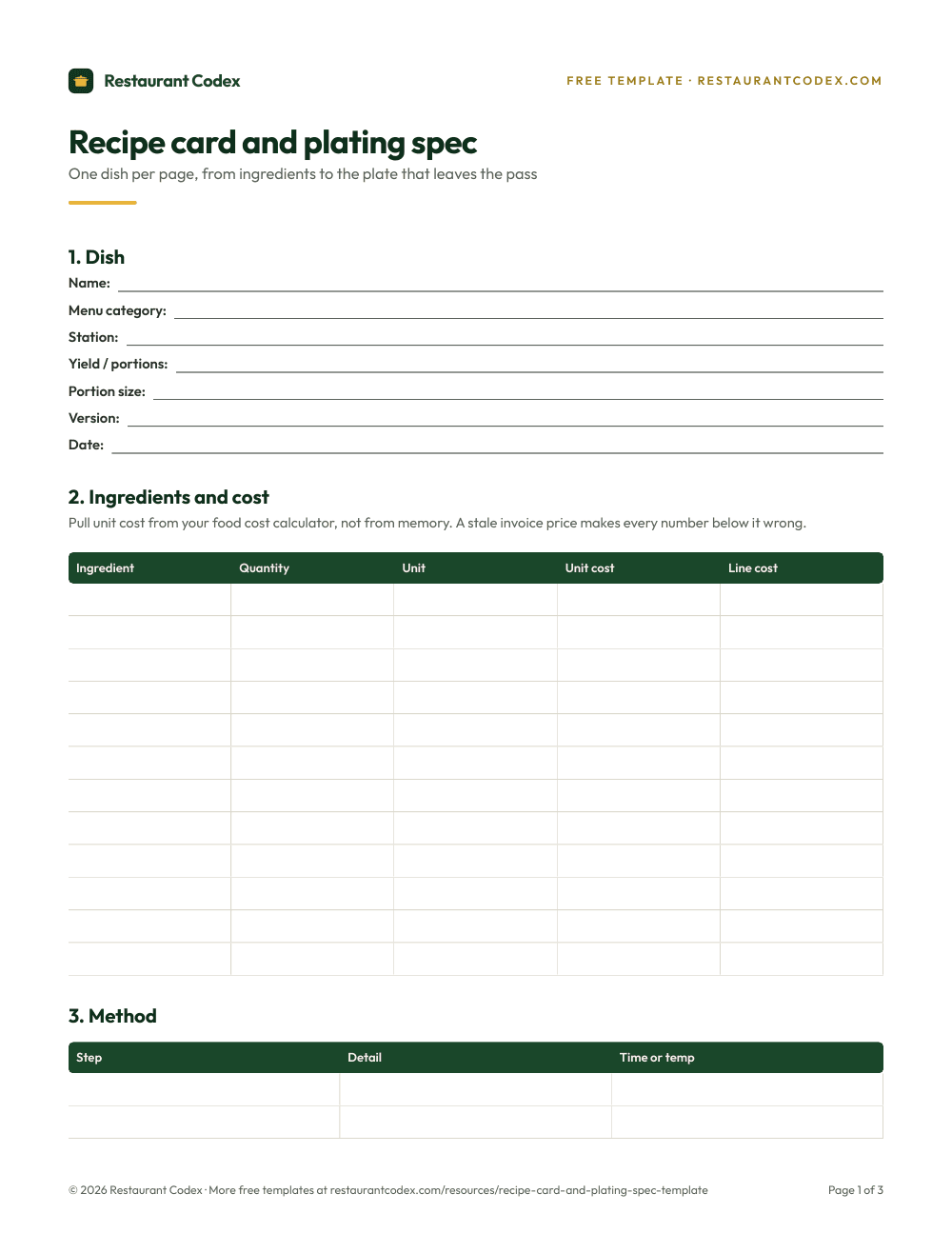
| Recipes | Digital Cookbook with ingredients, portions, allergens, cooking instructions and images | Recipes with allergens, photos, yield and shelf life, inside the Knowledge Base |
| SOPs and policies | Not described on the pages we read | Knowledge Base: SOPs, policies, the house manual; Codex Bot answers staff from it |
| Checklists and tasks | Not described on the pages we read | Lists on schedule in each location's time zone, photo proof, "due soon" and "overdue" pushes |
| Training | Professional training services on using MarketMan, included in support; no learning paths or tests for your staff described | A path per job role, tests graded on the server, practical sign-off, certificates, readiness by location, role and path |
| Commissary | Standalone and external modules, as add-ons | Not offered |
| Languages | Site in English with a Spanish version; app languages not stated | App in English, Spanish (Latin America) and Portuguese (Latin America), chosen per person |
| Pricing model | $249, $299 and from $449 a month; add-ons; custom quote | Per location, quoted on a 30-minute call; no free tier |
The overlap is real in the first half of the table and then it stops. Past the Digital Cookbook, MarketMan's pages are about buying and costing. Past inventory, Restaurant Codex's pages are about running the shift and teaching the standard.
Where MarketMan is the better choice
MarketMan is the better choice when purchasing is where the money leaks. It lets a manager order from many suppliers in one place, fill to par with one click, set purchasing budgets, price limits and permissions, and be alerted to shorts, subs, credits and billing irregularities. Restaurant Codex builds a buying list by supplier and sends it by email, WhatsApp or print, and doesn't describe anything past that.
It's the better choice when you want inventory tied to your POS and your books. Its integrations list Square, Toast, Lightspeed and Clover on the POS side and QuickBooks and Xero on accounting, and its actual vs. theoretical report compares counts with what the POS says you sold. Restaurant Codex says no POS feed is needed to start and ties daily sales to food cost, but it doesn't describe a POS-based theoretical usage report. If that report is your reason to buy, choose MarketMan.
It's the better choice for a commissary or central kitchen. MarketMan sells a commissary module for production, transfers and deliveries between units, and a separate one for a kitchen that sells to outside restaurants, caterers or ghost kitchens. Restaurant Codex has no commissary function.
It's the better choice if you want a price you can read before a call. MarketMan lists three plans and its add-ons. It also says multi-tier support comes with every plan, including a customer success manager, and that implementation takes two to four weeks for a single location. Restaurant Codex's rollout is an 8-Week Implementation Program.
Where Restaurant Codex is the better choice
Restaurant Codex is the better choice when the inventory problems start before the invoice. A cook who doesn't know the portion, a closer who skips the walk-in log, or a new hire who was never taught the receiving standard doesn't show up in a count until it's a variance. Restaurant Codex keeps the SOP, the recipe and the training path in the same system as the count. MarketMan's cookbook holds recipes, and its pages say it can be used to train kitchen staff, but they don't describe SOPs, policies or the house manual.
It's the better choice when you need proof that the work was done. Lists run on schedule, tasks can require a photo, the person gets a "due soon" and an "overdue" push, and a manager is told about an hour late. MarketMan's pages describe none of that, because it isn't what the product is for.
It's the better choice if your team needs training that is tested. Each job role gets a learning path in the staff app on day one, AI can draft tests from the manual that a manager edits, tests are graded on the server, a manager signs off the practical skill at the station, and readiness shows by location, role and path. See Training and LMS.
It's the better choice for a team that works in Spanish or Portuguese, and for a market where suppliers take orders by WhatsApp. The app runs in English, Spanish (Latin America) and Portuguese (Latin America), chosen per person, and the buying list goes to each supplier by email, WhatsApp or print. MarketMan's vendor EDI is limited to the US, Canada and the UK.
What does each platform cost?
MarketMan publishes prices and Restaurant Codex doesn't. On MarketMan's pricing page in October 2026:
| Plan | Price | Notable inclusions |
|---|---|---|
| Starter | $249 monthly | Real-time recipe costing, actual vs. theoretical, waste management, 1 vendor EDI integration, 50 AI-powered invoice scans a month |
| Growth | $299 monthly | Starter plus Smart Ordering, Order By Recipe, AI-assisted recipe optimization and suggestions, 2 EDI integrations, unlimited invoice scanning |
| Enterprise | From $449 | Growth plus email invoice scanning, advanced reports, unlimited EDI integrations, read-only API (5,000 calls a month) |
Add-ons sit on top. API access on Starter or Growth costs $25 a month for 1 to 3 locations, $59 for 4 to 9, $99 for 10 to 30 and $199 for 31 or more. Commissary is $499 a month standalone, or $749 for external unlimited. Advanced reports and email invoice scanning show up as add-ons for Starter and Growth. The page doesn't name a currency in its visible text, but its own markup lists USD.
The page doesn't say whether $249 covers one location or a group, and only the API add-on is priced by location count. For one restaurant that wants Order By Recipe and unlimited scanning, Growth is $299 a month, or $3,588 a year at the monthly rate, before add-ons. For a group, whether that number repeats for every location is the first thing to ask.
Restaurant Codex is paid, priced per location and quoted on a 30-minute call, with no free tier. Each location includes Operations, Knowledge Base, Training and LMS, Inventory, Codex Copilot, 5 manager and admin seats and 50 staff app seats, so a quote replaces the sum of several tools. Put both quotes next to what you spend now on inventory software, paper checklists and training time.
What changes across several locations
MarketMan's multi-unit pitch is control from headquarters. A corporate view rolls up results, pricing is set centrally, suppliers are authorized at the corporate level, locations can order only pre-approved items from selected vendors, and order approvals and alerts catch mistakes before a purchase order goes out. A central recipe library pushes updates to every location, and a side-by-side dashboard shows food cost percentage, waste rates, variance and purchase order activity by location.
Restaurant Codex's multi-location pitch is that every location runs the same system. Every location starts on the same plan, owners compare locations side by side with a live activity feed, food cost rolls up across all locations, and the same recipes, SOPs and training paths reach every site. Where MarketMan controls what each location can buy, Restaurant Codex shows whether each location is doing what the others do. See multi-location restaurant software and the restaurant food waste and inventory guide.
How to decide
Start with where the money goes. If it goes out through ordering, with price creep, over-ordering and no approval step, MarketMan is aimed straight at it. If it goes out through the kitchen, with portions that drift, recipes that live in someone's head and waste nobody logs, you need the standard written down and the staff tested on it, and inventory alone won't fix that.
Then check the market. MarketMan's pages are written for North America, the UK and Europe: vendor EDI covers the US, Canada and the UK, and phone lines go to North America, the UK and Germany. A group in Latin America that orders by WhatsApp and works in Spanish should ask MarketMan how that works in practice, and ask Restaurant Codex to show it.
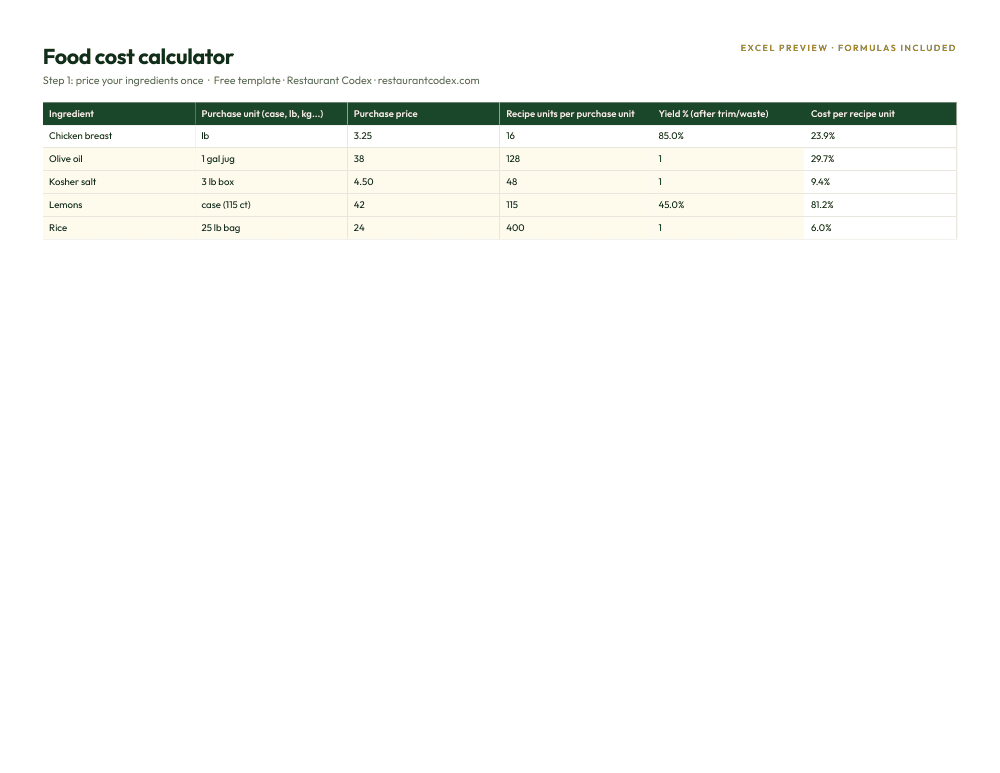
Last, ask both vendors for the same demo. For MarketMan, ask to see an invoice with a price increase come in and where the alert goes. For Restaurant Codex, ask to see the same invoice, and then a recipe change reach a line cook's phone. Whichever you pick, you'll be measuring food cost the same way, and the free calculator below shows the arithmetic.
Restaurant Codex
The same checklist, on every phone, with photo proof
Restaurant Codex runs this template as a live task with timestamps, photos and one view across every location. Bring it to a 30-minute working session and we'll show you how it would run across your locations.
By the Restaurant Codex team
Written with operators who run multi-location restaurant groups. Reviewed against the FDA Food Code and the sources listed below.