What is the Distintivo H?
The Distintivo H is a recognition that Mexico's tourism ministry (SECTUR) and health ministry give to fixed food and beverage establishments that meet the hygiene standards of the Mexican standard NMX-F-605-NORMEX-2018. SECTUR's page says the program began in 1990 to reduce foodborne illness among domestic and foreign tourists, and calls it "100% preventivo" (100% preventive). All quotes in this guide are translated from Spanish.
It is voluntary. No law or standard requires it to open or run a restaurant. What is mandatory is NOM-251-SSA1-2009, whose point 1.2 makes it binding on people who process food, beverages or food supplements for consumers in the country. For the H's own standard, the general rule is article 73 of the Ley de Infraestructura de la Calidad (Quality Infrastructure Law, published July 1, 2020): standards are voluntary, except in cases such as an authority or a public body requiring them (sections II and III) or a person declaring that their products or services conform to them (section IV).
That last exception matters to you. If you display the H without a valid one, you are declaring something that is not true. The declaration that put the standard in force is plain about it: the Distintivo is valid for one year, and if it is not renewed, the business holding it must take it out of the customer's sight.
A few facts about the standard itself. Mexico's Ministry of Economy, through its Dirección General de Normas, published the declaration that NMX-F-605-NORMEX-2018 is in force in the Diario Oficial de la Federación (DOF, the official gazette) on August 13, 2019. The Sociedad Mexicana de Normalización y Certificación (NORMEX) wrote and approved it, it cancels the 2015 version, and it applies to fixed establishments handling food and beverages in every phase: receiving, storage, preparation and service.
Who grants the Distintivo H and how do you get it?
SECTUR issues it, but you do not apply to SECTUR directly: you work with a Consultor H, and a verification unit checks the result. The Quintana Roo tourism ministry publishes the full process, and it agrees with SECTUR's federal page on the consultant, the standard, the checklist and the validity.
| Step | What happens | Who does it |
|---|---|---|
| 1. Hiring | You pick a Consultor H with a current SECTUR credential | You |
| 2. Diagnosis | Pre-audits to find critical points and gaps in receiving, storage, preparation and service | Consultant |
| 3. Training | A 10-hour course, "Manejo Higiénico de los Alimentos" (hygienic food handling), in class and on site, for operational staff and middle and senior managers | Consultant |
| 4. Implementation | The H Management System is applied using NMX-F-605-NORMEX-2018 and the checklist | Consultant and your team |
| 5. Validation | The consultant confirms you are ready to request verification | Consultant |
| 6. Verification | Final visit by a Unidad de Verificación (verification unit), which you hire as you need | Verification unit |
| 7. Issue | The unit reports the result to SECTUR and SECTUR issues the Distintivo | SECTUR |
Three roles, and they are worth keeping apart. NORMEX writes the standard. The consultant prepares you and charges for it. The verification unit, which the Quintana Roo page says is accredited by EMA-SECTUR, checks at the end. In the published process, the one who prepares you and the one who verifies you are separate.
What does the Distintivo H require from a restaurant?
It requires a 90% pass on a verification checklist and training for 80% of operational staff and 100% of middle and senior managers. Both numbers are SECTUR's. The checklist "se deberá cumplir en un 90% de satisfacción" (must be met at a 90% satisfaction level), and the program "contempla un programa de capacitación al 80% del personal operativo y al 100% del personal de mandos medios y altos" (includes training for 80% of operational staff and 100% of middle and senior managers).
The checklist covers 13 areas, which SECTUR lists as:
- Receiving food
- Storage
- Handling of chemicals
- Refrigeration and freezing
- Kitchen area
- Food preparation
- Service area
- Water and ice
- Employee restrooms
- Garbage handling
- Pest control
- Personnel
- Bar
The individual points within each area aren't listed here, because the full text of the standard isn't freely published. The declaration says it can be bought from NORMEX or consulted free at the Dirección General de Normas of the Ministry of Economy in Mexico City. If your consultant hands you a list of points, ask which part of the standard each one comes from.
Check eligibility before you pay. The Quintana Roo page asks for a legally constituted tourism company with at least two years of operations. The federal page does not mention the period, so confirm it with the consultant if your restaurant is new. If you run the restaurant through a Mexican subsidiary of a foreign company, also ask which legal entity has to hold the seal.
An example with invented numbers, to see how the 80% breaks. A restaurant has 30 operational staff and 4 managers. To comply it needs at least 24 trained operational staff (80% of 30) and all 4 managers. A year passes, 8 of the 24 trained people leave and 8 new hires arrive who nobody has trained. That is 16 of 30, or 53%, and you are 8 people short of the 80%.
How much does the Distintivo H cost and how long does it last?
It lasts one year and has no published federal fee: you agree the cost with the consultant. The one-year validity appears on SECTUR's page, on the Quintana Roo page, on Coahuila's procedure sheet and in the declaration that put the standard in force.
On cost, the only official number published is on Coahuila's state procedures portal: a fixed amount of $32,000.00 Mexican pesos, with the note "Pago directo al Consultor que elijan para coordinar su certificación" (paid directly to the consultant you choose to coordinate your certification) and the payment stage "conforme acuerdo con el consultor seleccionado" (as agreed with the selected consultant). SECTUR's page says nothing about cost. It is one state's figure, with no breakdown, and it does not say whether it includes the verification unit's visit. Use it as a reference point for asking for quotes, not as a price. Check the exchange rate yourself if you budget in dollars.
I also found no renewal price and no official timeline from hiring to issue. Ask the consultant for both in writing.
To see what changes with several locations, suppose the consultant charged $32,000 for each one, every year. That is an assumption for the math, not a published price.
| Locations | Yearly cost under the assumption |
|---|---|
| 1 | $32,000 |
| 3 | $96,000 |
| 5 | $160,000 |
| 12 | $384,000 |
With that in hand, the question you ask the consultant changes. It is no longer "how much is it?" but "how much per location, what does it include, and what discount is there if I certify several?"
How is the Distintivo H different from NOM-251?
NOM-251 is the mandatory health rule you must meet every day; the Distintivo H is a voluntary, third-party verification that lasts a year. They share a subject, hygienic food handling, and differ on almost everything else. One naming point helps: a "NOM" (Norma Oficial Mexicana) is an official, mandatory standard, while an "NMX" (Norma Mexicana) is a voluntary one.
| NOM-251-SSA1-2009 | Distintivo H (NMX-F-605-NORMEX-2018) | |
|---|---|---|
| Nature | Official Mexican standard, mandatory (point 1.2) | Mexican standard, voluntary |
| Who enforces or issues | Health ministry and state governments (point 11) | SECTUR and health ministry, with a consultant and a verification unit |
| Who it covers | Anyone who processes food for consumers in the country | Fixed food and beverage establishments that apply |
| How it is checked | Visit by the health authority | Outside verification that you hire |
| Duration | You meet it every day | One year |
| Training | At least once a year for all production staff (point 5.14.1) | 10-hour course; 80% of operational staff and 100% of managers |
| What it requires in writing | Daily free residual chlorine record (5.8.1) and a pest control certificate or record with a sanitary license number (5.10.11) | Checklist of 13 areas, to be met at 90% |
The practical consequence is a single one. Meeting NOM-251 does not give you the H, and holding the H does not excuse you from NOM-251, whose point 1.2 exempts no one for holding a seal. For a point-by-point view of what a health authority checks, read NOM-251 for restaurants in Mexico.
How do you keep the Distintivo H across several locations?
Treat it as an expiry date per location and a count of trained staff that moves every week. The official sources describe the process per establishment (the Quintana Roo page says "el establecimiento interesado", the interested establishment), so each location runs on its own year.
What works:
- A calendar of validity dates. A list with the issue and expiry date of each location, and an alert 90 days ahead. No official source details the renewal steps, so ask the consultant what they include and how long they take.
- A live training count. Who is trained, who joined afterward and who is missing, by location and by role. The 80% and the 100% are measured against today's roster, not the roster on the day of the training.
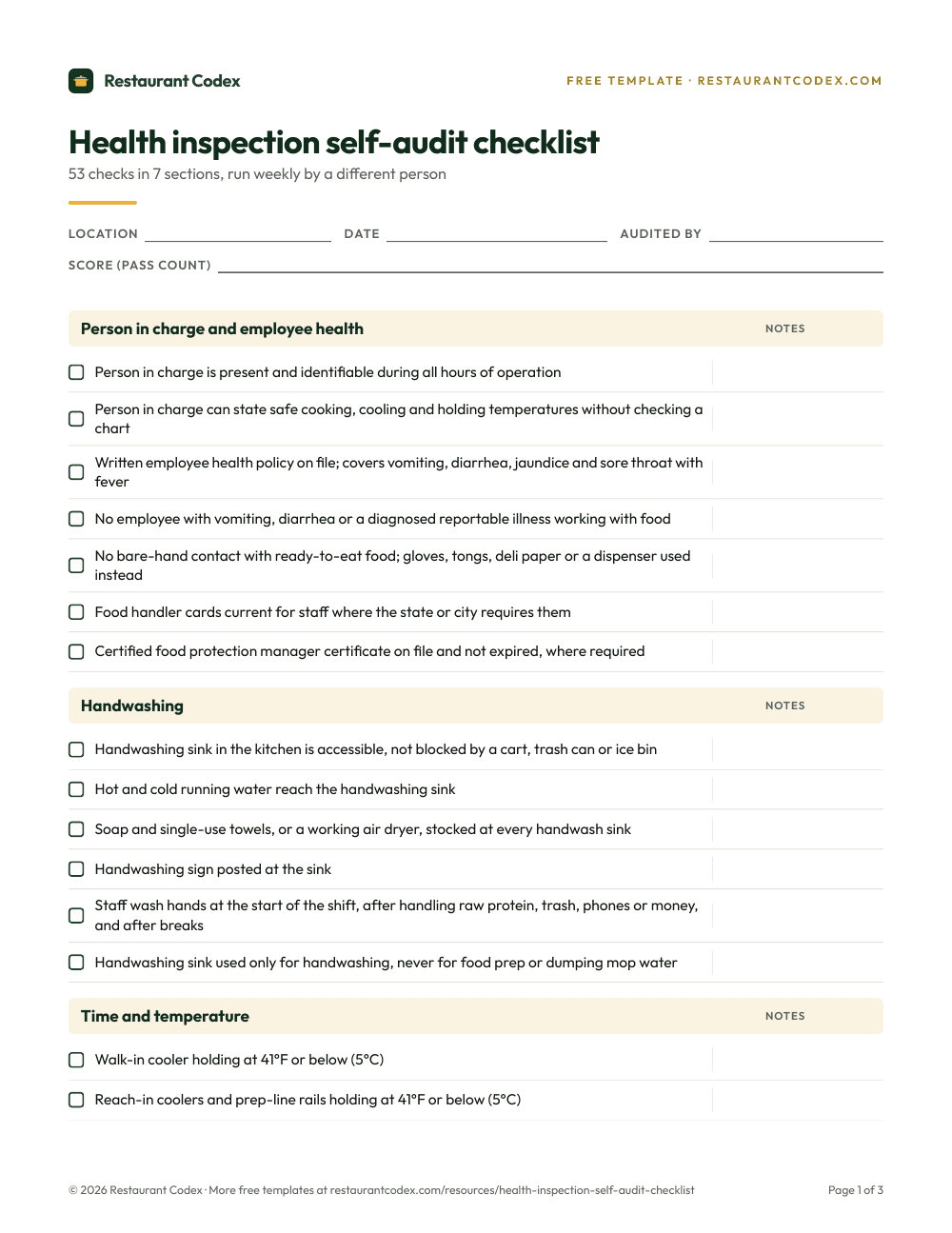
- An internal review of the 13 areas. Once a month, a manager from another location walks the areas with the self-audit checklist. Reaching 90% on verification day tells you nothing about the other 364 days.
- Daily records where NOM-251 asks for them. The temperature log and the cleaning schedule serve both the H and a health visit.
What does not work is the usual: preparing everyone for the verifier's visit and going back to routine afterward. With several locations, the standard wears down differently in each one, and the guide on consistency across locations explains why.
One practical question for the consultant is whether their credential lets them serve the locations in each state where you operate. In our analysis of Mexico's DENUE business registry, 73.3% of the groups with 2 to 15 locations operate in a single state (data), so one local consultant may be enough for many operators, but do not assume it.
Is the Distintivo H worth pursuing?
It depends on who is asking for it and on whether you already meet NOM-251 with daily evidence. The practical rule is the mandatory standard first and the seal second.
| Your situation | What I would do |
|---|---|
| A corporate client, a hotel or a tender requires it | Do it; it is their requirement, not the law's |
| You are in a tourist area and want a visible signal for visitors | Consider it, but only if you can renew it every year |
| You do not yet have temperature, chlorine and pest records up to date | Start with NOM-251 |
| Your restaurant opened less than two years ago | Ask the consultant whether they will take you; Quintana Roo asks for two years of operation |
| You have high turnover and nobody keeps the trained count | Fix that first; the example above shows how turnover breaks the 80% |
The verdict: if you can sustain it, the H gives you an outside check and a signal to the guest; if you cannot, do not leave it hanging expired, because the standard obliges you to take it down.
Where Restaurant Codex fits
Restaurant Codex does not certify you or replace the Consultor H or the verification unit; it does not issue the Distintivo and it is not a health authority. It is the place where you can keep the daily evidence and the count of trained people, which is what breaks between one verification and the next.
Concretely, you can write the procedures for each area once in the Knowledge Base and share them with the roles that use them. In Operations, opening and closing lists and temperature logs run at every location and can require photo proof. With Training and LMS, each role gets a path from day one, with a test and a manager's sign-off at the station, and you see who is certified and the readiness by location, role and path. That helps you track the 80% and the 100% without a separate spreadsheet. To see the whole system, read what Restaurant Codex is.
Restaurant Codex
The same checklist, on every phone, with photo proof
Restaurant Codex runs this template as a live task with timestamps, photos and one view across every location. Bring it to a 30-minute working session and we'll show you how it would run across your locations.
By the Restaurant Codex team
Written with operators who run multi-location restaurant groups. Reviewed against the FDA Food Code and the sources listed below.
Sources
- SECTUR, Estándar de Manejo Higiénico de los Alimentos, Distintivo H (gob.mx, page dated September 12, 2023)
- Secretaría de Turismo de Quintana Roo, Distintivo H: basic requirements, process and validity (published January 1, 2024)
- Diario Oficial de la Federación (August 13, 2019), Declaratoria de vigencia de la Norma Mexicana NMX-F-605-NORMEX-2018
- Diario Oficial de la Federación (March 1, 2010), NOM-251-SSA1-2009, hygiene practices for the processing of food, beverages and food supplements
- Gobierno de Coahuila, Trámites: Distintivo H (Higiene en Alimentos), cost and validity
- Diario Oficial de la Federación (July 1, 2020), Ley de Infraestructura de la Calidad, article 73