What permits do you need to open a restaurant in Colombia?
Before you open, Colombia's Police Code (Law 1801 of 2016, article 87) asks for three things: compliance with land-use rules, a current commercial registration from the chamber of commerce in your jurisdiction, and notice of the opening to the commander of the local police station. Health, safety, music and hours are enforced once you operate, and each comes from a different law.
Paragraph 2 of that article is the reassuring part: no authority may demand an additional license, permit or operating requirement unless the law provides for it. If someone asks you for a paper that isn't on this list, ask which law requires it.
| Requirement | Legal basis | Who issues it |
|---|---|---|
| Land use | Law 1801 of 2016, art. 87, num. 1 | Your municipality's planning office (confirm which one) |
| Commercial registration | Commercial Code, arts. 31 and 33; Law 1801, art. 87, num. 2 | Chamber of commerce |
| Opening notice | Law 1801, art. 87, num. 3 | Police station in your area |
| RUT and e-invoicing | Tax Code, arts. 555-2 and 616-1; DIAN Resolution 165 of 2023 | DIAN (the tax authority) |
| National consumption tax | Tax Code, arts. 512-1, 512-9 and 512-13 | DIAN |
| Health concept | Resolution 2674 of 2013, arts. 3 and 32 to 36 | Health authority |
| Fire department concept | Law 1575 of 2012, art. 42 | Your municipality's fire department |
| Music | Law 23 of 1982, arts. 158 and 159; Law 1801, art. 87 | Sayco and Acinpro (OSA) |
| Staff and social security | Substantive Labor Code; Law 1122 of 2007, art. 10 | You, as the employer |
There's no single window for all of it. In Bogotá, the Ventanilla Única Empresarial (VUE) publishes the fire department and Sayco and Acinpro procedures, and the Mayor's Office General Secretariat summarizes the article 87 requirements, including the notice letter to the police: two copies with the name, address, tax ID, commercial registration and details of the owner or legal representative, and a receipt that you keep.
How do you register a restaurant: chamber of commerce, RUT and electronic invoicing?
You register the establishment with the chamber of commerce, register as a taxpayer in the RUT at DIAN, and enable electronic invoicing. They go together in practice: in Bogotá, for example, the fire department asks for a copy of the RUT and the chamber of commerce certificate.
Commercial registration. The Commercial Code gives you one month from opening the establishment to register it (article 31) and requires renewal every year within the first three months (article 33). The Police Code is stricter, because it wants the registration current before you start operating. Meet the shorter deadline. The fee comes from Decree 1074 of 2015, as modified by Decree 045 of 2024, and depends on your assets. In Confecámaras' 2026 table, up to COP 78,715,000 in assets you pay COP 24,220 plus COP 8,477 for every million in assets, and the establishment pays separately COP 48,400 if it sits in the same jurisdiction as its owner's domicile, or COP 97,000 if it sits in another.
A hypothetical example: an owner with COP 60,000,000 in assets pays 24,220 + (8,477 × 60) = COP 532,840 for the registration, plus COP 48,400 for the establishment, for a total of COP 581,240. The RUES form costs COP 8,500 more. The yearly renewal uses the same tables.
RUT. It's the single mechanism DIAN uses to identify, locate and classify taxpayers (Tax Code, article 555-2). We didn't read the enrollment steps on DIAN's site, so we don't detail them here.
Electronic invoicing. VAT-responsible parties and consumption-tax-responsible parties must invoice (article 7 of Resolution 165 of 2023, per DIAN's Abecé); individuals who are responsible for neither are exempt (article 8). You can invoice through a technology provider, with your own software or with DIAN's free service, and in every case you need a digital signature certificate. A POS register can issue a ticket as long as the sale doesn't exceed 5 UVT, which at the 2026 UVT of COP 52,374 is COP 261,870 (our math), and if the customer asks for an invoice, you give one (Tax Code, article 616-1, paragraph 2).
Consumption tax. Restaurant service triggers the national consumption tax (article 512-1, numeral 3) at 8% on all consumption (article 512-9). It must be itemized on the ticket or invoice, and the voluntary tip stays out of the base. Individuals with gross income below 3,500 UVT the previous year and one establishment at most aren't responsible (article 512-13).
If the Ministry of Commerce classifies your restaurant as tourism-related, a parafiscal contribution of 1.5 per thousand of operating income is added (Law 2068 of 2020, article 36, paragraph 2). The law leaves the criteria to the ministry (article 37, paragraph 2), and we didn't check whether your location qualifies.
What is the health concept and what does Resolution 2674 of 2013 require?
The health concept is the verdict, favorable or unfavorable, that the health authority issues after inspecting your establishment (Resolution 2674 of 2013, article 3). For a restaurant, the inspection rests on the conditions in articles 32 to 36 and on what the rule asks of your food-handling staff.
What the resolution asks of a restaurant and its team:
- The premises (article 32). Areas separate from any dwelling and not used as a bedroom, enough drinking water, staff bathrooms separate from the preparation area, and a proper system for wastewater.
- Preparation (article 35). Perishables go in separate containers, refrigerated or frozen, and never mixed with prepared or ready-to-eat food. Staff directly involved in preparing or serving must not handle money at the same time (numeral 5).
- Staff (articles 11 and 12). A medical certificate of fitness to handle food, with a medical check at least once a year, and a continuous training plan from the moment of hiring, at least 10 hours a year.
- Responsibility (article 36). It falls on the owner, the management and the handlers. Paragraph 2 says the health authority will check training during its visits.
Three things the resolution doesn't say, and we haven't made up: what the concept costs, how long it takes and how long it lasts. Article 51 points to the Ministry of Health's inspection, oversight and control model, and article 52 applies the sanctions of Law 9 of 1979 through the procedure in Law 1437 of 2011. The resolution also doesn't say whether your municipality's authority issues the concept before you open or while you operate; ask your health secretariat on day one.
A practice the rule doesn't spell out: keep each handler's medical certificate and each training record at hand, printed or on a phone, because they're what the authority checks on a visit (articles 11 and 36, paragraph 2).
What do the fire department, land use and music license require?
The fire department reviews human safety and fire protection, land use is controlled by police inspectors, and music is authorized and paid to Sayco and Acinpro through the Organización Sayco Acinpro (OSA).
Fire department. Law 1575 of 2012 (article 42, with the text of Law 1796 of 2016) makes fire departments responsible for inspecting fire prevention and human safety in buildings, especially commercial establishments, and it includes the yearly inspection and testing of fire protection systems. In Bogotá, the VUE explains that the technical concept is valid for one year (article 213 of Resolution 661 of 2014) and that the police can ask for it. The system classifies your site by risk based on the year of construction, the area, the floors and other conditions: at low risk you do an online training and a self-review form, with random verification of 1% of applications; at moderate risk you may be notified of training or a visit; at high risk you get a visit within 15 business days at most. They ask for a copy of the RUT and the chamber of commerce certificate. The VUE says the procedure has a cost and that it varies; we couldn't find a figure we can confirm. In other cities the local fire department sets the procedure.
Land use. It's the first requirement in article 87, and police inspectors are the only ones who check that the premises respect the regulated use and its designated purpose (Law 1801, article 92, paragraph 7). Before you sign a lease, check whether the property allows a restaurant. We found no single national procedure to certify it; ask your municipality's planning office which document proves it.
Music. Every establishment open to the public that plays music must pay copyright and related rights (Law 23 of 1982, article 158) and show current proof of payment (Law 1801, article 87). The fee depends on how important music is to the business, the venue's capacity, its socioeconomic stratum and other factors, and the OSA has a simulator to calculate it. The procedure is done online through OSA Virtual, and the VUE gives it a maximum of 15 business days. Don't leave it for later: a restaurant that can't show the proof gets a type 3 fine and a temporary suspension.
What do you need to hire staff and pay social security?
You need contracts that comply with the Substantive Labor Code, enrollment of the team in health, pension and occupational risk coverage, and a budget that includes the surcharges of a business that works nights and Sundays.
Contract. A fixed-term contract must be in writing and can't exceed four years; if it doesn't meet the conditions, it's treated as indefinite from the start (Labor Code article 46, text of Law 2466 of 2025, article 6). The general rule is the indefinite term (article 47).
Hours and surcharges. The maximum is 8 hours a day and 42 a week (article 161, text of Law 2466 of 2025, article 11). Law 2101 of 2021, published on July 15, 2021, cut the hours in stages (article 3); by that table, the 42-hour week applies from July 15, 2026 (our math). Night work runs from 7:00 p.m. to 6:00 a.m. (article 160, which takes effect six months after Law 2466 of 2025 was enacted on June 25, 2025, so from December 2025 by our count) and carries a 35% surcharge (article 168). Work on a mandatory rest day, Sunday unless you agreed another in writing, is paid with a 100% surcharge, which the employer may phase in: 90% from July 1, 2026 and 100% from July 1, 2027 (article 179, text of Law 2466 of 2025, article 14). Overtime can't exceed 2 hours a day and 12 a week (Law 2466 of 2025, article 13).
Paragraph 1 of article 161 forbids hiring someone for two shifts in the same day, even with the worker's consent, except for supervision, management, trust or handling roles. If you run split shifts, ask a labor lawyer how it applies.
Statutory benefits. A service bonus of 30 days of salary per year, paid in two installments (article 306); severance of one month of salary per year (article 249); 15 business days of vacation per year (article 186); and a pair of shoes and a work outfit every four months for anyone earning up to two minimum wages who has been with you more than three months (article 230), delivered on April 30, August 31 and December 20 (article 232).
Social security. The health contribution is 12.5% of base salary, 8.5% paid by the employer and 4% by the worker (Law 1122 of 2007, article 10). A company that pays income tax is exempt from SENA, ICBF and the employer's health contribution for workers earning under 10 monthly minimum wages (Tax Code, article 114-1). We couldn't confirm pension, occupational risk and family compensation fund rates for a restaurant in an official source; your accountant will give you the current table. Contributions are paid through the PILA form.
We don't use minimum wage figures in pesos; confirm the current value with your accountant before you build the payroll budget.
What changes when you open a second location in Colombia?
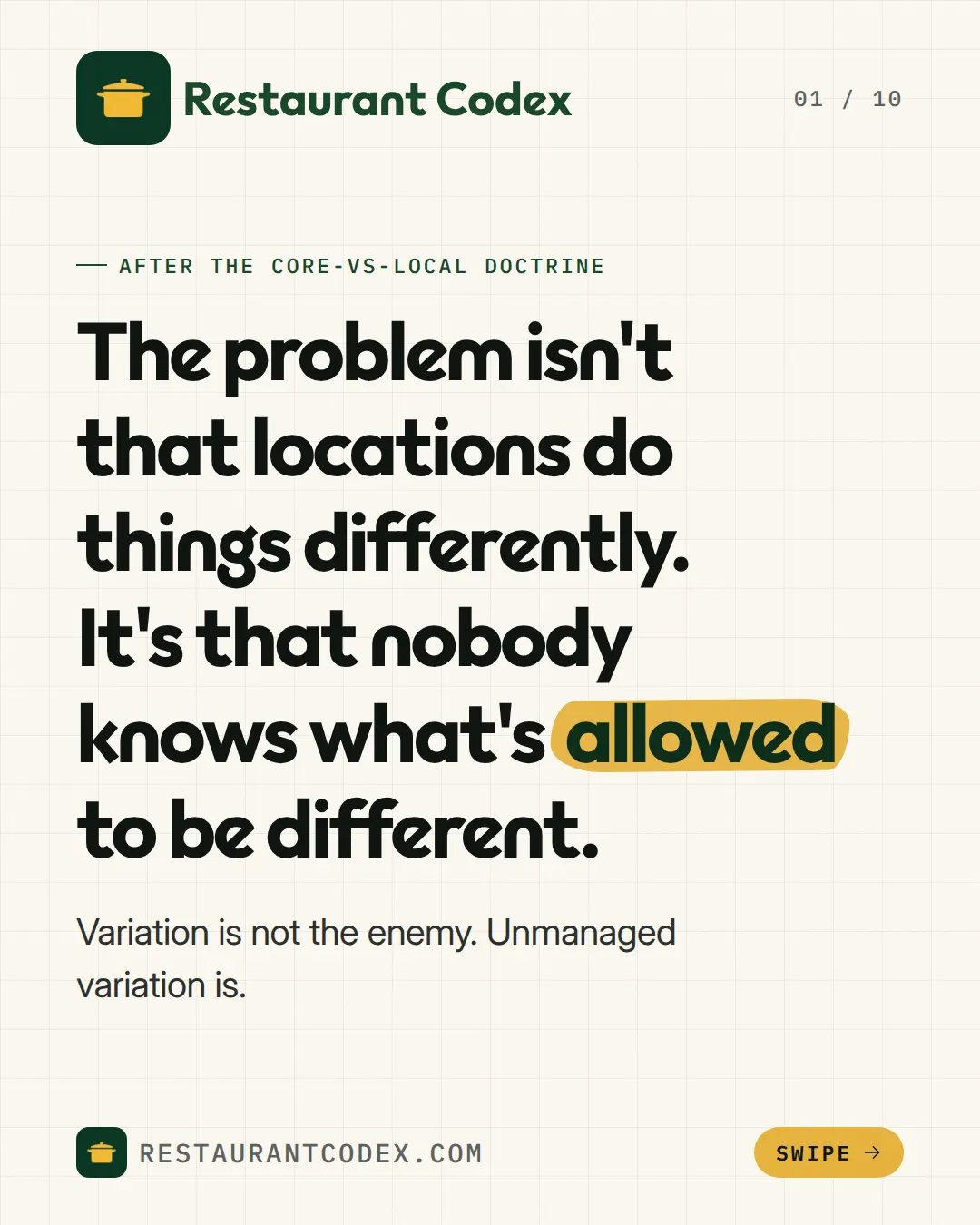
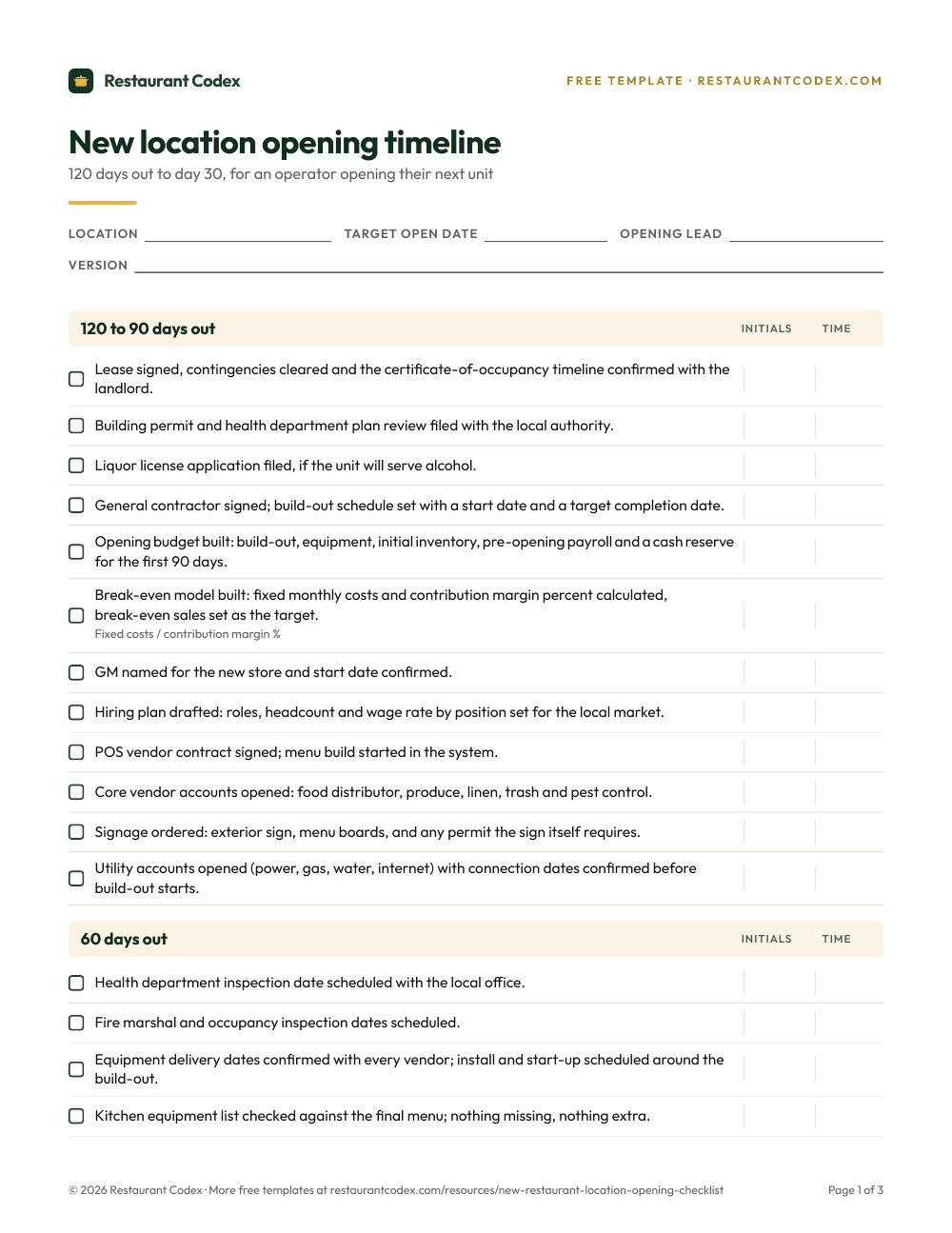
Each new location needs its own establishment registration, its own land-use check, its own notice to the police, its own health concept and its own fire department concept; what you share is the company, your standard contracts and the way you operate.
The Commercial Code requires registering each branch or commercial establishment and renewing it every year (articles 31 and 33). In Confecámaras' 2026 table, the establishment pays based on the owner's assets and on where it sits: with assets up to COP 78,715,000 it's COP 48,400 in the same jurisdiction and COP 97,000 in another; in the next bracket, up to COP 302,750,000, it's COP 121,000 and COP 242,000. If the second location falls under another chamber's jurisdiction, the establishment's registration fee doubles in that bracket.
In the commercial registry, 4,694 restaurant owners have between 2 and 15 establishments, and 82.4% of them operate within the jurisdiction of a single chamber of commerce, according to our analysis of Confecámaras data in the guide to restaurants in Colombia in numbers. Most grow inside their chamber's jurisdiction. That doesn't save you the paperwork: each address starts its own file. The order of an opening is in the guide to opening a second location.
Two locations are two calendars. Each one's registration renews between January and March, the fire department concept expires every year in Bogotá and the staff medical check repeats every 12 months. Put them in a shared calendar, with one person responsible for each date.
What happens if you open without meeting the requirements?
You pay a fine and, almost always, your activity gets suspended: article 92 of Law 1801 of 2016 ties each breach to a general fine and to a temporary or definitive suspension.
| Breach | Measure (art. 92, paragraph 2) |
|---|---|
| Not notifying the police of the opening (num. 3) | Community program or educational coexistence activity |
| Not showing proof of music payment (num. 2) | Type 3 fine and temporary suspension |
| Running an activity different from the one in the registration (num. 5) | Type 4 fine and temporary suspension |
| Admitting more people than the venue's capacity (num. 6) | Type 4 fine and temporary suspension |
| Breaking land-use rules (num. 12) | Type 4 fine and definitive suspension |
| Operating without meeting an article 87 requirement (num. 16) | Type 4 fine and temporary suspension |
Under the text of Law 2450 of 2025, a type 3 fine equals 8 daily minimum wages and a type 4 equals 16 (article 180). If you repeat a behavior that led to a temporary suspension within one year, the suspension becomes definitive (paragraph 6). And numeral 16 is read only against the article 87 requirements (paragraph 7), not against any rule at all.
Health violations follow a different track: Resolution 2674 (article 52) points to Law 9 of 1979 and Law 1437 of 2011, and we didn't read the specific sanctions there.
Where Restaurant Codex fits
Restaurant Codex doesn't file permits or track your expiration dates: that stays with your accountant, your lawyer and a calendar. What it does is hold, location by location, what you declared when you opened.
Operations schedules each location's opening and closing lists, temperature logs and deep cleans, with photo proof and alerts when something isn't done; that's the record you can show a health inspector. Training and LMS gives each role its path from day one and shows who's ready by location, role and path, which helps you meet the 10 yearly hours in article 12. If you open more locations, see the software for multi-location restaurants.
Restaurant Codex
The same checklist, on every phone, with photo proof
Restaurant Codex runs this template as a live task with timestamps, photos and one view across every location. Bring it to a 30-minute working session and we'll show you how it would run across your locations.
By the Restaurant Codex team
Written with operators who run multi-location restaurant groups. Reviewed against the FDA Food Code and the sources listed below.
Sources
- Senate of Colombia, Law 1801 of 2016, National Police and Coexistence Code (articles 87 and 88)
- Senate of Colombia, Law 1801 of 2016 (article 92: behaviors that affect economic activity)
- Senate of Colombia, Law 1801 of 2016 (article 180: fines, text of Law 2450 of 2025)
- Senate of Colombia, Commercial Code (articles 31 and 33: commercial registration)
- Senate of Colombia, Law 1575 of 2012, General Fire Department Law (article 42, text of Law 1796 of 2016)
- Ministry of Health and Social Protection, Resolution 2674 of 2013 (articles 3, 11, 12, 32 to 36, 51 and 52)
- DIAN, Tax Code (Estatuto Tributario, articles 114-1, 512-1, 512-9, 512-13, 555-2 and 616-1)
- DIAN, Resolution 165 of 2023, invoicing system (articles 7 and 8)
- DIAN, Abecé of the electronic sales invoice for the issuer
- DIAN, Press release 128 of 2025: 2026 UVT of COP 52,374
- Confecámaras (published by the Barranquilla Chamber of Commerce), 2026 commercial registration fees, Decree 1074 of 2015 as modified by Decree 045 of 2024
- Ventanilla Única Empresarial (VUE), Technical concept on human safety and fire protection in Bogotá
- Ventanilla Única Empresarial (VUE), Payment of copyright and related rights, Sayco and Acinpro
- Bogotá Mayor's Office, General Secretariat, Requirements to open a commercial establishment
- Senate of Colombia, Law 2466 of 2025, labor reform (articles 5, 6, 10, 11, 13 and 14)
- Senate of Colombia, Law 2101 of 2021, reduction of the working week (article 3)
- Senate of Colombia, Law 1122 of 2007 (article 10: health contribution)
- Senate of Colombia, Law 2068 of 2020, Tourism Law (articles 36 and 37)
- Senate of Colombia, Substantive Labor Code (articles 46 and 47: fixed-term contracts)
- Senate of Colombia, Substantive Labor Code (articles 160, 161 and 168: working hours and night surcharge)
- Senate of Colombia, Substantive Labor Code (articles 179 and 186: Sunday rest and vacation)
- Senate of Colombia, Substantive Labor Code (articles 230 and 232: work clothing and shoes)
- Senate of Colombia, Substantive Labor Code (article 249: severance)
- Senate of Colombia, Substantive Labor Code (article 306: service bonus)