Why does a restaurant's quality drop once the owner stops showing up every day?
A restaurant's quality drops once the owner steps back because the standard being enforced was never written down anywhere except the owner's head, so when that head leaves the building, nobody left knows what "right" was supposed to look like. A version of the same question shows up across restaurant forums on a loop. "How do I get my restaurant to run without my day-to-day involvement?" runs one recurring version. "Why does the quality and service of a newly opened restaurant deteriorate over time?" runs another, describing the same problem from the other side.
Most of what an owner does on the floor is invisible correction. They catch the portion that's crept up half an ounce, the sanitizer bucket testing weak, the greeting that's gotten lazy at table twelve, and they fix it on the spot without ever turning the fix into a rule anyone else can check. New hires learn "how we do things here" by watching the owner catch mistakes in real time, not by reading anything. Move that attention to a second location, or take a week off, and the catching stops. Nothing else was ever built to do it instead.
The stakes are higher than they look, because there's almost no financial cushion to absorb a slow quality slide. Only 42% of U.S. restaurants were profitable in 2024, according to the National Restaurant Association's 2026 State of the Industry data. A place already running that close to the line can't afford six months of drifting service before anyone notices.
What has to be written down before a restaurant runs without you?
Four kinds of standard have to exist in writing before a restaurant can run without the owner checking everything personally: what a finished plate looks like, what clean and safe look like, what a cash drawer should show at the end of a shift, and what a finished opening or closing actually includes. Anything that lives only in the owner's head has to move onto paper or into a system before it can be someone else's job.
Recipe and portion standards need a photo next to the ingredient list, not just a list, because "six ounces of protein" means something different to every new line cook until they've seen the plate it's supposed to match. Food-safety standards should tie to an actual number instead of a feeling: cold holding at 41°F (5°C) or below, hot holding at 135°F (57°C) or above, straight from the FDA Food Code (2022 edition), so a manager checks a thermometer instead of guessing whether something "seems fine." Cash procedure needs a second person in the count, every time, not just on nights it feels warranted.
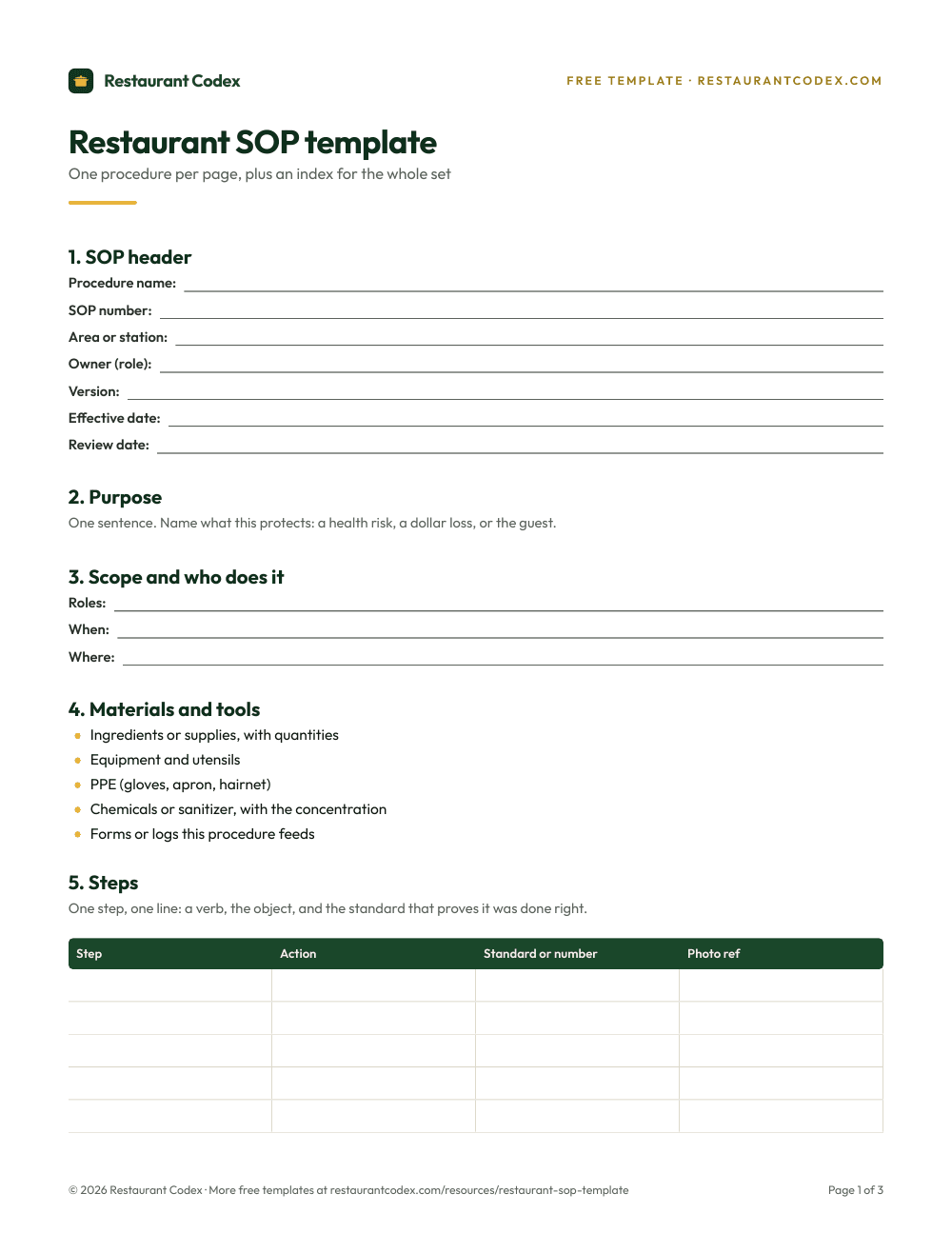
None of this has to be long. A one-page SOP for a single task with a clear standard and an owner beats a forty-page manual nobody opens after week one. Write the twenty or so procedures that actually cause arguments when they go undocumented, the ones a new manager will otherwise learn by making the mistake first, and keep them somewhere searchable, a knowledge base instead of a shared drive nobody opens.
Which decisions can a GM make without calling you first?
A GM can run a shift without calling the owner only for the decisions the owner has already drawn a boundary around in writing, ahead of time, not the decisions the owner is willing to improvise an answer to over the phone during a rush. A comp under a set dollar amount, a schedule swap between two trained people, sending someone home for a no-call no-show, a refund on a clear mistake: these are decisions a GM can make the same way every time once the boundary is written down once.
What stays with the owner is different in kind, not just in size: firing, a menu change, a lease or vendor contract, anything that touches the brand outside the building. The test isn't dollars. It's whether a wrong call can be fixed by tomorrow's shift or whether it follows the restaurant around for a year.
Writing the boundary does something a verbal "use your judgment" never does. It turns a live, stressful decision into a calm one made in advance. A GM who has to guess where the line is will default to calling every time, which defeats the entire point of having a GM. A GM working from a written boundary makes the call and notes it, and the owner finds out at the next review instead of mid-rush.
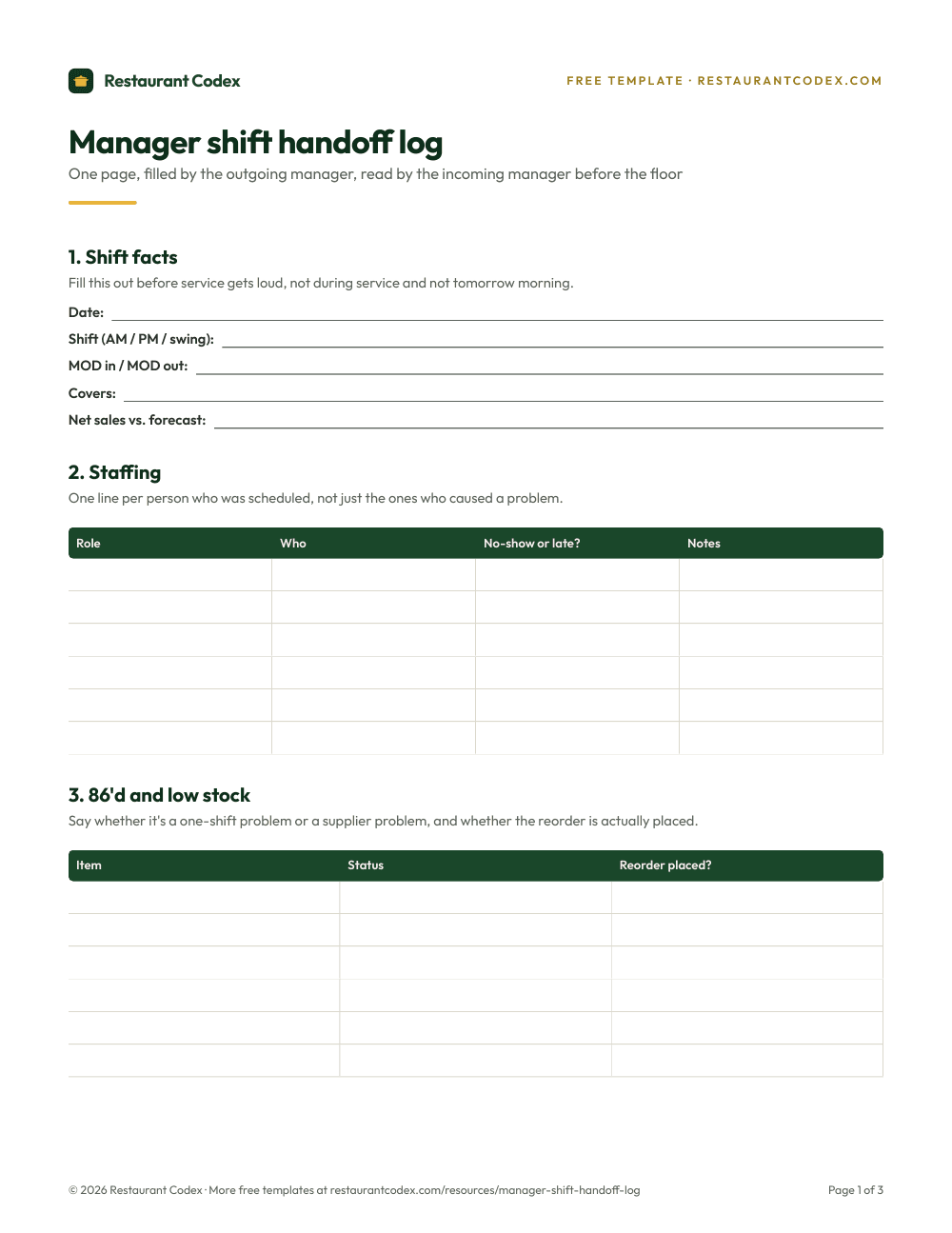
That note matters more than it looks. A decision made under a delegated boundary still needs a paper trail, a comp logged with a reason, a schedule change logged with who covered it, so the owner can see the pattern later without having fielded the call live.
What is the daily proof loop, and why isn't a completed checklist proof on its own?
The daily proof loop is the rule that a task only counts as done once it has a time, a number, or a photo attached to it, because a checked box by itself only proves someone held a pen, not that the walk-in actually read 41°F (5°C) at nine in the morning. A checklist with no evidence behind the checkmarks is a checklist filled in from memory at the end of the night, and everyone on the team knows it within a month.
Food safety is the clearest example, because the numbers involved aren't opinions. Cold holding has to sit at 41°F (5°C) or below and hot holding at 135°F (57°C) or above under the FDA Food Code (2022 edition), and a reading either clears that bar or it doesn't. A time-stamped temperature log, ideally with a photo of the actual thermometer, turns "we checked it" into something an owner can verify without having been in the building.
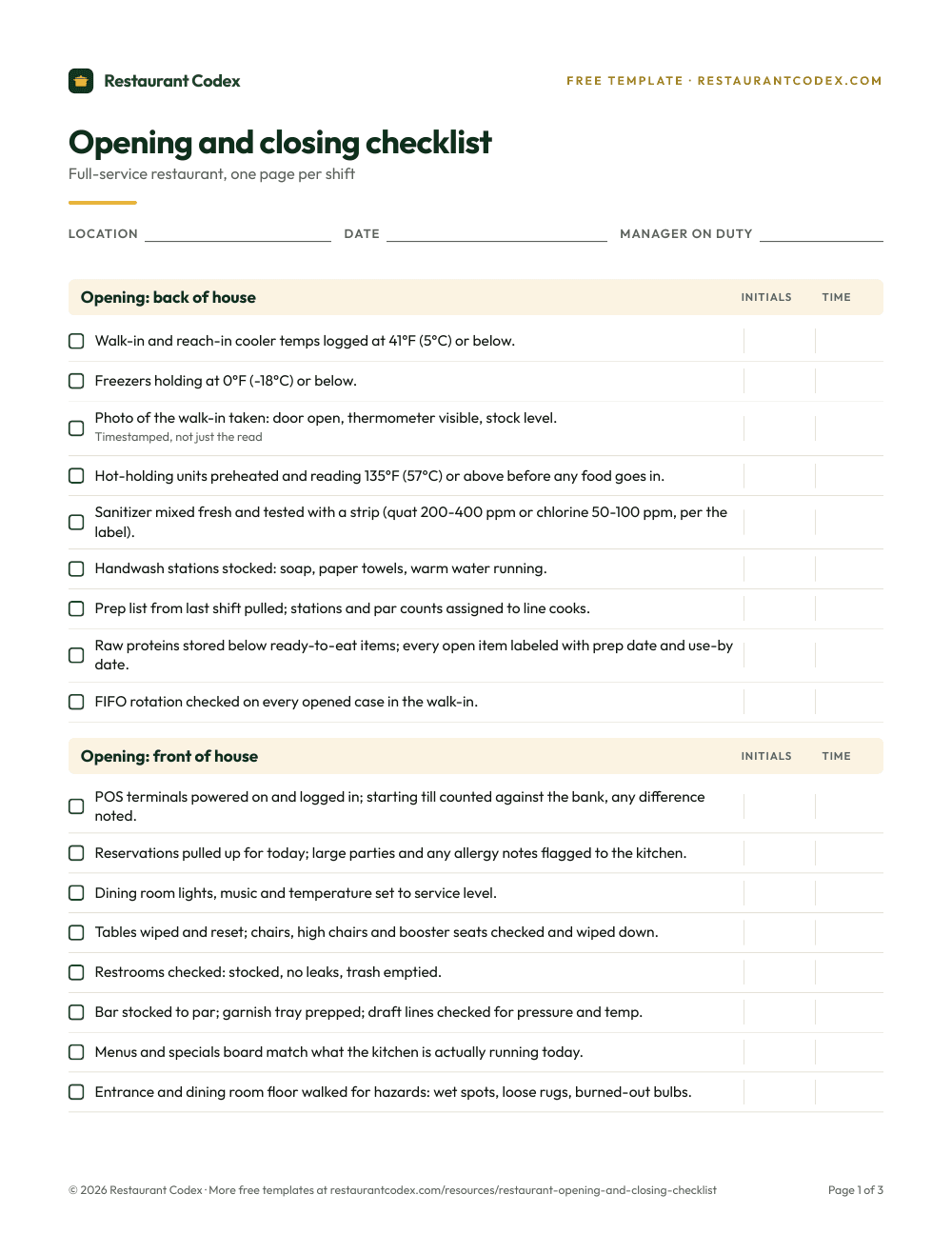
The same logic applies past food safety. A prep list needs a par number written down, not "enough." A deep-clean rotation needs a date and initials, not a general sense that it happens "regularly." Anywhere the standard is a feeling instead of a number, the proof loop has nothing to check, and the task quietly becomes optional the first busy week it gets skipped. It's the same discipline a shift handoff runs on, just extended across a full day instead of one changeover.
What should the weekly review cover once you're not there every day?
A weekly review has to look at the same short list of numbers every single week, labor against target, comps and voids, checklist completion rate, and any guest complaint that needed a manager, because a number only checked when something already feels wrong will always arrive after the problem instead of before it.
Labor is the number most owners already track, and it's worth knowing where it should land. Full-service labor runs a median 36.5% of sales, and profitable operators hold it closer to 34.2% (National Restaurant Association 2026 benchmarks). Prime cost, labor plus cost of goods together, should sit between 60% and 65% of revenue for a full-service operation (Restaurant365). A store inside those ranges most weeks that drifts out for one week has usually had a specific bad week: a call-out, a spoilage loss, a bad schedule. A store outside those ranges every week has a systems problem, not a bad week.
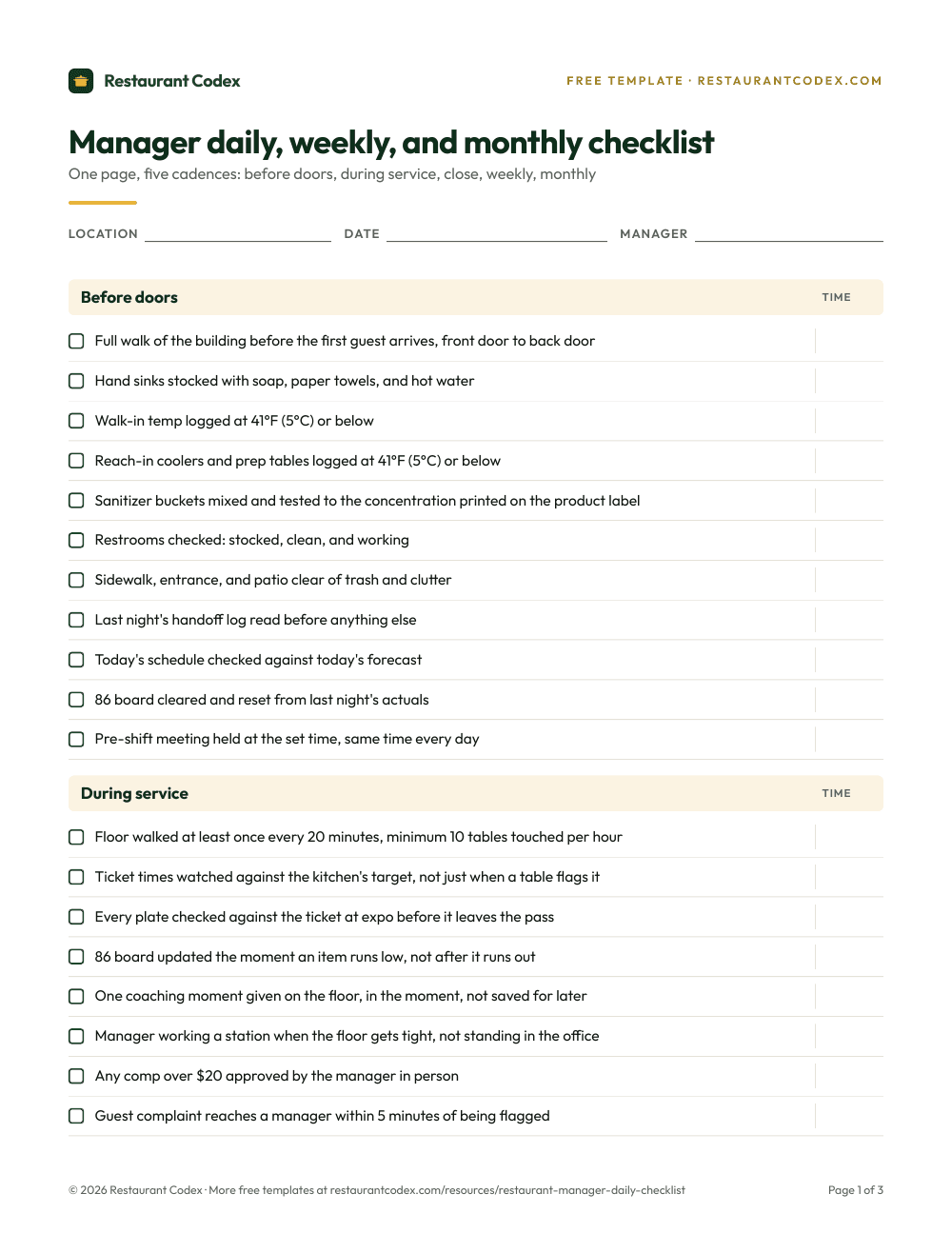
Checklist completion rate belongs on the same page as the money numbers, not in a separate binder, because a store hitting its labor target while skipping half its temperature checks is one bad week away from a health department visit undoing all of it. The weekly review is where daily proof turns into a pattern the owner can actually see.
What actually breaks first when an owner steps back?
The first thing to break when an owner steps back is almost never the big, visible failure. It's the small correction the owner used to make by walking the floor: a portion that creeps up half an ounce over a month, a side-work task that gets skipped on a slow Tuesday, a new hire trained by whoever happened to be free that day instead of the person who actually knows the station. Push this out to a second or third location and the same drift happens at each one independently, on its own timeline, which is why a single walk-through stops being enough past one building.
Turnover speeds this up, because every departure takes a piece of undocumented knowledge with it. Accommodation-and-food-services separations ran about 65% in 2025, close to double the 43% all-industry rate (BLS, Job Openings and Labor Turnover Survey; FRED, JTS7200TSR). A restaurant that depends on a couple of tenured people to informally cover for missing documentation is depending on exactly the group least likely to still be there in a year.
The cost shows up fastest in replacement, not in the drift itself. Losing one hospitality employee costs $5,864 on average and can run past $14,000 once recruiting, retraining, and lost productivity are counted (Cornell Center for Hospitality Research). A bad handover isn't a soft cost. It's a specific number that shows up on next month's labor line.
How do chains keep quality consistent across hundreds of locations?
Chains keep quality consistent by replacing the owner's personal catch with a written standard and a routine check, so a location gets measured against a number set on paper, not against whatever the most experienced person in the building happens to remember that day. A franchisor doesn't trust a location's quality to the charisma of whoever's running the shift. It audits against the same recipe card, the same plating spec, the same cleaning schedule, at every unit, on a fixed calendar.
The audit matters as much as the standard. A written recipe nobody checks against drifts exactly like an unwritten one, just slower. What a well-run chain buys with all that paperwork is a way to catch drift at the location level before a guest does, the same job the daily proof loop and the weekly review are doing at a single independent restaurant, just run at a larger scale.
There's a cost argument underneath this too. SHRM puts the full cost of replacing a key employee at 50% to 200% of their annual pay. A manager who's excellent but keeps every standard in their own head is exactly as replaceable as an undocumented restaurant is scalable, which is to say, not very. The written standard is what survives the person.
A 90-day handover, worked through
Take an owner who's opening a second location and needs the first one to run three or four days a week without them. Day one isn't handing the GM the keys. It's writing down the twenty procedures that would otherwise live only in the owner's head, the plate standards, the FDA Food Code temperature checks, the cash count, the opening and closing sequence, over the first thirty days, while the owner is still there every shift to confirm each one is actually right.
| Days | What happens | Who owns it |
|---|---|---|
| 1 to 30 | Standards get written and tested against a real shift | Owner, with the GM documenting |
| 31 to 60 | GM makes documented decisions inside a written boundary; owner reviews the log daily | GM, reviewed by owner |
| 61 to 90 | Owner attends the weekly review only; daily walk-throughs stop | GM runs the floor; owner checks the numbers |
The middle thirty days are where most owners quit early, because it's uncomfortable watching a GM make a call you'd have made differently. That discomfort is the actual transition happening. By day ninety, the owner isn't checking whether the walk-in was 41°F (5°C) this morning. They're checking whether it was 41°F (5°C) every morning this week, in the log, which is a different job entirely.
How Restaurant Codex holds this together without you in the building
We built the standard, the decision boundary, the daily proof, and the weekly review as one connected system instead of four separate habits living in different places. An SOP written once turns into the checklist a GM actually runs; a decision made inside a written boundary gets logged automatically instead of depending on someone remembering to mention it; and every temperature, checklist, and handoff carries a timestamp and, where it matters, a photo, so an owner can check a week of evidence from one screen in the time it used to take to walk one floor.
Restaurant Codex
The same checklist, on every phone, with photo proof
Restaurant Codex runs this template as a live task with timestamps, photos and one view across every location. Bring it to a 30-minute working session and we'll set it up on your real operation.
By the Restaurant Codex team
Written with operators who run multi-location restaurant groups. Reviewed against the FDA Food Code and the sources listed below.
Sources
- FDA Food Code 2022: cold holding, hot holding and two-stage cooling of TCS food
- National Restaurant Association 2026 data via WhippleWood, Financial Benchmarks for Restaurants
- BLS, Job Openings and Labor Turnover Survey, Table 4, quits rate by industry
- FRED (Federal Reserve Bank of St. Louis), Total Separations: Accommodation and Food Services (JTS7200TSR)
- Cornell Center for Hospitality Research, Tracey and Hinkin (2006), The Costs of Employee Turnover
- SHRM, The Myth of Replaceability: Preparing for the Loss of Key Employees
- Restaurant365, How to Calculate Prime Cost in a Restaurant