How Is AI Actually Used in Restaurants Right Now?
AI is in daily use in restaurants today in five places: voice ordering at the drive-thru, demand and staffing forecasts, reading supplier invoices, drafting marketing copy, and answering staff questions from the group's own manual. Twenty-six percent of restaurant operators say they use AI-related tools at all, according to the National Restaurant Association's State of the Restaurant Industry 2026 report, and the split matters more than the headline number. Marketing leads: 19% of full-service operators and 15% of limited-service operators use AI to help with marketing. Only 6% use it for customer orders, and 10% use it for administrative tasks, which tells you where operators actually trust it today and where they don't yet.
Drive-thru voice ordering gets the most attention because it's the one customers run into directly, and it's a mixed record. Wendy's piloted its FreshAI system, built with Google Cloud, in a single Columbus, Ohio restaurant in June 2023 before expanding to dozens of company-operated locations across Ohio and Florida; the initial test ran drive-thru service 22 seconds faster than the regional average, and the system takes orders in English and Spanish. McDonald's tried the same thing with IBM starting in October 2021, reached about 100 locations, and shut the test down in 2024 after voice recognition accuracy stayed in the low 80% range against a 95% target the chain had set before considering a wider rollout. The difference between those outcomes isn't the idea. It's whether the accuracy number actually cleared the bar before the rollout, not after.
Away from the counter, the growth is in the back office. In a Restaurant365 survey of more than 420 operators running close to 10,000 locations, the share using AI for back-office reporting and analytics rose from about 25% at the start of 2026 to 69% by mid-year, a jump concentrated in exactly the unglamorous work this guide covers next: demand forecasts, invoice reading, and scheduling.
What AI Is Best for a Restaurant Business?
There isn't one AI that's best for a restaurant business, because the jobs are different enough that the same tool rarely does all of them well. Starbucks' Deep Brew platform, built with Microsoft on Azure, uses machine learning to help optimize inventory and build barista schedules across its stores; that's a demand-and-labor tool, and it has nothing to do with answering a server's question about an allergen or drafting next week's email. A general-purpose assistant like the kind many owners already use for a quick draft is useful for the opposite case: no access to your records, so no business being asked anything with a real number attached.
The table below is organized by job, not by product, because that's the decision an owner is actually making.
| Job | What AI does well | What it gets wrong | What to require before trusting it |
|---|---|---|---|
| Voice ordering at the counter or drive-thru | Takes routine orders fast, upsells consistently, can run in more than one language | Mishears unusual requests and multi-item modifications, fails with the same confidence whether it heard right | A measured accuracy number you've checked yourself, and a staff override that's actually used, not just available |
| Demand and staffing forecasts | Spots patterns in weather, day-of-week, and local events a manager doing it by feel misses | Breaks on anything genuinely new it has no history for, a street closure, a one-off event | A person who builds the final schedule and can override the model, not just rubber-stamp it |
| Reading supplier invoices | Catches a price that moved, a duplicate bill, or a math error faster than someone skimming a stack of PDFs | Still needs a human who knows what last month's price actually was, or a small, steady increase slides through unnoticed | A flagged change that a person signs off on before it posts, not an invoice that pays itself |
| Staff questions from the manual | Answers small, specific questions fast, in whatever language the shift speaks | Invents an answer with the same confident tone whether it's grounded or guessing, unless something stops it | Shows the exact entry it pulled the answer from, and refuses or hands off anything it isn't tagged to answer |
| Marketing copy | Drafts a usable first pass of a caption, a menu line, a job post | Reads generic unless someone edits it into the restaurant's actual voice | A person reading every line before it goes out under the restaurant's name |
| Acting inside your operations software | Does the busywork once someone describes it in plain words: assign a task, log a count, pull a report across locations | Can make a change nobody asked for, or the right change in the wrong location, if nothing stops it | Approval required before anything risky happens, every change logged with before and after values, and an undo |
Can AI Answer Staff Questions Safely?
Yes, for the questions it's actually grounded to answer, and the word "grounded" is doing all the work in that sentence. An assistant that answers from the group's own recipes, SOPs, and allergen matrix is a different thing from a general chatbot pulling from the open internet, which can state a wrong temperature or a wrong ingredient in the same even tone it uses for a right one. The failure mode isn't a model being rude or obviously broken. It's a model sounding exactly as sure when it's wrong as when it's right, which is the one tell a busy line cook has no reason to catch.
The clearest warning of what happens when a company lets a chatbot speak for it without a human check isn't from a restaurant, it's from an airline. In February 2024, a British Columbia tribunal ruled against Air Canada after its website chatbot told a customer the wrong bereavement-fare policy; the airline argued the chatbot was responsible for its own words, and the tribunal disagreed, holding Air Canada liable for what its own tool told a customer and ordering it to pay damages. The lesson carries over directly: whatever an assistant tells a server or a guest, the restaurant owns it, not the software.
That's exactly why grounding and escalation matter more than how smart the model sounds. A well-built staff assistant answers the small stuff, what goes on a dish, where a cleaning product is stored, what a new hire's first-week schedule looks like, and refuses or hands off anything tagged as a hazard: a severe or ambiguous allergy, a medical event, a harassment complaint, a cash exception. Restaurant Codex's guide to the knowledge base goes deeper on what has to be written down before any assistant, ours or anyone's, has something real to answer from.
What Does an AI Agent for Restaurant Operations Actually Do?
An AI agent for restaurant operations reads and acts across the systems a manager already uses, instead of just answering questions about them, which is the real difference between a chatbot and an agent. A chatbot tells you the walk-in logged 46°F this morning. An agent, told in plain words to look into it, can pull the actual log, flag which location and shift it happened on, and open the follow-up task, without someone translating the request into five separate screens first.
That shift from answering to acting is also where the back-office adoption numbers are heading. The jump Restaurant365 measured, from about a quarter of operators using AI for back-office reporting to 69% within six months, lines up with a broader move from AI that summarizes a report to AI that's handed a task and expected to carry it out. The catch is that acting carries more risk than answering: a wrong answer gets corrected in conversation, a wrong action has already changed something. Any agent worth trusting with real operations needs the same three things regardless of who builds it: it asks before anything risky, it logs exactly what changed and when, and it can be undone.
What Should AI Never Do in a Restaurant?
AI should never make a final call on anything where being wrong has a real cost that can't be undone by tomorrow's shift: a severe allergy, a food-safety judgment call, a discipline decision, a change to a record that nobody reviews before it takes effect. The common thread isn't the topic, it's the stakes. A wrong answer about which sauce has nuts in it isn't a bad guess, it's a trip to the hospital. A change to an access list or a pay rate that posts without anyone looking at it isn't a convenience, it's a problem someone finds weeks later with no idea why it happened.
Privacy belongs on that same list, and it's easy to miss because it doesn't fail loudly the way a wrong allergen answer does. Staff schedules, performance notes, and guest contact details are personal data the moment they go into any AI tool, and what happens to that data afterward, whether a vendor trains on it, who else can see it, how long it's kept, is a real question to ask before it's handed over, not after.
The practical rule for any procedure: anything that can't be fixed by tomorrow's shift needs a person in the loop before it happens, not a review after the fact. AI can draft the comp, flag the schedule conflict, or surface the price change. A person still approves it.
How Should a Restaurant Group Start With AI?
Start with the documents, not the tool, because an assistant is only as good as what it has to answer from. Tapiz Bistro & Bakery in Mexico City structured 220 recipes into Restaurant Codex in two weeks, and that's the part that matters here regardless of which assistant eventually reads it: a recipe that exists only as a photo on someone's phone or a memory in the kitchen can't be pointed to by anything, grounded AI or a new hire reading a binder. Written, current, and findable comes before smart.
Once the documents exist, pick one low-risk job to start, not the one that touches the brand the most. Answering staff questions from the manual, or reading invoices for a price that moved, fails safely: a missed question gets re-asked, a flagged invoice gets double-checked. Customer-facing voice ordering fails loudly, on video, which is exactly what happened to the highest-profile drive-thru tests. Start where a mistake is a minor annoyance, not a clip that gets passed around.
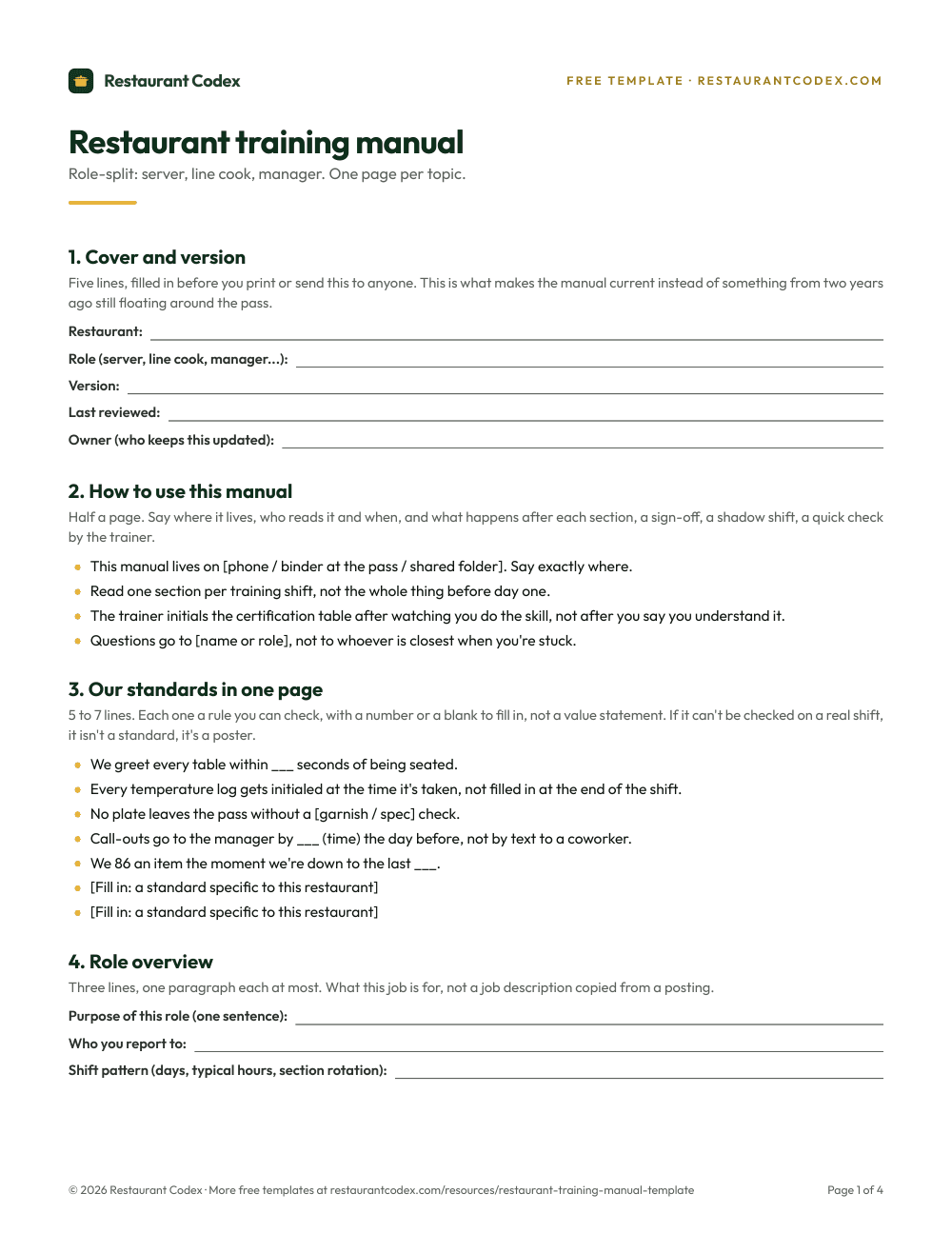
From there, the checklist is short: require approval before anything changes a record, log every change with what it was before and what it became, keep a human able to undo it, and actually read what staff are asking the assistant. That last one is free training-gap data that didn't exist before, and it costs nothing extra to collect once the assistant is already answering questions.
Where Restaurant Codex Fits
Restaurant Codex splits this into two tools instead of one, because answering and acting carry different risk. Codex Bot answers staff questions from the group's own manual and recipes, shows the exact entry it used, and never changes a record; it's built for the safe, high-volume case, the small specific question a new hire would otherwise wait on a manager to answer. Codex Copilot is the agent for owners and managers: it reads and acts across every module and location in a person's access, in plain words, and reaches other tools the group already runs through MCP. Risky changes ask for approval first, every change logs a before and after value, and anything it does can be undone.
Neither tool fixes a restaurant that hasn't written anything down. What Restaurant Codex does is give the writing somewhere to live and something grounded to answer from once it does, which is the same order this guide has followed from the start: documents, then the assistant that reads them, then the agent that acts on what it finds. What Restaurant Codex is covers the rest of what's in the system beyond AI.
Restaurant Codex
The same checklist, on every phone, with photo proof
Restaurant Codex runs this template as a live task with timestamps, photos and one view across every location. Bring it to a 30-minute working session and we'll show you how it would run across your locations.
By the Restaurant Codex team
Written with operators who run multi-location restaurant groups. Reviewed against the FDA Food Code and the sources listed below.
Sources
- National Restaurant Association, State of the Restaurant Industry 2026, AI adoption data reported by Restaurant Dive
- National Restaurant Association, Restaurant Economic Insights: Restaurants Remain Resilient Despite Challenging Business Conditions
- Nation's Restaurant News, McDonald's Is Ending Its AI Drive-Thru Test With IBM
- Restaurant365, 2026 State of the Restaurant Industry: Mid-Year Report
- Yahoo Tech, Inside Wendy's Drive-Thru AI That Makes Ordering Fast Food Even Faster
- Restaurant Technology News, Wendy's Plans Major Tech Investments to Improve Restaurant Order Accuracy and Speed
- Microsoft Source, Starbucks Turns to Technology to Brew Up a More Personal Connection With Its Customers
- Wikipedia, Moffatt v. Air Canada
- IAPP, Understanding Mexico's Federal Law on the Protection of Personal Data Held by Private Parties