Why don't staff follow the checklist?
Staff stop following a checklist for a handful of predictable reasons: it's too long to finish in the time it's handed over, it asks for a tick instead of proof the task happened, nobody reads it once it's filled in, it was written by someone who doesn't do the job anymore, no single name owns it, and doing it honestly gets punished while doing it fast does not.
None of that is a character problem. "Staff aren't consistently completing checklist items" and "employee not following SOPs" are two of the most common ways operators phrase this when they ask about it online, and both point at the same handful of causes, not at a crew that doesn't care. Walk into most restaurants where completion is a struggle and the sheet itself explains why. The line cook who initials every box in the last two minutes of a double isn't lazy. He's finishing a form that was built to be finished that way, at that speed, with that little thought behind it. To a health inspector or an owner, a checklist reads as a record of what happened. To the person filling it in at 11:58pm, it's often just a form standing between them and clocking out.
The fix isn't a stricter warning or a longer talk about accountability. It's changing what the sheet asks for, when it gets handed over, who wrote it, and whether anyone actually looks at it the same day it's filled in. Each of those is fixable on its own, and most restaurants only need to fix two or three of them before completion changes.
Is the checklist too long to actually get through?
Yes, in most restaurants where completion is the problem: a single master list with forty or fifty lines handed over all at once rarely gets finished honestly, while five or six shorter, role-based sections handed over at the point in the shift where each one applies usually do.
A closing list that covers cooling logs, cash counts, equipment shutdown, and a full walkthrough in one unbroken column asks someone at midnight to do four different jobs off one sheet. Split it closer to how a shift actually runs: opening kitchen, opening floor, a pre-service line check, closing floor, closing kitchen, and a short manager close. Each section lands in front of the person doing that part of the job at the moment it's relevant to them, not three hours early and not two hours late.
Length matters on its own, separate from timing. A ten-line line check handed over right before doors gets better completion than the same ten lines buried at line 31 of a fifty-item sheet, because attention doesn't hold evenly across fifty lines in a row, especially not during a shift someone's also trying to run at the same time. A restaurant that cuts one bloated list into shorter sections usually doesn't need to add a single new rule to see the difference; the rule was always there, it just used to arrive too late to matter.
What's the difference between a checkmark and evidence?
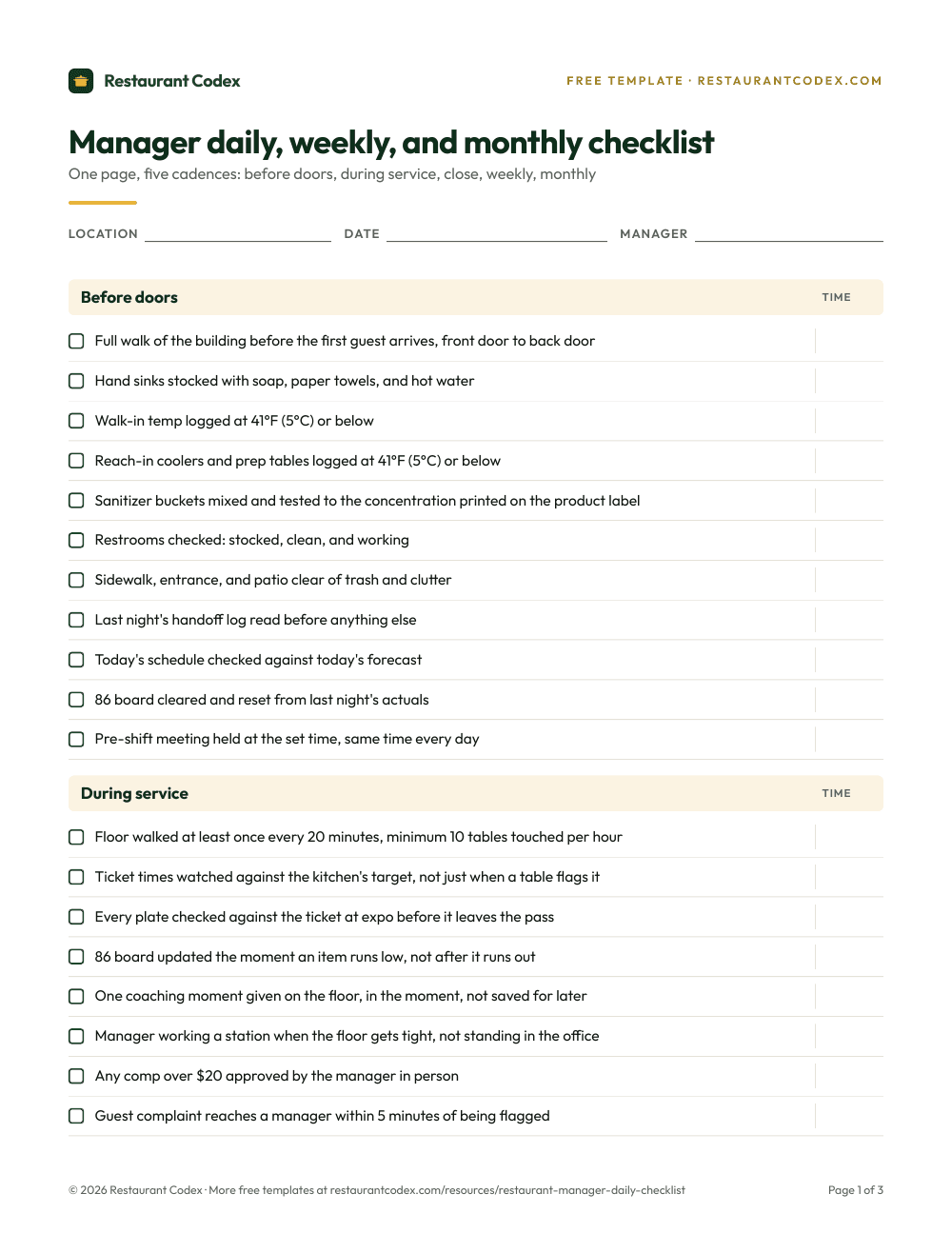
A checkmark only records that someone touched the page; evidence, a temperature, a photo, a count, records that the task happened the way the standard requires.
Cold holding has to read 41°F (5°C) or below and hot holding 135°F (57°C) or above under the FDA Food Code, and those are the two numbers a checklist should ask for, not a box next to the words "temp checked" (FDA Food Code, 2022). A tick tells you someone believes the walk-in is fine. A number tells you what the walk-in actually read at 6:14pm, and it's the number a health inspector wants to see in the log, not the tick next to it.
The same logic covers a deep clean. "Cleaned the hood," checked off, means nothing without a photo, a timestamp, or a supervisor's initials next to it, because a box can get checked from across the kitchen without anyone touching a rag. A phone photo of the actual hood, filed the moment the job's done, closes that gap in about the same amount of time it takes to check a box, and it's a lot harder to fake than a signature.
Who should actually write the checklist?
The checklist should be written, or at minimum reviewed line by line, by someone who currently works the shift it covers, not by an owner or a corporate template that hasn't touched a line in years.
A checklist inherits the blind spots of whoever wrote it. One still built around eight allergens is a checklist a food-safety-literate crew catches immediately, because sesame became the ninth major US allergen on January 1, 2023 (FDA, FASTER Act), and a pre-service line check still counting eight is telling the floor that nobody's updated it since. Staff notice when the sheet is behind the actual job. That's often the first sign, to them, that the whole document is decoration and not something worth taking seriously.
Writing it with the crew instead of at them fixes a second problem too: ownership. Every line needs one name attached to it, not "whoever's on shift." "Close the bar" with nobody's name next to it turns into three people assuming someone else already handled it, which is how a walk-in door gets left cracked open overnight. The same discipline that governs a written SOP applies here: a checklist is only as current as the last time someone who actually does the job read it and confirmed it still matches reality.
How do you hold staff accountable for cleaning and deep-cleaning tasks?
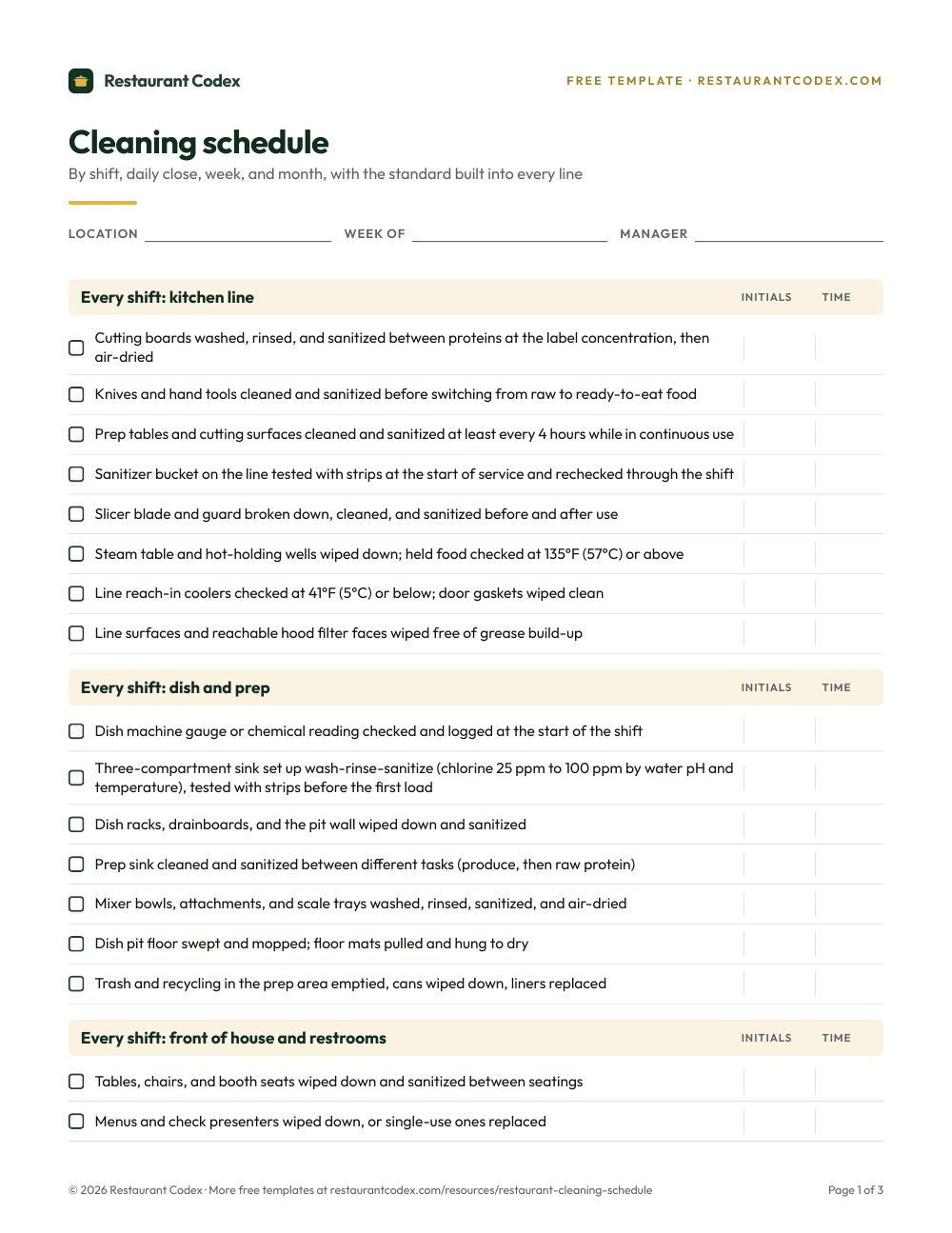
You hold staff accountable for cleaning by separating the nightly routine from the deep-clean rotation, asking for proof instead of a signature, and having a manager actually look at what came in, the same day, not once a month during a health-department scare.
Deep cleaning gets skipped more than nightly tasks because it's easy to bury on the same sheet as routine closing work, where it competes with fifteen other lines someone's racing through at midnight. Put it on its own rotation calendar instead: which station, which week, who's assigned, and what proof closes it out, a photo of the hood filter pulled and soaking, an initialed line next to walk-in shelving that actually got wiped down and not just swept around.
Accountability here isn't about catching someone in the act. Most staff who stop doing a deep clean properly aren't hiding anything. They've learned nobody checks, so the ten minutes it takes gets spent on something that visibly matters that night instead, a table that's waiting or a ticket that's backing up. Close that gap by reviewing the rotation every week and saying out loud what you saw, good or bad, and the ten minutes tends to come back on its own without a new policy attached to it.
What do you do when someone on the team says they know a better way?
When someone on the team says they know a better way than the SOP, there are only two honest outcomes: change the standard if they're right, or retrain and hold the line if they're not. The outcome to avoid is a silent exception, where the paper says one thing and the practiced version on the floor says another.
Creating the SOP is only half the battle, a line that turns up constantly among restaurant managers comparing notes online, because the other half is what happens the first time someone experienced quietly does it differently and it works fine, for a while. Let that slide without a conversation and the crew learns the written version is optional for anyone senior enough to get away with skipping it.
Ask the person to show you, not just tell you. If their method holds up under the same conditions the SOP has to survive, a slammed Friday, a new hire covering the station, a surprise inspection, rewrite the SOP and credit them for the fix. That's how a standard gets better instead of just older. If it only works when they're the one doing it, or only on a slow Tuesday, that's useful information too. It means the standard stays as written, and they get retrained on why, specifically, not just told to fall in line and drop it.
A checklist that survives a Tuesday lunch rush, worked through
Take a casual restaurant where the pre-service line check used to live inside a longer opening list and kept getting skipped by 11:15. Split into its own five-line section, handed to the line cook by the kitchen manager at 10:45, twenty minutes before doors: walk-in temp logged as a number, two prep items counted against par, fryer oil checked and dated, sanitizer strength tested with a strip and not a glance, and a photo of the line set up before the first ticket.
Each line carries a name, the line cook's, and a box on the manager's own daily sheet marking whether the line check came in before 11. The kitchen manager reads it standing at the pass, not filed away for later, and asks one question out loud the moment something's off: "walk-in reads 44, what's going on." That question, asked the same day, is what turns the sheet from paper into a working system. Skip that single step, the same-day read, and the rest of the redesign stops holding within a few weeks, no matter how well the sections were split.
Signs a checklist has turned into busywork
Every box filled in from memory at 11:58, right before someone clocks out. That's not completion, it's a crew protecting itself from a write-up, and it teaches everyone the sheet is theater rather than a record.
The same three items get flagged "fine" every day for months straight. Either the restaurant genuinely never has a slow walk-in or a dull knife in that stretch, which is unlikely, or nobody's actually checking, just signing.
Nobody above the person who filled it in ever reads it. A checklist nobody reviews the same day it's completed isn't held to any standard at all. It's paperwork with a shelf life of about one week before it gets replaced by next week's stack, unread in the same way.
The person who reports a real problem gets a harder time than the person who signs off on a problem that was never there. Once staff learn honesty costs more than a clean-looking lie, the checklist stops being useful within days, no matter how carefully it was formatted or how many sections it got split into.
How Restaurant Codex closes the loop on checklists
We built checklists around evidence and review instead of a box on a clipboard. Every line asks for what actually proves the job's done, a number, a photo, a count, tied to the person who did it, and a manager sees what came in the same day instead of finding out during an inspection three months later. When someone genuinely does know a better way, updating the standard takes minutes, not a committee meeting, so the version everyone's following on the floor stays the one that's actually true.
Restaurant Codex
The same checklist, on every phone, with photo proof
Restaurant Codex runs this template as a live task with timestamps, photos and one view across every location. Bring it to a 30-minute working session and we'll set it up on your real operation.
By the Restaurant Codex team
Written with operators who run multi-location restaurant groups. Reviewed against the FDA Food Code and the sources listed below.
Sources
- FDA Food Code 2022: cold holding, hot holding and two-stage cooling of TCS food
- FDA, FASTER Act: sesame as the 9th major food allergen (effective Jan. 1, 2023)
- FRED (Federal Reserve Bank of St. Louis), Total Separations Rate: Accommodation and Food Services (JTS7200TSR)
- SHRM, The Myth of Replaceability: Preparing for the Loss of Key Employees